Jorij, AbrahamBiblio.com

28.140 Ergebnisse
2016Best.-Nr. x-3319380397Springer Verlag 2016. Paperback. New. reprint edition. 196 pages. 9.25x6.10x0.45 inches. Springer Verlag paperback
Best.-Nr. 6200860904.Gpaperback. Good. Access codes and supplements are not guaranteed with used items. May be an ex-library book. paperback
2002Best.-Nr. Q-0739432192Plume 2002-01-01. Hardcover. New. In shrink wrap. Looks like an interesting title! Plume hardcover
1865Best.-Nr. 64322Davenport Iowa: Designed by W.H. Pratt and lithographed by A. Hageboeck 1865. Broadside. 38 x 31 cm. Several small tape repairs on verso several untaped tears on edges. A calligraphic portrait memorial of Lincoln using shading to form his likeness with the text of his Emancipation Proclamation. "Designed and written by W. H. Pratt and printed in Iowa the state that sent the most soldiers per capita to the front in the Civil War"- EBERSTADT 40. Designed by W.H. Pratt and lithographed by A. Hageboeck unknown books
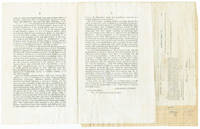
1864Best.-Nr. WRCAM55254N.p. perhaps Virginia 1864. 3pp. on a single folded sheet. with: OATH OF ALLEGIANCE. N.p. perhaps Harper's Ferry Va. 1864. Single sheet 3 x 7 3/4 inches. The OATH affixed to a partial manuscript ledger report recording lost military stores for an unidentified unit in 1863 which is itself glued to the verso of the last blank page of the Amnesty Proclamation. Minor toning light foxing some wrinkling. Overall very good. In a cloth chemise and green half morocco and cloth slipcase spine gilt. An exceedingly rare separate printing - perhaps by a military field press - of President Abraham Lincoln's December 1863 presidential proclamation offering amnesty to citizens of the Confederacy providing they take an oath that they "will abide by and faithfully support all proclamations of the President made during the existing rebellion having reference to slaves" i.e. the Emancipation Proclamation. When the number of persons in any state taking the oath reached ten percent of the number of voters in 1860 this group of loyal voters could form a state government that could be recognized by the President. The Amnesty Proclamation was issued with President Lincoln's third Annual Message to Congress i.e. State of the Union Address on December 8 1863. It was appended per the language in the title here to the official printing of that address but also printed separately. The present printing almost certainly executed in the weeks after Lincoln's State of the Union was likely hastily composed from the text of the official printing of the proclamation. The work carries no imprint information of any kind and bears the hallmarks of a military field press printing. Toward the close of 1863 with the Confederate Army in full retreat discussions in Congress centered on how to restore the Southern states to the Union. "The crisis which threatened to divide the friends of the Union is past" announced Lincoln. Now it was the duty of Congress to ensure that all citizens in the South regardless of race were guaranteed the equal protection of the law. A number of competing proposals emerged from deliberations but in the end during his message to Congress on Dec. 8 1863 Lincoln declared reconstruction of the South a wholly executive responsibility and "offered 'full pardon.with restoration of all rights of property except as to slaves' to all rebels who would take an oath of future loyalty to the Constitution and pledge to obey acts of Congress and presidential proclamations relating to slavery" Donald p.471. Those excluded from taking the oath were the highest ranking members of the Confederacy - government officials judges military and naval officers above the rank of army colonel or navy lieutenant former congressmen and "all who have engaged in treating colored persons or white persons otherwise than lawfully as prisoners of war." Lincoln further encouraged the southern states to make provisions "in relation to the freed people of such State which shall recognize and declare their permanent freedom provide for their education and which may yet be consistent as a temporary arrangement with their present condition as a laboring landless and homeless class." "Lincoln indicated that this was only one plan for reconstructing the rebel South and while it was the best he could think of for now he would gladly consider others and possibly adopt them. He might even modify his own classes of pardons if that seemed warrantable. Afterward almost everybody but die-hard Democrats seemed happy with the plan" Oates p.371. The proclamation is accompanied by a partially-printed OATH OF ALLEGIANCE dated 1864 and datelined Harper's Ferry Virginia. The oath requires the taker to "solemnly swear that I will support protect and defend the Constitution and Government of the United States against all enemies." It is signed in type by Henry A. Urban Lieutenant and A.D.C. Aide-de-Camp. The oath is printed with a blank space for the name of the person taking the oath and the date. There is also a space for people who know the oath-taker and "certify on honor that we know Mr. blank to be a true and loyal man to the Federal Government." The OATH is affixed to a partial manuscript ledger report recording lost military stores for an unidentified unit in 1863 This printing of the Amnesty Proclamation is just as interesting as the government broadside printing or the first pamphlet printing as this edition would have also been used in the field by Union troops encountering Confederate rebels. The composition of the beginning of the seventh paragraph is consistent with the first pamphlet printing of the Amnesty Proclamation Monaghan 191 and not the broadside printing. The text here begins "Therefore I Abraham Lincoln."; in the broadside printing the "Therefore" is present at the end of the preceding paragraph. The simple and somewhat loose execution of the composition seen here is consistent with field press printings as is the lack of an imprint of any kind. Perhaps this simple production was intended for Union troops to literally hand to Confederate soldiers to read. The presence of the portion of the ledger and the Oath of Allegiance lends credence to the notion that this edition of the Amnesty Proclamation was produced for use by the military. This printing of the Amnesty Proclamation is not in Monaghan OCLC nor in any reference work we could find. In fact we could find no other three-page editions of the Amnesty Proclamation at all. Surely printed in small numbers to begin with it is perhaps a unique surviving example. MONAGHAN 191 ref. SABIN 41162 note. David Herbert Donald: LINCOLN New York. 1995 p.471. Stephen B. Oates: WITH MALICE TOWARD NONE: A LIFE OF ABRAHAM LINCOLN New York. 1977 p.371. hardcover books
1863Best.-Nr. 55254N.p. perhaps Virginia. Late 1863 or early 1864. Lincoln's Amnesty Proclamation: A Most Uncommon and Interesting Printing An exceedingly rare separate printing - perhaps by a military field press - of President Abraham Lincoln's December 1863 presidential proclamation offering amnesty to citizens of the Confederacy providing they take an oath that they "will abide by and faithfully support all proclamations of the President made during the existing rebellion having reference to slaves" i.e. the Emancipation Proclamation. When the number of persons in any state taking the oath reached ten percent of the number of voters in 1860 this group of loyal voters could form a state government that could be recognized by the President. The Amnesty Proclamation was issued with President Lincoln's third Annual Message to Congress i.e. State of the Union Address on December 8 1863. It was appended per the language in the title here to the official printing of that address but also printed separately. The present printing almost certainly executed in the weeks after Lincoln's State of the Union was likely hastily composed from the text of the official printing of the proclamation. The work carries no imprint information of any kind and bears the hallmarks of a military field press printing. Toward the close of 1863 with the Confederate Army in full retreat discussions in Congress centered on how to restore the Southern states to the Union. "The crisis which threatened to divide the friends of the Union is past" announced Lincoln. Now it was the duty of Congress to ensure that all citizens in the South regardless of race were guaranteed the equal protection of the law. A number of competing proposals emerged from deliberations but in the end during his message to Congress on December 8 1863 Lincoln declared reconstruction of the South a wholly executive responsibility and "offered 'full pardon.with restoration of all rights of property except as to slaves' to all rebels who would take an oath of future loyalty to the Constitution and pledge to obey acts of Congress and presidential proclamations relating to slavery" Donald p.471. Those excluded from taking the oath were the highest ranking members of the Confederacy - government officials judges military and naval officers above the rank of army colonel or navy lieutenant former congressmen and "all who have engaged in treating colored persons or white persons otherwise than lawfully as prisoners of war." Lincoln further encouraged the Southern states to make provisions "in relation to the freed people of such State which shall recognize and declare their permanent freedom provide for their education and which may yet be consistent as a temporary arrangement with their present condition as a laboring landless and homeless class." "Lincoln indicated that this was only one plan for reconstructing the rebel South and while it was the best he could think of for now he would gladly consider others and possibly adopt them. He might even modify his own classes of pardons if that seemed warrantable.Afterward almost everybody but die-hard Democrats seemed happy with the plan" Oates p.371. The proclamation is accompanied by a partially-printed Oath of Allegiance dated 1864 and datelined Harper's Ferry Virginia. The oath requires the taker to "solemnly swear that I will support protect and defend the Constitution and Government of the United States against all enemies." It is signed in type by Henry A. Urban Lieutenant and A.D.C. Aide-de-Camp. The oath is printed with a blank space for the name of the person taking the oath and the date. There is also a space for people who know the oath-taker and "certify on honor that we know Mr. blank to be a true and loyal man to the Federal Government." The Oath is affixed to a partial manuscript ledger report recording lost military stores for an unidentified unit in 1863 This printing of the Amnesty Proclamation is just as interesting as the government broadside printing or the first pamphlet printing as this edition would have also been used in the field by Union troops encountering Confederate rebels. The composition of the beginning of the seventh paragraph is consistent with the first pamphlet printing of the Amnesty Proclamation Monaghan 191 and not the broadside printing. The text here begins "Therefore I Abraham Lincoln."; in the broadside printing "Therefore" is present at the end of the preceding paragraph. The simple and somewhat loose execution of the composition seen here is consistent with field press printings as is the lack of an imprint of any kind. Perhaps this simple production was intended for Union troops to literally hand to Confederate soldiers to read. The presence of the portion of the ledger and the Oath of Allegiance lends credence to the notion that this edition of the Amnesty Proclamation was produced for use by the military. This printing of the Amnesty Proclamation is not in Monaghan OCLC or in any reference work we could find. In fact we could find no other three-page editions of the Amnesty Proclamation at all. Surely printed in small numbers to begin with it is perhaps a unique surviving example. The OATH affixed to a partial manuscript ledger report recording lost military stores for an unidentified unit in 1863 which is itself glued to the verso of the last blank page of the Amnesty Proclamation. Minor toning light foxing some wrinkling. Overall very good. In a cloth chemise and green half morocco and cloth slipcase spine gilt. MONAGHAN 191 ref. SABIN 41162 note. David Herbert Donald Lincoln New York 1995 p.471. Stephen B. Oates With Malice Toward None: A Life of Abraham Lincoln New York 1977 p.371. hardcover
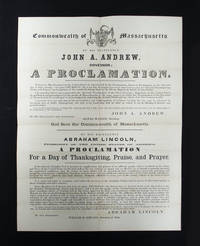
1863Best.-Nr. 68373Massachusetts 1863. LINCOLN Abraham. Massachusetts: 1863. Letterpress broadside 27 3/4 x 20 in.; 708 x 508 mm on paper incorporating several display and ornamental fonts as well as the seal of Massachusetts docketed on the verso "Post Office Hanover.' Some light offsetting. Nearly invisible professional repairs to the verso along the folds. A very nice example of this rare and important broadside This original broadside produced in Massachusetts is formatted in two halves with the top half being Governor John A. Andrew's announcement of Lincoln's Proclamation endorsing the observation of this day of Thanksgiving in his state dated July 27 1863 and the bottom half being Lincoln's actual proclamation dated July 15th 1863 and announcing that August 6th shall be set aside as a National Day of Thanksgiving. Though the exact printing date is unknown it can be assumed that it was printed within the week following July 27th. Thanksgiving was observed as a Holiday since colonial times and each state would set aside its own day for celebration. This proclamation was the first time that the Holiday would be celebrated on a set day nation wide making it the first observed Thanksgiving as a National Holiday. Though later the same year on October 3rd 1863 Lincoln made a second proclamation again announcing Thanksgiving as a Holiday but this time in November a date closer to the time most states had been celebrating it in the past. This earlier proclamation is actually the first time Thanksgiving was given national status but because the second proclamation was widely accepted the knowledge of this earlier one has been somewhat forgotten making this piece a rare and important document in the annals of American history. Though this broadside is for the State of Massachusetts no other broadsides from any other states that announce this date are known to exist and only three other copies of this rare document are located through OCLC. HBS 68373. $8500. Massachusetts unknown
Best.-Nr. 6209032281.Gpaperback. Good. Access codes and supplements are not guaranteed with used items. May be an ex-library book. paperback
Best.-Nr. ria9786209032288_inpPaperback. New. New Book; Fast Shipping from UK; Not signed; Not First Edition; La buona salute è un indice indispensabile per la vita sia degli adulti che dei bambini. La buona salute è collegata al diritto inalienabile alla vita. Senza un'assistenza sanitaria di qualità non sarà possibile godere di altri diritti paperback
189651p. + Folding plate showing guests and tables and a full page plate of a Lincoln medal. Uncut and unopened Bookplates of W. Emmert Swigart and Juniata College library (withdrawn). Mildly XLib. Small 4to. Original full cloth binding, lettered in gold. Library call mark on front board. Binding soiled. **PRICE JUST REDUCED! JUN5 BOX 1
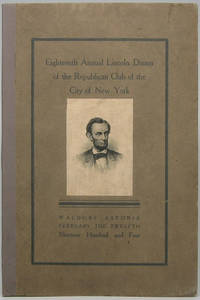
1904Best.-Nr. 44855New York: Press of Henry I. Cain and Son 1904. Paperback. Small 4to. Stiff green wrappers with tipped-on front wrapper plate and brown cloth spine. 96pp. Very good. Minor edgewear. Tight and nice first edition of the speeches given at this regular gathering "Celebrated at the Waldorf-Astoria the Ninety-Fifth Anniversary of the Birthday of Abraham Lincoln." Addresses include Indiana senator and soon-to-be vice president Charles W. Fairbanks Secretary of the Navy W.H. Moody and New York senator Chauncey M. Depew. In a facsimile letter signed by President Theodore Roosevelt he regrets his inability to attend. Rather uncommon. MONAGHAN 1444. Press of Henry I. Cain and Son paperback
2018Best.-Nr. 856MB2018. 1st edition 2018. Cham Springer 2018. 23.5 cm x 15.5 cm. XIII 454 Seiten in 1 Teil 241 Illustrationen. Softcover. Volume 2. Versand aus Deutschland / We dispatch from Germany via Air Mail. Einband bestoßen daher Mängelexemplar gestempelt sonst sehr guter Zustand. Imperfect copy due to slightly bumped cover apart from this in very good condition. Stamped. Advances in Intelligent Systems and Computing ; 680. paperback
Best.-Nr. 29470246-nnew. unknown
Best.-Nr. 30001712-nnew. unknown
Best.-Nr. 29470318-nnew. unknown
Best.-Nr. 30001712like new. unknown
Best.-Nr. 29470318like new. unknown
2021Best.-Nr. x-9811597111Springer 2021. Hardcover. New. 700 pages. 9.25x6.10x1.65 inches. Springer hardcover
2023Best.-Nr. x-3031275233Springer Nature 2023. Paperback. New. 932 pages. 9.25x6.10x1.84 inches. Springer Nature paperback
2021Best.-Nr. x-3030736881Springer Nature 2021. Paperback. New. 1061 pages. 9.25x6.10x2.09 inches. Springer Nature paperback
2020Best.-Nr. x-303049344XSpringer Nature 2020. Paperback. New. 324 pages. 9.25x6.10x0.77 inches. Springer Nature paperback
2018Best.-Nr. x-3030018172Springer-Verlag New York Inc 2018. Paperback. New. 544 pages. 9.25x6.10x1.10 inches. Springer-Verlag New York Inc paperback
2018Best.-Nr. x-3030018202Springer-Verlag New York Inc 2018. Paperback. New. 468 pages. 9.25x6.10x0.87 inches. Springer-Verlag New York Inc paperback
2016Best.-Nr. x-3319336088Springer 2016. Paperback. New. 520 pages. 9.25x6.10x1.14 inches. Springer paperback
2018Best.-Nr. x-3319763563Springer-Verlag New York Inc 2018. Paperback. New. 212 pages. 9.25x6.10x0.79 inches. Springer-Verlag New York Inc paperback