Livre Rare Book

97 résultats
1609réf. 115282antonio pinelli 1609 2 in-folio Venetiis (Venise), Antonium Pinellum (Antonio Pinelli), 1609, 2 volumes grands in-4 de 200x290 mm environ, (24) ff. (Titre gravé, Dédicace, divers), 1102 pages, (1) f. (colophon); (4) ff. (Titre gravé, préfaces), 674 pages, (1) f. (colophon), (4) ff. (Titre, préfaces), 326 pages, (34) ff. (Index biblicus). Reliure postérieure, demi-velin à coins, dos lisses ornés de faux nerfs dorés, portant titres dorés sur pièces de cuir rouge, tranches de tête rouges, gardes blanches. De petites taches sur les dos, coupes et coins émoussés, griffures sur les plats, gardes et pages de titres tamponnées, des rousseurs éparses, quelques feuillets avec des traces de mouillures, quelques feuillets restaurés en fin de volume, sinon intérieur propre, bon état général.
1909réf. 3108085Rom: Colleg. S. Anselm 1909-11. 20; 32 Seiten. Gr. 8° (24 x 17 cm). Zeitgenössischer Halbleinenband mit Marmorpapierbezug. [Hardcover / fest gebunden].
1723réf. 21193Augsburg, Strötter, 1723. Prächtiges, gest. Frontispiz von J. A. Fridrich, 18 Bll., 1068 SS.; 2 Bll, 418 SS.; 2 Bll., 630 SS.; 2 Bll., 562 SS.; 51 SS. Index. 4°. - 26:18,5 cm. Braune Ganzlederbände der Zeit mit reicher Rückenvergoldung und je 2 Rückenschildern. Die dekorativen Einbände hauptsächlich auf den Deckeln etwas beschabt, Ecken leicht bestoßen. Gelenke vereinzelt minimal wurmstichig.
1714réf. ALDR0672SchwNürnberg, Endter 1714. 4°. Gest. Frontispiz, Titel rot u. schwarz gedruckt, 8 Bl., 509; 520 Seiten, mit vielen gest. Initialen u. Illustrationen von Cornelius Nicola SCHURTZ einige Zierstücke u. Init. in Holzschnitt, neuerer Ganzlederband auf 5 Bünden, mit Rückenschild u. Streicheisenverz., sehr gut erhalten, im Text etwas gebräunt, jedoch fleckenfrei und breitrandig.
1748réf. 012869Sumpt. Haered. Balthasaris Ab Egmont, & Sociorum, Coloniae Agrippinae ( Köln ) 1748. Goldgeprägter Ganzlederband Solide, Altersschön
22 cm, in 8°, solida rilegatura coeva in piena pergamena, titolo e fregi in oro impressi al dorso, tagli colorati, p.(24), 998, (52). Grande antiporta calcografico inciso su rame, datato MCCXV e firmato da Suor Isabella Piccini. Ricchissimo apparato iconografico con 251 belle vignette xilografiche (5,5 x 8,5 cm) nel testo. Illustrazioni nitide ed assai dettagliate che caratterizzano questa bella edizione della Bibbia nella Vulgata Sisto-Clementina del Pezzana. Frontespizio stampato in rosso nero con grande marca tipografica (giglio ornato da ghirlande). Numerosi capolettera, testatine e finalini xilografici. Testo in latino, su due colonne entro cornice tipografia a doppia linea con note e rimandi. Errore di numerazione, (sono saltate le pagine 913-914 lo stesso errore si ritrova nelle edizioni successive) ma il testo è completo. Piccola firma di possesso coeva al frontespizio, qualche leggero alone molto marginale e rare bruniture lontano dal testo, stato di conservazione ottimo.
1843réf. RELI0757Mainz, Kirchhheim, Schott et Thielmann 1843. gr.-8°. LIII, 978 s., HLdr., Kanten berieben. Exemplar aus dem Nachlaß des aus Österreich gebürtigen Sinologen u. Stasi-Mitarbeiters Ernst Schwarz (1916-2003) u. mit dessen eh. Namenszug sowie einem mehrzeiligen Eintrag in chin. Schriftzeichen auf dem flieg. Vorsatzbl. u. auf dem Vortitelbl.; weiters der Vorbesitzereintrag von R. Plewka, Bautzen u. Namensstemp. von Prof. Joh. Heidrich, Bautzen.
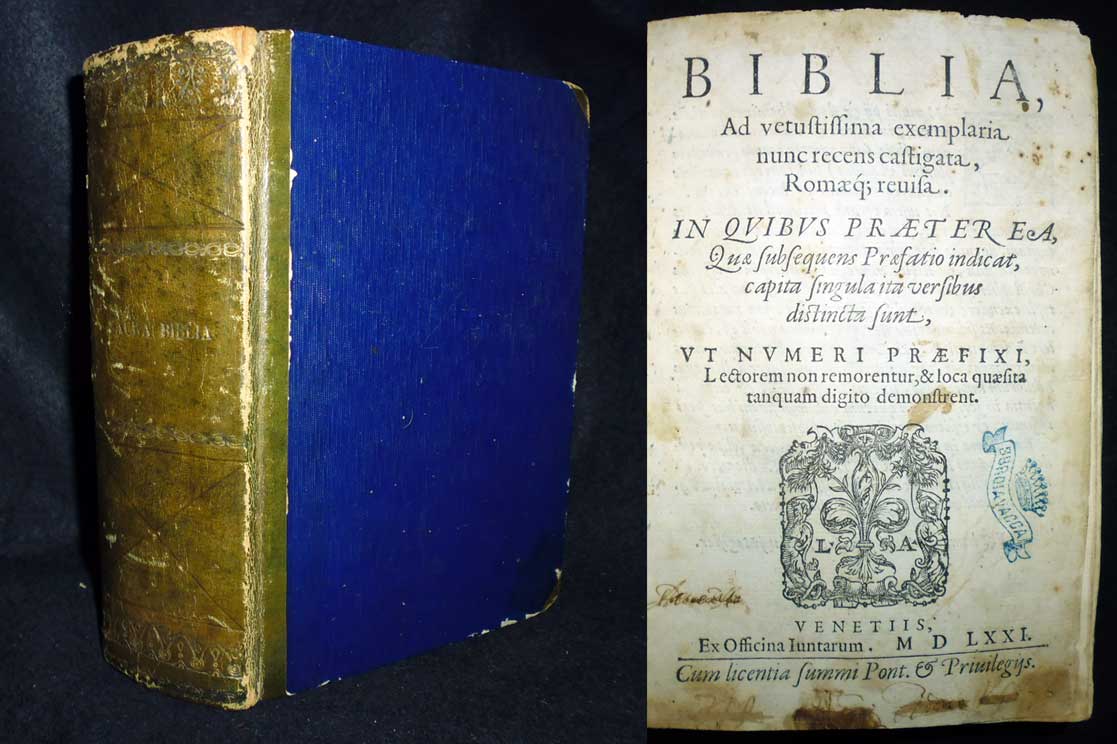
1571réf. ALDR0316Venetiis, Ex Officina Iuntarum (Venedig, Giunta) 1571. 8°. Titelbl., 7 nn. Bll., 488 Bll., 11 nn. Bll., mit je e. Druckermarke am Titel- und Schlussblatt, schönen Holzschnittinitialen, kleinen Illustrationen in Holzschnitt im Neuen Testament, sowie kleinen Ziervignetten, Text zweispaltig und gerahmt. Halblederband aus jüngerer Zeit, Rückenbeschriftung und ?zierlinien in Goldprägung, Buchschnitt mehrfärbig gesprenkelt, etwas bestoßen, Rückenleder berieben. Titelblatt mit einigen Flecken, Seiten sonst wenig gebräunt oder fleckig, mit e. Fehlstelle in Bl. 168 u. e. überklebten Stelle mit geringem Textverlust in Bl. 347. Mit verschiedenen durchgestrichenen Besitzvermerken u. einem Besitzstempel (Schriftband: Sbroiavacca mit neunzackiger Krone) am Titelblatt, sowie einem dreieckigen Ausfuhrstempel (Von der Zentralstelle für den Denkmalschutz zur Ausfuhr freigegeben) am hinteren Innendeckel. CNCE 5793. BM Italian Books 92 - venezianische Ausgabe dieser, von dem belgischen Bibelexegeten u. Angehörigen des Dominikanerordens Johannes Hentenius (1499-1566) im Auftrag Kaiser Karl V. ausgearbeiteten Bibel-Ausgabe. 1547 erstmals in Löwen erschienen, sollte sie zur Entstehung einer verbesserten Vulgata-Edition beitragen. Aus dem Besitz der Friauler Adelsfamilie Sbrojavacca. Seltene Ausgabe. Nicht bei Adams.
1816réf. 51902Paris, Didot 1816. 2, 584 Seiten, 8° (21,5 x 13 cm), marmorierter Lederband mit Marmorpapiervorsätzen sowie mit dezenter Filetenvergoldung und schwarzem Titelschild auf dem Rücken.
1899réf. GITh798Paris Goupil et Cie 1899. 2 parties en 1 volume in folio XXXI (notes d'art par Eugène Müntz) 144pp et 196pp dont table des illustrations et des matières des deux parties), le tout imprimé sur 2 colonnes et dans un double encadrement de filets rouges. Demi maroquin brun à coins, dos à nerfs janséniste, tête dorée, reliure de l'époque. Abondante et belle illustration en noir et blanc dans le texte, à pleine page et 52 hors texte, d'après les Maîtres de la peinture des XIVe, XVe et XVIe siècles tels que Fra Angelico, Cranach, Botticelli, Van Eyck, Jean Fouquet, Holbein... Exemplaire frais (petite coupure sans manque en marge inférieure d'un feuillet), imprimé sur beau papier glacé, dans une reliure sobre de bonne qualité.
In 12°; pp. 456, 341(27), un legno al frontespizio. Legatura in pergamena con tassello e titolo in oro al dorso, piccole integrazioni al dorso. Frontespizio e ultima carta foderate, nel testo 8 carte anticamente sostituite con testo manoscritto , qualche altra integrazione antica al testo.
1913réf. THEO0624Ldn. & Toronto, Dent 1913. XXI, 242 S., 1 Bl. Vlgsanz., OLn., leicht berieb., Ecken etw. bestoß., Vorsätze leimschattig mit zahlr. hs. Bleitsiftverm., Schnitt verstaubt. Text in Latein.
1491réf. 372087Basel: Nicolaus Kesler Kessler 1491. With one small polychrome gilt illuminated initial F on a2 initials in red or blue thoughout. Printed marginalia present on a2 and a7. 436 ff. 872 pp. final page is blank. 1 vols. Folio. Old leather tooled in blind clasps perished. Rebacked edges repaired last few leaves with marginal repairs final leaf of Names backed with small losses at head. Ownership marks struck out on title leaf. Very good. Cloth folding box. With one small polychrome gilt illuminated initial F on a2 initials in red or blue thoughout. Printed marginalia present on a2 and a7. 436 ff. 872 pp. final page is blank. 1 vols. Folio. Kesler's second Bible a page-for-page reprint of the edition 9 October 1487. These editions are notable for including at end the section headed "Translatores Biblie" with two notes "dealing with 1 ancient versions . and 2 with the methods of interpreting the Holy Scripture" D&M and form part of the apparatus accompanying many later editions of the Latin Bible. The first use of a title page for the Bible is ascribed to Johann Pruess in the 1486 Strassburg edition; here it is simply: Biblia. ISTC ib00591000; GW 4268; Goff B591; Copinger Incunabula Biblica 88; Darlow & Moule note at 6086. Provenance: W. A. Copinger bookplate; General Theological Seminary gift of Cornelius Vanderbilt and Dean Augustus Hoffman bookplates and blindstamps Nicolaus Kesler (Kessler) unknown
1476réf. 372231Nuremberg: Johann Sensenschmidt and Andreas Frisner 1476. Second Sensenschmidt and Frisner Bible. Text in two columns 57 lines per page rubricated with many manuscript initials in red and blue and black some descenders with leafy flourishes and occasional touches of green; some initial spaces unaccomplished. 392 ff. bound without first and last blanks. Copiously annotated chiefly in O.T. in several early Germanic Latin hands; a lengthy gloss to Acts 18 is dated at end 1525. 1 vols. Folio. Original pigskin stamped in blind vellum manuscript waste supports used at inner hinges last four leaves strengthened at gutter. Corners and bosses perished edgeworn some worming entering text at end; upper joint cracked and first two gatherings loosened. Vestiges of marginal tabs; a few paper. A bit rough very good. Second Sensenschmidt and Frisner Bible. Text in two columns 57 lines per page rubricated with many manuscript initials in red and blue and black some descenders with leafy flourishes and occasional touches of green; some initial spaces unaccomplished. 392 ff. bound without first and last blanks. Copiously annotated chiefly in O.T. in several early Germanic Latin hands; a lengthy gloss to Acts 18 is dated at end 1525. 1 vols. Folio. The second Bible printed by Sensenschmidt and Frisner at Nuremberg dated 1476 at the end of the Notitia by Menardus with generous margins and some idiosyncratic flourishes and decorations to the manuscript. At the foot of the first text leaf the manuscript ownership note of a brotherhood of monks in Gmünd. The second gathering includes a leaf where text on the verso is printed only in 44 lines and an inserted half leaf stub printed one side only in one column. Four stubs of blanks are visible at the end of Esdra but the text is complete resuming with Tobias. This copy bound without the Interpretationes hebraicorum nominum as is often the case; that work appears frequently with Koberger editions of this period and "should perhaps be regarded as a separate work". And excellent and unsophisticated copy. ISTC ib00546000 four other locations in N. America; GW 4221; Goff B546; Delaveau & Hillard 696. Provenance: W. A. Copinger bookplate; General Theological Seminary gift of Cornelius Vanderbilt and Dean Augustus Hoffman bookplates and blindstamps Johann Sensenschmidt and Andreas Frisner unknown
1540réf. 372229Paris: Ex officina Roberti Stephani typographi Regii 1540. Third edition and the first with these illustrations. Printer's device on title pages woodcut illustrations in text including 5 full-page ornamental initials. 10 268; 1 104 i.e. 103 error in pagination omitting leaf 83; 90; 92 ff. Collation: 10 a-z⸠A-I⸠K-LⶠAa10 Bb-Mm⸠NnⶠAA-KK⸠LL10 2a-2l⸠2mâ´. Early manuscript annotations. 1 vols. Folio 17x11-1/4 inches. Contemporary blindstamped pigskin over bevelled wooden boards title stamped on the upper cover lacks bosses hinges and clasps upper joint cracked darkening to spine other wear. Early vellum manuscript waste at inner hinges. Minor staining minor foxing a few scattered edge tears. Provenance: Christopher Jonas a Taubenheim early inscription mentioning commentary by Rabbi Moses ben Nahman Gerondi; Polling Monastery armorial bookplate; Duplum Bibliothecae Regiae Monacensis; General Theological Seminary stamps bookplate. Third edition and the first with these illustrations. Printer's device on title pages woodcut illustrations in text including 5 full-page ornamental initials. 10 268; 1 104 i.e. 103 error in pagination omitting leaf 83; 90; 92 ff. Collation: 10 a-z⸠A-I⸠K-LⶠAa10 Bb-Mm⸠NnⶠAA-KK⸠LL10 2a-2l⸠2mâ´. Early manuscript annotations. 1 vols. Folio 17x11-1/4 inches. The third and finest folio edition of Latin Vulgate Bible prepared by scholar/printer Robert Estienne 1503-59. Though the edition was entered into the Vatican's Index of Prohibited Books and is correspondingly scarce ultimately this text served as the foundation of the official Roman Vulgate. The illustrations of Noah's ark the Tabernacle of Moses and Temple of Solomon were widely copied. The general title page and the Prophetae are dated 1540; that of the New Testament is dated 1539; and that for the Hebraea Chaldaea Graeca & Latina Nomina . cum Interpretationis and Index is dated 1538. "The text was revised from additional MS sources; a list given at the end of the preface enumerates at least 16 MSS and 3 printed editions. This edition contains the first printing of the Prayer of Manasses in Greek and Latin. It is the text of this monumental edition which became the foundation of the official Roman vulgate ." Schreiber. The text of the Oratio Manassae is printed here for the first time leaf v8v. This is a tall and generally well preserved copy with good margins. Darlow & Moule 6117; Renouard pp. 48-9 no. 1; Copinger 275; Schreiber Estiennes 359; Adams B1022; Mortimer French 16th cent. 68 Ex officina Roberti Stephani typographi Regii unknown
réf. 2N4369Verlag der Goldenen Klassiker-Bibel Max Herzig Wien und Leipzig 1894. Zusammen 76 2328 708 Spalten mit 31 chromolithographirten und 61 Tondruck-Vollbildern nach klassischen Gemälden alter und neuer Meister der deutschen italienischen spanischen holländischen und französischen Schule und Entwürfen der Wandsbeker Kunstanstalt Haus- und Familien-Chronik nach Konkurrenz-Entwürfen deutscher Ornamentiker und Kalligraphen blind- und goldgeprägte Original-Ledereinbände mit Goldschnitt folio Band 1 gering fleckig und berieben/Band 2 Rücken eingerissen die letzten 10 Blatt gering fleckig/hinterer Deckelleder abgelöst durch Feuchtigkeit. - Prachtvolle Bibelausgabe in dekorativen Einbänden / Enthaltend den vom apostolischen Stuhle approbirten vollständigen Text und eine aus den von höchster Autorität ebenfalls gebilligte Anmerkung des größeren Allioli'schen Bibelwerks von dem Verfasser selbst besorgte abgekürzte Erläuterung jenes Textes. Mit Approbation des hochwürdigsten bischöflichen Ordinariats Augsburg - unknown
In 8, pp. 20 con foto in b/n n.t. Br. ed. Saggio relativo al lavoro della Commissio Vulgatae emendandae, voluta da papa Pio X per procedere ad una revisione del testo latino delle Scritture.
1675réf. 21061Lugduni Laurens 1675 -in-folio plein-veau 2 volumes, reliure d'époque plein veau raçiné brun in-folio (binding full calfskin in-folio) (26 x 38,5 cm), dos à nerfs (spine with raised bands), décoré or (gilt decoration), titre et tomaison frappés "or" (gilt title), pièce de titre et de tomaison sur fond bordeaux avec roulette "dentelles" "or" et double filets "or" en encadrement, entre-nerfs à caissons "or" dans un encadrement d'un double filet "or" avec rinceaux "or" aux angles, un filet à froid de part et d'autre des nerfs, roulette large "or" en tête et en pied, coiffes supérieures manquantes + coiffe de pied accidentée, coins écornés, roulette "or" sur les coupes et roulette "dentelle" "or" sur les chasses avec léger manque de dorure (blurred gilding), toutes tranches lisses dorées, titre imprimé en rouge et noir, Texte en latin à colonnes et manchettes, orné d'une gravure titre (frontispice) gravé sur bois en noir par Germain AUDRAN + une importante gravure en bas de la page de titre : "Marque de Pierre Guillimin", gravée sur bois en noir par Nicolas Auroux + 2 gravures front-de-chapitre historiées et légendées gravées sur bois en noir + de trés nombreuses lettrines historiées gravées sur bois en noir + cul-de-lampes historiés gravés sur bois en noir, ([12] + 482) + (455) Pages, M.DC.LXXV (1675) Lugduni, sumptibus Antonii Laurens Editeur,
1702réf. 21066Paris Dezallier 1702 -in-4 plein-maroquin 1 volume comportant 2 tomes reliés ensemble , reliure d'époque plein maroquin noir petit in-quarto (binding full calfskin in-4) (26,5 x 20 cm), dos à nerfs (spine with raised bands), décoré or et à froid (gilt and blind stamping decoration), titre frappé "or" (gilt title) avec filet à froid de part et d'autre, un filet à froid de part et d'autre des nerfs et en tête et en pied, léger accident à la coiffe supérieure, mors haut du 1er plat fendu sur 2 cm, plats décorés à froid d'un filet à froid en encadrement, épidermure au 1er plat, coins écornés, toutes tranches lisses jaspées rouges, les pages de garde manquent, Texte en latin à colonnes et manchettes, orné d'une gravure en bas de la page de titre : "Marque de l'Editeur A. Vitré", gravée sur bois en noir + de trés nombreuses lettrines historiées gravées sur bois en noir, traces de mouillures claires en marge des dernières pages, [8]-XX-624-512-114-[1] Pages, M.DCCII (1702) Parisiis, excudebat Antonius Vitré. Apud Antonium Dezallier Editeur,
réf. 4741Paris, Firmin Didot Frères, s.d. Un volume grand in-8 demi maroquin prune à coins, dos à nerfs dos à nerfs orné, titre doré, double filets dorés sur les plats, tranches dorées, édition de luxe, [1f.]frontispice, [1f.]titre, XXXI+546+73pp., frises en encadrement du texte, lettrines, illustrations à pleine page. Bel exemplaire .
1740réf. 139961Parisiis, typis Jacobi Vincent, viâ S. Severini, sub signo Angeli. M.DCC.XL. Cum approbatione & privilegio Regis. 1740 2 volumes. In-32 12 x 6 cm. Reliures de l’époque maroquin grenat, dos lisses ornés de fers dorés, plats encadrés d’un triple filet doré, contreplats encadrés de roulette dorée, pages de gardes dominotées, vignette au titre, 661 pp. en pagination continue, index epistolarum et evangeliorum. Plats et contreplats brunis.
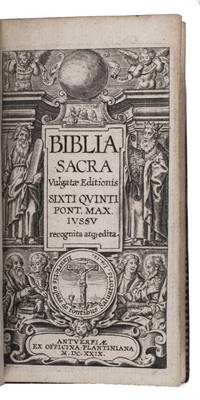
1629réf. 1052Antwerp: Officina Plantiniana = Balthasar I Moretus grandson of Christophe Plantin 1629. Uniform gold-tooled goatskin morocco ca. 1700 sewn on 4 supports richly gold-tooled spines gold-tooled turn-ins and board edges the boards in a panel design each board with a double frame of triple fillets the inner 2 fillets in each frame closer together than the outer with an ornament stamped on the intersections of the fillets at the corners of both frames and a flower in each corner between the frames with its head toward the corner; the spine with the title - BIBLIASACRA or NOVVMTESTA - and volume - TOM. I. etc. - in the 2nd of 5 compartments INDEX in the 3rd compartment of volume VII and the other compartments filled with curls and dots: a style sometimes called grotesque gold-tooled turn-ins marbled pastedowns blue red white and yellow extensively swirled headbands in green and white gilt edges. Seven volumes with the ca. 1711 engraved armorial bookplate of Jean Le Normand 1662-1733 Bishop of Evreau and probably bound for him his bookplate probably removed from volumes II and III as bound. 24mo in 8s 11.5 x 7 cm. With a richly engraved general title page 6 volume title pages each with the same Plantin-Moretus woodcut compasses device a smaller woodcut compasses device plus 3 of 4 repeats 2 appear on the back of the colophon; each of the others on an otherwise blank leaf woodcut tailpieces woodcut decorated initials. Set in roman and italic types. The present copy with 3 extra letterpress divisional title pages perhaps specially printed for this copy when it was bound. 7 volumes bound as 9 Old Testament I-VII & New Testament I-II. A small Latin Vulgate bible printed by the Plantin-Moretus office in Antwerp the smallest-format edition of the Sixtine-Clementine authorized Catholic text. The first volume of the Old Testament has only the engraved general title-page while each of the remaining Old Textament volumes as printed has a separate volume title-page naming the books it covers including the volume with the apocrypha miscellaneos texts and the indexes. After the general title-page follow a preface to the reader the decree of the Council of Trent "Paulus Papa V. Ad futuram rei memoriam" Pope Paul V died in 1621 and a privilege dated Brussels 1611. The Old Testament also has prefaces to the books. The New Testament has no preliminaries except its title-page. In 1546 the Council of Trent ordered a revision of the Vulgate Latin Bible to establish an authorized Catholic text. Pope Sixtus V ordered the preparation of the new edition printed by the Vatican Press and published in 1590. The book has been variously described as 12mo 16mo and 24mo but it is in fact a 24mo in 8s. The three divisional titles possibly printed specially for this copy have vertical chainlines and may be in 18mo format. The binding stamps are finely cut and skilfully applied especially the curls on the spine so it is likely to have been executed by one of the great French binders of ca. 1700.With an owner's inscription on a free endleaf in volume IV as bound "ce livre apartient a monseigneur L'Evesque D'Evreux" presumably Jean Le Normand 1662-1733 Bishop of Evreux from 1711 to his death whose bookplate appears in 7 of the 9 volumes: the handwriting is old-fashioned for 1711 so the book could have come to Le Normand from an earlier Bishop of Evreux but perhaps he simply wrote in an old-fashioned style. The pagination of volume ii accidentally omits numbers 577-578 but no leaf is missing there. Very slightly browned with an occasional minor spot and with the library stamps on the letterpress title-pages abraded but still generally in very good condition. With small cracks in the hinges of 4 volumes minor wear on the board edges and corners and volume III as bound vol. ii as printed darkened but the binding is also otherwise in very good condition with the tooling clear and sharp. A lovely little Catholic bible beautifully bound ca. 1700 in French gold-tooled red morocco an unusually small format for a Catholic bible.l Darlow & Moule 6211 New Testament only; STCV 6650952; USTC 1003882; not in www.bibliasacra.nl. Officina Plantiniana [= Balthasar I Moretus, grandson of Christophe Plantin], hardcover
1647réf. 10933Paris, Boullanger [Boulanger], 1647. 12° (15-18,5 cm). 12 Bll., 876 S., 25 Bll., [1], 4 Bll. Ganzleder der Zeit über vier echten Bünden mit vergoldeter Deckelverzierung
réf. 124923England c.1260-1275. . 579ll on very thin parchment; early foliation in roman numerals with errors top outer corner recto supplemented by modern foliation in pencil; horizontal catchword centre lower margin in quire 2 traces in quires 12 16 18 19 quires signed at the beginning very bottom inside corner in an Arabic numeral many trimmed presumably by the 19th-century binder ruled in lead sometimes with the top two middle two and bottom two horizontal lines full across full-length vertical bounding lines inside outside and between the columns and with an extra set of double rules at the top and bottom of the page justification 94-90 x 68-64 mm. Written by many scribes below the top line in very small formal gothic bookhands in two columns ff. 546-575v the Interpretation of Hebrew Names in three columns of 49-45 lines majuscules within the text stroked with red red and blue running titles and chapter numbers occasional red rubrics often blank spaces for the rubrics remain one-line alternately red and blue initials chapters begin with two-line with extensions up to fifteen lines alternately red and blue initials with pen decoration in the other colour approximately sixty-eight 6- to 25-line parted red and blue initials with red and/or blue pen work parted initials on f. i and iv verso opening prologue and Genesis extend the full-length of the page. With ten illuminated initials 7-lines high pink or mauve with white highlights infilled with pink and blue rinceaux some terminating with animal heads on highly polished gold grounds or on contrasting grounds of dark blue or pink heavily edged in black overall in very good condition f. 1 darkened and repaired in the inner margin f. 32 modern repair with slight loss of text f. 490 erasure with some damage to a few lines of text ff. 539-545 damage from damp top outer corner f. 544 top outer corner repaired with loss of text generous margins but trimmed some loss at the edges of the added text on ff. 544-545 the ink on some pages has faded or been abraded. Bound in early 19th-century red roan spine elaborately tooled in gilt and lettered 'Biblia/Sacra/M.S.S' expertly rebacked with old spine laid down boards with a single gilt rule speckled edges with yellow glazed endpapers lower board and edges lightly scuffed; a very handsome binding with 20th-century slipcase with paper label to spine lettered in ink and matching chemise. Dimensions 153 x 105 mm. Small portable Bibles containing the complete Old and New Testaments were one of the greatest achievements of 13th-century book production transforming the use and ownership of the Bible. This English example was copied by numerous scribes and decorated in a number of styles. The ten handsome illuminated initials decorate the Minor Prophets an unusual choice. Textual evidence links it to both the Dominicans and Franciscans. Notable here are the numerous additions that show how this was used including the contemporary table of introits and Mass lections and numerous marginal notes from the thirteenth to the fifteenth centuries. The first portable Bibles may have been copied in Paris at the end of the 1220s or early 1230s. Many of them were products of the commercial booksellers of Paris. English examples of this type of Bible however appear at almost the same time and 13th-century England was an important centre for the production of Bibles although in smaller numbers than France. However the text of English 13th-century Bibles is often quite distinct from contemporary Bibles from Paris. Centralised production in Paris resulted in numerous Bibles that share the same text the text modern scholars call the Paris Bible. In England a much more diffuse production meant that there is a much greater variety in the text of the Bibles; there is no 'typical' English text. The Psalms have been omitted here. This is fairly common in 13th-century Bibles and possibly more common in England than elsewhere. This Bible does show some influence of the Paris Bible. In particular the biblical books are arranged according to the 'new' Paris order the same order used today with the Gospels followed by the Pauline Epistles rather than by Acts and the books are divided according to the modern chapters although as noted above with many variations including some that Paul Saenger has identified as English Saenger 2013 and it includes the Interpretation of Hebrew Names. The many different scribes who copied this book and the variety of different styles found in the pen decoration are certainly of great interest. There are many intriguing bits of evidence that tell us how this Bible was put together. The rubricator for example made fairly frequent errors confusing prologues and biblical books and in one case inserting the wrong running title calling the book usually known as 2 Ezra in 13th-century Bibles and 3 Ezra by modern scholars Stegmüller 941 'Osee' i.e. the minor prophet Hosea. A corrector changed it to 'iosias' not the usual name for this book although it does begin 'Et fecit iosias ' The foliation in Roman numerals is also noteworthy most books in the Middle Ages do not include page or folio numbers with numerous mistakes in the series including large gaps despite the text being complete. Ten biblical books begin with finely executed illuminated initials by a well-trained but provincial or idiosyncratic artist freely interpreting more mainstream initials from commercial centres such as Oxford or Paris; most of the initials are pink or a distinctive mauve shade with white highlights infilled with tightly curled vine scrolls that terminate in simple leaves or animal-heads on contrasting grounds or on highly polished gold all heavily edged in black. The 'I' on f. 397v extends 30-lines and is infilled with a distinctive geometric lattice-pattern. The evidence of the script and decorations supports an origin in the second half of the thirteenth century probably c.1260-1275. It was used very early in its history in England and many small details fit best with an origin in England including the lack of a Psalter the Interpretation of Hebrew Names copied in three columns variations in the beginnings of some of the chapters Saenger 2013 p. 60 n. 104 and the quire structure especially the quires of sixteen and twenty leaves Ruzzier 2013 p. 116. None of these details by themselves would be an argument for an English origin but together they are highly suggestive. Moreover the main style of the penwork decoration although unusually exuberant and perhaps idiosyncratic and the style of the illuminated initials also suggest England. Evidence of the script however is more difficult to interpret. There are numerous hands in the volume and the rounded bookhands used by some of the scribes suggest they may have been from Southern France. It is worth remembering that Aquitaine was English throughout the thirteenth century. A full description with further information on the text and the provenance with a full bibliography is available on request. Branner Manuscript Painting in Paris during the Reign of St. Louis 1977; Burke Heraldic Register 1850 p. 83; De Hamel The Book. A History of the Bible 2001 chapter 5 'Portable Bibles of the Thirteenth Century'; Light The Bible and the Individual: The Thirteenth-Century Paris Bible. England, c.1260-1275]. hardcover
1878réf. 74449Paris, P. Lethielleux, Libraire-Editeur, 1878, in-8, demi-chagrin vert, plats percaline, titre à l'or, 170 pages. Bon état.