114 risultati
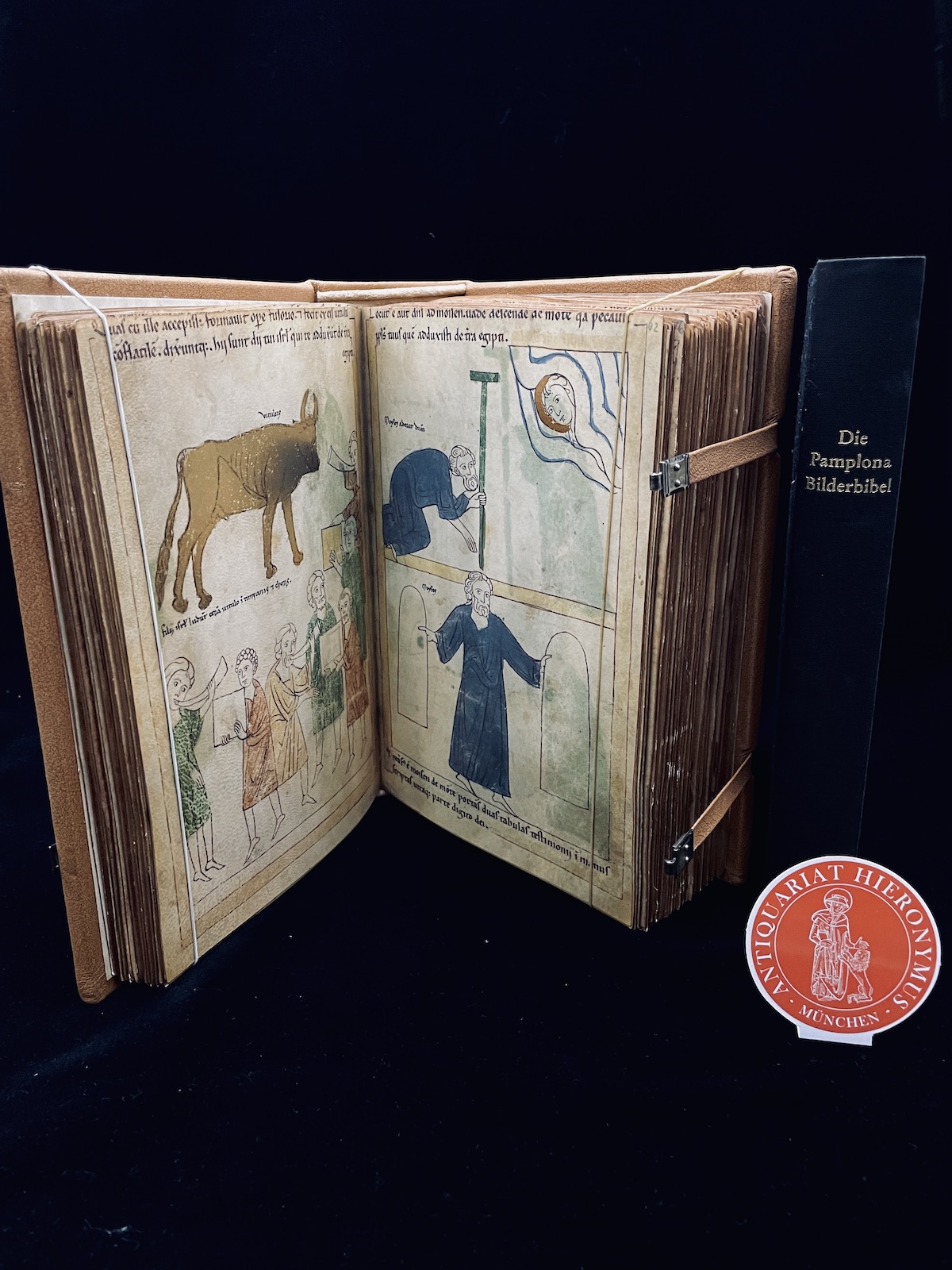
rif. 124923England c.1260-1275. . 579ll on very thin parchment; early foliation in roman numerals with errors top outer corner recto supplemented by modern foliation in pencil; horizontal catchword centre lower margin in quire 2 traces in quires 12 16 18 19 quires signed at the beginning very bottom inside corner in an Arabic numeral many trimmed presumably by the 19th-century binder ruled in lead sometimes with the top two middle two and bottom two horizontal lines full across full-length vertical bounding lines inside outside and between the columns and with an extra set of double rules at the top and bottom of the page justification 94-90 x 68-64 mm. Written by many scribes below the top line in very small formal gothic bookhands in two columns ff. 546-575v the Interpretation of Hebrew Names in three columns of 49-45 lines majuscules within the text stroked with red red and blue running titles and chapter numbers occasional red rubrics often blank spaces for the rubrics remain one-line alternately red and blue initials chapters begin with two-line with extensions up to fifteen lines alternately red and blue initials with pen decoration in the other colour approximately sixty-eight 6- to 25-line parted red and blue initials with red and/or blue pen work parted initials on f. i and iv verso opening prologue and Genesis extend the full-length of the page. With ten illuminated initials 7-lines high pink or mauve with white highlights infilled with pink and blue rinceaux some terminating with animal heads on highly polished gold grounds or on contrasting grounds of dark blue or pink heavily edged in black overall in very good condition f. 1 darkened and repaired in the inner margin f. 32 modern repair with slight loss of text f. 490 erasure with some damage to a few lines of text ff. 539-545 damage from damp top outer corner f. 544 top outer corner repaired with loss of text generous margins but trimmed some loss at the edges of the added text on ff. 544-545 the ink on some pages has faded or been abraded. Bound in early 19th-century red roan spine elaborately tooled in gilt and lettered 'Biblia/Sacra/M.S.S' expertly rebacked with old spine laid down boards with a single gilt rule speckled edges with yellow glazed endpapers lower board and edges lightly scuffed; a very handsome binding with 20th-century slipcase with paper label to spine lettered in ink and matching chemise. Dimensions 153 x 105 mm. Small portable Bibles containing the complete Old and New Testaments were one of the greatest achievements of 13th-century book production transforming the use and ownership of the Bible. This English example was copied by numerous scribes and decorated in a number of styles. The ten handsome illuminated initials decorate the Minor Prophets an unusual choice. Textual evidence links it to both the Dominicans and Franciscans. Notable here are the numerous additions that show how this was used including the contemporary table of introits and Mass lections and numerous marginal notes from the thirteenth to the fifteenth centuries. The first portable Bibles may have been copied in Paris at the end of the 1220s or early 1230s. Many of them were products of the commercial booksellers of Paris. English examples of this type of Bible however appear at almost the same time and 13th-century England was an important centre for the production of Bibles although in smaller numbers than France. However the text of English 13th-century Bibles is often quite distinct from contemporary Bibles from Paris. Centralised production in Paris resulted in numerous Bibles that share the same text the text modern scholars call the Paris Bible. In England a much more diffuse production meant that there is a much greater variety in the text of the Bibles; there is no 'typical' English text. The Psalms have been omitted here. This is fairly common in 13th-century Bibles and possibly more common in England than elsewhere. This Bible does show some influence of the Paris Bible. In particular the biblical books are arranged according to the 'new' Paris order the same order used today with the Gospels followed by the Pauline Epistles rather than by Acts and the books are divided according to the modern chapters although as noted above with many variations including some that Paul Saenger has identified as English Saenger 2013 and it includes the Interpretation of Hebrew Names. The many different scribes who copied this book and the variety of different styles found in the pen decoration are certainly of great interest. There are many intriguing bits of evidence that tell us how this Bible was put together. The rubricator for example made fairly frequent errors confusing prologues and biblical books and in one case inserting the wrong running title calling the book usually known as 2 Ezra in 13th-century Bibles and 3 Ezra by modern scholars Stegmüller 941 'Osee' i.e. the minor prophet Hosea. A corrector changed it to 'iosias' not the usual name for this book although it does begin 'Et fecit iosias ' The foliation in Roman numerals is also noteworthy most books in the Middle Ages do not include page or folio numbers with numerous mistakes in the series including large gaps despite the text being complete. Ten biblical books begin with finely executed illuminated initials by a well-trained but provincial or idiosyncratic artist freely interpreting more mainstream initials from commercial centres such as Oxford or Paris; most of the initials are pink or a distinctive mauve shade with white highlights infilled with tightly curled vine scrolls that terminate in simple leaves or animal-heads on contrasting grounds or on highly polished gold all heavily edged in black. The 'I' on f. 397v extends 30-lines and is infilled with a distinctive geometric lattice-pattern. The evidence of the script and decorations supports an origin in the second half of the thirteenth century probably c.1260-1275. It was used very early in its history in England and many small details fit best with an origin in England including the lack of a Psalter the Interpretation of Hebrew Names copied in three columns variations in the beginnings of some of the chapters Saenger 2013 p. 60 n. 104 and the quire structure especially the quires of sixteen and twenty leaves Ruzzier 2013 p. 116. None of these details by themselves would be an argument for an English origin but together they are highly suggestive. Moreover the main style of the penwork decoration although unusually exuberant and perhaps idiosyncratic and the style of the illuminated initials also suggest England. Evidence of the script however is more difficult to interpret. There are numerous hands in the volume and the rounded bookhands used by some of the scribes suggest they may have been from Southern France. It is worth remembering that Aquitaine was English throughout the thirteenth century. A full description with further information on the text and the provenance with a full bibliography is available on request. Branner Manuscript Painting in Paris during the Reign of St. Louis 1977; Burke Heraldic Register 1850 p. 83; De Hamel The Book. A History of the Bible 2001 chapter 5 'Portable Bibles of the Thirteenth Century'; Light The Bible and the Individual: The Thirteenth-Century Paris Bible. England, c.1260-1275]. hardcover
1476rif. 372231Nuremberg: Johann Sensenschmidt and Andreas Frisner 1476. Second Sensenschmidt and Frisner Bible. Text in two columns 57 lines per page rubricated with many manuscript initials in red and blue and black some descenders with leafy flourishes and occasional touches of green; some initial spaces unaccomplished. 392 ff. bound without first and last blanks. Copiously annotated chiefly in O.T. in several early Germanic Latin hands; a lengthy gloss to Acts 18 is dated at end 1525. 1 vols. Folio. Original pigskin stamped in blind vellum manuscript waste supports used at inner hinges last four leaves strengthened at gutter. Corners and bosses perished edgeworn some worming entering text at end; upper joint cracked and first two gatherings loosened. Vestiges of marginal tabs; a few paper. A bit rough very good. Second Sensenschmidt and Frisner Bible. Text in two columns 57 lines per page rubricated with many manuscript initials in red and blue and black some descenders with leafy flourishes and occasional touches of green; some initial spaces unaccomplished. 392 ff. bound without first and last blanks. Copiously annotated chiefly in O.T. in several early Germanic Latin hands; a lengthy gloss to Acts 18 is dated at end 1525. 1 vols. Folio. The second Bible printed by Sensenschmidt and Frisner at Nuremberg dated 1476 at the end of the Notitia by Menardus with generous margins and some idiosyncratic flourishes and decorations to the manuscript. At the foot of the first text leaf the manuscript ownership note of a brotherhood of monks in Gmünd. The second gathering includes a leaf where text on the verso is printed only in 44 lines and an inserted half leaf stub printed one side only in one column. Four stubs of blanks are visible at the end of Esdra but the text is complete resuming with Tobias. This copy bound without the Interpretationes hebraicorum nominum as is often the case; that work appears frequently with Koberger editions of this period and "should perhaps be regarded as a separate work". And excellent and unsophisticated copy. ISTC ib00546000 four other locations in N. America; GW 4221; Goff B546; Delaveau & Hillard 696. Provenance: W. A. Copinger bookplate; General Theological Seminary gift of Cornelius Vanderbilt and Dean Augustus Hoffman bookplates and blindstamps Johann Sensenschmidt and Andreas Frisner unknown
1599rif. ABC_46660Antwerp: colophon: printed by Daniel Vervliet and Hendrik Swingen for Jan I Moretus & Jan I van Keerberghen 1599. Contemporary richly blind-tooled calf over wooden boards sewn on 5 supports with brass catchplates remnants of leather strap fastenings brass corner pieces on all corners and a brass centrepiece on each board all with brass bosses. Folio. With an engraved title page coloured by a contemporary hand with extensive use of gold showing Moses on the left David on the right and the four evangelists below and 90 woodcuts in the text of both the Old and the New Testament all except one vividly coloured by a contemporary hand. The woodcuts in the Old Testament after a series by Hans Sebald Beham except for the first by Peter van der Borcht signed "P.B."; those in the New Testament are by an unidentified artist. Further with numerous woodcut decorated initials and headpieces also coloured by a contemporary hand. Set in two columns of gothic textura type with the marginal notes chapter headings and preface in roman type. 2 volumes bound as 1. Extraordinary copy of the first edition published by Moretus Moerentorf & Van Keerberghen of the famous Moerentorf Bible in the vernacular Dutch language printed in 1599 especially interesting for its vivid contemporary hand-colouring and for its richly blind-tooled contemporary binding. The authoritative Moerentorf Bible or Moretus Bible was a revision of the 1548 Louvain Bible in Dutch but corrected based on the improved Latin Vulgate of 1592 published by the authority of Pope Clement VIII. The Moerentorf Bible met extraordinary success and "became the standard Bible for Dutch Roman Catholics" Darlow & Moule for almost three centuries being repeatedly reprinted as the official Dutch translation of the Vulgate in the Low Countries.Jan Moerentorf better known as Jan I Moretus published this revised Dutch translation of the Old and New Testament together in 1599 with the title Biblia sacra. The first woodcut of the Old Testament in Genesis is signed "P.B" by Peter van der Borcht a Flemish painter draughtsman and etcher who was full-time assistant to Christopher Plantin and illustrated many of his liturgical works. The other woodcut illustrations in the Old Testament are copied from the engraved print series of the German painter and printmaker Hans Sebald Beham 1500-1550 who was especially known for his very small engravings. The present edition appeared in two issues one with the imprint of Moretus alone and the present one with the imprint of both Moretus and Van Keerberghen. Poortman shows a completely different first woodcut illustration not signed P.B. for the Moretus version says its other illustrations are printed from a different series of blocks differing in detail and rendering the scenes in mirror image and also notes differences in the orthography. With the bookplate on the front paste-down and library stamp on a free endleaf the back of the title-page and the first text page of Wetenschappelijke Bibliotheek Eindhoven the former monastic library of the Augustinian monastery in Eindhoven and one of the most important scholarly theological libraries of the Netherlands. Also with one contemporary annotation on Pp1 of the Old Testament.Binding slightly worn around the edges especially around the spine edges a little dust-soiled and some damage to the back board where the leather fastenings were originally attached to the boards with brass pins. Minor marginal stains spots and dust-soiling mostly in the first part and a few creases throughout the book a small tear in the right lower corner of Oo6 in the Old Testament not affecting the text a larger tear partly restored and restoration in the foot margin in L6 of the Old Testament. The colouring of the initials and woodcuts has slightly browned the paper. Overall however the Bible is in good condition. A beautiful copy of one of the most important Dutch Bibles ever published here in a richly blind-tooled contemporary binding and complete with all the illustrations coloured by a contemporary hand.l Belgica typographica 1541-1600 473 & 7886; Biblia Sacra 1599.B.dut.JM1.A; Bibliotheca Catholica Neerlandica impressa 4529; BM STC Dutch p. 24; Darlow & Moule 3300; Dirk Imhof Jan Moretus and the continuation of the Plantin press 1589-1610 B-36B; Pettegree Netherlandish Books 3891; Poortman Bijbel en prent I and pp. 131-133 217; STCV 12923651; USTC 402496; not in Adams. (colophon: printed by Daniel Vervliet and Hendrik Swingen for) Jan I Moretus & Jan I van Keerberghen, hardcover
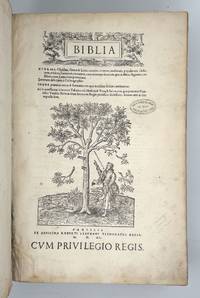
1540rif. 372229Paris: Ex officina Roberti Stephani typographi Regii 1540. Third edition and the first with these illustrations. Printer's device on title pages woodcut illustrations in text including 5 full-page ornamental initials. 10 268; 1 104 i.e. 103 error in pagination omitting leaf 83; 90; 92 ff. Collation: 10 a-z⸠A-I⸠K-Lâ¶ Aa10 Bb-Mm⸠Nnâ¶ AA-KK⸠LL10 2a-2l⸠2mâ´. Early manuscript annotations. 1 vols. Folio 17x11-1/4 inches. Contemporary blindstamped pigskin over bevelled wooden boards title stamped on the upper cover lacks bosses hinges and clasps upper joint cracked darkening to spine other wear. Early vellum manuscript waste at inner hinges. Minor staining minor foxing a few scattered edge tears. Provenance: Christopher Jonas a Taubenheim early inscription mentioning commentary by Rabbi Moses ben Nahman Gerondi; Polling Monastery armorial bookplate; Duplum Bibliothecae Regiae Monacensis; General Theological Seminary stamps bookplate. Third edition and the first with these illustrations. Printer's device on title pages woodcut illustrations in text including 5 full-page ornamental initials. 10 268; 1 104 i.e. 103 error in pagination omitting leaf 83; 90; 92 ff. Collation: 10 a-z⸠A-I⸠K-Lâ¶ Aa10 Bb-Mm⸠Nnâ¶ AA-KK⸠LL10 2a-2l⸠2mâ´. Early manuscript annotations. 1 vols. Folio 17x11-1/4 inches. The third and finest folio edition of Latin Vulgate Bible prepared by scholar/printer Robert Estienne 1503-59. Though the edition was entered into the Vatican's Index of Prohibited Books and is correspondingly scarce ultimately this text served as the foundation of the official Roman Vulgate. The illustrations of Noah's ark the Tabernacle of Moses and Temple of Solomon were widely copied. The general title page and the Prophetae are dated 1540; that of the New Testament is dated 1539; and that for the Hebraea Chaldaea Graeca & Latina Nomina . cum Interpretationis and Index is dated 1538. "The text was revised from additional MS sources; a list given at the end of the preface enumerates at least 16 MSS and 3 printed editions. This edition contains the first printing of the Prayer of Manasses in Greek and Latin. It is the text of this monumental edition which became the foundation of the official Roman vulgate ." Schreiber. The text of the Oratio Manassae is printed here for the first time leaf v8v. This is a tall and generally well preserved copy with good margins. Darlow & Moule 6117; Renouard pp. 48-9 no. 1; Copinger 275; Schreiber Estiennes 359; Adams B1022; Mortimer French 16th cent. 68 Ex officina Roberti Stephani typographi Regii unknown
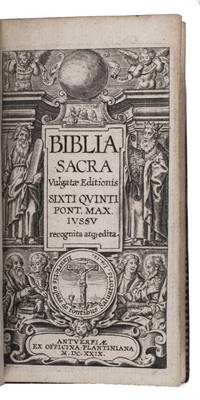
1629rif. 1052Antwerp: Officina Plantiniana = Balthasar I Moretus grandson of Christophe Plantin 1629. Uniform gold-tooled goatskin morocco ca. 1700 sewn on 4 supports richly gold-tooled spines gold-tooled turn-ins and board edges the boards in a panel design each board with a double frame of triple fillets the inner 2 fillets in each frame closer together than the outer with an ornament stamped on the intersections of the fillets at the corners of both frames and a flower in each corner between the frames with its head toward the corner; the spine with the title - BIBLIASACRA or NOVVMTESTA - and volume - TOM. I. etc. - in the 2nd of 5 compartments INDEX in the 3rd compartment of volume VII and the other compartments filled with curls and dots: a style sometimes called grotesque gold-tooled turn-ins marbled pastedowns blue red white and yellow extensively swirled headbands in green and white gilt edges. Seven volumes with the ca. 1711 engraved armorial bookplate of Jean Le Normand 1662-1733 Bishop of Evreau and probably bound for him his bookplate probably removed from volumes II and III as bound. 24mo in 8s 11.5 x 7 cm. With a richly engraved general title page 6 volume title pages each with the same Plantin-Moretus woodcut compasses device a smaller woodcut compasses device plus 3 of 4 repeats 2 appear on the back of the colophon; each of the others on an otherwise blank leaf woodcut tailpieces woodcut decorated initials. Set in roman and italic types. The present copy with 3 extra letterpress divisional title pages perhaps specially printed for this copy when it was bound. 7 volumes bound as 9 Old Testament I-VII & New Testament I-II. A small Latin Vulgate bible printed by the Plantin-Moretus office in Antwerp the smallest-format edition of the Sixtine-Clementine authorized Catholic text. The first volume of the Old Testament has only the engraved general title-page while each of the remaining Old Textament volumes as printed has a separate volume title-page naming the books it covers including the volume with the apocrypha miscellaneos texts and the indexes. After the general title-page follow a preface to the reader the decree of the Council of Trent "Paulus Papa V. Ad futuram rei memoriam" Pope Paul V died in 1621 and a privilege dated Brussels 1611. The Old Testament also has prefaces to the books. The New Testament has no preliminaries except its title-page. In 1546 the Council of Trent ordered a revision of the Vulgate Latin Bible to establish an authorized Catholic text. Pope Sixtus V ordered the preparation of the new edition printed by the Vatican Press and published in 1590. The book has been variously described as 12mo 16mo and 24mo but it is in fact a 24mo in 8s. The three divisional titles possibly printed specially for this copy have vertical chainlines and may be in 18mo format. The binding stamps are finely cut and skilfully applied especially the curls on the spine so it is likely to have been executed by one of the great French binders of ca. 1700.With an owner's inscription on a free endleaf in volume IV as bound "ce livre apartient a monseigneur L'Evesque D'Evreux" presumably Jean Le Normand 1662-1733 Bishop of Evreux from 1711 to his death whose bookplate appears in 7 of the 9 volumes: the handwriting is old-fashioned for 1711 so the book could have come to Le Normand from an earlier Bishop of Evreux but perhaps he simply wrote in an old-fashioned style. The pagination of volume ii accidentally omits numbers 577-578 but no leaf is missing there. Very slightly browned with an occasional minor spot and with the library stamps on the letterpress title-pages abraded but still generally in very good condition. With small cracks in the hinges of 4 volumes minor wear on the board edges and corners and volume III as bound vol. ii as printed darkened but the binding is also otherwise in very good condition with the tooling clear and sharp. A lovely little Catholic bible beautifully bound ca. 1700 in French gold-tooled red morocco an unusually small format for a Catholic bible.l Darlow & Moule 6211 New Testament only; STCV 6650952; USTC 1003882; not in www.bibliasacra.nl. Officina Plantiniana [= Balthasar I Moretus, grandson of Christophe Plantin], hardcover
1491rif. 372087Basel: Nicolaus Kesler Kessler 1491. With one small polychrome gilt illuminated initial F on a2 initials in red or blue thoughout. Printed marginalia present on a2 and a7. 436 ff. 872 pp. final page is blank. 1 vols. Folio. Old leather tooled in blind clasps perished. Rebacked edges repaired last few leaves with marginal repairs final leaf of Names backed with small losses at head. Ownership marks struck out on title leaf. Very good. Cloth folding box. With one small polychrome gilt illuminated initial F on a2 initials in red or blue thoughout. Printed marginalia present on a2 and a7. 436 ff. 872 pp. final page is blank. 1 vols. Folio. Kesler's second Bible a page-for-page reprint of the edition 9 October 1487. These editions are notable for including at end the section headed "Translatores Biblie" with two notes "dealing with 1 ancient versions . and 2 with the methods of interpreting the Holy Scripture" D&M and form part of the apparatus accompanying many later editions of the Latin Bible. The first use of a title page for the Bible is ascribed to Johann Pruess in the 1486 Strassburg edition; here it is simply: Biblia. ISTC ib00591000; GW 4268; Goff B591; Copinger Incunabula Biblica 88; Darlow & Moule note at 6086. Provenance: W. A. Copinger bookplate; General Theological Seminary gift of Cornelius Vanderbilt and Dean Augustus Hoffman bookplates and blindstamps Nicolaus Kesler (Kessler) unknown
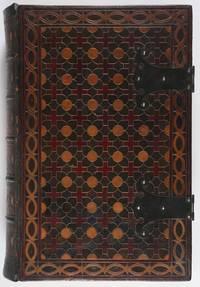
1701rif. 53475Liege: Jean-François Broncart 1701. First edition thus. Hardcover. Very good. Two tomes each in two parts bound in one volume folio: 6 lxxix 1 blank 544; 1 title 1 blank 545-957 1 blank xx Cantique des cantiques 96 La sagesse; Ecclesiastique de Jesus fils de Sirach; 1 title 1 blank 468; 1 title 1 blank 430 16 Oratio Manassae; Liber Esdrae - tertius et quartus pp. Main titles for each tome in red and black; secondary titles in black only all four titles with engraved printer's device; each dated 1701. Text in two columns Latin and French. Illustrated with 6 engraved plates: frontispiece Johann Friederich Karg von Bebenburg; folding plate with 16 vignettes 4x4 depicting well-known biblical scenes; 4 folding maps The Holy Land; The Promised Land Apportioned by Tribe; Jerusalem in the Second Temple Era - after Lamy; The World Known to the Evangelists. Quarter-page engraved vignettes at the head of each of the 30 biblical books; historiated initials; printed marginalia. Exquisitely bound in the 19th century in levant morocco extra over wooden boards with mosaic compartments in crimson ochre; and dark brown bordered in fine gilt line; spine with raised bands lightly rubbed; pair of brass mounts finished in black with steel rivets at both covers clasps and catched perished. All edges gilt and elaborately gauffered in textured floral motif; gilt inner dentelles; decorative endleaves renewed in orange and black; crimson silk ribbon marker. The work of a master binder. Expertly repaired at spine caps. Occasional faint embrowning; marginal dampstains beginning in second half mostly at outer corners; expanding to fore-edge and darkening considerably in final 20 leaves. Overall a very good copy with crisp text throughout though incomplete: lacks Antoine Arnould's "Concorde des quatre Evangélistes" along with its accompanying Latin version and the concluding index. Amply margined copy of this sumptuous edition of the Bible comprising the Latin Sixto-clementine Vulgate and the Port-Royal French translation printed in parallel columns. Isaac-Louis Lemaistre de Sacy 1613-1684 was the principal translator of the French version which was edited and completed after his death by Pierre Thomas du Fossé 1634-1698 and Henri-Charles de Beaubrun 1655-1723 who also provide annotations throughout. According to Barbier the French controversialist Thierry de Viaixnes 1659-1735 who found himself often at odds with his superiors was the principal editor of the work; at the time of its preparation he was serving as director of an academy at Hautvilliers in the diocese of Rheims McClintock & Strong. Dedicated to Johann Friederich Karg von Bebenburg 1648-1719 whose signed portrait was drawn and engraved by C. Gustav of Amling. An advocate of maximal papal power Karg served as Privy Councilor of the Prince-Bishop of Bamberg and Würzburg Peter Philipp von Dernbach then of Elector Max Emanuel of Bavaria. He served as Dean of Our Lady in Munich and was entrusted by Emperor Leopold I with a legation to Pope Innocence XI. By these efforts he secured in 1688 the election of Prince Joseph Clemens of Bavaria as Archbishop of Cologne as a result of which he was made Chancellor and Minister of State here noted on the frontispiece. Provenance and annotations: Bookplate of Herman Blum Blumhaven Library & Gallery with his ticket below; two gilt-stamped ex-libris morocco labels: Henry W. Poor oval; Adolph Lewisohn octogonal. References: Darlow & Moule 3779; Deleveau & Hillard Bibles imprimées du XVe au XVIIe siècles conservées è Paris 605; ADB 15 1882 "Karg: Johann Friedrich; Jean-François Broncart hardcover
1462rif. 001313Mainz: Johann Fust & Peter Schoeffer 14 August 1462 1462. Fust and Schoeffer 48-line Bible Leaf. Royal folio 413 x 286 mm. Leaf 194 from gathering 20 of book one text from 2 Esdras chapter 15 and 16. Double column 48-lines printed in Gothic type. Titles and chapters in alternating red and blue letters red and blue two-line initials rubricated capital initials. Lines 35 to 41 in both columns of recto only are reset. 2 -inch closed tear to outer margin just slightly affecting text expertly repaired two old paper-clip ghosting marks to upper margin. Leaf housed in a cloth portfolio; slipcase with gilt lettered red morocco spine label. A fine leaf from the fourth edition of the Vulgate Bible or the 48- line Bible preceded only by the 42-line Gutenberg Bible the 36-line Pfister Bible Bamberg and the 49-line Mentelin Bible Strassburg. The first also to include the date of publication the place of printing and bear the name of the printer. Mainz: Johann Fust & Peter Schoeffer, 14 August 1462, hardcover
1894rif. 33189Wien; Leipzig: Verlag der Goldenen Klassiker-Bibel Max Herzig 1894. First edition thus. Hardcover. g. Folio. 76 1080 columns 38 540pp 708 columns 354pp 127pp plates. Splendid blind and gilt-stamped crushed full morocco with gold lettering and decoration on front covers and spines. Beveled edges. Raised bands. All edges gilt. Decorative endpapers. Double ribbon marker in each volume. Title pages in red and black lettering. Text in two columns within double red and black ruled box. This remarkable edition of The Old and New Testaments is magnificently illustrated with 127 captioned chromolithographs after classical and modern paintings by the most renowned German Italian Spanish Dutch and French artists such as Ridinger C. W. E. Dietrich Luca Giordano Andrea Appiani Giorgio Barbarelli Ferdinand Boll Philippe de Champagne Nicolas Poussin Alessandro Turchi Jean Germain Drouet Carlo Dolci Rafael Santi Paolo Veronese Francesco Barbieri Leonardo da Vinci Michelangelo etc. Each plate is protected with a tissue-guard. Paper size 14 1/2 x 11 inches; image size varies ca 11 x 8 1/4 inches. Spine of first volume slightly discolored. Spine and front cover of second volume partly discolored. Bottom edge of the first six leafs first volume and of the first four leafs second volume partly damaged by silverfish not affecting pages throughout. Text in German gothic script. Bindings in overall good interior in good to very good condition. Verlag der Goldenen Klassiker-Bibel Max Herzig hardcover
2013rif. 481462013. ISBN-13: 9781584777816; ISBN-10: 1584777818. The Vulgate Edition in Law French Great Britain. Vulgate Edition. The Year Books; Or Reports in the Following Reigns with Notes to Brooke and Fitzherbert's Abridgments. Originally published: London: by George Sawbridge etc. 1678 1679-80. 11 volumes. Folio 9" x 14". 5802 pp. With New Introductory Notes and Tables in Each Volume Naming all Justices and Serjeants and Listing Calendar Years of Law Terms by David J. Seipp Professor of Law Boston University with Carol F. Lee of the District of Columbia Bar. Reprinted 2007 2013 by The Lawbook Exchange Ltd. Set: ISBN-13: 9781584777816; ISBN-10: 1584777818. Hardcover folio 9" x 14". New. $2495. Reprint of the Vulgate edition with new detailed introductions that address the history content and significance of the Year Books and tables that list all justices and sergeants as well as calendar years of law terms. The new material includes references to Seipp's Index and Paraphrase of Printed Year Book Reports 1268-1535 which is based on the Vulgate edition reprinted here. A powerful research tool Seipp's Index and Paraphrase of Printed Year Book Reports 1268-1535 is a free online database of all printed Year Book reports that indexes and summarizes almost all of the cases in this edition. It also guides the reader to later and prior proceedings of individual cases and to all case references in abridgments and other sources. It is difficult to overestimate the importance of The Year Books. As Marvin put it in his Legal Bibliography these were the "venerable books" from which Littleton Hobart Hale and Coke drew "so much valuable ore melting it into ingots and refining and sending it abroad as the correct coin of the common law" 756. As a series of notes on debates and points of pleadings they are primary sources for our knowledge of medieval common law. The origin of The Year Books is unknown. Maitland believed that the earliest volumes were notes taken by law students in court copied for the use of pleaders in later cases. Holdsworth maintained that The Year Books like other law reports were records of cases made by lawyers for their own private use with no thought toward subsequent publication. Though it is not known when the first volumes were compiled it is clear that the earliest cases date from 1268; t. unknown
1785rif. 40318Parisiis: Excudabat Fr. Amb. Didot natut maj. 1785. 8vo in 4s 19 cm 7.5". 8 vols. I: xvi 501 1 pp. II: 2 ff. 450 pp. III: 2 ff. 393 1 pp. IV: 2 ff. 428 pp. V: 2 ff. 400 pp. VI: 2 ff. 444 pp. VII: 2 ff. 407 1 pp. VIII: 2 ff. 373 1 pp. Produced here in fine French bibliophilic style is the most extensive collection of => Old Latin versions which exist only in fragments compiled from manuscripts and the writings of the Fathers by Pierre Sabbathier and continued after his death under the care of Vincent de La Rue Darlow & Moule. This edition following the first Rheims 173949 was issued In the Didot series Collection des auteurs classiques françois et latins. Binding: Full red crushed morocco gilt spine and boards; gilt rule on board edges; gilt rolls on turn-ins; marbled endpapers. All edges gilt. => Bindings signed Petit Succs. de Simier. Provenance: Bookplates of Casimir L. Stralem Clarence E. Clark and Brian Douglas Stilwell. WorldCat locates only six U.S. libraries reporting ownership of => all eight volumes as present here NYPL Cornell Seton Hall Holy Cross College New York Historical Society UC-Berkeley Law and two libraries reporting ownership of incomplete sets Harvard Divinity vols. 1 2 only University of Dayton vol. 3 only. . Darlow & Moule III 6263; Jammes Les Didot 25. Bound as above some joints outside showing cracking but all intact. All volumes housed in light marbled-paper open-back cases some with tape repairs. => Very good. Excudabat Fr. Amb. Didot natut maj. hardcover books
2013rif. 481462013. ISBN-13: 9781584777816; ISBN-10: 1584777818. The Vulgate Edition in Law French Great Britain. Vulgate Edition. The Year Books; Or Reports in the Following Reigns with Notes to Brooke and Fitzherbert's Abridgments. Originally published: London: by George Sawbridge etc. 1678 1679-80. 11 vols. Folio 9" x 14". 5802 pp. With New Introductory Notes and Tables in Each Volume Naming all Justices and Serjeants and Listing Calendar Years of Law Terms by David J. Seipp Professor of Law Boston University with Carol F. Lee of the District of Columbia Bar. Reprinted 2007 2013 by The Lawbook Exchange Ltd. Set: ISBN-13: 9781584777816; ISBN-10: 1584777818. Hardcover folio 9" x 14". New. $2495. Reprint of the Vulgate edition with new detailed introductions that address the history content and significance of the Year Books and tables that list all justices and sergeants as well as calendar years of law terms. The new material includes references to Seipp's Index and Paraphrase of Printed Year Book Reports 1268-1535 which is based on the Vulgate edition reprinted here. A powerful research tool Seipp's Index and Paraphrase of Printed Year Book Reports 1268-1535 is a free online database of all printed Year Book reports that indexes and summarizes almost all of the cases in this edition. It also guides the reader to later and prior proceedings of individual cases and to all case references in abridgments and other sources. It is difficult to overestimate the importance of The Year Books. As Marvin put it in his Legal Bibliography these were the "venerable books" from which Littleton Hobart Hale and Coke drew "so much valuable ore melting it into ingots and refining and sending it abroad as the correct coin of the common law" 756. As a series of notes on debates and points of pleadings they are primary sources for our knowledge of medieval common law. The origin of The Year Books is unknown. Maitland believed that the earliest volumes were notes taken by law students in court copied for the use of pleaders in later cases. Holdsworth maintained that The Year Books like other law reports were records of cases made by lawyers for their own private use with no thought toward subsequent publication. Though it is not known when the first volumes were compiled it is clear that the earliest cases date from 1268; the. unknown books
1574rif. 310455Geneva: Pierre de Saint-André 1574. Illustrated with woodcuts of the Tabernacle Noah's Ark maps including 1 folding etc. 8 435 1; 131 i.e. 113 27 f. Lacking title page with general title supplied from a near contemporary edition separate New Testament title with imprint of Francis Estienne. Small 8vo. 17th century morocco flat spine elaborate gilt scrollwork Dutch gilt endpapers. Some headlines shaved old pale dampstain to gutters at front small split to rear hinge at bottom. Illustrated with woodcuts of the Tabernacle Noah's Ark maps including 1 folding etc. 8 435 1; 131 i.e. 113 27 f. Lacking title page with general title supplied from a near contemporary edition separate New Testament title with imprint of Francis Estienne. Small 8vo. The general title in this copy is supplied from another edition entirely the octavo Biblia Sacra published in Lyon by Jean de Tournes in 1554. The New Testament title bears the imprint Francis Estienne 1567 as found in copies of the Biblia Sacra published in Geneva by Pierre de Saint-André in 1574 and 1583 with the preliminary leaves in this copy matching those of 1574. The title appears to have been supplied at an early date probably when the book was trimmed and rebound in the 17th century. Darlow and Moule 6160 Pierre de Saint-André unknown books
1723rif. 21193Augsburg, Strötter, 1723. Prächtiges, gest. Frontispiz von J. A. Fridrich, 18 Bll., 1068 SS.; 2 Bll, 418 SS.; 2 Bll., 630 SS.; 2 Bll., 562 SS.; 51 SS. Index. 4°. - 26:18,5 cm. Braune Ganzlederbände der Zeit mit reicher Rückenvergoldung und je 2 Rückenschildern. Die dekorativen Einbände hauptsächlich auf den Deckeln etwas beschabt, Ecken leicht bestoßen. Gelenke vereinzelt minimal wurmstichig.
1578rif. 113001578 3 tomes en 2 volumes (two books), reliure plein veau havane marbré in-octavo (binding full calfskin in-octavo)(14 x 20,3 cm), (reliure d'époque), dos 5 nerfs (spine with 5 raised bands) - entre-nerfs à la "fanfare" dorure très estompé (between the raised bands gilt very shaded off) - titre frappé or (gilt title), coiffes abîmées (head and tail of the spine lightly faded), plats avec craquelures et des épidermures (crackles and scratches on the covers), coins écornés (corners dog-eared), tranches jaspées (marbled edges) - petite tache d'encre sur la gouttière de queue du second volume (small ink mark on the bottom edge of the second book), texte 2 colonnes à manchette (text - 2 coloumns with marginal note) - texte en noir encadré de filets bruns rouge avec quelques soulignages à l'encre brune in texte (some underlining ), manque la page de titre du premier volume, remplacée par une photocopie (miss the title page of the first volume), illustrations : orné de 160 bois in-texte en noir par Tobias Stimmer (160 woodcuts in text and a map full page engraving by Tobias Stimmer) + une grande Carte hors-texte en noir de la Méditerranée et des pays circonvoisins (page 98 du tome 3) par Tobias Stimmer , cicatrices de mouillures sur la gouttière du second volume (scars of waterstains on the fore-edge of the second book), [(30)+ 612] + 251+ [ (6+ 224 + (72 pages d'index)] pages, 1578 Basileae per Thomam Guarinum,
1609rif. 115282antonio pinelli 1609 2 in-folio Venetiis (Venise), Antonium Pinellum (Antonio Pinelli), 1609, 2 volumes grands in-4 de 200x290 mm environ, (24) ff. (Titre gravé, Dédicace, divers), 1102 pages, (1) f. (colophon); (4) ff. (Titre gravé, préfaces), 674 pages, (1) f. (colophon), (4) ff. (Titre, préfaces), 326 pages, (34) ff. (Index biblicus). Reliure postérieure, demi-velin à coins, dos lisses ornés de faux nerfs dorés, portant titres dorés sur pièces de cuir rouge, tranches de tête rouges, gardes blanches. De petites taches sur les dos, coupes et coins émoussés, griffures sur les plats, gardes et pages de titres tamponnées, des rousseurs éparses, quelques feuillets avec des traces de mouillures, quelques feuillets restaurés en fin de volume, sinon intérieur propre, bon état général.
2005rif. 12952Simbach am Inn / Reinbek-Berlin, Müller & Schindler / Coron bei Kindler Verlag, 2005. "Gr.-8° (22,5-25 cm). 273 num. Bll. (Faksimile); 336 S. (Kommentarband)." "Blindgeprägtes Ganzleder über vier falschen Bünden mit zwei Schließen (Faksimile); OLeinwand mit vergoldetem Rückentitel und montierter Deckelillustration (Kommentarband)" [3 Warenabbildungen]
rif. 97909Parisiis, Excudebat Antonius Vitré, 1652, 8 volumes in-16 de 155x90 mm environ, T. I. (12) ff. (faux-titre, titre gravé, titre, epistola, praefatio), 768 p. - T. II. 714 p. (1) f. - T. III. 622 p. - T. IV. 648 p.-(2) ff. (index) - T. V. 780 p. - T. VI. 583 p. - T. VII. 480-110 p. (2) ff. (approbation, privilège) -T. VIII. 144-447 p. (27) ff. (index),plein maroquin bordeaux, titres et tomaisons dorés sur dos lisses, tranches coupes et chasses dorées, gardes marbrées avec ex-libris sur les premiers contreplats (en partie arrachés sur les tomes III et V). Quelques rousseurs, des notes au crayon à papier dans les tomes VII et VIII, dos décolorés ou brunis (tome I et V), 2 coiffes ébréchées, des mors en partie fendus avec trous et galerie de ver (tome VI et VIII), frottements sur le dos et les coins, petit manque de papier dans la marge p. 235-236, sinon bon état. Texte en latin.
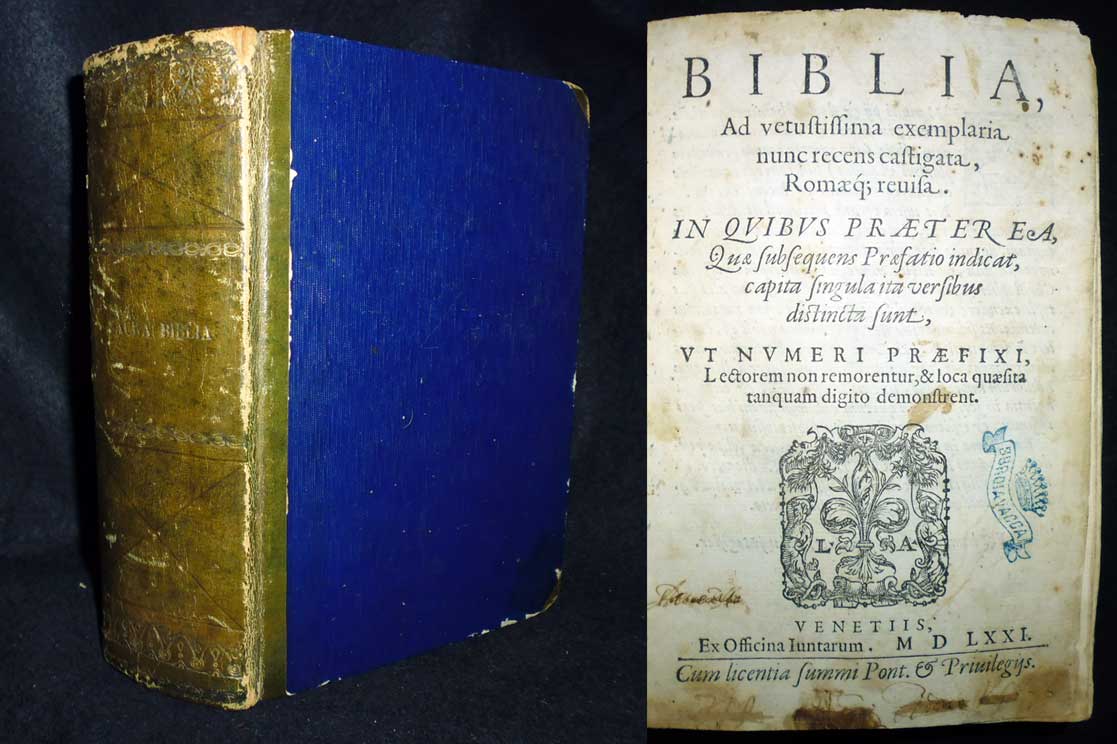
1571rif. ALDR0316Venetiis, Ex Officina Iuntarum (Venedig, Giunta) 1571. 8°. Titelbl., 7 nn. Bll., 488 Bll., 11 nn. Bll., mit je e. Druckermarke am Titel- und Schlussblatt, schönen Holzschnittinitialen, kleinen Illustrationen in Holzschnitt im Neuen Testament, sowie kleinen Ziervignetten, Text zweispaltig und gerahmt. Halblederband aus jüngerer Zeit, Rückenbeschriftung und ?zierlinien in Goldprägung, Buchschnitt mehrfärbig gesprenkelt, etwas bestoßen, Rückenleder berieben. Titelblatt mit einigen Flecken, Seiten sonst wenig gebräunt oder fleckig, mit e. Fehlstelle in Bl. 168 u. e. überklebten Stelle mit geringem Textverlust in Bl. 347. Mit verschiedenen durchgestrichenen Besitzvermerken u. einem Besitzstempel (Schriftband: Sbroiavacca mit neunzackiger Krone) am Titelblatt, sowie einem dreieckigen Ausfuhrstempel (Von der Zentralstelle für den Denkmalschutz zur Ausfuhr freigegeben) am hinteren Innendeckel. CNCE 5793. BM Italian Books 92 - venezianische Ausgabe dieser, von dem belgischen Bibelexegeten u. Angehörigen des Dominikanerordens Johannes Hentenius (1499-1566) im Auftrag Kaiser Karl V. ausgearbeiteten Bibel-Ausgabe. 1547 erstmals in Löwen erschienen, sollte sie zur Entstehung einer verbesserten Vulgata-Edition beitragen. Aus dem Besitz der Friauler Adelsfamilie Sbrojavacca. Seltene Ausgabe. Nicht bei Adams.
1843In-folio, pp. (2), xix, 256. Con una tavola in cui è riprodotta una pagina del manoscritto originale. Aponio fu uno scrittore cristiano del V-VI sec., probabilmente di origine orientale, che scrisse a Roma una Explanatio in canticum canticorum, in cui utilizzando il testo latino della vulgata fornisce una interpretazione allegorica. Editio princeps. Legatura in piena pelle con ricche impressioni in oro e a secco ai piatti, fregi e titolo in oro al dorso, tagli in oro.
1760rif. WB15737Venice: Ex Typographia Balleoniana 1760. Hardcover. Very Good. MDCCLX 1760. Folio 2 volumes 282 x 205mm. Vol. I: xcii 866pp. 1; Vol. II: 588pp. i.e. 888 72 corrections. Signatures: Vol. I: -58 66 A-Ggg8 Hhh10; Vol. II: A-Iii8 Kkk4 A-I4. Full-page engraved frontispiece of angels symbols and the four Evangelists in first volume only. Both title pages with the copperplate engraved vignette of putto beside thurible on clouds. Woodcut ornate initials friezes and other ornamentation throughout the text most historiated vignettes and of Old and New Testament scenes. Title page printed in red and black in first volume. Text in two columns throughout. Extensive printed footnotes. Contemporary mottled calf spine with six raised bands and gilt in compartments edges speckled in red; vol. 1 with minor marginal worm hole through part of the prologue few creases; corners bumped light edgewear more severe on volume 1 overall a good and sturdy two volume set of the Biblia Sacra. 19th-century ownership inscription written in Portuguese by a priest Antonio Bernadini from Coimbra. At one time in the Portuguese collection of Julio Dantas Livraria Particular. Stamped Residentia Bracarensis IHS on both titles. Jean-Baptiste du Hamel was a French cleric and physicist who published numerous scientific treatises and works on natural history in his lifetime. His last major work and his crowning achievement was his editorial work done on the Latin Vulgate Bible his Grande Bible to which he added an introduction notes and chronological historical and geographical tables with the assistance of the bible scholar Giuseppe Bianchini 1704-1764. The Vulgate edition of the Bible had already undergone significant revisions by Pope Sixtus V in 1590 and Clement VIII in 1592 and this version which Du Hamel worked from is sometimes called the Sixtine-Clementine version. Du Hamels Biblia Sacra was first printed in Paris in 1705 only one year before his death. Balleoniana editions of the Vulgate Bible appeared in 1731 1741 1760 here and 1779. This esteemed Venetian press was known for printing finely produced religious works; the Old and New Testament woodcuts are a remarkable collection of biblical imagery. This copy retains the early ownership inscription of a priest in Coimbra and seems to have enjoyed a long monastic scholarly life at a Benedictine Jesuit house in Braga Portugal. Together they comprise a complete set two magnificent mammoth folios of the revised Du Hamel Bible a classic for examining biblical criticism and interpretation in the eighteenth century. This edition quite rare; OCLC located copies a few copies in the US at Ohio Univ. Mount Angel Abbey in Oregon and Benedictine College in Kansas. Ex Typographia Balleoniana hardcover
1760rif. WB15737Venice: Ex Typographia Balleoniana 1760. Hardcover. Very Good. MDCCLX 1760. Folio 2 volumes 282 x 205mm. Vol. I: xcii 866pp. 1; Vol. II: 588pp. i.e. 888 72 corrections. Signatures: Vol. I: -58 66 A-Ggg8 Hhh10; Vol. II: A-Iii8 Kkk4 A-I4. Full-page engraved frontispiece of angels symbols and the four Evangelists in first volume only. Both title pages with the copperplate engraved vignette of putto beside thurible on clouds. Woodcut ornate initials friezes and other ornamentation throughout the text most historiated vignettes and of Old and New Testament scenes. Title page printed in red and black in first volume. Text in two columns throughout. Extensive printed footnotes. Contemporary mottled calf spine with six raised bands and gilt in compartments edges speckled in red; vol. 1 with minor marginal worm hole through part of the prologue few creases; corners bumped light edgewear more severe on volume 1 overall a good and sturdy two volume set of the Biblia Sacra. 19th-century ownership inscription written in Portuguese by a priest Antonio Bernadini from Coimbra. At one time in the Portuguese collection of Julio Dantas Livraria Particular. Stamped Residentia Bracarensis IHS on both titles. Jean-Baptiste du Hamel was a French cleric and physicist who published numerous scientific treatises and works on natural history in his lifetime. His last major work and his crowning achievement was his editorial work done on the Latin Vulgate Bible his Grande Bible to which he added an introduction notes and chronological historical and geographical tables with the assistance of the bible scholar Giuseppe Bianchini 1704-1764. The Vulgate edition of the Bible had already undergone significant revisions by Pope Sixtus V in 1590 and Clement VIII in 1592 and this version which Du Hamel worked from is sometimes called the Sixtine-Clementine version. Du Hamels Biblia Sacra was first printed in Paris in 1705 only one year before his death. Balleoniana editions of the Vulgate Bible appeared in 1731 1741 1760 here and 1779. This esteemed Venetian press was known for printing finely produced religious works; the Old and New Testament woodcuts are a remarkable collection of biblical imagery. This copy retains the early ownership inscription of a priest in Coimbra and seems to have enjoyed a long monastic scholarly life at a Benedictine Jesuit house in Braga Portugal. Together they comprise a complete set two magnificent mammoth folios of the revised Du Hamel Bible a classic for examining biblical criticism and interpretation in the eighteenth century. This edition quite rare; OCLC located copies a few copies in the US at Ohio Univ. Mount Angel Abbey in Oregon and Benedictine College in Kansas. Ex Typographia Balleoniana hardcover books
1679rif. 739061679. Cases from the Reign of Edward IV Parts IX and X of the Vulgate Edition Year Books. Vulgate Edition. Edward IV 1442-1483 King of England. Les Reports des Cases en Ley Que Fuerunt Argues en Temps du Roy Edward le Quart. Avec les Notations de le Tres Reverend Judges Brook & Fitz-Herbert. Et Auter References n'Unques Devant Imprimee. Ovesque un Table Perfect des Choses Notables Contenus en Ycel. London: Printed by George Sawbridge et al. And are to be sold by H. Twyford et al. 1680. ii 10 29 28 44 8 12 32 25 53 19 11 21 10 8 33 12 8 30 10 19 84 51 75 pp. Complete. Bound with Les Reports des Cases en Ley en le Cinque An du Roy Edward le Quart. Communement Appelle Long Quinto. Novelment Imprimee & Corrigee Ovesque References al Brook; Et un Table Perfect. London: Printed by George Sawbridge et al. And are to be sold by H. Twyford et al. 1680. ii 108 108-142 9 pp. Complete. Folio 15" x 9". Later eighteenth or nineteenth-century calf blind rules and fillets to boards raised bands blind fillets and lettering piece to spine gilt rules to board edges. Rubbing and scuffing to boards heavier rubbing and light wear to extremities front board separated but secured by cords rear joint starting at ends corners bumped and worn rear hinge cracked faint offsetting to endleaves minor worming to foot of front pastedown. Moderate toning to interior light foxing and soiling in a few places minor worming to bottom margin of first 100 or so leaves occasional faint dampstaining to edges of last several leaves text not affected. $700. It is difficult to overestimate the importance of the Year Books. As a series of notes on debates and points of pleadings in Norman England they are of crucial primary sources for our knowledge of medieval common law. They also provide a richly detailed portrait of contemporary English life customs and manners. The origin of the Year Books is unknown. Some scholars believe the earliest volumes were notes transcribed by law students for study and for the use of lawyers in later cases while others maintain they were made by lawyers. Though it is not known when the first manuscript volumes were compiled the date from the 1270s to 1535. Printed editions of the Year Books were first issued by William de Machlinia between 1481 and 1482. unknown
1724rif. 2011170004Paris : G. Desprez et J. Desessartz 1724. First Edition. Hardcover. Acceptable. Tall folio 40 x 27 cm. Bound in contemporary boards rebacked on modern leather with most of original spine inlaid. Edges conserved. All edges red. Text printed in two columns. 10 855 1 xxx. Lacking final two leaves of the Table des Epitres et Evangiles Index. Title page creased with chip torn from bottom margin corner. Woodcut title vignette. Ref. Bibles Paris 535. Not in Darlow/Moule. Jansenist translation by Louis-Isaac Lemaistre de Sacy. Paris : G. Desprez et J. Desessartz hardcover
1675rif. 21061Lugduni Laurens 1675 -in-folio plein-veau 2 volumes, reliure d'époque plein veau raçiné brun in-folio (binding full calfskin in-folio) (26 x 38,5 cm), dos à nerfs (spine with raised bands), décoré or (gilt decoration), titre et tomaison frappés "or" (gilt title), pièce de titre et de tomaison sur fond bordeaux avec roulette "dentelles" "or" et double filets "or" en encadrement, entre-nerfs à caissons "or" dans un encadrement d'un double filet "or" avec rinceaux "or" aux angles, un filet à froid de part et d'autre des nerfs, roulette large "or" en tête et en pied, coiffes supérieures manquantes + coiffe de pied accidentée, coins écornés, roulette "or" sur les coupes et roulette "dentelle" "or" sur les chasses avec léger manque de dorure (blurred gilding), toutes tranches lisses dorées, titre imprimé en rouge et noir, Texte en latin à colonnes et manchettes, orné d'une gravure titre (frontispice) gravé sur bois en noir par Germain AUDRAN + une importante gravure en bas de la page de titre : "Marque de Pierre Guillimin", gravée sur bois en noir par Nicolas Auroux + 2 gravures front-de-chapitre historiées et légendées gravées sur bois en noir + de trés nombreuses lettrines historiées gravées sur bois en noir + cul-de-lampes historiés gravés sur bois en noir, ([12] + 482) + (455) Pages, M.DC.LXXV (1675) Lugduni, sumptibus Antonii Laurens Editeur,