Antiquariat.de
114 résultats
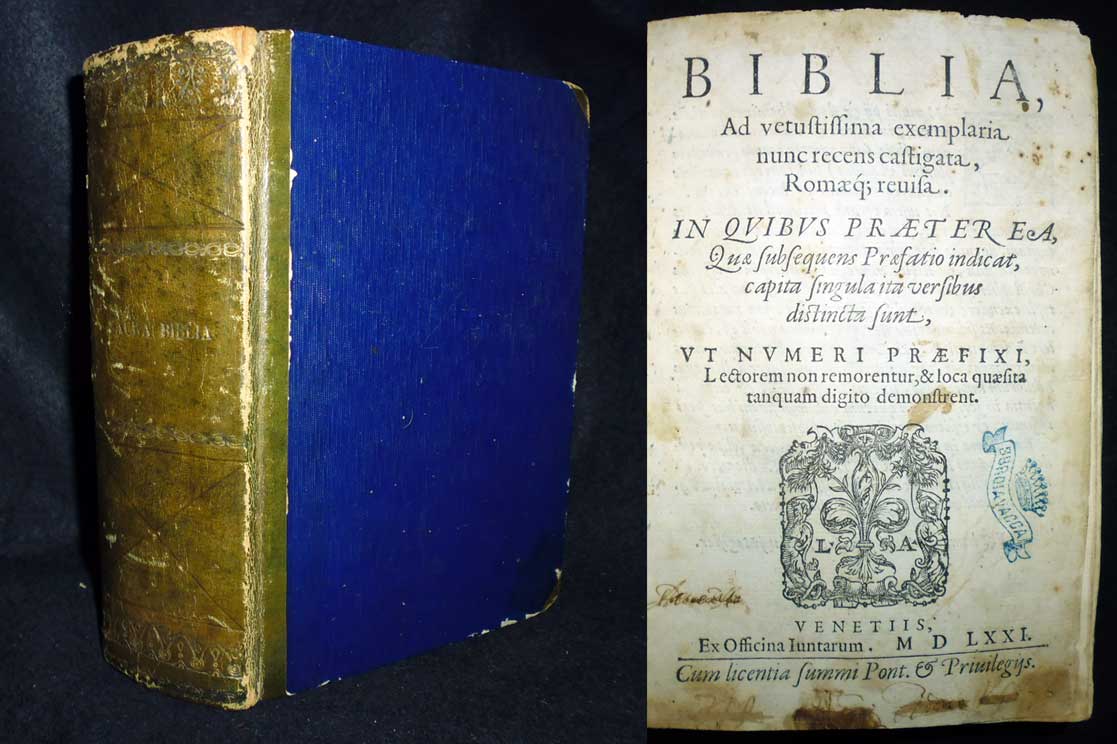
1571réf. ALDR0316Venetiis, Ex Officina Iuntarum (Venedig, Giunta) 1571. 8°. Titelbl., 7 nn. Bll., 488 Bll., 11 nn. Bll., mit je e. Druckermarke am Titel- und Schlussblatt, schönen Holzschnittinitialen, kleinen Illustrationen in Holzschnitt im Neuen Testament, sowie kleinen Ziervignetten, Text zweispaltig und gerahmt. Halblederband aus jüngerer Zeit, Rückenbeschriftung und ?zierlinien in Goldprägung, Buchschnitt mehrfärbig gesprenkelt, etwas bestoßen, Rückenleder berieben. Titelblatt mit einigen Flecken, Seiten sonst wenig gebräunt oder fleckig, mit e. Fehlstelle in Bl. 168 u. e. überklebten Stelle mit geringem Textverlust in Bl. 347. Mit verschiedenen durchgestrichenen Besitzvermerken u. einem Besitzstempel (Schriftband: Sbroiavacca mit neunzackiger Krone) am Titelblatt, sowie einem dreieckigen Ausfuhrstempel (Von der Zentralstelle für den Denkmalschutz zur Ausfuhr freigegeben) am hinteren Innendeckel. CNCE 5793. BM Italian Books 92 - venezianische Ausgabe dieser, von dem belgischen Bibelexegeten u. Angehörigen des Dominikanerordens Johannes Hentenius (1499-1566) im Auftrag Kaiser Karl V. ausgearbeiteten Bibel-Ausgabe. 1547 erstmals in Löwen erschienen, sollte sie zur Entstehung einer verbesserten Vulgata-Edition beitragen. Aus dem Besitz der Friauler Adelsfamilie Sbrojavacca. Seltene Ausgabe. Nicht bei Adams.
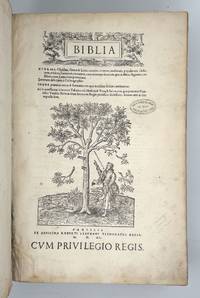
1540réf. 372229Paris: Ex officina Roberti Stephani typographi Regii 1540. Third edition and the first with these illustrations. Printer's device on title pages woodcut illustrations in text including 5 full-page ornamental initials. 10 268; 1 104 i.e. 103 error in pagination omitting leaf 83; 90; 92 ff. Collation: 10 a-z⸠A-I⸠K-LⶠAa10 Bb-Mm⸠NnⶠAA-KK⸠LL10 2a-2l⸠2mâ´. Early manuscript annotations. 1 vols. Folio 17x11-1/4 inches. Contemporary blindstamped pigskin over bevelled wooden boards title stamped on the upper cover lacks bosses hinges and clasps upper joint cracked darkening to spine other wear. Early vellum manuscript waste at inner hinges. Minor staining minor foxing a few scattered edge tears. Provenance: Christopher Jonas a Taubenheim early inscription mentioning commentary by Rabbi Moses ben Nahman Gerondi; Polling Monastery armorial bookplate; Duplum Bibliothecae Regiae Monacensis; General Theological Seminary stamps bookplate. Third edition and the first with these illustrations. Printer's device on title pages woodcut illustrations in text including 5 full-page ornamental initials. 10 268; 1 104 i.e. 103 error in pagination omitting leaf 83; 90; 92 ff. Collation: 10 a-z⸠A-I⸠K-LⶠAa10 Bb-Mm⸠NnⶠAA-KK⸠LL10 2a-2l⸠2mâ´. Early manuscript annotations. 1 vols. Folio 17x11-1/4 inches. The third and finest folio edition of Latin Vulgate Bible prepared by scholar/printer Robert Estienne 1503-59. Though the edition was entered into the Vatican's Index of Prohibited Books and is correspondingly scarce ultimately this text served as the foundation of the official Roman Vulgate. The illustrations of Noah's ark the Tabernacle of Moses and Temple of Solomon were widely copied. The general title page and the Prophetae are dated 1540; that of the New Testament is dated 1539; and that for the Hebraea Chaldaea Graeca & Latina Nomina . cum Interpretationis and Index is dated 1538. "The text was revised from additional MS sources; a list given at the end of the preface enumerates at least 16 MSS and 3 printed editions. This edition contains the first printing of the Prayer of Manasses in Greek and Latin. It is the text of this monumental edition which became the foundation of the official Roman vulgate ." Schreiber. The text of the Oratio Manassae is printed here for the first time leaf v8v. This is a tall and generally well preserved copy with good margins. Darlow & Moule 6117; Renouard pp. 48-9 no. 1; Copinger 275; Schreiber Estiennes 359; Adams B1022; Mortimer French 16th cent. 68 Ex officina Roberti Stephani typographi Regii unknown
1872réf. 510240Barri-Ducis / Ludovicus Guerin 1872. Hardcover. VERY GOOD. xxiv 1484pp. Rebound in black cloth with gilt spine lettering. From the non-circulating collection of Golden Gate Baptist Seminary with their bookplate noting donation from the library of Edward R. Dalgish as the only paraphernalia. Text entirely clean and fresh - a nice copy. Barri-Ducis / Ludovicus Guerin hardcover
1785réf. 40318Parisiis: Excudabat Fr. Amb. Didot natut maj. 1785. 8vo in 4s 19 cm 7.5". 8 vols. I: xvi 501 1 pp. II: 2 ff. 450 pp. III: 2 ff. 393 1 pp. IV: 2 ff. 428 pp. V: 2 ff. 400 pp. VI: 2 ff. 444 pp. VII: 2 ff. 407 1 pp. VIII: 2 ff. 373 1 pp. Produced here in fine French bibliophilic style is the most extensive collection of => Old Latin versions which exist only in fragments compiled from manuscripts and the writings of the Fathers by Pierre Sabbathier and continued after his death under the care of Vincent de La Rue Darlow & Moule. This edition following the first Rheims 173949 was issued In the Didot series Collection des auteurs classiques françois et latins. Binding: Full red crushed morocco gilt spine and boards; gilt rule on board edges; gilt rolls on turn-ins; marbled endpapers. All edges gilt. => Bindings signed Petit Succs. de Simier. Provenance: Bookplates of Casimir L. Stralem Clarence E. Clark and Brian Douglas Stilwell. WorldCat locates only six U.S. libraries reporting ownership of => all eight volumes as present here NYPL Cornell Seton Hall Holy Cross College New York Historical Society UC-Berkeley Law and two libraries reporting ownership of incomplete sets Harvard Divinity vols. 1 2 only University of Dayton vol. 3 only. . Darlow & Moule III 6263; Jammes Les Didot 25. Bound as above some joints outside showing cracking but all intact. All volumes housed in light marbled-paper open-back cases some with tape repairs. => Very good. Excudabat Fr. Amb. Didot natut maj. hardcover books
1843In-folio, pp. (2), xix, 256. Con una tavola in cui è riprodotta una pagina del manoscritto originale. Aponio fu uno scrittore cristiano del V-VI sec., probabilmente di origine orientale, che scrisse a Roma una Explanatio in canticum canticorum, in cui utilizzando il testo latino della vulgata fornisce una interpretazione allegorica. Editio princeps. Legatura in piena pelle con ricche impressioni in oro e a secco ai piatti, fregi e titolo in oro al dorso, tagli in oro.
réf. 61370543Saint Benedict Press LLC . Papeback. New. Illustrated edition Saint Benedict Press, LLC unknown
1905réf. 2076791Münster: Theissing'sche Buchhandlung 1905. VII, 260, (2) Seiten. Gr. 8° (23 x 15,5 cm) Orig.-Leinenband mit goldgeprägtem Rückentitel. [Hardcover / fest gebunden].
1889réf. 91111Freiburg: Herder'sche Verlagsbuchhandlung 1889. XIX, 219; IX, 85 Seiten. Frakturdruck. 8° (22,5 x 14,5 cm). Halblederband der Zeit. [Hardcover / fest gebunden].
1983réf. 93836Limitada: Coimbra 1983. 98 Seiten. Gr. 8° (22,5-25 cm). Orig.-Broschur. [Softcover / Paperback].
réf. 2N4369Verlag der Goldenen Klassiker-Bibel Max Herzig Wien und Leipzig 1894. Zusammen 76 2328 708 Spalten mit 31 chromolithographirten und 61 Tondruck-Vollbildern nach klassischen Gemälden alter und neuer Meister der deutschen italienischen spanischen holländischen und französischen Schule und Entwürfen der Wandsbeker Kunstanstalt Haus- und Familien-Chronik nach Konkurrenz-Entwürfen deutscher Ornamentiker und Kalligraphen blind- und goldgeprägte Original-Ledereinbände mit Goldschnitt folio Band 1 gering fleckig und berieben/Band 2 Rücken eingerissen die letzten 10 Blatt gering fleckig/hinterer Deckelleder abgelöst durch Feuchtigkeit. - Prachtvolle Bibelausgabe in dekorativen Einbänden / Enthaltend den vom apostolischen Stuhle approbirten vollständigen Text und eine aus den von höchster Autorität ebenfalls gebilligte Anmerkung des größeren Allioli'schen Bibelwerks von dem Verfasser selbst besorgte abgekürzte Erläuterung jenes Textes. Mit Approbation des hochwürdigsten bischöflichen Ordinariats Augsburg - unknown
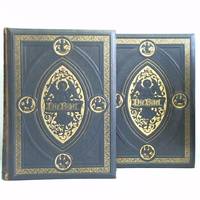
1894réf. 33189Wien; Leipzig: Verlag der Goldenen Klassiker-Bibel Max Herzig 1894. First edition thus. Hardcover. g. Folio. 76 1080 columns 38 540pp 708 columns 354pp 127pp plates. Splendid blind and gilt-stamped crushed full morocco with gold lettering and decoration on front covers and spines. Beveled edges. Raised bands. All edges gilt. Decorative endpapers. Double ribbon marker in each volume. Title pages in red and black lettering. Text in two columns within double red and black ruled box. This remarkable edition of The Old and New Testaments is magnificently illustrated with 127 captioned chromolithographs after classical and modern paintings by the most renowned German Italian Spanish Dutch and French artists such as Ridinger C. W. E. Dietrich Luca Giordano Andrea Appiani Giorgio Barbarelli Ferdinand Boll Philippe de Champagne Nicolas Poussin Alessandro Turchi Jean Germain Drouet Carlo Dolci Rafael Santi Paolo Veronese Francesco Barbieri Leonardo da Vinci Michelangelo etc. Each plate is protected with a tissue-guard. Paper size 14 1/2 x 11 inches; image size varies ca 11 x 8 1/4 inches. Spine of first volume slightly discolored. Spine and front cover of second volume partly discolored. Bottom edge of the first six leafs first volume and of the first four leafs second volume partly damaged by silverfish not affecting pages throughout. Text in German gothic script. Bindings in overall good interior in good to very good condition. Verlag der Goldenen Klassiker-Bibel Max Herzig hardcover
1891réf. 160797Regensburg, New York & Cincinnati: Druck und Verlag von Friedrich Pustet 1891. XLVIII, 1340; 1341 Seiten. Frakturdruck. Lateinisch-deutscher Paralleltext in zweispaltigem Druck. Gr. 8° (22,5-25 cm). Orig.-Halblederbände mit goldgeprägten Rückentiteln und Lesebändchen. [Hardcover / fest gebunden].
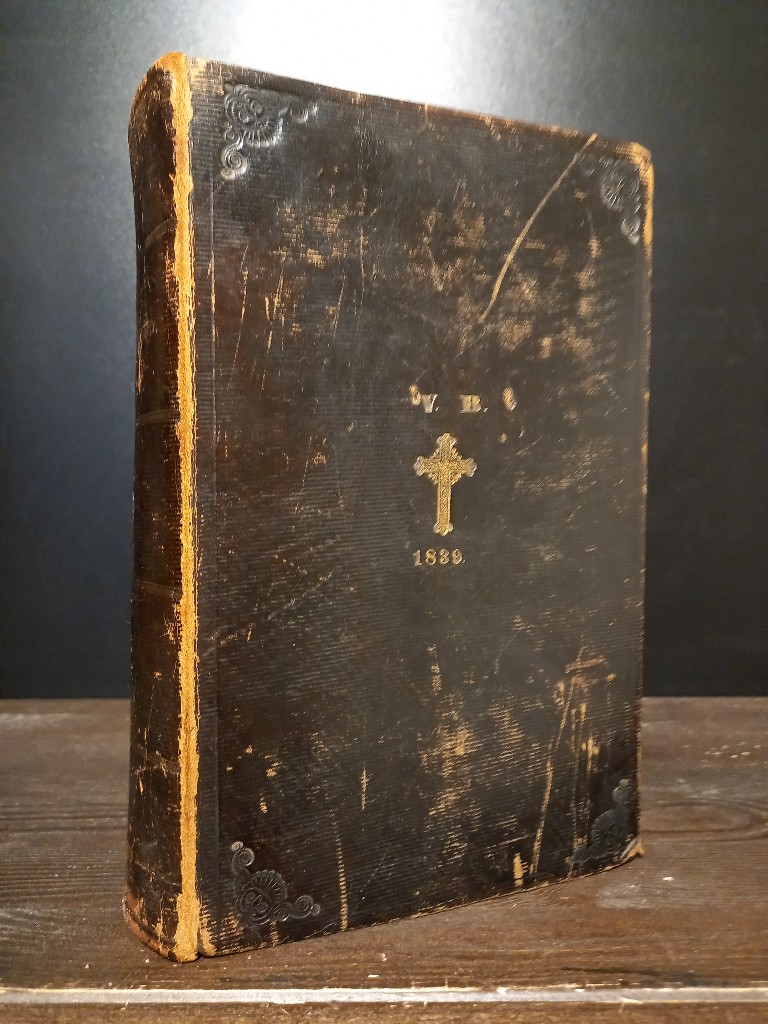
1838réf. 2142814Landshut: Johann Palm'sche Verlagsbuchhandlung / Wien: Mösle und Braumüller 1838. 536, 771 Seiten. Frakturdruck. Mit einem Frontispiz, gestochen und gedruckt von Carl Meyer in Nürnberg. Gr. 8° (22,5-25 cm) Lederband der Zeit mit Gold- und Blindprägung auf Deckel und Rücken (Titel, Kreuz, Initialen "V.B." und Jahreszahl "1839) auf dem Deckel sowie gelbgefärbten Schnitten. [Hardcover / fest gebunden].
1870réf. 2082497Regensburg: G. J. Manz 1867-1870. XLII, (2), 560; XVI, 557, XII, 243; XLVIII, 1215, (1) Seiten. Frakturdruck. Zweispaltendruck mit kritischem Apparat. Gr. 8° (23,5 x 15,5 cm). Halblederbände der Zeit mit Buntpapierbezügen, goldgeprägten Rückentiteln und marmorierten Schnitten. [Hardcover / fest gebunden].
1818réf. 3702Sulzbach [Regenkreise Baierns], Seidel Kunst- und Buchhandlung, 1818. Halbledereinband mit marmoriertem Deckel, blauer Farbschnitt, 8°, XLVIII, 462 S., 1 Blatt Anzeigen; -festes und sauberes Exemplar.
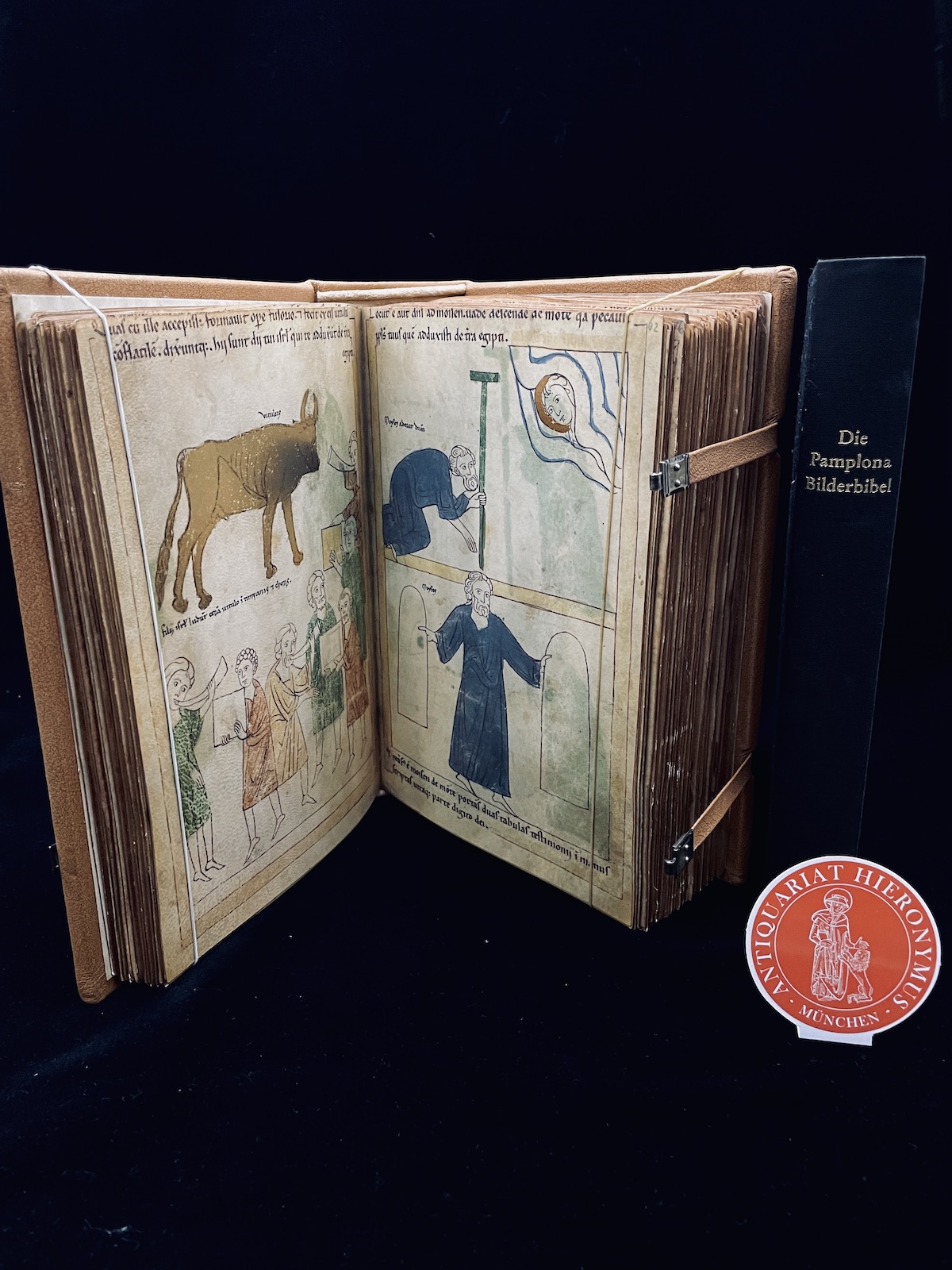
2005réf. 12952Simbach am Inn / Reinbek-Berlin, Müller & Schindler / Coron bei Kindler Verlag, 2005. "Gr.-8° (22,5-25 cm). 273 num. Bll. (Faksimile); 336 S. (Kommentarband)." "Blindgeprägtes Ganzleder über vier falschen Bünden mit zwei Schließen (Faksimile); OLeinwand mit vergoldetem Rückentitel und montierter Deckelillustration (Kommentarband)" [3 Warenabbildungen]
réf. 0282553975.Gpaperback. Good. Access codes and supplements are not guaranteed with used items. May be an ex-library book. paperback
2009réf. 1-1935302035Tan Books & Pub 2009. Leather Bound. New. lea edition. 1408 pages. 9.00x6.00x1.50 inches. Tan Books & Pub hardcover
2009réf. 1-1935302027Tan Books & Pub 2009. Imitation Leather. New. 1408 pages. 8.80x6.00x1.50 inches. Tan Books & Pub hardcover
2009réf. __1935302027Tan Books & Pub 2009. Imitation Leather. New. 1408 pages. 8.80x6.00x1.50 inches. Tan Books & Pub hardcover
réf. 124923England c.1260-1275. . 579ll on very thin parchment; early foliation in roman numerals with errors top outer corner recto supplemented by modern foliation in pencil; horizontal catchword centre lower margin in quire 2 traces in quires 12 16 18 19 quires signed at the beginning very bottom inside corner in an Arabic numeral many trimmed presumably by the 19th-century binder ruled in lead sometimes with the top two middle two and bottom two horizontal lines full across full-length vertical bounding lines inside outside and between the columns and with an extra set of double rules at the top and bottom of the page justification 94-90 x 68-64 mm. Written by many scribes below the top line in very small formal gothic bookhands in two columns ff. 546-575v the Interpretation of Hebrew Names in three columns of 49-45 lines majuscules within the text stroked with red red and blue running titles and chapter numbers occasional red rubrics often blank spaces for the rubrics remain one-line alternately red and blue initials chapters begin with two-line with extensions up to fifteen lines alternately red and blue initials with pen decoration in the other colour approximately sixty-eight 6- to 25-line parted red and blue initials with red and/or blue pen work parted initials on f. i and iv verso opening prologue and Genesis extend the full-length of the page. With ten illuminated initials 7-lines high pink or mauve with white highlights infilled with pink and blue rinceaux some terminating with animal heads on highly polished gold grounds or on contrasting grounds of dark blue or pink heavily edged in black overall in very good condition f. 1 darkened and repaired in the inner margin f. 32 modern repair with slight loss of text f. 490 erasure with some damage to a few lines of text ff. 539-545 damage from damp top outer corner f. 544 top outer corner repaired with loss of text generous margins but trimmed some loss at the edges of the added text on ff. 544-545 the ink on some pages has faded or been abraded. Bound in early 19th-century red roan spine elaborately tooled in gilt and lettered 'Biblia/Sacra/M.S.S' expertly rebacked with old spine laid down boards with a single gilt rule speckled edges with yellow glazed endpapers lower board and edges lightly scuffed; a very handsome binding with 20th-century slipcase with paper label to spine lettered in ink and matching chemise. Dimensions 153 x 105 mm. Small portable Bibles containing the complete Old and New Testaments were one of the greatest achievements of 13th-century book production transforming the use and ownership of the Bible. This English example was copied by numerous scribes and decorated in a number of styles. The ten handsome illuminated initials decorate the Minor Prophets an unusual choice. Textual evidence links it to both the Dominicans and Franciscans. Notable here are the numerous additions that show how this was used including the contemporary table of introits and Mass lections and numerous marginal notes from the thirteenth to the fifteenth centuries. The first portable Bibles may have been copied in Paris at the end of the 1220s or early 1230s. Many of them were products of the commercial booksellers of Paris. English examples of this type of Bible however appear at almost the same time and 13th-century England was an important centre for the production of Bibles although in smaller numbers than France. However the text of English 13th-century Bibles is often quite distinct from contemporary Bibles from Paris. Centralised production in Paris resulted in numerous Bibles that share the same text the text modern scholars call the Paris Bible. In England a much more diffuse production meant that there is a much greater variety in the text of the Bibles; there is no 'typical' English text. The Psalms have been omitted here. This is fairly common in 13th-century Bibles and possibly more common in England than elsewhere. This Bible does show some influence of the Paris Bible. In particular the biblical books are arranged according to the 'new' Paris order the same order used today with the Gospels followed by the Pauline Epistles rather than by Acts and the books are divided according to the modern chapters although as noted above with many variations including some that Paul Saenger has identified as English Saenger 2013 and it includes the Interpretation of Hebrew Names. The many different scribes who copied this book and the variety of different styles found in the pen decoration are certainly of great interest. There are many intriguing bits of evidence that tell us how this Bible was put together. The rubricator for example made fairly frequent errors confusing prologues and biblical books and in one case inserting the wrong running title calling the book usually known as 2 Ezra in 13th-century Bibles and 3 Ezra by modern scholars Stegmüller 941 'Osee' i.e. the minor prophet Hosea. A corrector changed it to 'iosias' not the usual name for this book although it does begin 'Et fecit iosias ' The foliation in Roman numerals is also noteworthy most books in the Middle Ages do not include page or folio numbers with numerous mistakes in the series including large gaps despite the text being complete. Ten biblical books begin with finely executed illuminated initials by a well-trained but provincial or idiosyncratic artist freely interpreting more mainstream initials from commercial centres such as Oxford or Paris; most of the initials are pink or a distinctive mauve shade with white highlights infilled with tightly curled vine scrolls that terminate in simple leaves or animal-heads on contrasting grounds or on highly polished gold all heavily edged in black. The 'I' on f. 397v extends 30-lines and is infilled with a distinctive geometric lattice-pattern. The evidence of the script and decorations supports an origin in the second half of the thirteenth century probably c.1260-1275. It was used very early in its history in England and many small details fit best with an origin in England including the lack of a Psalter the Interpretation of Hebrew Names copied in three columns variations in the beginnings of some of the chapters Saenger 2013 p. 60 n. 104 and the quire structure especially the quires of sixteen and twenty leaves Ruzzier 2013 p. 116. None of these details by themselves would be an argument for an English origin but together they are highly suggestive. Moreover the main style of the penwork decoration although unusually exuberant and perhaps idiosyncratic and the style of the illuminated initials also suggest England. Evidence of the script however is more difficult to interpret. There are numerous hands in the volume and the rounded bookhands used by some of the scribes suggest they may have been from Southern France. It is worth remembering that Aquitaine was English throughout the thirteenth century. A full description with further information on the text and the provenance with a full bibliography is available on request. Branner Manuscript Painting in Paris during the Reign of St. Louis 1977; Burke Heraldic Register 1850 p. 83; De Hamel The Book. A History of the Bible 2001 chapter 5 'Portable Bibles of the Thirteenth Century'; Light The Bible and the Individual: The Thirteenth-Century Paris Bible. England, c.1260-1275]. hardcover
1966Old English poem. viii, 55 pages. Bibliography and Glossary. Slight foxing on covers.
1984réf. 3029987Freiburg, Herder 1984. 118 Seiten, Gr. 8° (25 x 16 cm), Orig.-Pappeinband.
1988réf. 3029988Freiburg, Herder 1988. 100 Seiten, Gr. 8° (25 x 16 cm), Orig.-Pappeinband.
1885réf. 9980Regensburg, Verlag G. J. Manz, 1885. 4°, 559 S., 554 S., 800 S., Die heiligen Schriften des alten und neuen Testaments nach der Vulgata. Zweiter, vierter, fünfter Band. ?bis Porphetie Isaias. Rücken an einem Band angerissen, Gelenke gelockert u.z.Tl. geplatzt, Einbände stark berieben und stark bestoßen, Flecken a. Schnitt, altersbedingte Bräunungen, gr. Fleck am Schnitt von Band 4, Gebr.sp., Halbleder