Antiquariat.de
784 resultados
1922ref. 13730ABBerlin, Brandus, 1922. 35,5 : 26 cm.
1928Very Good Turkish, Ottoman (1500-1928) Original manuscript autograph ijazatnama [i.e. License, or diploma for assent] signed by Ali Haydar Gürbüzler written for famous Turkish mevlevi poet Aasf Halet Çelebi, (1907-1958). 18x11,5 cm. In Ottoman script (Turkish with Arabic letters). 8 lines. It starts with "Huve". Dated November 20, 1928. A short qasida on verso signed by 'Mustafa'. Ali Haydar Gürbüzler, known as Ahiskali Ali Haydar Efendi [i.e. Ali Haydar Efendi of Meshketia], the Turkish lawyer, lecturer, professor, clergyman, the mystic is also the last sheikh of the Ismet Efendi Lodge located in the district of Çarsamba, Fatih, in Istanbul. Asaf Halet Çelebi [or, Asef], (1907-1958), was a Turkish mystical poet. Although not very widely known, due to his erudite and often foreign-influenced style, he is considered to be Turkey's first surrealist poet. In his youth Çelebi was still influenced by Ottoman court literature, but starting from 1937 he adopted Western poetic styles and techniques, such as free-form verse. In his poems one finds themes originating in the cultures of Persia and India. As a librarian, Çelebi had a lot of time and opportunity to read, and his readings stood at the base of his poetic work. An often recurring theme of his poems is philosophical ideas which he found, for instance, in Buddhism. From there he took names and terms with vast philosophical connotations, such as Siddhartha and Mara, which, for the non-initiated, created an obstacle in understanding his work, although he did provide explanations in his prose. "Edîb-i Rusen-zamir Asaf Halet bey efendi oglumuza, haz-i viran (?) imtihan(?)-i hayat ve mehatira(?) Mazhar-i ihtiram olduklari daima görülmelidir ki herkes sevke gelsin de onlarin ? olmaga çalissin. Saban (?) Asef Halet bey oglumuzun anane-i(?) ilm u feng(?), Siir ve edebiyat ve musikiye intisabini gördügümde kendisinin feyz ve kemalatinin azadiyatini (?) cenab-i feyyaz görmeden tezrii'(?) ve niyaz ile bu mahalli imza eylerim, fi 7 cemaziyelevvel? Sene 1347 - fi 20 tesrin-i sani sene 1928. El fakir el-hakir'ül-ibad Haydar [i.e. Naqshbandiyya shaykh -Hâlidî shaykh Haydar Efendi of Meshketia -Ahiskali Haydar Efendi)].".
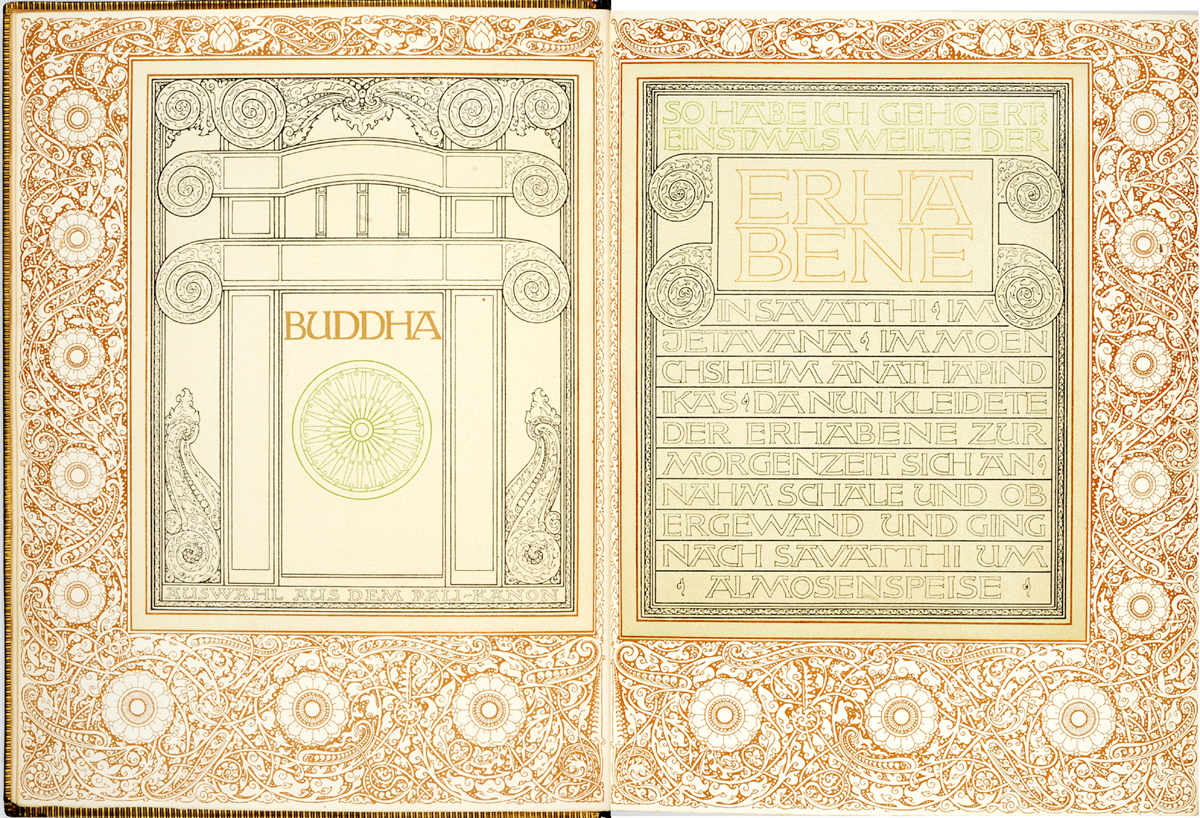
1922ref. 60558Berlin, Brandus 1922. 263 S. 4to. OGanz-Pgt. mit Goldprägung und Goldschnitt.
Eines von 225 Exemplaren auf Zanders-Bütten. Hier in der Vorzugsausstattung in Ganzpergament. Die gesamte buchkünstlerische Gestaltung wurde von Marcus Behmer entworfen. Wie ein Füllhorn der Gnade schüttet er seine reiche Buchdekoration über dieses Werk aus, das damit zur schönsten modernen "Buddha-Ausgabe" des 20. Jahrhunderts wird. Die Pali-Überlieferung gehört zum ältesten Schriftgut des Buddhismus, es handelt sich um eine Sammlung von Dialogen und Lehrvorträgen Buddhas. Die Übertragung besorgte Paul Dahlke, der Erbauer des buddhistischen Tempels in Berlin-Frohnau. Tadelloses Exemplar. - Schauer Bd. II,44.
ref. 012767[Bouddhisme, Bouddha] Michel-Jean-François Ozeray, Recherches sur Buddou ou Bouddou instituteur religieux de l'Asie orientale. Paris, Brunot-Labbe [imprimerie de Feugueray], 1817. In-8, XXXV-[1]-137-[2]p. Edition originale TRES rare du premier ouvrage occidental sur le Bouddhisme. Il fut publié trois ans après la création de la première chaire d'études chinoises en Occident, au collège de France, dont Jean-Pierre Abel-Rémusat (1788-1832) fut le premier titulaire. Il est d'ailleurs considéré comme un des fondateurs de la sinologie. Cet ouvrage est donc le premier à s'intéresser de manière sérieuse au Bouddhisme. Il fut par de nombreuses personnalités de l'époque dont évidemment Abel-Rémusat mais aussi le philosophe Arthur Schopenhauer ou l'important orientaliste prussien Julius Klaproth. Cet ouvrage est donc capital dans le développement de la connaissance du Bouddhisme en Occident. Cartonnage bradel papier fin XIXe, reliure sur brochure, non rogné. Quelques taches, quelques feuillets avec mouillure marginale (avant la reliure actuelle). Il manque le faux-titre. Très rare ouvrage.
ref. 015366[Bouddhisme, Bouddha] Michel-Jean-François Ozeray, Recherches sur Buddou ou Bouddou instituteur religieux de l'Asie orientale. Paris, Brunot-Labbe [imprimerie de Feugueray], 1817. In-8, XXXV-[1]-137-[2]p. Edition originale très rare du premier ouvrage occidental sur le Bouddhisme. Il fut publié trois ans après la création de la première chaire d'études chinoises en Occident, au collège de France, dont Jean-Pierre Abel-Rémusat (1788-1832) fut le premier titulaire. Il est d'ailleurs considéré comme un des fondateurs de la sinologie. Cet ouvrage est donc le premier à s'intéresser de manière sérieuse au Bouddhisme. Il fut lu wxpar de nombreuses personnalités de l'époque dont évidemment Abel-Rémusat mais aussi le philosophe Arthur Schopenhauer ou l'important orientaliste prussien Julius Klaproth. Cet ouvrage est donc capital dans le développement de la connaissance du Bouddhisme en Occident. Demi-basane légèrement postérieure, dos lisse orné. Mors frottés et fendillés, coiffe supérieure arasée, papier des plats usés. Petite mouillure claire sur une dizaine de feuillets à la fin. Très rare ouvrage
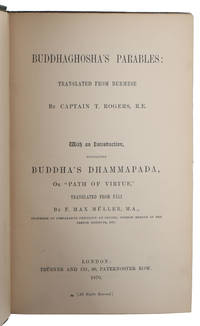
1870ref. 63105London, 1870. 8vo. Original green full cloth with gilt lettering to spine and gilt illustration of Buddha to front board. Spine a little darkened and wear to capitals. Inner front hinge open and partly cracked, but still honlding. Inner back hinge weak. Unopened and internally very nice, clean, and fresh. With the large book plate of Ernest Ridley Debenham to inside of front board and ex Libris of Societatis Divinae Sapientiae to front free end-paper, along with old owner's signature. CLXXII, (206), 24 (advertisements) pp.
1870ref. 63105London 1870. 8vo. Original green full cloth with gilt lettering to spine and gilt illustration of Buddha to front board. Spine a little darkened and wear to capitals. Inner front hinge open and partly cracked but still honlding. Inner back hinge weak. Unopened and internally very nice clean and fresh. With the large book plate of Ernest Ridley Debenham to inside of front board and ex Libris of Societatis Divinae Sapientiae to front free end-paper along with old owner's signature. CLXXII 206 24 advertisements pp. Scarce first edition of the highly influential first English translation of the Dhammapada along with Buddhaghosha’s Parables. Excerpts of the Dhammapada had appeared in English in the periodical The Friend printed in Colombo Sri Lanka but a full English translation which is based upon Fausböll’s version from 1855 being the first European edition of a complete Pali-text as well as the first Latin translation of the Dhammapada only appeared in 1870. Today the Dhammapada is probably the most frequently translated Buddhist text in the world. The Dhammapada the extremely influential collection of sayings of the Buddha in verse form constitutes one of the most widely read and best known Buddhist scriptures. The original version of the Dhammapada is in the Khuddaka Nikaya a division of the Pali Canon of Theravada Buddhism. Each saying recorded in the collection was made on a different occasion in response to a unique situation that had arisen in the life of the Buddha and his monastic community. “The Dhammapada is the best known and most widely esteemed text in the Pali Tipitaka the sacred scriptures of Theravada Buddhism. The work is included in the Khuddaka Nikaya "Minor Collection" of the Sutta Pitaka but its popularity has raised it far above the single niche it occupies in the scriptures to the ranks of a world religious classic. Composed in the ancient Pali language this slim anthology of verses constitutes a perfect compendium of the Buddha's teaching comprising between its covers all the essential principles elaborated at length in the forty-odd volumes of the Pali canon.” The Dhammapada. The Buddha's Path of Wisdom. Translated from the Pali by Acharya Buddharakkhita with an Introduction by Bhikkhu Bodhi 1996. Buddhist tradition has it that shortly after the passing away of the Lord Buddha five hundred of his disciples met in council at Rajagaha in order to recall the truths they had received from their spiritual teacher during the previous forty-five years. They wanted these truths about moral and spiritual conduct to live on forever and for Buddha’s message to be available for all future disciples. The followers and Arhat felt the responsibility to convey the teaching and discipline of the Buddhist order as faithfully and truly as possible and having no written texts to rely on they prepared the many discourses for recitation with repetitions in various contexts so that they could be remembered. Like the verses of Homer and other ancient works that were only written down later. “At that time according to the Sinhalese the Dhammapada was orally assembled from the sayings of Gautama given on some three hundred different occasions. Put in verse form the couplets contrast the vanity of hypocrisy false pride heedlessness and selfish desire with the virtues of truthfulness modesty vigilance and self-abnegation. The admonitions are age-old yet they strike home today their austerity of purpose fittingly relieved by gentle humor and earthy simile. Subsequently several renditions of the Dhammapada in the Sanskrit and Chinese languages came into circulation; likewise a number of stanzas are to be found almost verbatim in other texts of the canonical literature testifying to the esteem in which its content was anciently held. Since first collated the Dhammapada has become one of the best loved of Buddhist scriptures recited daily by millions of devotees who chant its verses in Pali or in their native dialect.” Bodhi 1996. “The Dhammapada an anthology of verses attributed to the Buddha has long been recognized as one of the masterpieces of early Buddhist literature. Only more recently have scholars realized that it is also one of the early masterpieces in the Indian tradition of kavya or belles lettres.” The Dhammapada. A Translation. translated from the Pali by Thanissaro Bhikkhu. Buddhaghosha's Parables is a collection of Buddhist stories and moral lessons compiled by the Indian scholar and monk Buddhaghosha in the 5th century CE. The present first English translation includes 50 parables that illustrate various aspects of Buddhist philosophy and ethics. The stories cover a wide range of topics from the importance of mindfulness and the dangers of attachment to the virtues of compassion and the nature of enlightenment. Each parable is accompanied by a commentary that explains its meaning and relevance to Buddhist practice. hardcover
ref. 108981 p.l. 38 folding leaves. 8vo 280 x 174 mm. orig. wrappers with cover wrappers old stitching. Thần Xá: An Thái French colonial period. An extremely rare woodcut book printed by nuns in a rural monastery in northern Vietnam. “An eponymous MahÄyÄna sutra that recounts the qualities vows and pure land of the buddha Bhaiṣajyaguru — the Master of Healing also known as the Medicine Buddha or the TathÄgata of Lapis-Lazuli Light. The scripture was most likely written in northern India during the early centuries of the Common Era. In this sutra Bhaiṣajyaguru vowed that his name if merely uttered would cure diseases free prisoners secure food and clothing for the impoverished and produce other similar benefits. He also vowed that his body would be as resplendent as lapis lazuli itself so that it might illuminate the world” Donald Lopez & Robert Buswell The Princeton Dictionary of Buddhism “Bhaiṣajyagurusūtra”. The Scripture of the Medicine Buddha T. 450 translated from Sanskrit into Chinese by Xuanzang 602–664 in the year 650 C.E. has been a popular text in East Asian and Tibetan Buddhist traditions. In our copy the sutra itself is bookended by a liturgical opening including the “Incense Praise” praises for the Buddha and a “sutra-opening gÄthÄ” and a final homage to the Medicine Buddha. According to the colophon bound at the beginning of the volume the scripture was printed for a specific occasion by three bhikkhuni or ordained Buddhist nuns affiliated with the An Thái temple 安泰寺 in the Thần Xá village 神èˆæ‘ of the An Lại commune 安賴社 in the Thanh Khê canton 清溪 Äại An district 大安縣 Nam Äịnh province å—å®šçœ of northern Vietnam. Only the names of two of them are fully legible: they are Quảng Thuận 廣順 and Quảng Thành 廣æˆ. They printed and disseminated this Scripture of the Medicine Buddha with a sincere mind when the statues of three of their masters were completed and placed into stupas. In their colophon they traced the lineage of themselves and their masters to the bhikkhuni An Dương Tháp 安陽塔 dharma name Nguồn Hạnh æºå¹¸ and pseudonym Minh Lâm 明ç³. Despite the country’s long history of Buddhist and Confucian learning woodblock-printed books published within Vietnam itself are far fewer in number than their Chinese or Japanese counterparts. This scarcity is owed to the high cost of domestic production: according to the estimate of Kathlene Baldanza as late as the 19th century “the labor cost of printing in Vietnam was five to ten times higher than in China. Even ink and brushes were more expensive to produce in Vietnam.” Extensive international trade between northern Vietnam and southern China — where plentiful books were printed at very low costs — meant that “it was generally cheaper to purchase books from China than to buy them locally” “Publishing Book Culture and Reading Practices in Vietnam” Journal of Vietnamese Studies 13.3 2018 pp. 10–11. Beyond the limited cases of official and temple-based publishing Vietnamese publishers were pushed toward niche genres such as Sino-Vietnamese dictionaries ritual manuals or morality books. Regardless of genre woodblock-printed books from Vietnam are very difficult to find today outside a few major collections such as the Institute of Sino-Nôm Studies in Hanoi and l’École française d’Extrême-Orient in Paris. We will not focus on the humid climate of the country or the massive destruction of the nation’s cultural heritage during its long war of independence in the post World War II period. The catalogue of materials kept at the Institute of Sino-Nôm Studies mentions two copies VHv.1071 AC.116 of the Scripture of the Medicine Buddha printed in 1911 and it is unclear if those were printed with the same woodblocks as ours. We know for certain however that no material at the Institute of Sino-Nôm Studies gives the An Thái temple as the place of publication despite the large numbers of temples and monasteries listed. This copy being an example of Vietnamese women’s printing in a rural monastery is extremely rare. Fine copy. First leaf a little frayed and the outer wrappers are quite frayed. ⧠Li Guimin æŽè²´æ°‘ “Zaizhi yu bianyi: Yuenan hanchuan fojiao dianji de zhuanhua å†è£½èˆ‡è®Šç•°â€”—越å—漢傳佛教典ç±çš„轉化” Foguang xuebao 佛光學報 7 No. 1 2021: pp. 111–37. Yuenan Hannan wenxian ziliaoku 越å—漢喃文ç»è³‡æ–™åº« Academia Sinica. unknown