3337 resultados
1965Riproduzione in facsimile del prezioso codice redatto in lingua greca. Volume in copertina rigida con legatura in pelle, titolo impresso in oro al piatto e al dorso, sovraccoperta originale il tutto contenuto in un robusto cofanetto editoriale muto. A chiusura del volume, in apposita tasca, è conservato un agile manuale introduttivo in lingua italiana di 22 pagine. Opera in condizioni eccellenti; spedizione in 24 ore dalla conferma dell'ordine.
1759in 8°, (19x13) cm, rilegatura coeva in piena pergamena, titolo in oro su tassello al dorso; pp. (12), 656. L'opera è completa di tutte le tavole: una tavola all' antiporta; una vignetta incisa con stemma cardinalizio di G. Portacarrero in testa alla dedica; una grande carta geografica più volte ripiegata (... campagna di Roma) e 40 tavole ripiegate fuori testo che rappresentano tra l'altro vedute quali: "Roma, capitale dello Stato Pontificio"; "Palazzo... gran Curia di Monte Citorio"; "Piramide"; "Veduta della della fontana sul Monte Gianicolo"; "Veduta di Campo Vaccino"; "La città di Velletri"; "La città e il porto di Ostia"; "La città e il porto di Civitavecchia", ecc. Piccolo restauro al verso di una tavola. Esemplare ottimo, raro da trovarsi completo di tutte le tavole.
1732due tomi in quattro parti, cioé 4 volumi in-folio, pp. (24), CCLII, 210, (2); (10), CCLXX, (2), CCXXIV, XXXVI; (14), CLXXXVIII, 258, (4); (14), XCII, 332, (2). Legatura. coeva p. perg. rigida, tass. con tit. oro sui dorsi, tagli rossi. Medaglione di Papa Clemente XII inc. su ciascun titolo, alcune testatine e iniziali incise. Monumentale opera che raccoglie testi storici e documenti concernenti le delicate questioni tra lo Stato Pontificio e quello Sabaudo, i feudi di Asti e delle altre abbazie del Piemonte. Il primo tomo contiene la ''Informazione istorica delle differenze tra la Sede Apostolica e la Real Corte di Savoja'', il secondo le ''Riflessioni sopra la scrittura della Corte di Torino intorno ai fogli, che hanno il titolo di Progetto di accomodamento'' e il ''Discorso sopra la materia beneficiale...e finalmente altro Discorso intorno al giuramento de' Vescovi del Piemonte prestato al moderno Re di Sardegna'' (vedi ultima parte). I tomi terzo e quarto hanno maggior interesse per la storia del Piemonte, contenendo rispettivamente '' I Feudi ecclesiastici dell'Asteggiana'' e ''L'Abbadia di San Benigno, e suoi feudi'', entrambi corredati di centinaia i documenti; tra essi spiccano soprattutto quelli riguardanti le comunità del basso Canavese in quanto vittime di una sorta di persecuzione religiosa, e cioè i ''testimoniali di pubblica protesta delle Comunità di San Benigno, Flet, Lombardore, Montanaro, Feletto, ecc.'', che riportano le testimonianze di una miriade di persone rifugiatesi nelle abbazie per il timore di subire soprusi dei soldati sabaudi o di esser imprigionati. Grandiosa opera storica sul conflitto tra Vaticano e Savoia nel XVIII sec., di notevole pregio e rarità. Magnifico esemplare. Manno-Promis, vol. I, n.1490..
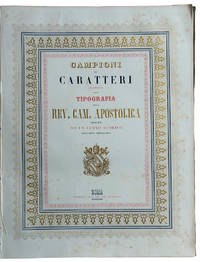
1853ref. LL 603TYPOGRAPHIC SPECIMENS OF THE VATICAN PRINTING HOUSE. Folio 342x255 mm; original cloth with title impressed in gold on upper cover; half-title leaf title-page leaf printed in blue red and gold within a triple border as well printed in blue red and gold a leaf with the advice to reader pp. VIII 62 plates and 4 plates containing many samples of fonts text printed in Italian Latin Greek Copic French also with sample of numbers music typographical borders tailpieces etc. last 4 plates: " Campioni dei tratti di penna" so calligraphic samples. Francesco Salviucci belonging to a well-known family of Roman typographers director of the Typography of the "Reverenda Camera Apostolica" describes a vast sample of the printing characters present in the typography preceded by a brief excursus on typographic art in general. In addition to the characters there are various friezes and engravings including the image of a steamship probably the first of the Papal State. Maggs cat. n. 509; Books on Printing Part II Books From Famous Presses 15th To 20th Century. Tipografia della Rev. Camera Apostolica hardcover
1715in-folio, ff. (8), 218, con complessive 93 tav., di cui svariate su doppio foglio, così numerate: 1-34, (1), 35-42, (1), 43-87; la tav. 41 è doppia e la 57 è quadrupla. Leg. coeva p. pelle, tit. oro e monogramma sormontato da corona, nello scomparto superiore del dorso a nervi. Vignetta allegorica inc. al titolo, iniziali silogr. istoriate. Terza edizione (la I è del 1696) aumentata di 7 tavole, di opera importantissima per la storia della costruzione della Basilica di S. Pietro, «classica per dottrina e per l'accuratezza d'esecuzione» (Cicognara), illustrata da bellle incisioni a piena e doppia pag., delle quali le 30 che offrono vedute, piante e rilievi architettonici sono del Bonanni stesso. Le altre sono opere di Frezza, Specchi, Westerhout, Alet, S. Bartoli etc. Bell'esemplare a grandi margini.. De Backer-Sommervogel II, p. 378, n. 6. Nè Olschki Choix, nè Ciocognara hanno questa III edizione. ..
1599Quattro pagine (un foglio in -4° ripiegato) contenenti tre lettere di Clemente VIII. Si dà il permesso a Francisco De Montilla, missionario francescano in Oriente di prendere delle reliquie dall’Italia per portarle nelle Filippine (dove Clemente, nel 1595, aveva elevato Manila a sede metropolitana). Ferrara era passata sotto il dominio dello Stato Pontificio a gennaio del 1598, cioè pochi mesi prima della redazione di queste lettere: per sottolineare l’importanza del recupero della città, Clemente prese possesso di persona della nuova provincia, dove avrebbe soggiornato fra il maggio e il novembre di quell’anno. La richiesta dell’altare, argomento della prima di queste tre lettere, proveniva da Antonio de Cordoba y Cardona, ambasciatore spagnolo a Manila: da notare che la Spagna decidette, nella questione della successione ferrarese, di mantenersi neutrale. Four pages (a folded leaf in -4°) including three Clemente VIII’s letters. Permission is given to Francisco de Montilla, a Franciscan missionary in Far East, to take holy relics from Italy, to be bringed in the Philippine (were Clemente, in 1595, raised Manila to metropolitan seat). Ferrara become under the Vatican dominion on january 1598, a few months before these letters were written. To underline the importance of having recovered this city, Clemente went himself to the city, where he stayed between may and november of that year. The request of an altair, subject of the first letter, had been done by Antonio de Cordoba y Cardona, performative Spanish ambassador in Manila: it has to be noticede that Spain remained neutral in the Ferrara question.
1853ref. 3438Roma, Presso Tommaso, 1853 grand in-4 (43,2 x 32 cm), demi-chagrin gris (reliure du dix-neuvième siècle). Album contenant dix planches gravées sur cuivre soit en tout 145 costumes (légendés) religieux et militaires en coloris d'époque, attribués à Filippo Ferrari, représentant le Trône Pontifical et le Sacré Collège à l'époque du Pape Pie IX.
1792ref. 3602Rome:: Presso Lazzarini 1792. FIRST EDITION. Octavo:. 15.5 x 10.8 cm. 4 216 pp. Collation: 2 a-m8 n12 the first leaf 1 is a blank and is present Printed on blue paper. In contemporary mottled calf the spine and boards tooled in gold. A very fine copy of the very rare first catalogue of the Museo Pio-Clementino - founded by Pope Clement XIV in 1771 and greatly expanded his successor by Pius VI- written for the use of visitors by the keeper of the museum Pasquale Massi of Cesena. Rare. The Museo Pio-Clementino was the first major curatorial museum within what are known today collectively as the Vatican Museums. In 1771 Pope Clement XIV had Michelangelo Simonetti adapt the Belvedere Pavilion to accommodate the papal collection of ancient art. When Clement’s successor the avid art collector Pius VI was elevated to the pontificate in 1775 the pace of acquisition increased dramatically and very soon the collections outgrew the rooms arranged for them by Simonetti. In 1776 Pius VI called for a radical restructuring of the existing museum and the construction of new grand spaces to house the ever-expanding collection. Massi’s catalogue a room-by-room guide of the museum with descriptions of all of the artifacts and artworks housed therein is an invaluable record of how the greatly expanded museum of antiquities looked in the late 18th century with its newly constructed series of rooms and the recently installed masterpieces of ancient sculpture -the fruits of some of the most important excavations in Italy including the excavation of Hadrian’s villa at Tivoli. In addition to providing a record of the arrangement of the exhibits Massi’s catalogue in which he provides details of provenance acquisition and attribution of each artwork described serves as a history of the museum’s formation and preserves valuable information about the art trade and the function of archaeology in the late 18th century. Massi has used a system of numbers and letters to indicate which works were added to the museums by Julius II and his various successors above all Clement XIV and the then-current pope Pius VI. In his introduction Massi tells us that he has designed his guide for portability and easy reference by tourists by arranging the descriptions of the objects in each room in the form of a walking itinerary. Since it is necessary at two points to retrace one’s steps Massi’s guide leads us along one side of each room as we proceed through the galleries. When it is time to reverse our course he leads us along the opposite side of the rooms already traversed thus keeping us engaged and entertained as we retrace our steps through the vast complex. Our tour begins at the new entrance to the museum in the corridor of Cleopatra also known as the corridor of the inscriptions just within the new entrance to the museum. We then pass through two vestibules. The first one is square with frescoes by Giovanni da Udine in the vault. In it we encounter the tomb of the Scipios and the Belvedere Torso. The second vestibule is round and in its center is a large bowl made of pavonazzetto. From here we proceed through a corridor into the porticoed octagonal courtyard of the Belvedere the site of Julius II’s first installation of ancient sculpture transformed by Simonetti in the 1770’s. Massi then leads us through the hall of the animals the gallery of statues the gallery of busts and the “loggia scoperta” the room of masks. We make our way back through these galleries to arrive at the series of rooms created by Simonetti in the 1780’s. The first of these is the hall of the muses. We then enter the breathtaking Sala Rotonda with its immense newly installed ancient porphyry basin from the Domus Aurea through which we make our way to the Sala of the Greek Cross where we find the newly installed ancient porphyry sarcophagus of Constantine’s daughter Constantia. From here Massi takes us via Simonetti’s new staircase up past the unfinished hall of the biga to Bramante’s vast gallery of the candelabra which is itself divided into numerous rooms with vases statuary and jewelry. Exiting by the stairs we visit the library and trace our way back through the new wing and via the Belvedere courtyard where we marvel at the Laocoön and the Belvedere Apollo to the cortile the great open court of he complex where our tour ends. Cicognara 3408. I have located 6 copies in the U.S.: Getty UC Riverside USC Cleveland NW Chicago Presso Lazzarini, unknown books
1792ref. 3602Rome: Presso Lazzarini 1792. FIRST EDITION. Hardcover. Fine. Printed on blue paper. In contemporary mottled calf the spine and boards tooled in gold. A very fine copy of the very rare first catalogue of the Museo Pio-Clementino - founded by Pope Clement XIV in 1771 and greatly expanded his successor by Pius VI- written for the use of visitors by the keeper of the museum Pasquale Massi of Cesena. Rare. The Museo Pio-Clementino was the first major curatorial museum within what are known today collectively as the Vatican Museums. In 1771 Pope Clement XIV had Michelangelo Simonetti adapt the Belvedere Pavilion to accommodate the papal collection of ancient art. When Clement's successor the avid art collector Pius VI was elevated to the pontificate in 1775 the pace of acquisition increased dramatically and very soon the collections outgrew the rooms arranged for them by Simonetti. In 1776 Pius VI called for a radical restructuring of the existing museum and the construction of new grand spaces to house the ever-expanding collection. Massi's catalogue a room-by-room guide of the museum with descriptions of all of the artifacts and artworks housed therein is an invaluable record of how the greatly expanded museum of antiquities looked in the late 18th century with its newly constructed series of rooms and the recently installed masterpieces of ancient sculpture -the fruits of some of the most important excavations in Italy including the excavation of Hadrian's villa at Tivoli. In addition to providing a record of the arrangement of the exhibits Massi's catalogue in which he provides details of provenance acquisition and attribution of each artwork described serves as a history of the museum's formation and preserves valuable information about the art trade and the function of archaeology in the late 18th century. Massi has used a system of numbers and letters to indicate which works were added to the museums by Julius II and his various successors above all Clement XIV and the then-current pope Pius VI. In his introduction Massi tells us that he has designed his guide for portability and easy reference by tourists by arranging the descriptions of the objects in each room in the form of a walking itinerary. Since it is necessary at two points to retrace one's steps Massi's guide leads us along one side of each room as we proceed through the galleries. When it is time to reverse our course he leads us along the opposite side of the rooms already traversed thus keeping us engaged and entertained as we retrace our steps through the vast complex. Our tour begins at the new entrance to the museum in the corridor of Cleopatra also known as the corridor of the inscriptions just within the new entrance to the museum. We then pass through two vestibules. The first one is square with frescoes by Giovanni da Udine in the vault. In it we encounter the tomb of the Scipios and the Belvedere Torso. The second vestibule is round and in its center is a large bowl made of pavonazzetto. From here we proceed through a corridor into the porticoed octagonal courtyard of the Belvedere the site of Julius II's first installation of ancient sculpture transformed by Simonetti in the 1770's. Massi then leads us through the hall of the animals the gallery of statues the gallery of busts and the "loggia scoperta" the room of masks. We make our way back through these galleries to arrive at the series of rooms created by Simonetti in the 1780's. The first of these is the hall of the muses. We then enter the breathtaking Sala Rotonda with its immense newly installed ancient porphyry basin from the Domus Aurea through which we make our way to the Sala of the Greek Cross where we find the newly installed ancient porphyry sarcophagus of Constantine's daughter Constantia. From here Massi takes us via Simonetti's new staircase up past the unfinished hall of the biga to Bramante's vast gallery of the candelabra which is itself divided into numerous rooms with vases statuary and jewelry. Exiting by the stairs we visit the library and trace our way back through the new wing and via the Belvedere courtyard where we marvel at the Laocoön and the Belvedere Apollo to the cortile the great open court of he complex where our tour ends. Presso Lazzarini hardcover
1694In 2°, (16) cc. (inclusi i due frontespizi), 489 (1) pp., (14) cc., doppio frontespizio in latino e italiano, entrambi con vignette tipografiche, con 79 tavole fuori testo, bianche al verso di cui 69 a piena pagina e 10 piu' volte ripiegate, legatura coeva in mezza pergamena e carta decorata con angoli.
1513In-8°; cc. (12). Edizione originale del poema di Giovanni Francesco Pico della Mirandola, una delle prime fonti sulla collezione di statuaria antica conservata al Giardino del Belvedere in Vaticano. Scritto nell’ultimo anno del pontificato di Giulio II (1503-1513), l’opera sottolinea la passione per le antichità classiche che con questo papa divenne una vera e propria moda nella Roma del tempo. Molti si domandarono se fosse idoneo consevare nel tempio della cristianità una collezione che esaltava anche le divinità pagane. Pico, seguace della corrente savonaroliana che denigrava la cultura rinascimentale del recupero e dell’imitazione dei classici romani e greci, si serve di quest’opera per stigmatizzare questa contrasto, proponendo nei suoi versi la Vergine Maria come contraltare alla Venere classica, presentando la collezione del vaticano come la manifestazione fisica della corruzione culturale e morale della Roma di Giulio II. Nella lettera a Francesco Giraldi, umanista ed erudito nativo di Ferrara, datata 1512, Pico offre una sorta di panoramica sulle statue collocate nel Belvedere: sono tra le prime parole che vengono spese sul posizionamento in quel luogo di quello che fu il simbolo della rinascita del classico, il gruppo del Laocoonte ritrovato presso la Domus Aurea nel 1506 e acquistato da Giulio II. Vengono anche citate la statua di Apollo e Cleopatra, e la grande immagine del Tevere. Giovanni Francesco Pico della Mirandola (1470-1533), nipote di Giovanni Pico, autore di una biografia su Savonarola, si fece portavoce di una difesa degli insegnamenti cristiani contro la nuova cultura nascente. Salvatore Settis, Sonia Maffei, Ludovico Rebaudo, Laocoonte, fama e stile: “La matrice antica del luogo, giardino delle Esperidi, luogo ideale per l’ozio filosofico, centro della nuova politica di Giulio II colpisce Giovanni Pico della Mirandola; è li che egli ambienta il De Venere et cupidine cogliendo la natura pagana del luogo: Laocoonte e le anticaglie solo identificate per veloci evocazioni, sono quasi come idoli chiamati ad animare il regno di Venere e della vana venustas”. The original edition of the poem by Pico della Mirandola, one of the first sources on the collection of ancient statues preserved in the Belvedere Vatican Garden. Written during the last year of pontificate by Julius II (1513), the work underlines the passion for classic antiquities that became, with this Pope, a fever in contemporary Rome. Many was wondering if it was suitable to put a heaten sculpture collection in Vatican. Pico, follower of Savonarola in blaming Renaissance culture of recovery and imitation of Roman empire, through this work means to criticize the moral and cultural corruption of Iulius II Rome, putting this collection as its physical manifestation, and in his verses he puts the Holy Mary to counterbalance the classic Venus. In his letter to Giraldi, Pico offers a bird’s eye view on statues put in Belvedere. These are between the first words spent about the putting in this place of a symbol of Classic rebirth: the Laocoon found in the Domus Aurea area and bought by the pope.
collana completa natura in posa-le storie di maria de medici di Rubens al Lussemburgo-il Caravaggio e le sue grandi opere da san luigi dei francesi-le pitture nere di Goya alla quinta del sordo-la camera degli sposi del Mantegna a Mantova-i teneri del carpaccio in san Giorgio degli schiaffoni-il greco di toledo e il duo espressionismo estremo-nos non il primo viaggio a Tahiti di Gauguin-la cappella sisitina in vaticano (1)-la cappella sistina in vaticano (2) Rizzoli editore rilegatura in tela con copertina in carta plastificata OPERA COMPLETA IN OTTIME CONDIZIONI