259 Ergebnisse
Best.-Nr. 2652Utrecht, Guilielmus, 1698. 10,5x17 cm. 1 frontispice gravé + Préface + 544 pages + Index. Reliure de l'époque en plein parchemin. Dos lisse portant le titre calligraphié à l'encre brune. Reliure en partie désolidarisée du corps de l'ouvrage, cependant cahiers bien cousus entre eux. Petites traces d'usage sur la reliure, sinon ouvrage propre et de présentation agréable.
1748First edition. Period boards. 8vo. 134 pages, 22 cm. In Hebrew. Title translates to Alshekh on the Torah. The Alshich (1508-1593) was born in the Ottoman Empire, and was the son of Hayyim Alshich. He is one of the few rabbis in Jewish history to receive the title of Hakadosh. He later moved to Safed where he became a student of Rabbi Joseph Caro. His students included Rabbi Hayim Vital and Rabbi Yom Tov Tzahalon. CD 000120874. SUBJECTS: Bible. Pentateuch -- Commentaries. OCLC lists 9 copies worldwide. Wear to boards. Pages are wavy but otherwise Good Condition. (HEB-48-50)
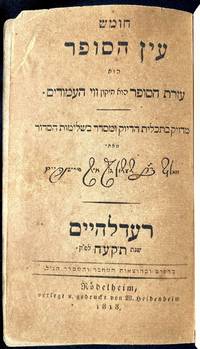
1821Best.-Nr. 43558Redelhaim Roedelheim: W. Heidenheim 1821. 1st edition. Modern Cloth with gilt spines and marbled endpapers 12mo 17 cm. 5 volumes: Bereshit: VIII pages 1 64 3 24 4 54 leaves; Shemot: 1 65-119 8. 28 78 leaves. Vayikra: 1 119-159 24 80 leaves. Bamidbar: 1 159-215 2 16; 50 leaves. Devarim: 1 216-166 18 52 leaves. The Pentateuch in Hebrew published over the course of 1818-1821. Haftarot with special title pages and separate pagination are appended to each volume. Each volume contains liturgy for Shabbat and other occasions. Chumash Ein HaSofer was published "to assist the scribe and 'tikkun vavei ha'amudin.'" Printed in a layout similar to a Torah scroll with thousands ! of mesorah markings in the margins of the pages a list of letters written especially large or small and letters with dots. Mesorah ta'amim grammar and general laws about Safrus handwriting sacred religious texts such as Torah scrolls. Each volume thus includes the appropriate section of the Chumash the Haftarot as well as many important laws for Sofrim. Ein HaSofer was the work of renowned grammarian Rabbi Wolf Heidenheim who worked for several years to prepare this work for publication At the end of each of the five chumashim haftarot appear after a separate title page as well as the Shabbat Shacharit and Mussaf prayers including Yotzrot Siluk and Ofanim for special Shabbats. Shabbat prayers appear at the end of the fifth volume the rest of the volumes have just the piyutim without the prayers. Rabbi Wolf Binyamin Heidenheim 1757-1832 was a German scholar and grammarian who published many important works. His publications which are renowned for their accuracy remain popular until today. In 1818 he undertook to publish the Chumash Ein HaSofer with the objective of providing Sofrim with an extremely accurate text upon which to base their writing of the holy texts. OCLC: 52775573 A set with repairs and damaged spines sold for over $530 at auction in 2022. Toning and foxing otherwise Very Good Condition. An attractive set in modern cloth bindings. BER-1-6. Redelhaim [Roedelheim]: W. Heidenheim unknown
1902Very Good Turkish, Ottoman (1500-1928) Full leather bdg. Cr. 8vo. (19 x 13 cm). In Karamanlidika (Ottoman Turkish with Greek letters). 104 p. Partly uncut. Ai Kuriakai tou Etous: Yani senenin her kiryakisinde okunan Evangelion'un izahati içün. Phylladion (Juz): 5. Prep. by Savvas Dimitriadis. [In Greek] Sundays of the year: [In Turkish with Greek alphabet] Exegesis of the Gospel which is read every Sunday of the year. Sermons delivered by the doctor E. Emmanuelidis. Printed and published with the approval of the Patriarchate Ecclesiastical Commission. [In Greek:] "Act reasonably and speak practically" (S. Isidore de Peluse). Publisher: Savvas Dimitriadis. Paper 5: Imprimerie du Patriarchat, March 1902. [Published] 12 fascicles, nos 1-12 (November 1901- October 1902). 56 to 128 pages per booklet, with serial number and indication of the month of the year at the bottom of each title page. Contents: P. 1: Title.; P. 2: Notice saying that the Greek translation of these "Homilies" is reserved to the author (E. Emanuelidis).; P. 3: Preface by S. Dimitriadis which explains the need for each Christian to devote Sunday to meditate "these fragrant flowers of the Holy Orthodoxy". By publishing from November 1901 under the title "Ai Kuriakai tou Etous", Emmanuel Emmanuel's sermons, he rendered his orthodox brothers an appreciable service. Procopi (Ürgüb), March 1, 1902.; Homilies. Fifth of Twelve. First and Only Edition. Balta (XX Siecle) 5.; Dallegio & Salaville IV, 337.
1915Very Good Turkish, Ottoman (1500-1928) Original decorative and illustrated cloth bdg. Demy 8vo. (21 x 14 cm). In Turkish with Greek alphabet - Karamanlidika. 116 p., 18 unnumbered b/w plates. Anin celil zuhuru. Mattheaios Incili yirmi dördüncü babin tefsiri. [TURKISH WITH GREEK ALPHABET - KARAMANLIDIKA]. The Karamanlides or simply Karamanlides are Greek-Orthodoxes, Turkish-speaking people native to the Karaman and Cappadocia regions of Anatolia. Today, a majority of the population lives within Greece, though there is a notable diaspora in Western Europe and North America. Karamanlides were Greek-Orthodox Christians in Central Anatolia who had spoken Turkish as their primary language. The term is geographical, derived from the 13th-century Beylik of Karaman. This was the first Turkish kingdom to use Turkish as its official language and originally the term would only refer to the inhabitants of the town of Karaman or from the region of Karaman. After the Christians in the area were exchanged with a Muslim population of Greece in 1923, the title became a label for local Muslim inhabitants. Historically, the Karamanlides spoke Karamanli Turkish. Its vocabulary drew overwhelmingly from Turkic words with many Greek loan words. The language should not be confused with Cappadocian Greek, which was spoken in the same region during the same timeframe but is derived from the Greek language. While the official Ottoman Turkish was written in the Arabic script, the Karamanlides used the Greek alphabet for writing its form of Turkish. (Source: Wikipedia). Karamanli Turkish had its own literary tradition and produced numerous published works in print in the 19th century, some of them published by Evangelinos Misailidis, by the Anatoli or Misailidis publishing house (Misailidis 1986, p. 134). First Edition. Extremely rare.
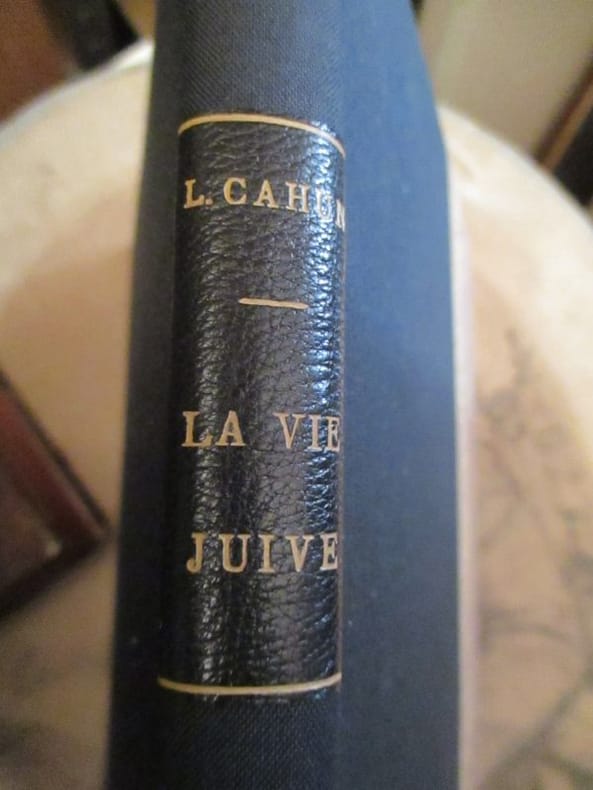
1886Best.-Nr. 71901886 Paris ED. Monnier, De Brunhoff et cie éditeur 1886 In4 format 32cmX22cm relié pleine toile bleue marine incrustée de bandes de toile beige et papier liège. reliure signée Armelle Guégant 114 pages nombreuses illustrations in et hors texte.
1703Best.-Nr. PHO-1998Ienae : sumptibus Bielckianis, 1703, in-4 (19,5x16cm), 10ff.-96pp., demi toile postérieure, titre au dos, titre renforcé, rousseur, papier uniformément bruni, mouillure. Texte en hébreu et latin en regard, imprimé sur deux colonnes.
1924419 pages. Index. Footnotes. Frontis portrait of Adam Weishaupt. "I have felt impelled to devote one more book to the Revolution as a whole by going this time further back into the past and attempting to trace its origins from the first century of the Christian era. For it is only by taking a general survey of the movement that it is possible to understand the causes of any particular phase of its existence. The French Revolution did not arise merely out of conditions or ideas peculiar to the eighteenth century, nor the Bolshevist Revolution out of political and social conditions in Russia on the teaching of Karl Marx. Both these explosions were produced by forces which, making use of popular suffering and discontent, had long been gathering strength for an onslaught not only on Christianity, but on all social and moral order." - Preface. Bookplate upon front free endpaper. Last two leaves of index loose but present. Back free endpaper missing. Front board loosely attached. Tiny bit of writing atop last blank page. Gilt lettering upon backstrip worn but legible. SINGERMAN 161, WEEMS p.71. Book
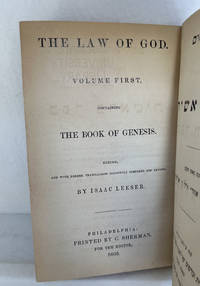
1845Best.-Nr. 42820862FIRST EDITION IN ENGLISH of the Pentateuch translated by a Jew and the first American translation of the Torah. Isaac Leeser was the single most influential Jewish figure in 19th-century America. His many accomplishments include establishing the vernacular sermon as a permanent feature in the American synagogue publishing the first successful American Jewish newspaper and founding the first American rabbinical school. "When Leeser commences his public career the scattered Jewish individuals and the members of the congregation in the United States did not number more than from 12000 to 15000. His purpose to mold these into a community was to be achieved in part by the pulpit and in part by the press. … Leeser participated in all Jewish movements. He was the earliest promoter of all the national enterprises—the first congregational union the first Hebrew day-schools the first Hebrew college the first Jewish publication society—and of numberless local undertakings. The 'Occident' acquired a national and even an international reputation; the Maimonides' College of which he was president paved the way for future Jewish colleges in the United States; and his translation of the Bible became an authorized version for the Jews of America" Jewish Encyclopedia. "Practically every form of Jewish activity which supports American Jewish life today as either established or envisaged by this one man" and "almost every kind of publication which is essential to Jewish survival was written translated or fostered by him" B. W. Korn. Leeser's greatest contribution was his translation of the Bible and these volumes contain the first printing of the first and most important portion of this monumental work Leeser's English translation of the Torah. This translation was not superseded until well into the 20th century. Emphasizing that this is an American work Leeser notes in the introduction that "I have to state that I have not looked at a single work issued by English Jews and that hence I have not borrowed a single idea or suggestion from any one of them living or dead." Five volumes. Hebrew and English text on facing pages. Finely bound in mottled calf spines gilt a.e.g. Title neatly restored several restored perforated and ink stamps. A very handsome set in a splendid binding. C. Sherman, 5605-6 hardcover