261 resultados
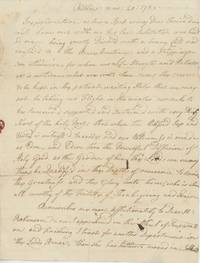
1789ref. List2987Philadelphia Pennsylvania 1789. Single three-page letter measuring 7 ¾ x 9 ¾ inches. Folded with large tears at folds; excellent. A letter from H. Cathrall in Philadelphia to her friend Amey Thurston dated October 20th 1789. The letter discusses her health and the health and lives of their mutual friends. She also describes her experience of hearing ministry at a women's Quaker meeting: "our yearly Solemnity was uncommonly large and much sisterly condescension was comfortingly evidencd; and thro the condescension of Isarels Israel's King and Shepherd we were made in some sittings reverently to rejoice in that the Lord in wondrous Mercy had not forgotten Sion 'nor yet in Anger cast off his People'~". Though Quaker worship meetings did not exclude women Philadelphia did have a women's monthly meeting as well; Haverford College holds its membership book for 1793 Cathrall does not appear in it but at least one other name mentioned in her letter does. Of interest to scholars of Philadelphia's long Quaker history especially the role of Quaker women. unknown
1787ref. 15881Philadelphia: Printed by Joseph Cruikshank 1787 First edition. Contemporary calf burgundy morocco spine label. Octavo. With alphabetical index. Bottom corners rubbed small chip at foot of spine some light browning. Contemporary ink inscription on front free endpaper. A very good copy. An interesting collection of short biographies of early American Quaker ministers. Over fifty of the people discussed are women. Printed by Joseph Cruikshank unknown
1765pp. lix, 679, (xxviii). Folio. Engraved bookplate of: John Glaisyer, Chymist & Druggist, Brighton" Engraved armorial bookplate of Francis Frederick Fox. Contemporary full leather binding, joints cracked. A nice copy of an important and scarce Quaker work. George Fox (1624-1691), was the founder of the Society of Friends (Quakers). By nature serious and contemplative, at the age of 19 he entered upon a wandering quest for spiritual enlightenment. In 1646 he underwent a mystical experience that convinced him that Christianity was not an outward profession but an inner light by which Christ directly illumines the believing soul. Revelation was for Fox not confined to the Scriptures. In 1647 he began to preach. Although often the victim of mob brutality and eight times imprisoned between 1649 and 1675, Fox won many followers, especially among groups of separatists. In 1668 he prepared the first pattern of organization, which was for some years to serve as the discipline of the Society of Friends. The London Yearly Meeting was started in 1671. To confirm his followers in their beliefs and to spread the truths, Fox went in 1671 to the West Indies and to America, where he made arduous journeys to various colonies scattered between New England and North Carolina. Later he twice visited Holland. His sincerity, serenity, fearlessness, and powerful preaching are attested to by a number of his contemporaries. This Journal, with a preface by William Penn, was first published in 1694. An early owner of this book was Francis Frederick Fox (1832-1915) the 2nd son of Francis Ker Fox of Brislington House. He was an oil and colour merchant, President of the Grateful Society in 1869. Sadly, his wife Alice died in childbirth in 1870 and he was left a widower with six children. He was Master of the Society of Merchant Venturers in 1878 & 79 and Sheriff in 1894. He was a J.P. for Bristol and for Gloucestershire and an Alderman for the city from 1865. He wrote extensively on local history. Perhaps he was a descendant of the great Quaker George Fox. Smith p. 690; Sabin 25352. **PRICE JUST REDUCED! PA62
iv, [5]-186, [2]pp. 3 Works bound in one, 12mo (170 x 100 mm), cont. calf, gilt, a nice copy.
1806ref. 241081New York: Published by Samuel Stansbury Southwick and Hardcastle Printers 1806. First American edition same year as the London edition. Frontispiece Oval portrait by P. Maverick. 1 vols. 8vo. Contemporary American tree calf red morocco labels light scuffing to joints and extremities some browning spotting and offsetting of text but not offensive contemporary American bookplate of Cornell Munro; a handsome copy. First American edition same year as the London edition. Frontispiece Oval portrait by P. Maverick. 1 vols. 8vo. Sabin 13492 Published by Samuel Stansbury, Southwick and Hardcastle Printers unknown books
1768Les Quakers a leur frère V…. Lettres plus philosophiques… Un volume di 108 pagine. Legatura moderna in tela. L'opera è indirizzata a Voltaire, ed utilizza la visione dei Quakers degli Stati Uniti per combattere le idee illuministe e razionaliste di Voltaire. Che rispose a sua volta all'auore con una lettera. Non comune.
1828ref. 415545Richmond Indiana: no publisher 1828. Softcover. Very Good. First edition. Octavo. 26pp. Stitched self-wrappers. Age-toned light dampstain and creases at the edges of some of the leaves near very good. Quaker's report including sections of the care of Native Americans and freed Africans. no publisher] unknown
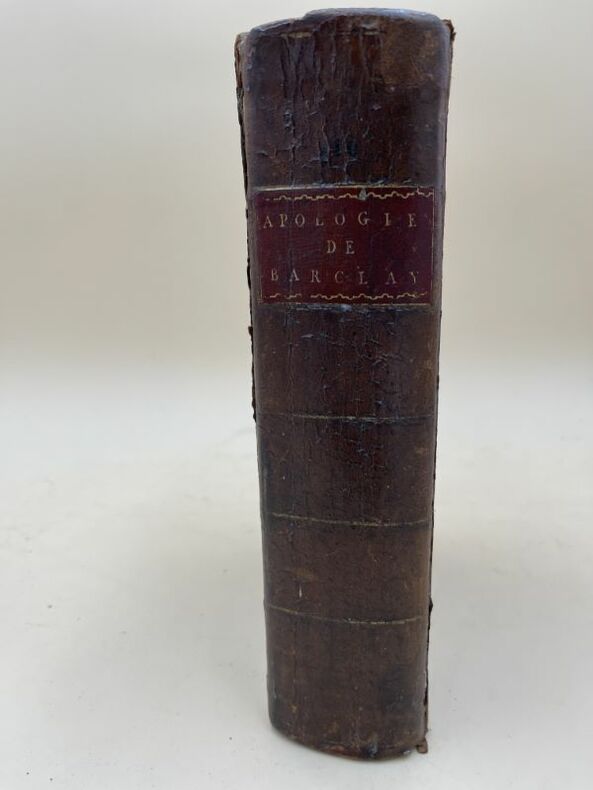
1797ref. 9994545Imprimerie Jaques Phillips Londres, Imprimerie Jaques Phillips et Fils, 1797. Fort In-8 relié pleine basane de l'époque, dos lisse, filets dorés, pièce de titre rouge. XXXII + 652 pages. Index des textes de l'Ecriture cités dans l'ouvrage, table des auteurs cités et table des choses principales. Quelques rousseurs et brunissures, reliure légèrement usagée sans gravité, mors fragile. Bon exemplaire malgré les défauts signalés. Ex-dono du temps "Témoignage d'amitié de Stéphane GRELLET, de NEW YORK dans la NOUVELLE ANGLETERRE". Un ouvrage essentiel sur le sujet qui eut un grand retentissement en son temps. Ecrit à l'origine en Latin et en Anglais, l'ouvrage fut traduit en Allemand, Hollandais, Espagnol et cette présente édition française traduite par E. P.BRIDEL...pour l'instruction des étrangers.
1797Londres, Imprimerie Jaques Phillips et Fils, 1797. Fort In-8 relié pleine basane de l'époque, dos lisse, filets dorés, pièce de titre rouge. XXXII + 652 pages. Index des textes de l'Ecriture cités dans l'ouvrage, table des auteurs cités et table des choses principales. Quelques rousseurs et brunissures, reliure légèrement usagée sans gravité, mors fragile. Bon exemplaire malgré les défauts signalés. Ex-dono du temps "Témoignage d'amitié de Stéphane GRELLET, de NEW YORK dans la NOUVELLE ANGLETERRE". Un ouvrage essentiel sur le sujet qui eut un grand retentissement en son temps. Ecrit à l'origine en Latin et en Anglais, l'ouvrage fut traduit en Allemand, Hollandais, Espagnol et cette présente édition française traduite par E. P.BRIDEL...pour l'instruction des étrangers.
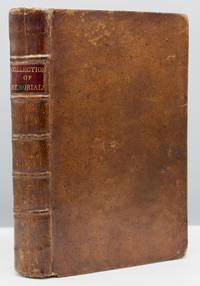
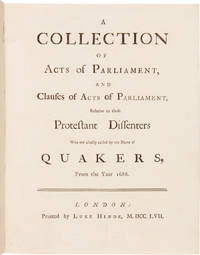
1757ref. WRCAM25203London: Printed by Luke Hinde 1757. 88489-96pp. Quarto. Contemporary reversed calf red leather label. A bit rubbed. Internally clean and crisp. Very good. This collection of statutes covers a very broad range both explicit restrictions on Quakers and many more subtle ones including acts for encouraging the growth of coffee in the American colonies and others relative to colonial finances e.g. "An Act for the more easy Recovery of Debts in his Majesty's Plantations and Colonies in America." in which Quakers are treated differently under the law. SABIN 14370. Printed by Luke Hinde hardcover books
1757ref. 25203London: Printed by Luke Hinde 1757. Significant Compilation of Quaker-Related Laws This collection of statutes covers a very broad range both explicit restrictions on Quakers and many more subtle ones including acts for encouraging the growth of coffee in the American colonies and others relative to colonial finances e.g. "An Act for the more easy Recovery of Debts in his Majesty's Plantations and Colonies in America." in which Quakers are treated differently under the law. Quarto. Contemporary reversed calf red leather label. A bit rubbed. Internally clean and crisp. Very good. SABIN 14370. hardcover
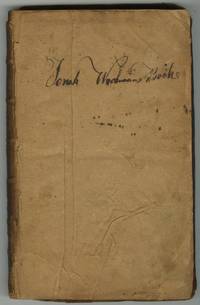
1779ref. BK0134Philadelphia: Joseph Crukshank 1779. 8vo contemporary calf 256 pp. With the ownership signatures of Jonah Woolman and Burr Woolman. Front board and preliminary page detached else good fair condition. A strong association copy of the first edition owned by Jonah Woolman 1733-1799 younger brother of the Quaker minister and abolitionist John Woolman and subsequently by Jonah's son Burr Woolman 1787-1844. Churchman and John Woolman were fellow ministers and worked together directly in the campaign against slaveholding among Friends. In his Journal Churchman records that in 1759 he and Woolman were engaged in "visiting some active members of our Society who held slaves" in Philadelphia and New Jersey; Woolman's own journal likewise records meeting Churchman by agreement in Philadelphia and spending much of a week visiting Friends who held enslaved people. The provenance connects Churchman's account to the immediate family of one of his collaborators in this work. Jonah Woolman was John Woolman's younger brother and Burr Woolman whose ownership signature also appears was Jonah's son. . Joseph Crukshank unknown
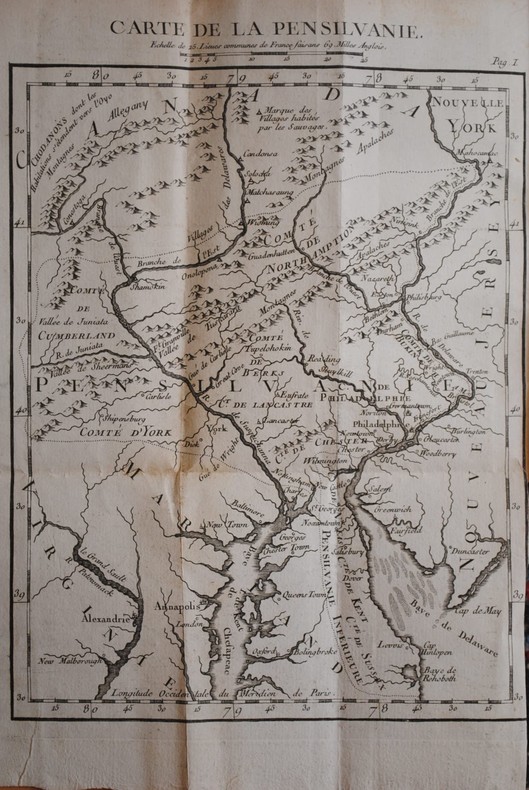
1768ref. 4A-8PARIS, GANEAU (DE L'IMPRIMERIE D' HOURY), 1768. IN-8° (185x115mm), XX - 372 - 2ff., 1 CARTE DÉPLIANTE, FAUX TITRE ET TITRE TACHÉS, PIQÛRES, TRÈS CLAIRE MOUILL. MARG. AU MILIEU DE L'EXEMPLAIRE. BROCHÉ, DOS SALI. UNIQUE ÉDITION DE CET OUVRAGE BASÉ SUR CELUI DU BOTANISTE PEHR KALM POUR L'HISTOIRE NATURELLE ET SUR LE VOYAGE DE GOTTLIEB MITTELBERGER POUR LA PARTIE CONSACRÉES AU QUAKERS. ILLUSTRÉ D'UNE CARTE DÉPLIANTE. UNIQUE FRENCH EDITION OF THIS DESCRIPTION OF PENNSYLVANIA BASED ON THE WORKS OF KALM AND MITTELBERGER. ILLUSTRATED WITH 1 FOLDING MAD. SEWED (FIRST LVS STAINED, FOXING).
First edition, ii,238pp., cont. calf, rebacked, rubbed. The first Quaker bibliography. "Hereby may be seen, not only what Books have been Printed of the Sufferings which many of the said People underwent, but also the many Warnings to the Governments and Rulers, &c. Concerned..." ? Advertisement of verso of title.
1725ref. 19572London: Printed and Sold by the Assigns of J. Sowle 1725. Second edition in English. Boards somewhat scratched; some light toning; a very good copy collated and complete. Folio contemporary calf neatly rebacked with the original spine laid down and a new red cloth label lettered in gilt corners neatly restored and endpapers renewed 12 699 1 16 4 pages. First published in Dutch in Amsterdam in 1717 and per the OUDNB translated by the Quaker historian and lexicographer Sewel himself into English but published posthumously in London in 1722. Smith vol. 2 page 561; Sabin 79603. Printed and Sold by the Assigns of J. Sowle, unknown books
1844ref. 20220422London: Edward Marsh 1844. First Edition. Hardcover. Fine. Octavo; 4 247 pages publisher's embossed black cloth newly rebacked in leather An excellent precis of the history of the treatment of the Indian tribes east of the Mississippi River. The 2 fine maps are the frontispiece 16x11 cm. of the territories several Indian nations occupied previously to the settlement of the English colonies in America. The large folding map 46x43 cm also in color shows the territory NOW occupied by the natives In addition to the areas east of the Mississippi River this volume republished the report of two Quakers John Lang & Samuel Taylor who traveled in 1842 west of the Mississippi visiting the Winnebago Shawnees Kickapoos Delawares Kansas Osages Cherokees and Choctaws. Sabin 86572; Phillips Maps of America p.604; see also Howes L72; not in Field; Graff 2386 2387; Hubach p. 95; Jones 1073; Rader 2199; Wagner-Camp-Becker 96; Streeter 1807; Eberstadt 137:332; Not in Siebert Catalogues . The map of North America depicts an independent Texas extending north nearly to the Oregon border and northwest to Russian America. Edward Marsh hardcover
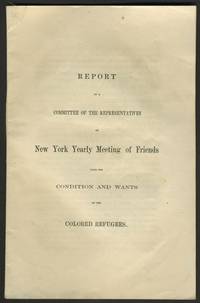
1862ref. 27695New York: The Religious Society of Friends 1862. First printing. Pamphlet. Very good condition. Three reports from the Quakers during the Civil War on their ministry amongst the "Colored Refugees" of Virginia & Washington DC reporting on the conditions and needs at Fort Monroe Camp Barker Craney Island Alexandria Hampton Norfolk etc. Conditions are tough in the refugee camps but none wish to return to where they have fled from. "Slaves have been abandoned and we must help. Don't we owe them for our prosperity--- enjoying indirectly from the unrequited labor of these people." Encyclopedia Virginia writes on their website- "In this report dated May 1864 the Committee on Colored Refugees who were representatives of the New York Yearly Meeting of Friends gives its assessment of the needs of the formerly enslaved people escaping behind Union lines and how Quaker charity efforts were meeting them in contraband camps across Virginia including Alexandria. One of their agents Harriet Jacobs wrote her own letter documenting what she saw in Alexandria and Washington D.C. For Quakers the abolition of slavery was a moral and religious imperative." Title continues: Address of the Representatives of New-York Yearly Meeting of Friends to Its Members.; Third Report of Committee of the Representatives of New York Yearly Meeting of Friends upon the Condition and Wants of the Colored Refugees 1862 Report OCLC: 21308787 8vo 30pp black title on cream paper wraps saddle stitched. Clean throughout. 1862 Address OCLC: 25519700 8vo 10pp. October 24th 1862. 1864 Third Report OCLC: 25113848 cites 9 copies; 8vo 23pp May 1864 slt. marked wrapper. All in their original self wrappers overall in very good condition. The Religious Society of Friends unknown
1822ref. 415530Richmond Ind: Elijah Lacey Printer 1822. Unbound. Very Good. First Indiana edition. Bifolia folded to make four pages. Old folds age-toning and small tears about very good. OCLC locates no physical copies. Elijah Lacey, Printer unknown
1725ref. 035981London: Assigns of J. Sowle 1725. Second Edition Corrected . Original Full Leather. Very Good. 12 7/8" Tall. X 699 Xvi Index 4 Pp Catalog At End. Original Simple Full Calf Five Bands Morocco Spine Label Yellow Endpapers. "Second Edition Corrected". Worn Fraying At Corners Front Hinge Patly Cracked Nicely Refurbished. Contents Clean Slight Wear Pp 123-126 Partly Detached. Original Signatures Of Joseph Pike On Front Pastedown Title Page 1 And Rear Endpaper; Pike D. 1729 Wrote "An Epistle To The National Meeting Of Friends In Dublin" One Of Three Important Early Treatises On Quaker Conduct The Other Two Written By Penn And Barclay. Additional Ownership Information Of The Quakers Sarah And Margaret Beale Myrtle Hill Terrace CorkAnd John And Fanny Edmondson Dublin 1860. An Exceptional Association Copy Of An Important History. Assigns of J. Sowle hardcover
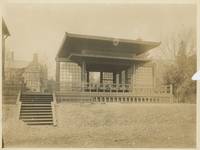
1910ref. List2847Bryn Mawr Pennsylvania; and others 1910. Eleven photographs approximately 7 x 9 ½ inch and smaller. With stamps for Brown Brothers Illustrations Bureau and E.J. Reily verso; most with captions verso. Most with chipping and wear at edges; overall good. Open-air schools became popular in the United States in the early 20th century in response to public health crises including tuberculosis.1 Conducting lessons in open-air classrooms reduced the transmission of diseases which allowed many children to attend school despite their often chronic illnesses. Offered here are eleven photographs of open-air schools three of which are identified as the Phebe Anna Thorne Model School at Bryn Mawr. The Phebe Anna Thorne Model School opened in 1913 under the direction of the College’s president Carey Thomas using funds donated by Samuel Thorne in memory of his sister Phebe Anna.2 The Thornes were an affluent New York Quaker family; Phebe Anna 1828–1909 was the only daughter to survive to adulthood and was a philanthropist and supporter of progressive social causes.3 The school was part of Bryn Mawr’s Department of Education which trained its students in teaching younger pupils rather than those of highschool or college age – the students in most of these photos are probably in about 4th or 5th grade.3 It also allowed testing of more cutting-edge pedagogical practices: the structure of the school was quite experimental including open-air classrooms outdoor naptime a flexible curriculum and less formal assessment. Of interest to scholars of the history of education especially experimental pedagogy. 1 Sherman C. Kingsley & F.B. Dresslar “Open-Air Schools” Department of the Interior Bureau of Education Bulletin 23 1916. 2 Cornelia Meigs What Makes a College A History of Bryn Mawr The MacMillan Company 1956. 3 Olive Floyd Phebe Anna Thorne: Quakeress Privately Printed in Rye New York 1958. unknown
1715ref. 21197London 1715. Broadsheet. 1p. plus printed docket title on verso. Dbd. Early folds and early stab holes in left margin. Moderate toning and foxing. Very good. Quakers seek relief on affirmation. In 1696 after experiencing decades of exclusion and imprisonment for conscientiously refusing to take loyalty and court oaths Quakers were granted the right by Parliament to take a "solemn affirmation" in legal situations in place of an actual oath. Over the next two decades numerous Quakers objected to the invocation of God's name in the official affirmation and refused it as they had the oath. In 1715 a bill was under consideration in Parliament to renew indefinitely the Quakers' right to the affirmation. The Quaker authors of the present petition support the bill but ask that it be amended with a revised affirmation that does not include the name of God. ESTC lists copies at four institutions: the British Library the Library of the Religious Society of Friends the National Library of Scotland and Oxford. Smith A Descriptive Catalogue of Friends' Books Vol. II p.265 listing its imprint at "about 1721". unknown
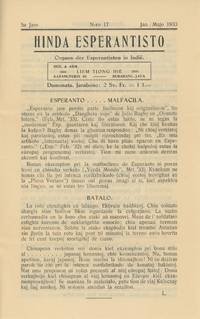
1947ref. List2844Austria; Java Indonesia; London England; and Los Angeles California 1947. Sixteen pieces: two "Friends' Esperanto Society" bulletins 8 x 12 ½ inch each; two letters 8 ½ x 11 inch each; seven "Hinda Esperantisto" pamphlets 5 ½ x 8 inch four pages each; two "Declaration" forms 4 x 6 inches; one BES pamphlet 4 ½ x 6 inches eight pages; one set of tickets for membership information 2 x 5 inches missing one tear-off ticket and one "Universala Ligo" membership card for 1947 3 x 4 ½ inches. Folded; some chipping and tearing at edges. Overall excellent to near fine. Esperanto is an artificial language created by Polish physician Ludwik Zamenhof 1859-1917 in 1887. Zamenhof intended Esperanto to be a universal second language; his experiences growing up Jewish in the Russian Empire among Russian Polish German and Yiddish speakers-all of whom regarded each other at best with suspicion-led him to believe that an easily-learned neutral second language could by contrast inspire unity between all people. Offered here is a small collection of materials related to various Esperanto societies: the "BES" a Czech group the Universal Esperanto Association the Friends' Esperanto Society the Esperanto Club of Los Angeles and Hinda Esperantisto - "Indian Esperantist" based in Java Indonesia. These materials written largely in Esperanto note that most quotes herein are translated are mostly typical club bulletins advertising events announcing members' news and reminding the reader of upcoming fees. The BES pamphlet besides advertising its Adresaro member directory solicits donations for a "living monument to Esperanto"-a headquarters-to be built in Potštejn in Czechia "in the shape of a five-pointed star which would become a real home for all those who love goodness beauty health truth and progress. The stone-like majestic white building will shine brightly in a beautiful circle from a moderate slope and the fragrant forest behind it will form a charming background." 1932 This utopian vision was likely prevented at least in part by the Nazi occupation of the country. Esperanto speakers including Zamenhof's family in particular were among their many targets. The effort to purge the universal language from Europe was clearly not successful; a postwar letter from a language teacher in Austria to a gentleman in California included in this collection notes that the Californian's address had been printed "in the magazine 'Die Weltsprache'" - that is "The World Language" February 14 1947. Esperanto's egalitarian and pacifist aims form a large part of its appeal to Quakers. It is unclear whether the Friends' Esperanto Society which authored two of the items in this collection is the same as the Kvakera Esperanto-Societo which was founded in 1921 and is still active. The March 1935 bulletin announces the F.E.S.'s annual meeting at Friends House in London the headquarters of the Religious Society of Friends in Britain. An obituary for Wilson Henry Sturge the Society's Vice President remarks on "his desire for international friendship and understanding through Esperanto" March 1935. The January 1936 bulletin calls members to petition their local Registrar of Education for Esperanto to be taught in high schools a request echoed by the Universala Esperanto-Asocio's declaration form calling on the United Nations to "help to spread the use of this language in every possible way" including supporting its teaching in schools in order "to facilitate communication between the peoples of the world and to promote social progress." George R. Thompson's letter to the Los Angeles Esperanto Club as its President strikes a similarly idealistic tone. He gives Club members his "Decalogue" finishing with an exhortation to: "10. Fix our eyes directly on our dear goal the universal brotherhood of humanity and global peace - through linguistic mutual understanding" August 1 1933. "Hinda Esperantisto" written by Liem Tjong Hie is somewhat more polemical. Its announcements include news from the Manchurian Federation of Esperantists who proposed to make Esperanto the region's official language and "to abolish the English language" Jan-May 1933. It criticizes "the European progressive writers" especially the Hungarian Esperantist Kálmán Kalocsay for making the language more difficult for learners. Liem also writes mysteriously: "The world does not know that the Belgian Esperanto Institute dir. Frans Schoofs Antwerp is a physically rotting company. The shamelessness of the leaders is shown by the fact that they are so heroic in victimizing distant people knowing that they cannot do anything against them. A black mark to the apparent reputation of the leaders!" These pamphlets also include side-by-side Indonesian and Esperanto blurbs including a review of a new book for Malaysian Esperanto learners - Esperanto caught on quickly in Asia where it still enjoys widespread popularity. Of interest to Esperantistoj and historians of Esperanto. unknown
1849ref. BK0018Ferrisburgh Vermont 1849. Autograph letter signed "Anne R. M." to her husband Lloyd Minturn in San Francisco "Upper California." 8 pp.; approximately 1700 words. With stampless cover bearing a black "NEW-YORK / 40" datestamp of January 17 and manuscript routing "per Cherokee. Significant edge wear and central vertical crease; text generally clear and complete. An intimate Christmas letter from Anna Robinson Minturn of Ferrisburgh Vermont to her husband Lloyd then engaged in the hotel and real estate business at Pueblo San José during the California Gold Rush. Writing on the anniversary of his departure Anna describes the four-month-old son Lloyd had never seen questions whether California's speculative "mania" could last and repeatedly urges him to return home. Lloyd Minturn had traveled to California in January 1849 with David Lion Gardiner and other eastern emigrants. By November Gardiner reported that Minturn was "at Pueblo San Jose keeping a hotel and speculating in real estate."1 Anna's references to Lloyd's hotel and stables their rental and the uncertain recovery of his investment relate directly to his California business. He later appears in San Francisco as a member of the Committee of Vigilance of 1851 with his place of business on California Street and his residence at the Mansion House.2 Anna begins writing late on Christmas day imagining a future holiday spent with Lloyd "by thy quiet fire-side in Vermont-with thy wife and darling child with thee." Returning to the letter three days later she reflects on the year since his departure: "Oh how much I think about thee as the anniversary of thy departure comes round . When I think of thee my dearest ask then what a weary dreary time it seems . Our little darling improves so rapidly is so very lovely that I can hardly bear to have thee away." News that another California emigrant Dr. Stone had returned safely made Lloyd's absence still more painful. Although she understood that "the object of thy pilgrimage" at last appeared attainable Anna wondered why the management of his property could not be entrusted to an agent asking why "Mr. Ruckle" cannot "receive the rents & pay the former owner and send thee thy portion of the profits." However she immediately checks her own advice with an observation on marriage and gender: "You men know so much more how these things work than we so that it is rather labor wasted to advise much and I do hate to see a woman trying to rule her husband-don't thee" Anna feared that Lloyd might remain away sacrificing his domestic life only to lose the anticipated reward. Her skepticism extends to the Gold Rush itself: "I do hope though that the man who has taken your property will be able to pay you-that would be so bad to stay away so long-sacrificing so much & lose thy reward entirely-don't thee suppose this mania in California will end much as the land speculation did here seems to me it must. I hope thee won't get drawn in." Much of the letter is devoted to their infant son whose birth Lloyd may initially have learned of from another returning emigrant because of the "shamefully neglected" Pacific mails. At four months the boy weighed eighteen and one-quarter pounds and had "cheeks as hard as little apples." Anna encloses a lock of his hair explaining that she had kissed it before sending it. The contrast between California and the Vermont household runs throughout the letter. Anna describes the snow distant mountains sleighing baked apples and buckwheat cakes while Lloyd remains in a place known to her mainly through contradictory reports and unreliable correspondence. She cites Bayard Taylor's account of portions of California as suitable wheat country while noting that other observers claimed wheat could not be grown there at all remarking on the "contradictory accounts about California" that make it hard to "tell what to believe." Her anxiety was heightened by reports of cholera progressing toward California. She closes by asking Lloyd to protect his health and praying that he might be restored to her "in sound health both body & soul." Anna was a daughter of Rowland Thomas and Rachel Robinson of Rokeby the prominent Ferrisburgh Quaker family whose home later became known for its role in the Underground Railroad. Other letters from Anna to Lloyd during his California absence survive at the Bancroft Library and the Smithsonian.3 Overall a substantial and affecting account of the Gold Rush from the perspective of a wife left behind. 1 David Lion Gardner Letter to Juliana McLachlan Gardiner November 30 1849 David Gardiner Letters BANC MSS 2006/127 box 1.The Bancroft Library University of California Berkeley. 2 Anna Robinson Minturn Letters to Lloyd Minturn 1849-1851 Warshaw Collection of Business Americana Subject Categories: Steamboats box 1 folder 6 J-L Archives Center National Museum of American History Smithsonian Institution Washington DC. 3 Anna R. Minturn "Anna R. Minturn to Mr. Lloyd Minturn Ferrisburgh December 2 1849" California Gold Rush Letters BANC MSS C-B 547 box 5 The Bancroft Library University of California Berkeley. . unknown
1715ref. 21205London 1715. 4pp. Printed in two columns. Disbound. Small folio. Early folds and early stab holes in left margin. Some foxing. One of Two Known Copies A rare and expansive appeal to Parliament against the 1715 bill to renew the Quakers' right to the "solemn affirmation" in place of the legal oath. In 1696 after experiencing decades of exclusion and imprisonment for conscientiously refusing to take loyalty and court oaths Quakers were granted the right by an act of Parliament to take a "solemn affirmation" in legal situations in place of an actual oath. In 1715 a bill was under consideration in Parliament to renew that act indefinitely. Significantly longer than most lobbying documents from this time this petition asks that Parliament only extend the act if the affirmation be made "of no Force where they are concern'd in Interest but where they only Affirm as Witnesses between others there being no Temptation for them to Lye when it brings no Profit to them." Many Quakers by this time had achieved significant prosperity in manufacturing and commerce adding fuel to their enemies' resentment. The author of this pamphlet charges various Friends with hypocrisy greed and swindling and reprints an earlier petition describing six widows of commanders of two "Guinea ships" allegedly defrauded by Quakers including one Quaker from Maryland. Not listed in Joseph Smith's Biblioteca Anti-Quakeriana or A Descriptive Catalogue of Friends' Books. ESTC records only one copy at Oxford. unknown
ref. 46400295, Londres, chez David Fowler, de l'Imprimerie de J. Cooper, 1791; in-12, plein maroquin rouge, guirlandes dor., dos orné, tranches dorées. (Reliure de l'époque). 286 pp., 1 f. errata. EDITION ORIGINALE et seule parue. A la fin du volume l'éditeur Fowler annonce une édition en anglais de l'ouvrage "actuellement sous presse". Elle ne semble point avoir paru. Le Catal. de la British Library (cote 527 h.26) ne mentionne que l'édition en français. L'éditeur précise que l'ouvrage fut composé plusieurs années avant la Révolution française "il allait paraître lorsqu'elle survint. J'en suspendis alors l'impression afin de voir quelle tournure ce grand événement prendrait et quelles facilités il en résulterait pour l'introduction d'un pareil ouvrage dans un pays où autrefois il eut été proscrit et brûlé. Je fus si frappé des sages décrets de l'Assemblée Nationale Conformes aux vœux formés dans cet opuscule…". Nous n'avons trouvé aucun renseignement sur l'auteur, un certain Poopds, un Quaker familier de la langue française. En confiant son manuscrit à l'éditeur peu avant son décès, l'auteur a exigé le secret sur son nom. Violent pamphlet, inspiré par la philosophie des Lumières, contre les préjugés catholiques, la superstition, l'imposture des prêtres, le fanatisme et la répression préjugés des intolérants, paganisme des prêtres, commémoration du fanatisme pour la Terre Sainte, la Bible n'est pas un livre divin, miracles supposés, moines dangereux, réfutation de quelques erreurs de Locke, conseils pour un prince éclairé, etc. Ce livre est très rare. Très bel exemplaire en maroquin de l'époque.