277 resultados
ref. 317297London. Good. Softcover. 30 issues mostly good-very good. . paperback
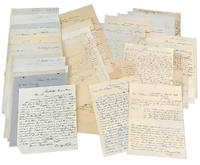
ref. 143728Philadelphia and from Various Places. 1837–1845. Approximately 145 manuscript items viz. 38 handwritten letters and 109 manuscript receipts. All in very good condition. Housed in an archival box. William P. Cresson Co. of Philadelphia was actively engaged in the hardware commission business in the 1830’s and 1840’s. The company offered a variety of products with a strong focus on metal ware household building materials and household furnishings. In the late 1840’s the firm began selling cooking stoves and became stove manufacturers and likely hollow ware manufacturers as well. During the late 1840’s and 1850’s a number of stove patents were applied for in the firm’s name. William P. Cresson manufacturer and philanthropist 1814–1892 was the son of Caleb Cresson 1775–1821. Caleb Cresson was himself a prominent and wealthy Philadelphia Quaker merchant and the husband of Sarah Emlen 1787–1870. W.P. Cresson’s family clearly enjoyed a prosperous and affluent style of living that would have been consistent with the successful endeavors of William’s father. This archive can be described as follows: I. William P. Cresson Co. Incoming Business Correspondence. 20 letters all written in 1842; 18 letters all written in 1845. Cresson had a sizeable business and this incoming correspondence records a variety of New England firms that were involved with this mid-Atlantic firm. An example of the correspondence in part: John D. Johnson writes an interesting letter to Cresson regarding brass makers and brass agents concerning manufacturing prices and the intricacies of dealing with the brass makers May 4 1842. Johnson later writes of other concerns selling brass at cheaper prices of the instability in the brass market and of a future hope: "On the whole I think that the manufacturers are beginning to have some confidence in each other and I believe the time is not very far distant when we shall all be willing to come under prescribed rules and regulations but until this can be achieved we must be somewhat irregular.” Johnson then writes briefly of “making an article for paper makers…" A one page ALS from Joel Bartlett of Harmony Maine concerns a discussion of the Cresson firm selling shank handles made by Bartlett on commission. Bartlett informs that the shank handles he is manufacturing are of high quality and is willing to send along samples. May 10 1842 On Bartlett ref. Folsom Fifty Years in the Northwest 1888 pp185–186. J. Danforth & Co. asks Cresson to sell bottles and Brittania ware and coffee pots May 12 1842. Later Danforth sent by steam boat from Middleton Connecticut “tea setts” tea pots sugars and creamers and soup bowls. In exchange Danforth asks Cresson to send along some blind fastenings saw “stretchers” and windows springs. Josiah Hayden of Haydensville wants to send Cresson cheap pens. A number of merchants ask plead for payments for goods sold or goods hoped to have been sold. Others ask for advice concerning the reduction of their manufacturing output and future trade prospects in wire and gauge metals. From Pine Plains Dutchess County New York Cresson purchased cradles scythes from Silas Harris May 29 1842. From Dotterer & Taylor of Reading Pennsylvania comes a letter of exact specifications for a proposed “15 horse engine” with three boilers June 5 1842. This is followed by an excellent letter from another steam engine manufacturer a John H. Gage in Nashua N.H. who writes to Cresson of a steam engine order and what he can offer the company at the present time June 10 1845. Another firm writes requesting Cresson to send by rail a large quantity of “cram paper” that will be suitable for packing sad irons January 24 1842. A New York entity asks Cresson to provide prices and quantity available for a large order for tea kettles coffee mills hatchets shoe blacking mill saws cow hides Eagle and New England wood screws and shank augers June 30 1845. Various other letters are devoted to outstanding debts and bills paid or not paid or agents traveling to and from delayed by various inconveniences of pre-1850 American transportation. II. William P. Cresson Family and Business Receipts 1837–1845. 109 manuscript receipts a blend of business and private household expenses. These receipts range from 1837-1845 the majority are from the late 1830’s. Among the more interesting receipts in part: Two receipts one for gold fillings “replacing part of a plug” etc. are from noted dentist Samuel Sheldon Fitch 1801–1876. S.S. Fitch was a Jefferson graduate and a pioneer in dentistry. Fitch’s A System of Dental Surgery 1829 was a standard work in its day and from its successful proceeds Fitch devoted his efforts as a publisher and patent medicine manufacturer. See Atwater I: 321–325 Receipts to benevolent societies: The Female Society of Philadelphia for the Relief and Employment of the Poor “for one large comfortable” and the Magdalen Society of Philadelphia. A receipt to Dennis Rearson for marble post stones for Laurel Hill cemetery to be cut and engraved. Jappaning 175 feet of iron chain; repairing stoves and ovens; one black Russian hat a receipt for a passage from Pittsburgh to Louisville; shovel and tong stands; “altering pew cushions” a receipt for blankets a valice trunk “to hanging 4 Looking Glasses” expenses for resetting curb stone; “2 sett dishes Brittania Ware”; etc. A receipt for US almanacs bought of Watson & Reynolds by Cresson for what appears to be H. Peale. This is possibly Henrietta Peale 1806–1892 daughter of artist Rembrandt Peale 1778–1860. Twenty-five receipts specific to purchases by Mrs. William P. Cresson record a wide variety of Philadelphia merchants and providers of household and domestic services in part: Foodstuffs purchased: Peaches raisins prunes almonds wines hams soda & water crackers sherry mustard rice etc. Household wares: gold plates moulded dishes linens gold pencils sweeping brush cut lamps cone pitcher cone boats etc. Services rendered: glazing English glass paying Sarah Binns dressmaker capes and corsets made merino shirts made etc. A receipt is also seen for altering front chamber nursery dining room parlors stair and entry carpet; fixing stair rods and fitting oil “cloaths”; putting up parlor bed and window curtains payable to a Rachael Fletcher etc. Of mention a portrait of W.P. Cresson is located at the Smithsonian and this description includes a facsimile of a daguerreotype portrait of W.P. Cresson from an online source. unknown
1847ref. 2345Boston: Printed by S.N. Dickinson & Co. 1847. A full-throated cry against slavery. The Quakers who had long opposed slavery wonder how a supposedly Christian nation could allow such evil to exist. "From the border slave states to the far south and southwest the vessels of the slave-trader regularly ply laden with youthful victims reared like cattle for the market" page 4. This pamphlet is scarce to the market. PHYSICAL DETAILS: 12mo 7 1/4 x 4 5/8 inches; 183 x 119 mm 12 pages in original printed wrappers softcover. CONDITION: Slight soiling and creasing to wrappers horizontal fold probably for mailing. Very Good or better. Printed by S.N. Dickinson & Co. paperback
ref. 0428785549.Ghardcover. Good. Access codes and supplements are not guaranteed with used items. May be an ex-library book. hardcover
1859ref. 000010694Philadelphia: Association of Friends for the Diffusion of Religious and Useful Knowledge 1859. Later edition. Hardcover. Very Good. 12mo. 2 iii-vii 1 9-103 3 pp. Brown publisher's cloth with gold lettering on the front board. Coated yellow endpapers and pastedowns. Excerpts taken from Tracts Illustrating the History Doctrine and Discipline of the Society of Friends published in London in 1851. A few nicks to the cloth; leaves show minor foxing with a contemporary gift inscription on the front flyleaf. Association of Friends for the Diffusion of Religious and Useful Knowledge hardcover
1993ref. 1672VG Softback volume featuring the life times and writings of the Quaker visionary. 293pp with index ISBN 185072136x ~ 16.00 ~ John BellersThe Improvement of Physicik Quakers Society Of Friends Immorality Raising a College Of Industry ~ Religion Sessions Book Trust paperback
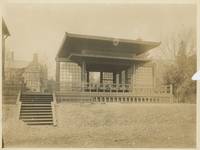
1910ref. List2847Bryn Mawr Pennsylvania; and others 1910. Eleven photographs approximately 7 x 9 ½ inch and smaller. With stamps for Brown Brothers Illustrations Bureau and E.J. Reily verso; most with captions verso. Most with chipping and wear at edges; overall good. Open-air schools became popular in the United States in the early 20th century in response to public health crises including tuberculosis.1 Conducting lessons in open-air classrooms reduced the transmission of diseases which allowed many children to attend school despite their often chronic illnesses. Offered here are eleven photographs of open-air schools three of which are identified as the Phebe Anna Thorne Model School at Bryn Mawr. The Phebe Anna Thorne Model School opened in 1913 under the direction of the College’s president Carey Thomas using funds donated by Samuel Thorne in memory of his sister Phebe Anna.2 The Thornes were an affluent New York Quaker family; Phebe Anna 1828–1909 was the only daughter to survive to adulthood and was a philanthropist and supporter of progressive social causes.3 The school was part of Bryn Mawr’s Department of Education which trained its students in teaching younger pupils rather than those of highschool or college age – the students in most of these photos are probably in about 4th or 5th grade.3 It also allowed testing of more cutting-edge pedagogical practices: the structure of the school was quite experimental including open-air classrooms outdoor naptime a flexible curriculum and less formal assessment. Of interest to scholars of the history of education especially experimental pedagogy. 1 Sherman C. Kingsley & F.B. Dresslar “Open-Air Schools” Department of the Interior Bureau of Education Bulletin 23 1916. 2 Cornelia Meigs What Makes a College A History of Bryn Mawr The MacMillan Company 1956. 3 Olive Floyd Phebe Anna Thorne: Quakeress Privately Printed in Rye New York 1958. unknown
1896ref. 17238vo Good Gilt Titles on Front Page Blue Boards HB No DJ. Edges turned in Pages Foxed Marks to Back Cover Watermark to endpapers with previous owner sig and inscription. Tissue transparency on title page. 296pp Headley Brothers hardcover
ref. 22684Philadelphia: Printed by John Richards No. 130 North Third Street. 1839. The full title is: 'An Address to the Quarterly Monthly and Preparative Meetings and the Members thereof composing the Yearly Meeting of Friends held in Philadelphia By the Committee appointed at the late Yearly Meeting to have charge of the Subject of Slavery.' 12pp 12mo. Pamphlet in original plain brown wraps. In good condition lightly aged and worn. Begins with two pages of extracts from the minutes 17 May 1839 regarding the setting up of the committee on 'the deeply interesting subject of Slavery' with reference to 'Benjamin Price Jr. Clerk' and 'Deborah F. Wharton Clerk.' The address itself 'Signed by direction and on behalf of the Committee by John Jackson Clerk' is eight pages long. Towards the beginning it notes that 'Many of our forefathers were slave-holders and the unrighteous practice of holding our fellow-creatures in bondage was not then forbidden by our discipline.' The change of policy is described with reference to 'Anthony Benezet and John Woolman'. Later the address notes: 'The advancement of this righteous concern and the increase of light upon the subject of human rights are causing this system of iniquity to totter to its base. Hence under the influence of fearful excitement many are putting forth their strength to impede the progress of principles which if ultimately triumphant will break the fetters of the slave. A part of the trading interests at the North is evidently involved with those of the South and an influence is in this way exerted against the onward course of Emancipation; thus light and darkness antagonize each other.' And later still: 'Within a few years great events hae occurred in relation to Slavery and much light has been spread on the subject. The experience derived from Emancipation in the British West Indies has opened a new era. . while we have painful evidence that a great body of slave-holders are influenced by injustice and cruelty . There are many whose consciences are burdened by a system which they derived from their ancestors . the money of the slave-trader is temptingly held up before them; . they cannot separate the tender ties of family connexion among their slaves; they dare not receive the price of blood. . We believe they are fervently desiring the deliverance of master and slave from the bondage to which both are subjected. Their hearts have bounded with joy at the success of Emancipation in the British West Indies; it has opened a door of hope thaty they also may be legally permitted to prove the advantage of requited labour over that which is extorted by the lash of the oppressor. .'. The entries on OCLC WorldCat are not clear but the item is uncommon. Philadelphia: Printed by John Richards, No. 130 North Third Street. 1839. paperback
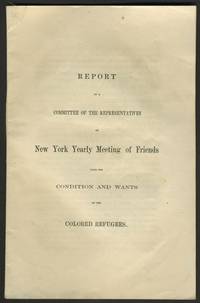
1862ref. 27695New York: The Religious Society of Friends 1862. First printing. Pamphlet. Very good condition. Three reports from the Quakers during the Civil War on their ministry amongst the "Colored Refugees" of Virginia & Washington DC reporting on the conditions and needs at Fort Monroe Camp Barker Craney Island Alexandria Hampton Norfolk etc. Conditions are tough in the refugee camps but none wish to return to where they have fled from. "Slaves have been abandoned and we must help. Don't we owe them for our prosperity--- enjoying indirectly from the unrequited labor of these people." Encyclopedia Virginia writes on their website- "In this report dated May 1864 the Committee on Colored Refugees who were representatives of the New York Yearly Meeting of Friends gives its assessment of the needs of the formerly enslaved people escaping behind Union lines and how Quaker charity efforts were meeting them in contraband camps across Virginia including Alexandria. One of their agents Harriet Jacobs wrote her own letter documenting what she saw in Alexandria and Washington D.C. For Quakers the abolition of slavery was a moral and religious imperative." Title continues: Address of the Representatives of New-York Yearly Meeting of Friends to Its Members.; Third Report of Committee of the Representatives of New York Yearly Meeting of Friends upon the Condition and Wants of the Colored Refugees 1862 Report OCLC: 21308787 8vo 30pp black title on cream paper wraps saddle stitched. Clean throughout. 1862 Address OCLC: 25519700 8vo 10pp. October 24th 1862. 1864 Third Report OCLC: 25113848 cites 9 copies; 8vo 23pp May 1864 slt. marked wrapper. All in their original self wrappers overall in very good condition. The Religious Society of Friends unknown
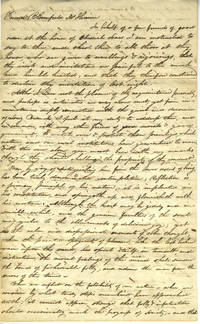
1823ref. 281351823. A three-page manuscript letter from Ephraim Smooth to Bloomfield McIlvaine exhorting him to follow the tenants of meditation and balance inherent in the Quaker tradition. A dance was held at the home of Obediah Sears and Ephraim Smooth writes at length about Quaker tradition of contemplation rejecting "ill-judged indulgence of riot & gaiety" refering to Bloomfield's education he graduated from the College of New Jersey later Princeton in 1812 and his power to influence the youths and finally offers a curative silent meditation with Simon Pure Obediah Broadbrim and himself to "cheerfully join in the dance of the spirit". Dated 5th day 7 month 1823 5 July 1823. Reference is made to the flute and fiddle made in Edenton North Carolina we assume; and addressed to "Bottany Bay" which we assume is the one on Edisto Island South Carolina. Bloomfield McIlvaine 22 Feb 1797- 18 Aug 1826 died at 30 in New Jersey. He married Henrietta Maria Banker in June 1824. His father was Joseph McIlvaine who died a couple hours after his son aged 58. Joseph was a US senator for New Jersey. Bloomfield was a lawyer - his extensive library takes four pages in his will just the books valued at $939.35. He is buried in Saint Mary's Episcopal Churchyard in Burlington New Jersey. unknown
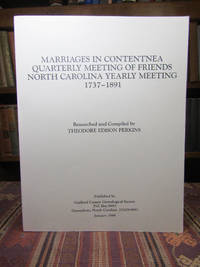
1988ref. 049389Greensboro North Carolina: Guilford County Genealogical Society 1988. First Edition First Printing . Soft cover. Very Good. 4to - over 9¾ - 12" tall. Quarto. 561 pages. Soft cover bound in grey wrappers. Light wear to the binding; the spine has the title hand-written on it. A sound copy and clean within. Guilford County Genealogical Society paperback
1988ref. 045426Greensboro North Carolina: Guilford County Genealogical Society 1988. First Edition First Printing . Hardcover. Near Fine. 4to - over 9¾ - 12" tall. 4to. 561 pages. Hardcover bound in black buckram with original tan wrappers bound in. Light wear to the binding. A sound copy and clean within. Guilford County Genealogical Society hardcover
2009ref. 044728Philadelphia PA: Quaker Pr of Friends General 2009. First Edition First Printing . Hardcover. Near Fine/Very Good. 8vo - over 7¾ - 9¾" tall. 8vo. 548 pages indexed. Hardcover in blue dust jacket. Light wear to the jacket. The text is clean. Contains some illustrations. Quaker Pr of Friends General hardcover
ref. 18208Philadelphia. Friends' Book-Store. 1871. Hardcover. 12mo. 18cm 268p. black pebbled cloth missing front free end paper a fine bright sound clean copy ds1. - A Connecticut Quaker's diary. Samuel Scott was born in London in 1719 and died in 1788 in Hartford Connecticut in 1788. He had been a Quaker minister for thirty-six years. Originally published in Philadelphia in 1809. Philadelphia. Friends' Book-Store. 1871 hardcover
1715ref. 21205London 1715. 4pp. Printed in two columns. Disbound. Small folio. Early folds and early stab holes in left margin. Some foxing. One of Two Known Copies A rare and expansive appeal to Parliament against the 1715 bill to renew the Quakers' right to the "solemn affirmation" in place of the legal oath. In 1696 after experiencing decades of exclusion and imprisonment for conscientiously refusing to take loyalty and court oaths Quakers were granted the right by an act of Parliament to take a "solemn affirmation" in legal situations in place of an actual oath. In 1715 a bill was under consideration in Parliament to renew that act indefinitely. Significantly longer than most lobbying documents from this time this petition asks that Parliament only extend the act if the affirmation be made "of no Force where they are concern'd in Interest but where they only Affirm as Witnesses between others there being no Temptation for them to Lye when it brings no Profit to them." Many Quakers by this time had achieved significant prosperity in manufacturing and commerce adding fuel to their enemies' resentment. The author of this pamphlet charges various Friends with hypocrisy greed and swindling and reprints an earlier petition describing six widows of commanders of two "Guinea ships" allegedly defrauded by Quakers including one Quaker from Maryland. Not listed in Joseph Smith's Biblioteca Anti-Quakeriana or A Descriptive Catalogue of Friends' Books. ESTC records only one copy at Oxford. unknown
1715ref. 21197London 1715. Broadsheet. 1p. plus printed docket title on verso. Dbd. Early folds and early stab holes in left margin. Moderate toning and foxing. Very good. Quakers seek relief on affirmation. In 1696 after experiencing decades of exclusion and imprisonment for conscientiously refusing to take loyalty and court oaths Quakers were granted the right by Parliament to take a "solemn affirmation" in legal situations in place of an actual oath. Over the next two decades numerous Quakers objected to the invocation of God's name in the official affirmation and refused it as they had the oath. In 1715 a bill was under consideration in Parliament to renew indefinitely the Quakers' right to the affirmation. The Quaker authors of the present petition support the bill but ask that it be amended with a revised affirmation that does not include the name of God. ESTC lists copies at four institutions: the British Library the Library of the Religious Society of Friends the National Library of Scotland and Oxford. Smith A Descriptive Catalogue of Friends' Books Vol. II p.265 listing its imprint at "about 1721". unknown
1821ref. 1015808vo leather spine label gilt lines on spine 184 pp. Top hinge cracked some minor wear to extremities volume slightly bent small hole through pages 7 and 8 some slight foxing but internally generally bright and clean. This is a collection of short biographies of notable Quakers who passed away between 1783 and 1820.While much of the text appears to talk about the personal challenges these people faced some comments are directed at their works with others including native Americans. Solomon W. Conrad,
1812ref. 006145Philadelphia: David Hogan; Solomon Wiatt 1812. Hardcover. Very Good -. T.T. Stiles printer. 288 p.; 19 cm. Contemporary tree calf with six spine compartments between gilt rules. Red leather label in second compartment with gilt-tooled title: "Mosheim's E. History." Includes "Appendix: Vindication of the Quakers; To the Editors of the American Edition of Mosheim's Ecclesiastical History" signed by John Drinker on behalf of Philadelphia Yearly Meeting 1799. Contains Errata on p. 286. Publisher's catalog on final two pages. Scarce. In Very Good- Condition: corners are bumped and rubbed; joints just starting but still solid; 6-cm. tear at upper corner of p. 31 with archival repair; foxing; otherwise clean and tight. David Hogan; Solomon Wiatt hardcover
1791ref. 005068London: James Phillips 1791. Hardcover. Good. The Fifth Edition. vii 1 601 3 p.; 21 cm. Signatures: a4 A-2P8 -2P7 2P8 8vo. Original plain calf boards with later plain calf spine. Modern box with gilt-tooled spine title: Chalkley's Works. The Works of Thomas Chalkley has a separate title page but continous pagination and signing. Publisher's catalog on final 2 unpaginated pages. ESTC T061338. Lengthy inscription on front free endpaper by Joseph Brinton 1754-1809 of Lancaster County Pa. who purchased the book in 1791. He was the son of Moses and Eleanor Brinton and married Susanna Rigbee in 1784. With: two small pieces of pressed seaweed left in the book. Inscriptions on back fixed endpaper indicate that over the following century the book descended through the Brinton and Cooper families. Lacking one leaf containing pages 369-70 which has been unobtrusively supplied. In Good Condition: leather is rubbed with some loss; pp. 369-70 supplied as described; pp. 495-96 has been rehinged; old dampstain along fore-edge of title page and several following leaves; occasional soiling heavy on a few pages. James Phillips hardcover
1848ref. 005102Philadelphia: Joseph Rakestraw 1848. Pamphlet. Very Good. 16 p.; 22 cm. Lacking wrapper. Disbound from a volume of unrelated 19th-century pamphlets. "20" in ink at upper right-hand corner of title page. Enoch Lewis 1776-1856 was a Pennsylvania Quaker and a mathematician who edited several mathematical works and published several textbooks including one on spherical projections. He was an abolitionist establishing the monthly journal African Observer and taking an active role in the Underground Railroad in Chester County Pa. In this pamphlet he examines another issue of concern to the Society of Friends that of legal and judicial oaths which Friends refused to take. Very scarce. In Very Good Condition; lacking wrapper; disbound; very light foxing on title page and p. 16; otherwise clean and bright. Joseph Rakestraw unknown
1797ref. 004161New York: Isaac Collins 1797. Hardcover. Very Good -. xii 2 360 p.; 18 cm. Contemporary full calf with six spine compartments between gilt rules; leather label in second compartment with gilt-tooled title "Journal of Job Scott." Early American Imprints ser. 1 Evans 32810. Howes S-228. Old inscription running vertically on front board. Inscriptions on endpapers and blank adjacent leaves containing family records for former owner Samuel Davis 1766-1809 his wife Sarah Leedom Davis 1764-1806 Ruth Anna Davis 1801-1846 presumably their daughter her husband William Chandler 1787-1878 and their 10 children. Burials are noted as being "at the Valley" at Kennett Square and at Union Hill. Written in upper part of title page: "Friends' Boarding Haus Kennet Square Pa." Job Scott 1751-1793 was an American Quaker travelling minister. In Very Good- Condition: leather is rubbed; minor loss at spine ends; light soiling throughout; some page corners creased; a solid copy. Isaac Collins hardcover
1783ref. 003530Philadelphia: Joseph Crukshank 1783. Hardcover. Very Good. 164 xxiv 184 p.; 17 cm. Signatures: pi1 A-2H6 12mo. Contemporary full calf with six spine compartments between raised bands. Memoirs of the Life Religious Experiences and Labours in the Gospel of James Gough Dublin: printed in 1782; Philadelphia: re-printed by Joseph Crukshank 1783 has separate title page and pagination but continuous signatures. James Gough's "Memoirs" were edited by his brother John Gough. Early Am. Imprints ser. 1 Evans 18146 17961; Smith Friends' Books 2:476; Hildeburn Pennsylvania 4699. Former owner's name on front free endpaper with note: Edward Bettle Jr. "bot of Porter & Coates." In Very Good Condition: leather is rubbed; lacking leather at head of spine; front joint cracked; pages are browning; otherwise clean and tight. Joseph Crukshank hardcover
1781ref. 003539Dublin: Robert Jackson 1781. Hardcover. Very Good. xxiv 186 p.; 17 cm. Signatures: A-H12 I6 K4 -K4 12mo. Contemporary full speckled calf; six spine compartments between raised bands. Gilt-tooled leather label in second compartment with title "Gough's Life." Small paper label in first compartment with number "17." Blind-tooled decoration on board edges. Printed label on front fixed endpaper for Aimwell School Library. In 1796 the Society for the Free Instruction of Female Children was established in Philadelphia by three Quaker women. The name Aimwell School was adopted in 1807. The first edition of the memoirs of the English Quaker schoolmaster and author James Gough 1712-1780. Includes the author's An Epistle to Friends in All Parts of Ireland p. 159-184. In Very Good Condition: edges rubbed; minor loss at head of spine; old dampstaining to fore-edges; light foxing throughout; otherwise clean and tight. Robert Jackson hardcover
1738ref. 003373London: Assigns of J. Sowle 1738. Hardcover. Very Good . For the Testimony of a Good Conscience From the Time of Their being first distinguished by that Name Taken from Original Records and other Authentick Accounts; Volume III From the year 1660 to the year 1666." 2 546 xxviii 10 p.: 1 leaf folded; 20 cm. Signatures: B8x1 C-2H8 2I-2U4 x4 8vo. Modern calf with original original gilt-tooled spine label. The folded leaf contains the table A Summary Account of the Sufferings in the Second and Third Volumes. Contains: An Alphabetical Index of the Names of the Sufferers in the Third Volume pp. 479-546 and An Index Containing Some of the Principal Contest of this Third Volume pp. 1-xxviii. Includes Errata on first page following p. xxviii and publisher's advertisements on final 8 unpaginated pages. In Very Good Condition: very occasional soiling; folded leaf is intact and solid. A clean and tight copy of an important work in Quaker history. Assigns of J. Sowle hardcover