Besse, JosephBiblio.com

289 resultados
1738ref. 003373London: Assigns of J. Sowle 1738. Hardcover. Very Good . For the Testimony of a Good Conscience From the Time of Their being first distinguished by that Name Taken from Original Records and other Authentick Accounts; Volume III From the year 1660 to the year 1666." 2 546 xxviii 10 p.: 1 leaf folded; 20 cm. Signatures: B8x1 C-2H8 2I-2U4 x4 8vo. Modern calf with original original gilt-tooled spine label. The folded leaf contains the table A Summary Account of the Sufferings in the Second and Third Volumes. Contains: An Alphabetical Index of the Names of the Sufferers in the Third Volume pp. 479-546 and An Index Containing Some of the Principal Contest of this Third Volume pp. 1-xxviii. Includes Errata on first page following p. xxviii and publisher's advertisements on final 8 unpaginated pages. In Very Good Condition: very occasional soiling; folded leaf is intact and solid. A clean and tight copy of an important work in Quaker history. Assigns of J. Sowle hardcover
1793pp. (10), 147, [3] [Contents],35 [The Ancient Testimony Of The People called Quakers]. 12mo. 165 mm. Worn contemporary binding of leather backed paper boards. Evans 25141. PA 60 Rt Stk. **PRICE JUST REDUCED!
1788Two volumes in one. pp. 150; 34. 12mo. Foxed. Original leather boards. Spine taped. Evans 20950. PA 61 L Stk. **PRICE JUST REDUCED!
1773Two volumes in one. pp. 150, 64, 3 [Bookseller's catalogue]. Aged stained. 12mo. Worn contemporary full leather Philadelphia binding. Boards detached. XLib. Evans 12661. **PRICE JUST REDUCED! PA 60 Rt. Stk x2
17735 p. l., 147, [3], 64 p. Hardcover Good condition, lacking backstrip, front cover detached Evans
1737[14],574,[20]p. Hardcover Very good condition, in worn panelled calf
1775574, [18] p. Hardcover Very good condition, in full calf, hinges cracked Evans 13821
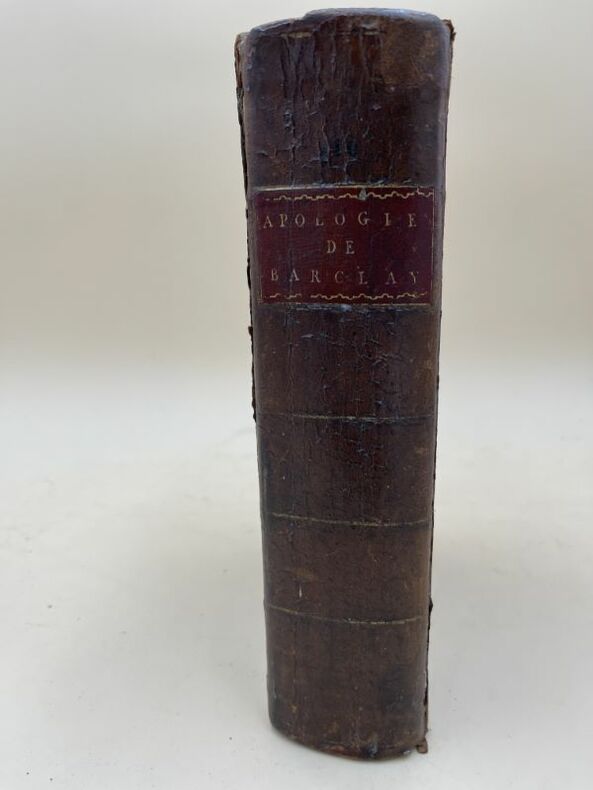
1797Londres, Imprimerie Jaques Phillips et Fils, 1797. Fort In-8 relié pleine basane de l'époque, dos lisse, filets dorés, pièce de titre rouge. XXXII + 652 pages. Index des textes de l'Ecriture cités dans l'ouvrage, table des auteurs cités et table des choses principales. Quelques rousseurs et brunissures, reliure légèrement usagée sans gravité, mors fragile. Bon exemplaire malgré les défauts signalés. Ex-dono du temps "Témoignage d'amitié de Stéphane GRELLET, de NEW YORK dans la NOUVELLE ANGLETERRE". Un ouvrage essentiel sur le sujet qui eut un grand retentissement en son temps. Ecrit à l'origine en Latin et en Anglais, l'ouvrage fut traduit en Allemand, Hollandais, Espagnol et cette présente édition française traduite par E. P.BRIDEL...pour l'instruction des étrangers.
2004ref. 1648VG/FINE Softback Volume a new edition of the 1973 volume collecting a multitude of Quaker sources together to illustrate the relationship of early Friends with God. 622pp with index ~ 71.50 ~ George Fox Quakers Society Of Friends Pendle Hill Swarthmoor Margaret Fell ~ Religion Pendle Hill Publications paperback
ref. 16828, Philadelphia, Kimber, Conrad & Co, 1805, Bound, contemporary leather with goldimpression on back, decorated inner platters, a little personal note is glued in with a stamp, 135 x 215mm., 588(XVI)pp.
1797ref. 9994545Imprimerie Jaques Phillips Londres, Imprimerie Jaques Phillips et Fils, 1797. Fort In-8 relié pleine basane de l'époque, dos lisse, filets dorés, pièce de titre rouge. XXXII + 652 pages. Index des textes de l'Ecriture cités dans l'ouvrage, table des auteurs cités et table des choses principales. Quelques rousseurs et brunissures, reliure légèrement usagée sans gravité, mors fragile. Bon exemplaire malgré les défauts signalés. Ex-dono du temps "Témoignage d'amitié de Stéphane GRELLET, de NEW YORK dans la NOUVELLE ANGLETERRE". Un ouvrage essentiel sur le sujet qui eut un grand retentissement en son temps. Ecrit à l'origine en Latin et en Anglais, l'ouvrage fut traduit en Allemand, Hollandais, Espagnol et cette présente édition française traduite par E. P.BRIDEL...pour l'instruction des étrangers.
1973ref. 106438Eerdmans 1973 In-8 cartonné 23,4 cm sur 15,7. Pas de jaquette. Couverture légèrement passée, coins émoussés, intérieur propre. 622 pages. Bon état d’occasion.
First Edition, xii, 556, 12pp., portrait, ownership inscription of on upper blank margin of title, original brown blind-stamped cloth, lettered in gilt on spine, a nice copy. "In 1827 Walker joined the Society of Friends, his diaries contain extracts of his remarkable journeys with James Backhouse, visiting the convict settlements in Van Dieman's Land, South Wales (including, at that time, Moreton Bay), and Norfolk Island. His wife was a member of Lady Franklin's committee to visit the female prisoners. In 1843 he was appointed to a board of inquiry into conditions at the Female Factory, built by Lieutenant-Governor Arthur in 1827 in accord with Elizabeth Fry's recommendations. Worried over the growing number of prostitutes, he formed a committee to 'suppress vice' by finding employment for destitute women. In 1848 Lieutenant-Governor Denison asked him to share in the task of providing an asylum for these women, and noted in his journal: 'the very personification of a mild, benevolent, and excellent Quaker' A respected founder with Backhouse of the Society of Friends in Hobart, Walker was always ready to plead for any convict under punishment by solitary confinement or treadmill for refusing in Quaker custom to remove his hat in respect to authority, to explain to judges the Quaker aversion to oaths, or to reason against state aid to religion. Although unable to repeat his missionary journeys, he managed to visit Friends around the island and encouraged others to travel 'in the ministry' to help new Meetings on the mainland". - Australian Dictionary of Biography. Ferguson, 6473.
ref. 1390660311.Gpaperback. Good. Access codes and supplements are not guaranteed with used items. May be an ex-library book. paperback
1852ref. 5992Genève, Paris Émile Beroud, Grassart 1852 In-8 576 pp, Extraite des mémoires publiés par ses deux filles et enrichie de matéraiaux inédits par l'auteur des biographies d'Albert de Haller, Jean-Gaspard Lavater, etc. Orné d'un portrait gravé. 2è édition revue et augmentée. Toutes tranches marbrées, mouillure d'angle sur l'ensemble du volume, rousseurs. dos orné de caissons et filets dorés
New revised edition, 4to (195 x 154 mm), 484, [8]pp., cont. calf, rubbed, hinges cracked, head and foot of spine chipped. An important source on the Quakers which includes, as well, much on the Irish society, local history and genealogy. Provenance: Early ownership ink signature to title page "John Humphreys, City new, Sarum [Salisbury], L/N."
First edition, ii,238pp., cont. calf, rebacked, rubbed. The first Quaker bibliography. "Hereby may be seen, not only what Books have been Printed of the Sufferings which many of the said People underwent, but also the many Warnings to the Governments and Rulers, &c. Concerned..." ? Advertisement of verso of title.
1809ref. 76436New Bedford:: Abraham Shearman Jun. 1809. First edition. old full sheep. . Light discoloration to the text throughout the paper is not at all brittle; light rubbing to the leather; tight and sound. . 8vo. Printed by Direction of the Meeting. Annotated in an old hand at the top of the title page: "This Book belongs to Rhode Island Monthly Meeting of Friends." A note at the close of the Introduction refers to additions on three pages approx. 200 words; regarding those "out of unity with friends" inspecting testimonies and the receipt of military pensions of persons who subsequently became members. These manuscript additions are dated 1822 1811 and 1818.l Abraham Shearman, Jun., hardcover
1953ref. LFA01068N° 17 de la revue "Saint Cyr" : 180 pages, format 240 x 310 mm, illustrée, brochée couverture couleurs, publié en 1953
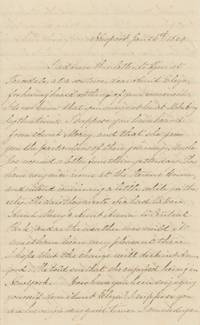
1871ref. List3241Rhode Island Massachusetts and New York 1871. Thirty-two letters two apparently missing final pages; with fifteen pages of incomplete letter material. Excellent to Near Fine. Letters from some of the young ladies of the Hazard family primarily Gertrude Minturn 1843–1877 Anna Peace 1845–1868 and Esther Robinson 1848–d. Hazard with some from other family and friends. The family was descended from Thomas Hazard one of the founding settlers of Newport Rhode Island.1 The girls were educated and often write from school; Anna and Esther attend the ‘Friends School’ in Providence which is probably the Moses Brown School and Gertrude attends Dr. Dio Lewis’s School for Young Ladies in Lexington Massachusetts. Founded by Diocletian Lewis a temperance and physical culture advocate the school incorporated his exercise system developed to condition weaker individuals. Gertrude describes a regimen of thirty minutes of walking plus an hour and a half of exercise and discusses Dr. Lewis: “Dr Lewis gives familiar lectures on any subject which the scholars propose. He is a very pleasant genial man and takes part in the games & dancing with the greatest spirit. There are about 20 scholars. Some of them board in the village but are subject to the rules of the school. This building is very large and is mostly occupied by the patients of Dr Lewis’ ‘Movement Cures’ to whom most of his time is devoted. The scholars and patients associate together. Indeed we are under very little constraint the teachers leaving our actions to be regulated by our own sense of propriety; and they seldom find occasion to reprove the scholars for misdemeanors.” November 23 1864 Meanwhile Anna and Esther’s education is more on the religious side; Esther writes: “We have not been to meeting very often since we returned from our lovely visit to Newport but the first Sunday morning I did think all the time of it as I said I was going to. We were edified this morning by a sermon from Elizabeth Meader or rather a torrent of noise so that I am nearly deafened now. I don’t think I ever heard a more horrible combination of sounds from the mouth of any human being.” January 8 1865 Though speaking in tongues is most strongly associated with Pentecostalism it is not unheard of in Quakerism. In his book of genealogy and reflections the girls’ father Thomas Hazard 1797–1886 connects the family’s “strong religious tendencies” to his own interest in spiritualism.2 This interest in mediumship comes up several times in the letters first in 1864 when one of the girls reports that “Pa writes us that at a circle which he attended a few days ago a clairvoyant medium described our house at Vaucluse perfectly” February 24 1864 and later when one of the girls attends a circle with their father in Philadelphia: “Yesterday morning Pa & I had a sitting with a Mrs. Robinson a trance speaking medium. The communication from mother was the most beautiful I ever heard. She spoke to us just as she used to on earth using the same expressions. It seemed as if I could almost see her – we are going again on Monday.” February 8 1867 That is the pair spoke to Frances Minturn Hazard who had died in 1854. Of interest to researchers of the Hazard family and Rhode Island Quakers. 1 Caroline Elizabeth Robinson The Hazard Family of Rhode Island 1635–1894 Printed for the Author 1896. 2 Thomas R. Hazard Recollections of Olden Times Sanborn 1879 228. unknown books
1871ref. List3241Rhode Island Massachusetts and New York 1871. Thirty-two letters two apparently missing final pages; with fifteen pages of incomplete letter material. Excellent to Near Fine. Letters from some of the young ladies of the Hazard family primarily Gertrude Minturn 1843–1877 Anna Peace 1845–1868 and Esther Robinson 1848–d. Hazard with some from other family and friends. The family was descended from Thomas Hazard one of the founding settlers of Newport Rhode Island.1 The girls were educated and often write from school; Anna and Esther attend the ‘Friends School’ in Providence which is probably the Moses Brown School and Gertrude attends Dr. Dio Lewis’s School for Young Ladies in Lexington Massachusetts. Founded by Diocletian Lewis a temperance and physical culture advocate the school incorporated his exercise system developed to condition weaker individuals. Gertrude describes a regimen of thirty minutes of walking plus an hour and a half of exercise and discusses Dr. Lewis: “Dr Lewis gives familiar lectures on any subject which the scholars propose. He is a very pleasant genial man and takes part in the games & dancing with the greatest spirit. There are about 20 scholars. Some of them board in the village but are subject to the rules of the school. This building is very large and is mostly occupied by the patients of Dr Lewis’ ‘Movement Cures’ to whom most of his time is devoted. The scholars and patients associate together. Indeed we are under very little constraint the teachers leaving our actions to be regulated by our own sense of propriety; and they seldom find occasion to reprove the scholars for misdemeanors.” November 23 1864 Meanwhile Anna and Esther’s education is more on the religious side; Esther writes: “We have not been to meeting very often since we returned from our lovely visit to Newport but the first Sunday morning I did think all the time of it as I said I was going to. We were edified this morning by a sermon from Elizabeth Meader or rather a torrent of noise so that I am nearly deafened now. I don’t think I ever heard a more horrible combination of sounds from the mouth of any human being.” January 8 1865 Though speaking in tongues is most strongly associated with Pentecostalism it is not unheard of in Quakerism. In his book of genealogy and reflections the girls’ father Thomas Hazard 1797–1886 connects the family’s “strong religious tendencies” to his own interest in spiritualism.2 This interest in mediumship comes up several times in the letters first in 1864 when one of the girls reports that “Pa writes us that at a circle which he attended a few days ago a clairvoyant medium described our house at Vaucluse perfectly” February 24 1864 and later when one of the girls attends a circle with their father in Philadelphia: “Yesterday morning Pa & I had a sitting with a Mrs. Robinson a trance speaking medium. The communication from mother was the most beautiful I ever heard. She spoke to us just as she used to on earth using the same expressions. It seemed as if I could almost see her – we are going again on Monday.” February 8 1867 That is the pair spoke to Frances Minturn Hazard who had died in 1854. Of interest to researchers of the Hazard family and Rhode Island Quakers. 1 Caroline Elizabeth Robinson The Hazard Family of Rhode Island 1635–1894 Printed for the Author 1896. 2 Thomas R. Hazard Recollections of Olden Times Sanborn 1879 228. unknown
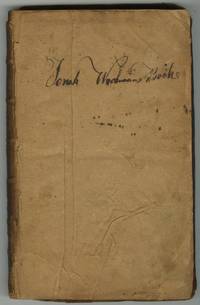
1779ref. BK0134Philadelphia: Joseph Crukshank 1779. 8vo contemporary calf 256 pp. With the ownership signatures of Jonah Woolman and Burr Woolman. Front board and preliminary page detached else good fair condition. A strong association copy of the first edition owned by Jonah Woolman 1733-1799 younger brother of the Quaker minister and abolitionist John Woolman and subsequently by Jonah's son Burr Woolman 1787-1844. Churchman and John Woolman were fellow ministers and worked together directly in the campaign against slaveholding among Friends. In his Journal Churchman records that in 1759 he and Woolman were engaged in "visiting some active members of our Society who held slaves" in Philadelphia and New Jersey; Woolman's own journal likewise records meeting Churchman by agreement in Philadelphia and spending much of a week visiting Friends who held enslaved people. The provenance connects Churchman's account to the immediate family of one of his collaborators in this work. Jonah Woolman was John Woolman's younger brother and Burr Woolman whose ownership signature also appears was Jonah's son. . Joseph Crukshank unknown books
1779ref. BK0134Philadelphia: Joseph Crukshank 1779. 8vo contemporary calf 256 pp. With the ownership signatures of Jonah Woolman and Burr Woolman. Front board and preliminary page detached else good fair condition. A strong association copy of the first edition owned by Jonah Woolman 1733-1799 younger brother of the Quaker minister and abolitionist John Woolman and subsequently by Jonah's son Burr Woolman 1787-1844. Churchman and John Woolman were fellow ministers and worked together directly in the campaign against slaveholding among Friends. In his Journal Churchman records that in 1759 he and Woolman were engaged in "visiting some active members of our Society who held slaves" in Philadelphia and New Jersey; Woolman's own journal likewise records meeting Churchman by agreement in Philadelphia and spending much of a week visiting Friends who held enslaved people. The provenance connects Churchman's account to the immediate family of one of his collaborators in this work. Jonah Woolman was John Woolman's younger brother and Burr Woolman whose ownership signature also appears was Jonah's son. . Joseph Crukshank unknown
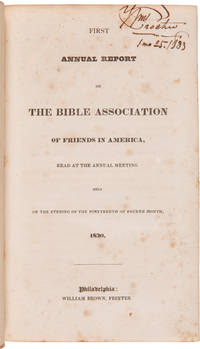
1821ref. 61985Various locations and publishers as noted below. 1821-1834. Collection of Quaker Pamphlets Compiled by a Baltimore Friend An interesting sammelband consisting of twenty-nine tracts published variously between 1821 and 1834 all relating in one way or another to the Society of Friends and bound in a matching set of two volumes. The volumes and many of the bound-in pamphlets bear the handwritten signature of "Wm Procter" and each volume of texts is preceded by a table of contents written in ink in the same hand. Some pamphlets also note the year Procter acquired them. The compiler of these two volumes was almost certainly William Procter 1780-1860 of Baltimore Maryland. Born in York England Procter arrived in Baltimore in 1796 at the age of sixteen. He married Anna Wilson in 1809 and together they had six children. Procter was a hardware merchant and an active member of the Baltimore Yearly Meeting of the Society of Friends. A death notice in the January 17 1860 issue of the Baltimore Sun described Procter as "a venerable and highly esteemed member of the Society of Friends Orthodox and the oldest hardware importer of Baltimore" distinguished for his "unobtrusive manners and integrity of character." The American Annual Monitor a publication of the Society of Friends in America noted that Procter was "much attached to our religious Society and filled many stations in the church to the satisfaction of his friends." The present collection of tracts and pamphlets reflects Procter's involvement and interest in the affairs of the Baltimore community of Friends. From the published minutes of the Baltimore Yearly Meeting documenting the activities of the Society and polemical tracts relating to the bitter theological controversies that divided the Friends community to pamphlets treating some of the issues and institutions in which members of the Baltimore Meeting were personally financially and politically invested the pamphlets herein offer a unique glimpse into American Quakerism in the 1820s and 30s. Included are pamphlets written in both condemnation and defense of Job Scott a Quaker preacher mystic and quietist from Providence Rhode Island as well as a host of pamphlets concerning the Hicksite schism that splintered the Quaker community in the 1820s. Also included is a publication commemorating the establishment of McKim's School in Baltimore a charity school funded by Quaker John McKim and his sons Isaac and William and another pamphlet on the collapse of the Union Bank of Maryland headed by Baltimore Quaker Thomas Ellicott. Most of the pamphlets were published either in Baltimore or Philadelphia with others published - one each - in Wilmington Delaware; Trenton New Jersey; and Mount Pleasant Ohio. A handful of others lack publication information. Early printer's imprints include those of William Brown Philadelphia Thomas Kite Philadelphia T. Murphy Baltimore and R. Porter & Son Wilmington. There is a total of twenty-nine separate works three of them duplicates across the two volumes fourteen in one and fifteen in the other. The titles in the order in which they appear are: First volume: 1 First Annual Report of the Bible Association of Friends in America Read at the Annual Meeting Held on the Evening of the Nineteenth of Fourth Month 1830. Philadelphia: William Brown 1830. 133pp. SMITH FRIENDS' BOOKS I:780. AMERICAN IMPRINTS 531. 2 Second Annual Report of the Bible Association of Friends in America Read at the Annual Meeting Held on the Evening of the Eighteenth of Fourth Month 1831. Philadelphia: William Brown 1831. 31pp. SMITH FRIENDS' BOOKS I:780. 3 Third Annual Report of the Bible Association of Friends in America Read at the Annual Meeting Held on the Evening of the Sixteenth of Fourth Month 1832. Philadelphia: William Brown 1832. 17pp. SMITH FRIENDS' BOOKS I:780. 4 An Appeal to the Society of Friends in Behalf of The Bible Association of Friends in America. Philadelphia: William Brown 1832. 72pp. SABIN 86036. AMERICAN IMPRINTS 11363. SMITH FRIENDS' BOOKS I:780. 5 A Declaration of the Yearly Meetings of Friends Held in Philadelphia Respecting the Proceedings of Those Who Have Lately Separated from the Society: and Also Shewing the Contrast Between Their Doctrines and Those Held by Friends. Philadelphia: Thomas Kite 1828. 32pp. SABIN 19183. AMERICAN IMPRINTS 33301. 6 The Testimony of the Society of Friends on the Continent of America. Philadelphia: Joseph Rakestraw 1830. 36pp. AMERICAN IMPRINTS 1508. SABIN 86070. SMITH FRIENDS' BOOKS I:780. 7 A Letter from Luke Howard of Tottenham Near London to a Friend in America; Containing Observations upon a Treatise Written by Job Scott entitled Salvation by Christ &c. N.p. 1825. 20pp. SMITH FRIENDS' BOOKS I:982. 8 A Letter from a Friend in America to Luke Howard of Tottenham Near London in Which the Character of Our Late Friend Job Scott Is Vindicated and Defended and His Doctrines Shown to Be Consistent with Scripture and Sound Reason. In Reply to a Letter Addressed by Luke Howard to the Author. N.p. 1826. 54pp. plus errata leaf bound in. SABIN 78289. SMITH FRIENDS' BOOKS I:943. 9 Charter of M'Kim's School Incorporated by The General Assembly of Maryland December Session 1820: with the By-Laws of the Trustees of That Institution. Baltimore: T. Murphy 1821. 15pp. including in-text illustration plus embossed seal of the school on separate slip of paper bound in. OCLC records only three copies at Yale Duke and the Library Company of Philadelphia. AMERICAN IMPRINTS 5889. 10 Owen Robert Dale: Letters Addressed to William Gibbons of Wilmington Del. in Reply to "An Exposition of Modern Scepticism;" Together with an Address to the Society of Friends and a Letter to Eli Hilles Benj. Ferris and Others. First Published in the F. Enquirer. Philadelphia: J.A. M'Clintock 1830. 24pp. AMERICAN IMPRINTS 2920. 11 Gibbons William: An Exposition of Modern Scepticism in a Letter Addressed to the Editors of the Free Enquirer. Wilmington De.: R. Porter and Son 1829. 48pp. AMERICAN IMPRINTS 38754. 12 Gould M.T.C.: The Friend or Advocate of Truth Extra. Facts from M.T.C. Gould Respecting Isaac T. Hopper caption title. Philadelphia 1831 16pp. 13 Defence of Isaac T. Hopper Against the Aspersions of Marcus T.C. Gould half title. N.p. N.d. 12pp. 14 Address of the Sufferers of the Eastern District of the City of Baltimore to the Yearly Meeting Held in Baltimore 10th Month 28th 1822. N.p. 1822. 24pp. OCLC locates only five copies. AMERICAN IMPRINTS 8778. Second volume: 15 Extracts from The Minutes of Baltimore Yearly Meeting caption title. N.p. 1833. 21pp. SMITH FRIENDS' BOOKS I:776. 16 Extracts from The Minutes of Baltimore Yearly Meeting caption title. N.p. 1831. 23pp. SMITH FRIENDS' BOOKS I:776. 17 Extracts from The Minutes of Baltimore Yearly Meeting caption title. N.p. 1830. 12pp. SMITH FRIENDS' BOOKS I:776. 18 Extracts from The Minutes of Baltimore Yearly Meeting caption title. N.p. 1829. 15pp. SMITH FRIENDS' BOOKS I:776. 19 Bates Elisha: The Incorporation of Ohio Yearly Meeting for the Purpose of Establishing a Boarding School Defended: or an Explanation of the Application Made by Friends to the Legislature of Ohio. Mount Pleasant Oh. 1833. 23pp. AMERICAN IMPRINTS 17684. 20 Foulke Joseph: Friends' Almanac for the Year of our Lord 1834. Being the Second After Leap Year…. Philadelphia: Evan Lewis 1833. 29-48pp. AMERICAN IMPRINTS 18930. DRAKE 11877. 21 Bates Elisha: A View of the Sentiments of Elias Hicks Respecting Future Rewards and Punishments. Philadelphia: Thomas Kite 1829. 16pp. AMERICAN IMPRINTS 37723. 22 Review of a Letter from Elias Hicks to Dr. N. Shoemaker. Fourth Edition. Philadelphia: Thomas Kite 1829. 28pp. AMERICAN IMPRINTS 40251. SMITH FRIENDS' BOOKS I:943. 23 A Review of Elias Hicks' Letter to Thomas Willis on the Miraculous Conception of Our Lord and Saviour Jesus Christ. Philadelphia: Thomas Kite 1829. 27pp. 24 Epistles and Testimonies Issued by the Yearly Meetings of Friends in North America; Setting Forth Their Faith Respecting the Holy Scriptures and in the Divinity and Offices of Our Lord and Saviour Jesus Christ; Shewing That the Antichristian Doctrines of Those Who Have Lately Separated from the Society are Repugnant Thereto. Philadelphia: Thomas Kite 1828. 83pp. AMERICAN IMPRINTS 33295. SABIN 86056. SMITH FRIENDS' BOOKS I:779. 25 Another copy of The Testimony of the Society of Friends on the Continent of America. Philadelphia: Joseph Rakestraw 1830. 36pp. 26 The Decision in a Cause Decided in the Court of Chancery of the State of New Jersey between Thomas L. Shotwell Complainant and Joseph Hendrickson and Stacy Decow Defendants caption title. Trenton N.J.: P.J. Gray 1832. 90pp. Likely extracted from Wood George and Isaac H. Williamson The Society of Friends Vindicated: Being the Arguments of the Counsel of Joseph Hendrickson in a Cause Decided in the Court of Chancery of the State of New Jersey between Thomas L. Shotwell Complainant and Joseph Hendrickson and Stacy Decow Defendants. By George Wood and Isaac H. Williamson Counsellors at Law. To Which Is Appended the Decision of the Court. Trenton N.J.: P.J. Gray 1832. "An important case relating to a dispute between Orthodox and Hicksite Friends over funds belonging to the Society before the division" - SABIN. AMERICAN IMPRINTS 17135. SABIN 105026. FELCONE COLLECTION 1435. 27 Another copy of Address of the Sufferers of the Eastern District of the City of Baltimore to the Yearly Meeting Held in Baltimore 10th Month 28th 1822. N.p. 1822. 24pp. 28 Another copy of Gould M.T.C.: The Friend or Advocate of Truth Extra. Facts from M.T.C. Gould Respecting Isaac T. Hopper caption title. Philadelphia 1831 16pp. 29 Johnson Reverdy: Reply to a Pamphlet Entitled "A Brief Exposition of Matters Relating to the Bank of Maryland" with an Examination into Some of the Causes of the Bankruptcy of That Institution. Baltimore: Jas. Lucas & E.K. Deaver 1834. 54251pp. AMERICAN IMPRINTS 25136. SABIN 36271. Together the pamphlets provide a comprehensive look at the Society of Friends in Baltimore and in the United States more broadly between 1821 and 1834. Bound in two volumes. Contemporary three-quarter calf and marbled boards spines gilt. Boards rubbed shelfworn corners and spine ends worn. Intermittent tanning foxing and staining. Very good overall. The American Annual Monitor for 1861; or Obituary of the Members of the Society of Friends in America for the Year 1860. No. 4 New York 1861 p.145. "Death of an Aged Citizen. – Mr. Wm Proctor sic" in The Sun Baltimore MD January 17 1860. hardcover books
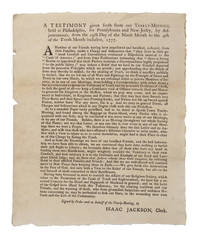
1777ref. 69134Philadelphia. 1777. Calling for the Rights of Conscientious Objectors and the Release of Exiled Quakers A rare broadside concerning the so-called "Quaker exiles" the Philadelphia Friends who were rounded up held without hearing and banished to the Virginia frontier in 1777–1778 during the height of the American Revolution. Signed in type by clerk Isaac Jackson on behalf of the Yearly Meeting the broadside calls for the release of "A Number of our Friends" who have recently "been imprisoned and banished unheard from their Families under a Charge and Insinuation that 'they have in their general Conduct and Conversation evidenced a Disposition inimical to the Cause of America.'" When war broke out between Britain and its North American colonies many Quakers remained steadfast in their religious commitment to pacifist principles refusing to pay taxes bear arms or take oaths of allegiance on behalf of the Patriot cause. This pacifism was met with suspicion by American Revolutionaries who accused Quakers of secretly supporting the British. In August and September 1777 with Philadelphia under imminent threat of capture by the enemy Quakers became the victims of growing persecution. Patriot suspicions were seemingly confirmed when on August 25 1777 the Continental Congress received a letter from Major-General John Sullivan reporting the discovery of several documents signed "the Spank-town Yearly-Meeting" implicating the Society of Friends in passing sensitive military information to the British. Never mind that no such Meeting at Spanktown existed or that the documents were likely fabricated by someone intent on maligning Quakers. The letter together with the incriminating documents were immediately referred to a committee which in its report concluded that the actions of "a number of Quakers of considerable wealth.render it certain and notorious that those persons are with much rancour and bitterness disaffected to the American cause" and that since those persons might be inclined "to communicate intelligence to the enemy and in various other ways to injure the councils and arms of America" they therefore ought to be considered a risk "to the public safety" Ford. The committee recommended that "the executive powers of the respective states.apprehend and secure all persons as well among the people called Quakers as others who have in their general conduct and conversation evidenced a disposition inimical to the cause of America" Ford. On August 28 the Congress approved the committee's recommendation. Three days later on August 31 the Supreme Executive Council of Pennsylvania in response to the resolution in Congress called for the arrest of forty-one people among them some of the city's most prominent and wealthy Quakers. Following their arrest in early September the prisoners were held for several days at the Philadelphia Masonic Lodge pending their removal to Virginia. The prisoners were offered release on condition that they swear or affirm allegiance to the Commonwealth of Pennsylvania but some refused. On September 10 the twenty remaining prisoners nearly all of them either Quakers or disowned former Quakers were banished from Philadelphia and sent to the Virginia frontier. En route the exiles were granted writs of habeas corpus by Chief Justice Thomas McKean of the Pennsylvania Supreme Court but these were denied. The next day the Pennsylvania Assembly passed a bill suspending habeas corpus entirely. The prisoners arrived in Winchester Virginia on September 29. They were released the following April in the face of mounting public pressure but only after two had died in exile. The present broadside is a product of the "extensive publishing campaign" that helped secure the Quaker exiles' release Whidbee. The broadside serves first to reiterate the Friends' position of pacifism and neutrality to remind the public that Quakers "are led out of all Wars and Fightings by the Principle of Grace and Truth in our own Minds by which we are restrained either as private Members of Society or in any of our Meetings from holding a Correspondence with either Army." The authors explain that Quakers are called "to spread the Testimony of Truth and the peaceable Doctrines of Christ to seek the good of all." They then go on to address the fabricated documents recently discovered by the Continental Army and to combat the resulting spread of misinformation: "As to a nameless Paper lately published said to be dated at Spank-Town Yearly-Meeting and found among the Baggage on Staten-Island every Person who is acquainted with our Stile may be convinced it was never wrote at any of our Meetings or by any of our Friends." The authors go on to note that "there is no Meeting throughout our whole Society of that Name; nor was that Letter or any one like it ever wrote in any of our Meetings since we were a People." Finally the Yearly Meeting pleads for the release of "our banished Friends" who they insist "have done nothing to forfeit their just Right to Liberty." OCLC locates at least six copies at Yale University the Society of the Cincinnati the Friends Historical Library Florida Atlantic University the Library of Congress and Princeton University. Additionally we find one copy at Brown University and two at the Library Company of Philadelphia. A rare broadside marking an important moment in the history of civil liberty religious freedom habeas corpus and conscientious objection in America. Old folds two horizontal and one vertical. Very minor splitting to one fold affecting text without loss. Light toning. Near fine. SABIN 94920. EVANS 15302. HILDEBURN 3638. SMITH FRIENDS' BOOKS I p.762. ESTC W5972. OCLC 1365079001 27103627 1268543044. Jack D. Marietta The Reformation of American Quakerism 1748–1783 Philadelphia: Univ. of Pennsylvania Press 1984 pp.240-44. Arthur J. Mekeel "The Relation of the Quakers to the American Revolution" in Quaker History Vol. 65 no. 1 Spring 1976 pp.3-18. Robert F. Oaks "Philadelphians in Exile: The Problem of Loyalty during the American Revolution" in Pennsylvania Magazine of History and Biography Vol. 96 no. 3 July 1972 pp.298-325. Paige L. Whidbee "The Quaker Exiles: 'The Cause of Every Inhabitant'" in Pennsylvania History: A Journal of Mid-Atlantic Studies Vol. 83 no. 1 Winter 2016 p.29. Worthington Chauncey Ford ed. Journals of the Continental Congress 1774–1789 Vol. VIII May 22–October 2 1777 Washington: Government Printing Office 1907 pp.694-95. unknown books