264 resultados
1825pp. iv, (1)-322. All edges decorated in yellow. Foxed. Early manuscript of Deborah Gest on first fly leaf, with genealogy in pencil: 'I believe this Deborah Gest was the grandmother of Deborah Gest Pownall. The latter was the grandmother of Dorothy G. and S. Barnard Pownall'. 8vo. 220 mm. Original full leather binding, worn. Original leather spine label, spine very worn with loss at head. Hardbound. Good. Elias Hicks (1748-1830) was a traveling Quaker minister from Long Island. In his ministry he promoted unorthodox doctrines that led to controversy, which inevitably caused the first major schism within the Religious Society of Friends. He was among the first Quaker abolitionists. S&S/AI 20880. PAIMP 22
First edition, 12mo (150 x 95 mm), [3], 6-21, [1]pp., disbound. Smith, J. Friends' Books, II 566.
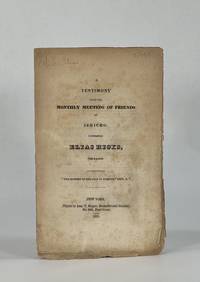
1830ref. 8959New York: Isaac T. Hopper 1830. Unbound. Very Good binding. Octavo. 8 pp. Folded sheet never bound; untrimmed. Separation at the folds of the outer two leaves; toning and soiling; pencil notations. A laudatory biography of Elias Hicks who had led a umber of Quakers into schism. Sabin 31718; American Imprints 1510. Isaac T. Hopper unknown
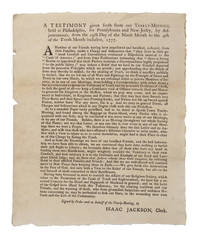
1777ref. 69134Philadelphia. 1777. Calling for the Rights of Conscientious Objectors and the Release of Exiled Quakers A rare broadside concerning the so-called "Quaker exiles" the Philadelphia Friends who were rounded up held without hearing and banished to the Virginia frontier in 1777–1778 during the height of the American Revolution. Signed in type by clerk Isaac Jackson on behalf of the Yearly Meeting the broadside calls for the release of "A Number of our Friends" who have recently "been imprisoned and banished unheard from their Families under a Charge and Insinuation that 'they have in their general Conduct and Conversation evidenced a Disposition inimical to the Cause of America.'" When war broke out between Britain and its North American colonies many Quakers remained steadfast in their religious commitment to pacifist principles refusing to pay taxes bear arms or take oaths of allegiance on behalf of the Patriot cause. This pacifism was met with suspicion by American Revolutionaries who accused Quakers of secretly supporting the British. In August and September 1777 with Philadelphia under imminent threat of capture by the enemy Quakers became the victims of growing persecution. Patriot suspicions were seemingly confirmed when on August 25 1777 the Continental Congress received a letter from Major-General John Sullivan reporting the discovery of several documents signed "the Spank-town Yearly-Meeting" implicating the Society of Friends in passing sensitive military information to the British. Never mind that no such Meeting at Spanktown existed or that the documents were likely fabricated by someone intent on maligning Quakers. The letter together with the incriminating documents were immediately referred to a committee which in its report concluded that the actions of "a number of Quakers of considerable wealth.render it certain and notorious that those persons are with much rancour and bitterness disaffected to the American cause" and that since those persons might be inclined "to communicate intelligence to the enemy and in various other ways to injure the councils and arms of America" they therefore ought to be considered a risk "to the public safety" Ford. The committee recommended that "the executive powers of the respective states.apprehend and secure all persons as well among the people called Quakers as others who have in their general conduct and conversation evidenced a disposition inimical to the cause of America" Ford. On August 28 the Congress approved the committee's recommendation. Three days later on August 31 the Supreme Executive Council of Pennsylvania in response to the resolution in Congress called for the arrest of forty-one people among them some of the city's most prominent and wealthy Quakers. Following their arrest in early September the prisoners were held for several days at the Philadelphia Masonic Lodge pending their removal to Virginia. The prisoners were offered release on condition that they swear or affirm allegiance to the Commonwealth of Pennsylvania but some refused. On September 10 the twenty remaining prisoners nearly all of them either Quakers or disowned former Quakers were banished from Philadelphia and sent to the Virginia frontier. En route the exiles were granted writs of habeas corpus by Chief Justice Thomas McKean of the Pennsylvania Supreme Court but these were denied. The next day the Pennsylvania Assembly passed a bill suspending habeas corpus entirely. The prisoners arrived in Winchester Virginia on September 29. They were released the following April in the face of mounting public pressure but only after two had died in exile. The present broadside is a product of the "extensive publishing campaign" that helped secure the Quaker exiles' release Whidbee. The broadside serves first to reiterate the Friends' position of pacifism and neutrality to remind the public that Quakers "are led out of all Wars and Fightings by the Principle of Grace and Truth in our own Minds by which we are restrained either as private Members of Society or in any of our Meetings from holding a Correspondence with either Army." The authors explain that Quakers are called "to spread the Testimony of Truth and the peaceable Doctrines of Christ to seek the good of all." They then go on to address the fabricated documents recently discovered by the Continental Army and to combat the resulting spread of misinformation: "As to a nameless Paper lately published said to be dated at Spank-Town Yearly-Meeting and found among the Baggage on Staten-Island every Person who is acquainted with our Stile may be convinced it was never wrote at any of our Meetings or by any of our Friends." The authors go on to note that "there is no Meeting throughout our whole Society of that Name; nor was that Letter or any one like it ever wrote in any of our Meetings since we were a People." Finally the Yearly Meeting pleads for the release of "our banished Friends" who they insist "have done nothing to forfeit their just Right to Liberty." OCLC locates at least six copies at Yale University the Society of the Cincinnati the Friends Historical Library Florida Atlantic University the Library of Congress and Princeton University. Additionally we find one copy at Brown University and two at the Library Company of Philadelphia. A rare broadside marking an important moment in the history of civil liberty religious freedom habeas corpus and conscientious objection in America. Old folds two horizontal and one vertical. Very minor splitting to one fold affecting text without loss. Light toning. Near fine. SABIN 94920. EVANS 15302. HILDEBURN 3638. SMITH FRIENDS' BOOKS I p.762. ESTC W5972. OCLC 1365079001 27103627 1268543044. Jack D. Marietta The Reformation of American Quakerism 1748–1783 Philadelphia: Univ. of Pennsylvania Press 1984 pp.240-44. Arthur J. Mekeel "The Relation of the Quakers to the American Revolution" in Quaker History Vol. 65 no. 1 Spring 1976 pp.3-18. Robert F. Oaks "Philadelphians in Exile: The Problem of Loyalty during the American Revolution" in Pennsylvania Magazine of History and Biography Vol. 96 no. 3 July 1972 pp.298-325. Paige L. Whidbee "The Quaker Exiles: 'The Cause of Every Inhabitant'" in Pennsylvania History: A Journal of Mid-Atlantic Studies Vol. 83 no. 1 Winter 2016 p.29. Worthington Chauncey Ford ed. Journals of the Continental Congress 1774–1789 Vol. VIII May 22–October 2 1777 Washington: Government Printing Office 1907 pp.694-95. unknown
1777ref. 69134Philadelphia. 1777. Calling for the Rights of Conscientious Objectors and the Release of Exiled Quakers A rare broadside concerning the so-called "Quaker exiles" the Philadelphia Friends who were rounded up held without hearing and banished to the Virginia frontier in 1777–1778 during the height of the American Revolution. Signed in type by clerk Isaac Jackson on behalf of the Yearly Meeting the broadside calls for the release of "A Number of our Friends" who have recently "been imprisoned and banished unheard from their Families under a Charge and Insinuation that 'they have in their general Conduct and Conversation evidenced a Disposition inimical to the Cause of America.'" When war broke out between Britain and its North American colonies many Quakers remained steadfast in their religious commitment to pacifist principles refusing to pay taxes bear arms or take oaths of allegiance on behalf of the Patriot cause. This pacifism was met with suspicion by American Revolutionaries who accused Quakers of secretly supporting the British. In August and September 1777 with Philadelphia under imminent threat of capture by the enemy Quakers became the victims of growing persecution. Patriot suspicions were seemingly confirmed when on August 25 1777 the Continental Congress received a letter from Major-General John Sullivan reporting the discovery of several documents signed "the Spank-town Yearly-Meeting" implicating the Society of Friends in passing sensitive military information to the British. Never mind that no such Meeting at Spanktown existed or that the documents were likely fabricated by someone intent on maligning Quakers. The letter together with the incriminating documents were immediately referred to a committee which in its report concluded that the actions of "a number of Quakers of considerable wealth.render it certain and notorious that those persons are with much rancour and bitterness disaffected to the American cause" and that since those persons might be inclined "to communicate intelligence to the enemy and in various other ways to injure the councils and arms of America" they therefore ought to be considered a risk "to the public safety" Ford. The committee recommended that "the executive powers of the respective states.apprehend and secure all persons as well among the people called Quakers as others who have in their general conduct and conversation evidenced a disposition inimical to the cause of America" Ford. On August 28 the Congress approved the committee's recommendation. Three days later on August 31 the Supreme Executive Council of Pennsylvania in response to the resolution in Congress called for the arrest of forty-one people among them some of the city's most prominent and wealthy Quakers. Following their arrest in early September the prisoners were held for several days at the Philadelphia Masonic Lodge pending their removal to Virginia. The prisoners were offered release on condition that they swear or affirm allegiance to the Commonwealth of Pennsylvania but some refused. On September 10 the twenty remaining prisoners nearly all of them either Quakers or disowned former Quakers were banished from Philadelphia and sent to the Virginia frontier. En route the exiles were granted writs of habeas corpus by Chief Justice Thomas McKean of the Pennsylvania Supreme Court but these were denied. The next day the Pennsylvania Assembly passed a bill suspending habeas corpus entirely. The prisoners arrived in Winchester Virginia on September 29. They were released the following April in the face of mounting public pressure but only after two had died in exile. The present broadside is a product of the "extensive publishing campaign" that helped secure the Quaker exiles' release Whidbee. The broadside serves first to reiterate the Friends' position of pacifism and neutrality to remind the public that Quakers "are led out of all Wars and Fightings by the Principle of Grace and Truth in our own Minds by which we are restrained either as private Members of Society or in any of our Meetings from holding a Correspondence with either Army." The authors explain that Quakers are called "to spread the Testimony of Truth and the peaceable Doctrines of Christ to seek the good of all." They then go on to address the fabricated documents recently discovered by the Continental Army and to combat the resulting spread of misinformation: "As to a nameless Paper lately published said to be dated at Spank-Town Yearly-Meeting and found among the Baggage on Staten-Island every Person who is acquainted with our Stile may be convinced it was never wrote at any of our Meetings or by any of our Friends." The authors go on to note that "there is no Meeting throughout our whole Society of that Name; nor was that Letter or any one like it ever wrote in any of our Meetings since we were a People." Finally the Yearly Meeting pleads for the release of "our banished Friends" who they insist "have done nothing to forfeit their just Right to Liberty." OCLC locates at least six copies at Yale University the Society of the Cincinnati the Friends Historical Library Florida Atlantic University the Library of Congress and Princeton University. Additionally we find one copy at Brown University and two at the Library Company of Philadelphia. A rare broadside marking an important moment in the history of civil liberty religious freedom habeas corpus and conscientious objection in America. Old folds two horizontal and one vertical. Very minor splitting to one fold affecting text without loss. Light toning. Near fine. SABIN 94920. EVANS 15302. HILDEBURN 3638. SMITH FRIENDS' BOOKS I p.762. ESTC W5972. OCLC 1365079001 27103627 1268543044. Jack D. Marietta The Reformation of American Quakerism 1748–1783 Philadelphia: Univ. of Pennsylvania Press 1984 pp.240-44. Arthur J. Mekeel "The Relation of the Quakers to the American Revolution" in Quaker History Vol. 65 no. 1 Spring 1976 pp.3-18. Robert F. Oaks "Philadelphians in Exile: The Problem of Loyalty during the American Revolution" in Pennsylvania Magazine of History and Biography Vol. 96 no. 3 July 1972 pp.298-325. Paige L. Whidbee "The Quaker Exiles: 'The Cause of Every Inhabitant'" in Pennsylvania History: A Journal of Mid-Atlantic Studies Vol. 83 no. 1 Winter 2016 p.29. Worthington Chauncey Ford ed. Journals of the Continental Congress 1774–1789 Vol. VIII May 22–October 2 1777 Washington: Government Printing Office 1907 pp.694-95. unknown books
1815pp. (1) [title page], (1) [Blank], (3)-7 [Introduction], (4) [Index], (9)-118, (2) [Publisher's catalogue]. Foxed. 12mo. 175 mm. Original full leather binding, worn. Front board detached. Spine very worn. Hardbound. Fair. Kersey, born in York, PA was a very prominent Quaker. He discussed Slavery with Madison in 1814. S&S/AI 35055. PALIB 4
1842120p. Foxed. 24mo. Original leather. Front board detached. Spine worn with loss. Important Quaker treatise. Chester County, PA. Apparently not in American Imprints. PA 60 Rt Stk.
19194 pages. Nice cover art. Above-average wear. 2" x 2" chunk missing from top of first page - music unaffected. Assorted peripheral openings. A worthy working copy. Sheet music
1738ref. 003373London: Assigns of J. Sowle 1738. Hardcover. Very Good . For the Testimony of a Good Conscience From the Time of Their being first distinguished by that Name Taken from Original Records and other Authentick Accounts; Volume III From the year 1660 to the year 1666." 2 546 xxviii 10 p.: 1 leaf folded; 20 cm. Signatures: B8x1 C-2H8 2I-2U4 x4 8vo. Modern calf with original original gilt-tooled spine label. The folded leaf contains the table A Summary Account of the Sufferings in the Second and Third Volumes. Contains: An Alphabetical Index of the Names of the Sufferers in the Third Volume pp. 479-546 and An Index Containing Some of the Principal Contest of this Third Volume pp. 1-xxviii. Includes Errata on first page following p. xxviii and publisher's advertisements on final 8 unpaginated pages. In Very Good Condition: very occasional soiling; folded leaf is intact and solid. A clean and tight copy of an important work in Quaker history. Assigns of J. Sowle hardcover
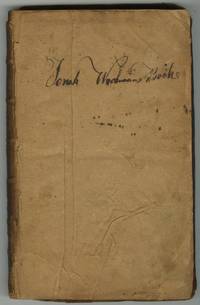
1779ref. BK0134Philadelphia: Joseph Crukshank 1779. 8vo contemporary calf 256 pp. With the ownership signatures of Jonah Woolman and Burr Woolman. Front board and preliminary page detached else good fair condition. A strong association copy of the first edition owned by Jonah Woolman 1733-1799 younger brother of the Quaker minister and abolitionist John Woolman and subsequently by Jonah's son Burr Woolman 1787-1844. Churchman and John Woolman were fellow ministers and worked together directly in the campaign against slaveholding among Friends. In his Journal Churchman records that in 1759 he and Woolman were engaged in "visiting some active members of our Society who held slaves" in Philadelphia and New Jersey; Woolman's own journal likewise records meeting Churchman by agreement in Philadelphia and spending much of a week visiting Friends who held enslaved people. The provenance connects Churchman's account to the immediate family of one of his collaborators in this work. Jonah Woolman was John Woolman's younger brother and Burr Woolman whose ownership signature also appears was Jonah's son. . Joseph Crukshank unknown
1779ref. BK0134Philadelphia: Joseph Crukshank 1779. 8vo contemporary calf 256 pp. With the ownership signatures of Jonah Woolman and Burr Woolman. Front board and preliminary page detached else good fair condition. A strong association copy of the first edition owned by Jonah Woolman 1733-1799 younger brother of the Quaker minister and abolitionist John Woolman and subsequently by Jonah's son Burr Woolman 1787-1844. Churchman and John Woolman were fellow ministers and worked together directly in the campaign against slaveholding among Friends. In his Journal Churchman records that in 1759 he and Woolman were engaged in "visiting some active members of our Society who held slaves" in Philadelphia and New Jersey; Woolman's own journal likewise records meeting Churchman by agreement in Philadelphia and spending much of a week visiting Friends who held enslaved people. The provenance connects Churchman's account to the immediate family of one of his collaborators in this work. Jonah Woolman was John Woolman's younger brother and Burr Woolman whose ownership signature also appears was Jonah's son. . Joseph Crukshank unknown books
1779pp. vii, 256. 8vo. Text worn and aged. Missing first fly leaf. Old page repair. Final leaf has loss of text. 200mm. Original leather binding very worn. Evans 16223. Modest copy of an important Quaker classic. PA 59 Rt Stk **PRICE JUST REDUCED!
1783pp. vi, 236. Loss of text on K1. Some copies have a leaf of bookseller's ad at end. 8vo. 21 cm. Worn and damped. Essentially disbound. Early manuscript ownerships. Richardson was an early Quaker minister. He made tours of England, and later, leaving his two surviving children with foster parents, he set out for America as an evangelist. Arriving in Maryland in 1701 after a 16-week crossing. He spent more than two years there, ceaselessly touring and disputing with Quakers and non-Quakers, on one occasion accompanying William Penn to treat with some American Indians, who made a favourable impression on him. He also visited Bermuda and Barbados. Evans 18158. **PRICE JUST REDUCED! PA 60 Mid Stk
1783pp. vi, 236, (2) [Publisher's catalogue]. Browned but not brittle. First fly leaf chipped. Pencil manuscript ownership of Jacob Paxson on first fly leaf and title page. 12mo. 195 mm. Nice original full leather binding, slightly scuffed. Raised bands. John Richardson (1667-1753) was an English Quaker minister who preached extensively in England, and then set out for America as an evangelist, arriving in Maryland in 1701 after a 16-week crossing. He spent more than two years there, ceaselessly touring and disputing with Quakers and non-Quakers, on one occasion accompanying William Penn to treat with some American Indians, who made a favourable impression on him. He also visited Bermuda and Barbados. First American Edition. Evans 18158; Sabin 71023. Hardbound. Good. EVANS1
1737[14],574,[20]p. Hardcover Very good condition, in worn panelled calf
1775574, [18] p. Hardcover Very good condition, in full calf, hinges cracked Evans 13821
ref. 16828, Philadelphia, Kimber, Conrad & Co, 1805, Bound, contemporary leather with goldimpression on back, decorated inner platters, a little personal note is glued in with a stamp, 135 x 215mm., 588(XVI)pp.
1780ref. 8847London: James Philips 1780. Original Wrappers. Good binding. Octavo. 32 pp. In original plain wrappers; original stitching perished now renewed. Generally edgeworn and soiled with six-digit number rubber-stamped on the front wrapper; some dog-earing shallow closed tears and chipping. Originally issued in 1666 this is an important publication by the 17th century Quaker who at the time was urging member to follow the central tenets of the Quaker faith and not put trust wholly in the clergy of whom he was suspicious. The preface of this copy points to the insecurity around the American Revolution. It states: "The ensuing Tract is re-published at the Request of several Friends who thought it might be of Service to settle the the sic Minds of many in these unstable Times and incline them to look Home to that Rock which has been is and will be the only Safety for the Righteous in all Storms and Trials of every Kind which may attend them in this Life: and it thought necessary to reprint it for the general Service at this Time wherein there are such Commotions Wars and Rumours of Wars in the Earth" p. 3. An import tract reissued in an important time. ESTC N9235. Oxford Dictionary of National Biography. James Philips unknown
Folio, 4pp., caption title, with folds which have browned and have short tears. Printer's name suggested by Evans and Hildeburn. Hildeburn, 1411; Sabin, 61621; Evans, 7422.
1812ref. 006145Philadelphia: David Hogan; Solomon Wiatt 1812. Hardcover. Very Good -. T.T. Stiles printer. 288 p.; 19 cm. Contemporary tree calf with six spine compartments between gilt rules. Red leather label in second compartment with gilt-tooled title: "Mosheim's E. History." Includes "Appendix: Vindication of the Quakers; To the Editors of the American Edition of Mosheim's Ecclesiastical History" signed by John Drinker on behalf of Philadelphia Yearly Meeting 1799. Contains Errata on p. 286. Publisher's catalog on final two pages. Scarce. In Very Good- Condition: corners are bumped and rubbed; joints just starting but still solid; 6-cm. tear at upper corner of p. 31 with archival repair; foxing; otherwise clean and tight. David Hogan; Solomon Wiatt hardcover
1861pp. iv, 120. Inner hinges cracked. Sm. 8vo. Original worn blue cloth binding. XLib (Swarthmore College). Gift from the author to Henry Foster. Binder's ticket on rear paste down. PA 60 Mid Stk.
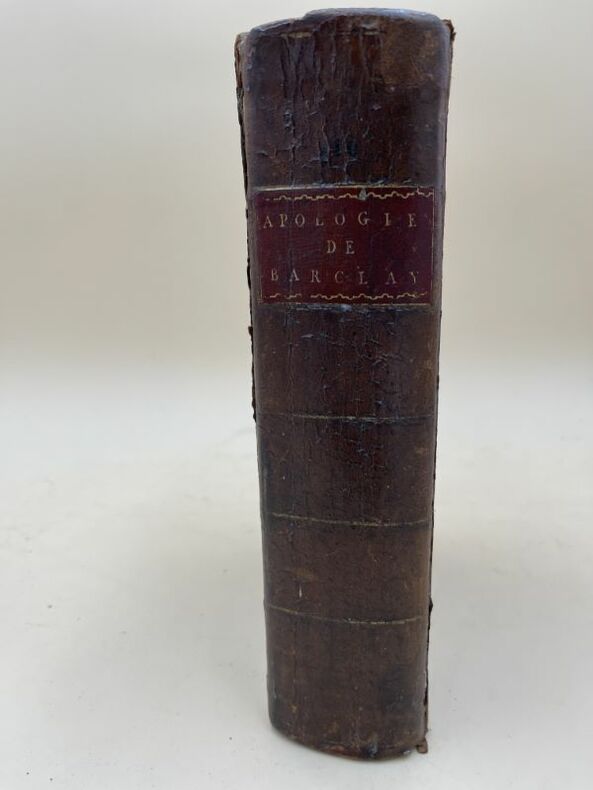
1797Londres, Imprimerie Jaques Phillips et Fils, 1797. Fort In-8 relié pleine basane de l'époque, dos lisse, filets dorés, pièce de titre rouge. XXXII + 652 pages. Index des textes de l'Ecriture cités dans l'ouvrage, table des auteurs cités et table des choses principales. Quelques rousseurs et brunissures, reliure légèrement usagée sans gravité, mors fragile. Bon exemplaire malgré les défauts signalés. Ex-dono du temps "Témoignage d'amitié de Stéphane GRELLET, de NEW YORK dans la NOUVELLE ANGLETERRE". Un ouvrage essentiel sur le sujet qui eut un grand retentissement en son temps. Ecrit à l'origine en Latin et en Anglais, l'ouvrage fut traduit en Allemand, Hollandais, Espagnol et cette présente édition française traduite par E. P.BRIDEL...pour l'instruction des étrangers.
1797ref. 9994545Imprimerie Jaques Phillips Londres, Imprimerie Jaques Phillips et Fils, 1797. Fort In-8 relié pleine basane de l'époque, dos lisse, filets dorés, pièce de titre rouge. XXXII + 652 pages. Index des textes de l'Ecriture cités dans l'ouvrage, table des auteurs cités et table des choses principales. Quelques rousseurs et brunissures, reliure légèrement usagée sans gravité, mors fragile. Bon exemplaire malgré les défauts signalés. Ex-dono du temps "Témoignage d'amitié de Stéphane GRELLET, de NEW YORK dans la NOUVELLE ANGLETERRE". Un ouvrage essentiel sur le sujet qui eut un grand retentissement en son temps. Ecrit à l'origine en Latin et en Anglais, l'ouvrage fut traduit en Allemand, Hollandais, Espagnol et cette présente édition française traduite par E. P.BRIDEL...pour l'instruction des étrangers.
1834ref. 02723Philadelphia: Elijah Weaver 1834. First edition. Octavo. Contemporary 3/4 paper over cloth boards; viii 279 pp. Lacking paper spine label; paper to board edges chipped; heavy foxing throughout which is typical for this title. A Good but complete and tight copy. Famous legal case of internecine Quaker squabbling. Elijah Weaver hardcover
vi, 474, 32pp., orig. cloth.