LARSON, Rebecca,Biblio.com
263 resultados
ref. Q106Knopf 1999. hbk 399pp b/w illustrations ISBN: 0679437622 excellent in dj as new Knopf, 1999, unknown
1948Detailed description of the Lake District. In three parts: Westmoreland, Cumberland, Lancashire. With sixteen plates and a map, 245 pages. Index. Red cloth covers. Book has some light foxing to page edges.
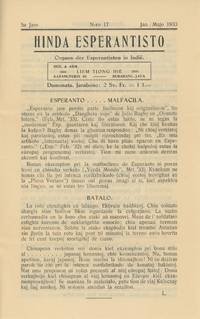
1947ref. List2844Austria; Java Indonesia; London England; and Los Angeles California 1947. Sixteen pieces: two "Friends' Esperanto Society" bulletins 8 x 12 ½ inch each; two letters 8 ½ x 11 inch each; seven "Hinda Esperantisto" pamphlets 5 ½ x 8 inch four pages each; two "Declaration" forms 4 x 6 inches; one BES pamphlet 4 ½ x 6 inches eight pages; one set of tickets for membership information 2 x 5 inches missing one tear-off ticket and one "Universala Ligo" membership card for 1947 3 x 4 ½ inches. Folded; some chipping and tearing at edges. Overall excellent to near fine. Esperanto is an artificial language created by Polish physician Ludwik Zamenhof 1859-1917 in 1887. Zamenhof intended Esperanto to be a universal second language; his experiences growing up Jewish in the Russian Empire among Russian Polish German and Yiddish speakers-all of whom regarded each other at best with suspicion-led him to believe that an easily-learned neutral second language could by contrast inspire unity between all people. Offered here is a small collection of materials related to various Esperanto societies: the "BES" a Czech group the Universal Esperanto Association the Friends' Esperanto Society the Esperanto Club of Los Angeles and Hinda Esperantisto - "Indian Esperantist" based in Java Indonesia. These materials written largely in Esperanto note that most quotes herein are translated are mostly typical club bulletins advertising events announcing members' news and reminding the reader of upcoming fees. The BES pamphlet besides advertising its Adresaro member directory solicits donations for a "living monument to Esperanto"-a headquarters-to be built in Potštejn in Czechia "in the shape of a five-pointed star which would become a real home for all those who love goodness beauty health truth and progress. The stone-like majestic white building will shine brightly in a beautiful circle from a moderate slope and the fragrant forest behind it will form a charming background." 1932 This utopian vision was likely prevented at least in part by the Nazi occupation of the country. Esperanto speakers including Zamenhof's family in particular were among their many targets. The effort to purge the universal language from Europe was clearly not successful; a postwar letter from a language teacher in Austria to a gentleman in California included in this collection notes that the Californian's address had been printed "in the magazine 'Die Weltsprache'" - that is "The World Language" February 14 1947. Esperanto's egalitarian and pacifist aims form a large part of its appeal to Quakers. It is unclear whether the Friends' Esperanto Society which authored two of the items in this collection is the same as the Kvakera Esperanto-Societo which was founded in 1921 and is still active. The March 1935 bulletin announces the F.E.S.'s annual meeting at Friends House in London the headquarters of the Religious Society of Friends in Britain. An obituary for Wilson Henry Sturge the Society's Vice President remarks on "his desire for international friendship and understanding through Esperanto" March 1935. The January 1936 bulletin calls members to petition their local Registrar of Education for Esperanto to be taught in high schools a request echoed by the Universala Esperanto-Asocio's declaration form calling on the United Nations to "help to spread the use of this language in every possible way" including supporting its teaching in schools in order "to facilitate communication between the peoples of the world and to promote social progress." George R. Thompson's letter to the Los Angeles Esperanto Club as its President strikes a similarly idealistic tone. He gives Club members his "Decalogue" finishing with an exhortation to: "10. Fix our eyes directly on our dear goal the universal brotherhood of humanity and global peace - through linguistic mutual understanding" August 1 1933. "Hinda Esperantisto" written by Liem Tjong Hie is somewhat more polemical. Its announcements include news from the Manchurian Federation of Esperantists who proposed to make Esperanto the region's official language and "to abolish the English language" Jan-May 1933. It criticizes "the European progressive writers" especially the Hungarian Esperantist Kálmán Kalocsay for making the language more difficult for learners. Liem also writes mysteriously: "The world does not know that the Belgian Esperanto Institute dir. Frans Schoofs Antwerp is a physically rotting company. The shamelessness of the leaders is shown by the fact that they are so heroic in victimizing distant people knowing that they cannot do anything against them. A black mark to the apparent reputation of the leaders!" These pamphlets also include side-by-side Indonesian and Esperanto blurbs including a review of a new book for Malaysian Esperanto learners - Esperanto caught on quickly in Asia where it still enjoys widespread popularity. Of interest to Esperantistoj and historians of Esperanto. unknown books
1947ref. List2844Austria; Java Indonesia; London England; and Los Angeles California 1947. Sixteen pieces: two "Friends' Esperanto Society" bulletins 8 x 12 ½ inch each; two letters 8 ½ x 11 inch each; seven "Hinda Esperantisto" pamphlets 5 ½ x 8 inch four pages each; two "Declaration" forms 4 x 6 inches; one BES pamphlet 4 ½ x 6 inches eight pages; one set of tickets for membership information 2 x 5 inches missing one tear-off ticket and one "Universala Ligo" membership card for 1947 3 x 4 ½ inches. Folded; some chipping and tearing at edges. Overall excellent to near fine. Esperanto is an artificial language created by Polish physician Ludwik Zamenhof 1859-1917 in 1887. Zamenhof intended Esperanto to be a universal second language; his experiences growing up Jewish in the Russian Empire among Russian Polish German and Yiddish speakers-all of whom regarded each other at best with suspicion-led him to believe that an easily-learned neutral second language could by contrast inspire unity between all people. Offered here is a small collection of materials related to various Esperanto societies: the "BES" a Czech group the Universal Esperanto Association the Friends' Esperanto Society the Esperanto Club of Los Angeles and Hinda Esperantisto - "Indian Esperantist" based in Java Indonesia. These materials written largely in Esperanto note that most quotes herein are translated are mostly typical club bulletins advertising events announcing members' news and reminding the reader of upcoming fees. The BES pamphlet besides advertising its Adresaro member directory solicits donations for a "living monument to Esperanto"-a headquarters-to be built in Potštejn in Czechia "in the shape of a five-pointed star which would become a real home for all those who love goodness beauty health truth and progress. The stone-like majestic white building will shine brightly in a beautiful circle from a moderate slope and the fragrant forest behind it will form a charming background." 1932 This utopian vision was likely prevented at least in part by the Nazi occupation of the country. Esperanto speakers including Zamenhof's family in particular were among their many targets. The effort to purge the universal language from Europe was clearly not successful; a postwar letter from a language teacher in Austria to a gentleman in California included in this collection notes that the Californian's address had been printed "in the magazine 'Die Weltsprache'" - that is "The World Language" February 14 1947. Esperanto's egalitarian and pacifist aims form a large part of its appeal to Quakers. It is unclear whether the Friends' Esperanto Society which authored two of the items in this collection is the same as the Kvakera Esperanto-Societo which was founded in 1921 and is still active. The March 1935 bulletin announces the F.E.S.'s annual meeting at Friends House in London the headquarters of the Religious Society of Friends in Britain. An obituary for Wilson Henry Sturge the Society's Vice President remarks on "his desire for international friendship and understanding through Esperanto" March 1935. The January 1936 bulletin calls members to petition their local Registrar of Education for Esperanto to be taught in high schools a request echoed by the Universala Esperanto-Asocio's declaration form calling on the United Nations to "help to spread the use of this language in every possible way" including supporting its teaching in schools in order "to facilitate communication between the peoples of the world and to promote social progress." George R. Thompson's letter to the Los Angeles Esperanto Club as its President strikes a similarly idealistic tone. He gives Club members his "Decalogue" finishing with an exhortation to: "10. Fix our eyes directly on our dear goal the universal brotherhood of humanity and global peace - through linguistic mutual understanding" August 1 1933. "Hinda Esperantisto" written by Liem Tjong Hie is somewhat more polemical. Its announcements include news from the Manchurian Federation of Esperantists who proposed to make Esperanto the region's official language and "to abolish the English language" Jan-May 1933. It criticizes "the European progressive writers" especially the Hungarian Esperantist Kálmán Kalocsay for making the language more difficult for learners. Liem also writes mysteriously: "The world does not know that the Belgian Esperanto Institute dir. Frans Schoofs Antwerp is a physically rotting company. The shamelessness of the leaders is shown by the fact that they are so heroic in victimizing distant people knowing that they cannot do anything against them. A black mark to the apparent reputation of the leaders!" These pamphlets also include side-by-side Indonesian and Esperanto blurbs including a review of a new book for Malaysian Esperanto learners - Esperanto caught on quickly in Asia where it still enjoys widespread popularity. Of interest to Esperantistoj and historians of Esperanto. unknown
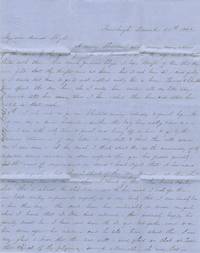
1849ref. BK0018Ferrisburgh Vermont 1849. Autograph letter signed "Anne R. M." to her husband Lloyd Minturn in San Francisco "Upper California." 8 pp.; approximately 1700 words. With stampless cover bearing a black "NEW-YORK / 40" datestamp of January 17 and manuscript routing "per Cherokee. Significant edge wear and central vertical crease; text generally clear and complete. An intimate Christmas letter from Anna Robinson Minturn of Ferrisburgh Vermont to her husband Lloyd then engaged in the hotel and real estate business at Pueblo San José during the California Gold Rush. Writing on the anniversary of his departure Anna describes the four-month-old son Lloyd had never seen questions whether California's speculative "mania" could last and repeatedly urges him to return home. Lloyd Minturn had traveled to California in January 1849 with David Lion Gardiner and other eastern emigrants. By November Gardiner reported that Minturn was "at Pueblo San Jose keeping a hotel and speculating in real estate."1 Anna's references to Lloyd's hotel and stables their rental and the uncertain recovery of his investment relate directly to his California business. He later appears in San Francisco as a member of the Committee of Vigilance of 1851 with his place of business on California Street and his residence at the Mansion House.2 Anna begins writing late on Christmas day imagining a future holiday spent with Lloyd "by thy quiet fire-side in Vermont-with thy wife and darling child with thee." Returning to the letter three days later she reflects on the year since his departure: "Oh how much I think about thee as the anniversary of thy departure comes round . When I think of thee my dearest ask then what a weary dreary time it seems . Our little darling improves so rapidly is so very lovely that I can hardly bear to have thee away." News that another California emigrant Dr. Stone had returned safely made Lloyd's absence still more painful. Although she understood that "the object of thy pilgrimage" at last appeared attainable Anna wondered why the management of his property could not be entrusted to an agent asking why "Mr. Ruckle" cannot "receive the rents & pay the former owner and send thee thy portion of the profits." However she immediately checks her own advice with an observation on marriage and gender: "You men know so much more how these things work than we so that it is rather labor wasted to advise much and I do hate to see a woman trying to rule her husband-don't thee" Anna feared that Lloyd might remain away sacrificing his domestic life only to lose the anticipated reward. Her skepticism extends to the Gold Rush itself: "I do hope though that the man who has taken your property will be able to pay you-that would be so bad to stay away so long-sacrificing so much & lose thy reward entirely-don't thee suppose this mania in California will end much as the land speculation did here seems to me it must. I hope thee won't get drawn in." Much of the letter is devoted to their infant son whose birth Lloyd may initially have learned of from another returning emigrant because of the "shamefully neglected" Pacific mails. At four months the boy weighed eighteen and one-quarter pounds and had "cheeks as hard as little apples." Anna encloses a lock of his hair explaining that she had kissed it before sending it. The contrast between California and the Vermont household runs throughout the letter. Anna describes the snow distant mountains sleighing baked apples and buckwheat cakes while Lloyd remains in a place known to her mainly through contradictory reports and unreliable correspondence. She cites Bayard Taylor's account of portions of California as suitable wheat country while noting that other observers claimed wheat could not be grown there at all remarking on the "contradictory accounts about California" that make it hard to "tell what to believe." Her anxiety was heightened by reports of cholera progressing toward California. She closes by asking Lloyd to protect his health and praying that he might be restored to her "in sound health both body & soul." Anna was a daughter of Rowland Thomas and Rachel Robinson of Rokeby the prominent Ferrisburgh Quaker family whose home later became known for its role in the Underground Railroad. Other letters from Anna to Lloyd during his California absence survive at the Bancroft Library and the Smithsonian.3 Overall a substantial and affecting account of the Gold Rush from the perspective of a wife left behind. 1 David Lion Gardner Letter to Juliana McLachlan Gardiner November 30 1849 David Gardiner Letters BANC MSS 2006/127 box 1.The Bancroft Library University of California Berkeley. 2 Anna Robinson Minturn Letters to Lloyd Minturn 1849-1851 Warshaw Collection of Business Americana Subject Categories: Steamboats box 1 folder 6 J-L Archives Center National Museum of American History Smithsonian Institution Washington DC. 3 Anna R. Minturn "Anna R. Minturn to Mr. Lloyd Minturn Ferrisburgh December 2 1849" California Gold Rush Letters BANC MSS C-B 547 box 5 The Bancroft Library University of California Berkeley. . unknown books
1849ref. BK0018Ferrisburgh Vermont 1849. Autograph letter signed "Anne R. M." to her husband Lloyd Minturn in San Francisco "Upper California." 8 pp.; approximately 1700 words. With stampless cover bearing a black "NEW-YORK / 40" datestamp of January 17 and manuscript routing "per Cherokee. Significant edge wear and central vertical crease; text generally clear and complete. An intimate Christmas letter from Anna Robinson Minturn of Ferrisburgh Vermont to her husband Lloyd then engaged in the hotel and real estate business at Pueblo San José during the California Gold Rush. Writing on the anniversary of his departure Anna describes the four-month-old son Lloyd had never seen questions whether California's speculative "mania" could last and repeatedly urges him to return home. Lloyd Minturn had traveled to California in January 1849 with David Lion Gardiner and other eastern emigrants. By November Gardiner reported that Minturn was "at Pueblo San Jose keeping a hotel and speculating in real estate."1 Anna's references to Lloyd's hotel and stables their rental and the uncertain recovery of his investment relate directly to his California business. He later appears in San Francisco as a member of the Committee of Vigilance of 1851 with his place of business on California Street and his residence at the Mansion House.2 Anna begins writing late on Christmas day imagining a future holiday spent with Lloyd "by thy quiet fire-side in Vermont-with thy wife and darling child with thee." Returning to the letter three days later she reflects on the year since his departure: "Oh how much I think about thee as the anniversary of thy departure comes round . When I think of thee my dearest ask then what a weary dreary time it seems . Our little darling improves so rapidly is so very lovely that I can hardly bear to have thee away." News that another California emigrant Dr. Stone had returned safely made Lloyd's absence still more painful. Although she understood that "the object of thy pilgrimage" at last appeared attainable Anna wondered why the management of his property could not be entrusted to an agent asking why "Mr. Ruckle" cannot "receive the rents & pay the former owner and send thee thy portion of the profits." However she immediately checks her own advice with an observation on marriage and gender: "You men know so much more how these things work than we so that it is rather labor wasted to advise much and I do hate to see a woman trying to rule her husband-don't thee" Anna feared that Lloyd might remain away sacrificing his domestic life only to lose the anticipated reward. Her skepticism extends to the Gold Rush itself: "I do hope though that the man who has taken your property will be able to pay you-that would be so bad to stay away so long-sacrificing so much & lose thy reward entirely-don't thee suppose this mania in California will end much as the land speculation did here seems to me it must. I hope thee won't get drawn in." Much of the letter is devoted to their infant son whose birth Lloyd may initially have learned of from another returning emigrant because of the "shamefully neglected" Pacific mails. At four months the boy weighed eighteen and one-quarter pounds and had "cheeks as hard as little apples." Anna encloses a lock of his hair explaining that she had kissed it before sending it. The contrast between California and the Vermont household runs throughout the letter. Anna describes the snow distant mountains sleighing baked apples and buckwheat cakes while Lloyd remains in a place known to her mainly through contradictory reports and unreliable correspondence. She cites Bayard Taylor's account of portions of California as suitable wheat country while noting that other observers claimed wheat could not be grown there at all remarking on the "contradictory accounts about California" that make it hard to "tell what to believe." Her anxiety was heightened by reports of cholera progressing toward California. She closes by asking Lloyd to protect his health and praying that he might be restored to her "in sound health both body & soul." Anna was a daughter of Rowland Thomas and Rachel Robinson of Rokeby the prominent Ferrisburgh Quaker family whose home later became known for its role in the Underground Railroad. Other letters from Anna to Lloyd during his California absence survive at the Bancroft Library and the Smithsonian.3 Overall a substantial and affecting account of the Gold Rush from the perspective of a wife left behind. 1 David Lion Gardner Letter to Juliana McLachlan Gardiner November 30 1849 David Gardiner Letters BANC MSS 2006/127 box 1.The Bancroft Library University of California Berkeley. 2 Anna Robinson Minturn Letters to Lloyd Minturn 1849-1851 Warshaw Collection of Business Americana Subject Categories: Steamboats box 1 folder 6 J-L Archives Center National Museum of American History Smithsonian Institution Washington DC. 3 Anna R. Minturn "Anna R. Minturn to Mr. Lloyd Minturn Ferrisburgh December 2 1849" California Gold Rush Letters BANC MSS C-B 547 box 5 The Bancroft Library University of California Berkeley. . unknown
1808pp. (6), (1)-112. Foxed. Some signatures browned but not brittle. Early manuscript ownership of the Thirdhaven Preparative Meeting (Easton, MD). 24mo. 140 mm. Disbound. Fair. S&S/AI 15075. SCARCE. PAIMP 25
1938ref. 759341938 Paris, Société Religieuse des Amis Quakers, 1938, in 8° broché, 316 pages ; petit défaut de papier au dos.
1973207p. Original publisher's cloth binding. DJ. Novel about Indiana Quakers for young people.
196830 pages. Features: The Burlington Glass Site; Pennsylvanian German Folk Art; Canadian Furniture; Starting a Book Collection, by L.S. Loomer; The Children of Peace - a sect of the Quakers founded by David Willson and went on to build their first church in the village of Sharon, Ontario in 1819 - with illustrations; Horse Brasses - article with black and white photos; Guide to Canadian Woods - Part 2 - Softwoods and Imported Decorative Woods, by Michael Harmes; The Built-in English Rooms at the Royal Ontario Museum; Glossary of Pottery and Porcelain Terms. Average wear. Unmarked. A sound copy. Magazine
1910ref. 28312New York 1910. 1 vols. 4to. Grey printed board string for hanging at top. Some soiling and wear to corners else very good 2. 1 vols. 4to. From the collection of the Seaman family of Glen Cove and Westbury Long Island and Woodbury Falls NY who were longtime members of the Society of Friends. ¶ Accompanied by an illustration showing the FRIENDS' MEETING HOUSE IN NEW YORK & Seminary ca. 1910 some spotting and light soiling.¶ Also accompanied by two issues of the "FRIENDS' INTELLIGENCER" dated 28 March 1903 and 30 March 1921. unknown
ref. 1332925790.Gpaperback. Good. Access codes and supplements are not guaranteed with used items. May be an ex-library book. paperback
1871427 p. Slightly age stained. 12mo. Black publisher's cloth binding. Head repaired. Bookplate (1899) of William Pennell Jones (1837-1903), who was a Delaware County Quaker Hicksite. Very useful biographical record of Pennsylvania Quakers. **PRICE JUST REDUCED! PA 59
vi, 474, 32pp., orig. cloth.
1834ref. 02723Philadelphia: Elijah Weaver 1834. First edition. Octavo. Contemporary 3/4 paper over cloth boards; viii 279 pp. Lacking paper spine label; paper to board edges chipped; heavy foxing throughout which is typical for this title. A Good but complete and tight copy. Famous legal case of internecine Quaker squabbling. Elijah Weaver hardcover
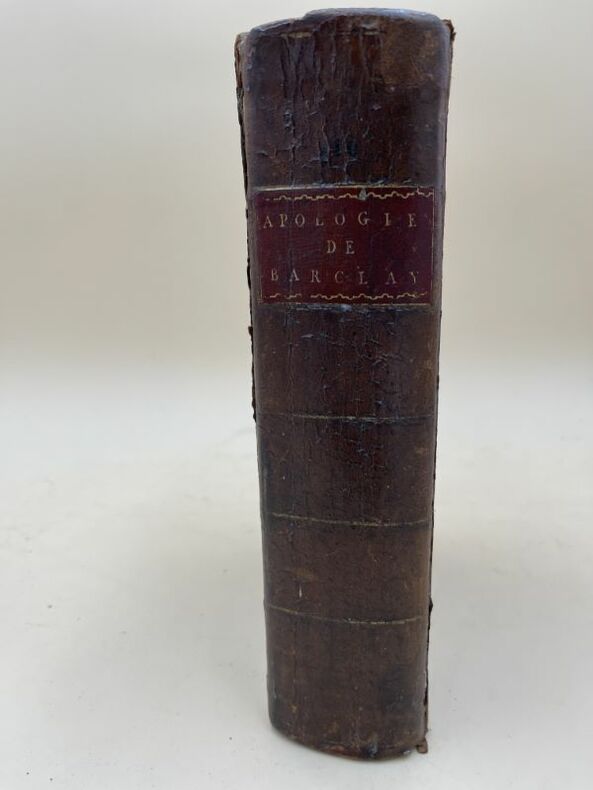
1797Londres, Imprimerie Jaques Phillips et Fils, 1797. Fort In-8 relié pleine basane de l'époque, dos lisse, filets dorés, pièce de titre rouge. XXXII + 652 pages. Index des textes de l'Ecriture cités dans l'ouvrage, table des auteurs cités et table des choses principales. Quelques rousseurs et brunissures, reliure légèrement usagée sans gravité, mors fragile. Bon exemplaire malgré les défauts signalés. Ex-dono du temps "Témoignage d'amitié de Stéphane GRELLET, de NEW YORK dans la NOUVELLE ANGLETERRE". Un ouvrage essentiel sur le sujet qui eut un grand retentissement en son temps. Ecrit à l'origine en Latin et en Anglais, l'ouvrage fut traduit en Allemand, Hollandais, Espagnol et cette présente édition française traduite par E. P.BRIDEL...pour l'instruction des étrangers.
1797ref. 9994545Imprimerie Jaques Phillips Londres, Imprimerie Jaques Phillips et Fils, 1797. Fort In-8 relié pleine basane de l'époque, dos lisse, filets dorés, pièce de titre rouge. XXXII + 652 pages. Index des textes de l'Ecriture cités dans l'ouvrage, table des auteurs cités et table des choses principales. Quelques rousseurs et brunissures, reliure légèrement usagée sans gravité, mors fragile. Bon exemplaire malgré les défauts signalés. Ex-dono du temps "Témoignage d'amitié de Stéphane GRELLET, de NEW YORK dans la NOUVELLE ANGLETERRE". Un ouvrage essentiel sur le sujet qui eut un grand retentissement en son temps. Ecrit à l'origine en Latin et en Anglais, l'ouvrage fut traduit en Allemand, Hollandais, Espagnol et cette présente édition française traduite par E. P.BRIDEL...pour l'instruction des étrangers.
1861pp. iv, 120. Inner hinges cracked. Sm. 8vo. Original worn blue cloth binding. XLib (Swarthmore College). Gift from the author to Henry Foster. Binder's ticket on rear paste down. PA 60 Mid Stk.
1812ref. 006145Philadelphia: David Hogan; Solomon Wiatt 1812. Hardcover. Very Good -. T.T. Stiles printer. 288 p.; 19 cm. Contemporary tree calf with six spine compartments between gilt rules. Red leather label in second compartment with gilt-tooled title: "Mosheim's E. History." Includes "Appendix: Vindication of the Quakers; To the Editors of the American Edition of Mosheim's Ecclesiastical History" signed by John Drinker on behalf of Philadelphia Yearly Meeting 1799. Contains Errata on p. 286. Publisher's catalog on final two pages. Scarce. In Very Good- Condition: corners are bumped and rubbed; joints just starting but still solid; 6-cm. tear at upper corner of p. 31 with archival repair; foxing; otherwise clean and tight. David Hogan; Solomon Wiatt hardcover
Folio, 4pp., caption title, with folds which have browned and have short tears. Printer's name suggested by Evans and Hildeburn. Hildeburn, 1411; Sabin, 61621; Evans, 7422.
1780ref. 8847London: James Philips 1780. Original Wrappers. Good binding. Octavo. 32 pp. In original plain wrappers; original stitching perished now renewed. Generally edgeworn and soiled with six-digit number rubber-stamped on the front wrapper; some dog-earing shallow closed tears and chipping. Originally issued in 1666 this is an important publication by the 17th century Quaker who at the time was urging member to follow the central tenets of the Quaker faith and not put trust wholly in the clergy of whom he was suspicious. The preface of this copy points to the insecurity around the American Revolution. It states: "The ensuing Tract is re-published at the Request of several Friends who thought it might be of Service to settle the the sic Minds of many in these unstable Times and incline them to look Home to that Rock which has been is and will be the only Safety for the Righteous in all Storms and Trials of every Kind which may attend them in this Life: and it thought necessary to reprint it for the general Service at this Time wherein there are such Commotions Wars and Rumours of Wars in the Earth" p. 3. An import tract reissued in an important time. ESTC N9235. Oxford Dictionary of National Biography. James Philips unknown
1775574, [18] p. Hardcover Very good condition, in full calf, hinges cracked Evans 13821
1737[14],574,[20]p. Hardcover Very good condition, in worn panelled calf
1783pp. vi, 236. Loss of text on K1. Some copies have a leaf of bookseller's ad at end. 8vo. 21 cm. Worn and damped. Essentially disbound. Early manuscript ownerships. Richardson was an early Quaker minister. He made tours of England, and later, leaving his two surviving children with foster parents, he set out for America as an evangelist. Arriving in Maryland in 1701 after a 16-week crossing. He spent more than two years there, ceaselessly touring and disputing with Quakers and non-Quakers, on one occasion accompanying William Penn to treat with some American Indians, who made a favourable impression on him. He also visited Bermuda and Barbados. Evans 18158. **PRICE JUST REDUCED! PA 60 Mid Stk
1783pp. vi, 236, (2) [Publisher's catalogue]. Browned but not brittle. First fly leaf chipped. Pencil manuscript ownership of Jacob Paxson on first fly leaf and title page. 12mo. 195 mm. Nice original full leather binding, slightly scuffed. Raised bands. John Richardson (1667-1753) was an English Quaker minister who preached extensively in England, and then set out for America as an evangelist, arriving in Maryland in 1701 after a 16-week crossing. He spent more than two years there, ceaselessly touring and disputing with Quakers and non-Quakers, on one occasion accompanying William Penn to treat with some American Indians, who made a favourable impression on him. He also visited Bermuda and Barbados. First American Edition. Evans 18158; Sabin 71023. Hardbound. Good. EVANS1