261 resultados
1818321 p. Foxed. First fly leaf detached. 8vo. 220mm. Original full worn leather binding. Front board almost detached. Original leather spine label. Fifth edition. AI 46865. PA 60 L Stk
1806ref. 001197Philadelphia Pa: Benjamin Johnson 1806. Hardcover. Very Good -. The fourth edition. Imprint: "Philadelphia: Printed for Benjamin Johnson and Samuel Wood New-York." 423 3 p.; 18 cm. Full calf; six spine compartments with gilt-tooled borders and red morocco spine label in second compartment reading "Woolman's Works." Inscriptions on back endpapers and preceding blank leaf indicating that this book was given to Mary Smith in 1888 by her mother E.D. Smith. Variant of Early American Imprints 2nd series Shaw and Shoemaker 11899 in which the imprint is: "Philadelphia: Printed by Benjamin Johnson no. 31 Market Street. 1806." Although the text is otherwise identical the final two pages of publisher's advertisements are for Samuel Wood New York not Bennett & Walton as found in the Early Am. Imprints copy. Contents: A journal of the life and travels of John Woolman -- Some considerations on the keeping of Negroes -- Considerations on pure wisdom and human policy; on labor; on schools; and on the right use of the Lord's outward gifts -- Considerations on the true harmony of mankind -- Remarks on sundry subjects -- An epistle to the quarterly and monthly meeting of Friends -- A word of remembrance and caution to the rich. In Very Good- Condition: rubbed and scraped; small worm hole near head of spine; lacking front free endpaper; scattered soiling. Benjamin Johnson hardcover
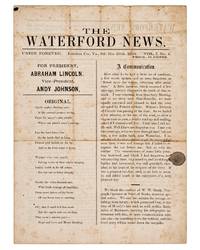
1864ref. 3090Loudon VA: Published by "Sarah Lizzie & Lida 1864. First edition. custom folder. Good. THE UNION UNDERGROUND WOMEN'S NEWSPAPER OF CONFEDERATE VIRGINIA: A remarkable Union newspaper written and edited by three young Quaker women inside Confederate Virginia - this issue prominently endorsing Abraham Lincoln for reelection. An extraordinary survival from one of the most remarkable journalistic enterprises of the Civil War: an underground Union newspaper conceived written edited and distributed by three young Quaker women living within Confederate Virginia. Sarah A. Steer 1837-1921 and sisters Elizabeth "Lizzie" Dutton 1839-1915 and Emma Eliza "Lida" Dutton 1844-1913 lived in Waterford Loudoun County a strongly Unionist Quaker community repeatedly exposed to Confederate incursions. Determined that their Union sympathies "should not be suppressed" the three women reported edited published and distributed the newspaper arranging for its printing across Union lines. Their copy was carried across the Potomac into Maryland where the paper was printed by the Baltimore American whose editor was an old friend of the Dutton family. The women themselves described the enterprise as a "hazardous undertaking." Their stated purpose was "to cheer the weary soldier and render material aid to the sick and wounded" with proceeds from the ten-cent cover price benefiting the United States Sanitary Commission. Only eight issues appeared during the final year of the Civil War. This August 1864 issue underneath the bold masthead proclaiming "UNION FOREVER" opens with a prominent political endorsement: FOR PRESIDENT ABRAHAM LINCOLN. Vice-President ANDY JOHNSON. Appearing less than three months before the presidential election the announcement was an explicit declaration of Union political allegiance by three young women publishing within a Confederate state. MOSBY'S RAIDERS AND GUERRILLA WARFARE: Several articles in this issue document the reality of guerrilla warfare surrounding Waterford. Mosby's Raiders-also called Mosby's Rangers-were Confederate cavalrymen commanded by John Singleton Mosby the officer known as the "Gray Ghost." Officially the 43rd Battalion Virginia Cavalry they specialized in quick raids behind Union lines principally in northern Virginia. They attacked supply and communication routes captured soldiers and horses and dispersed to evade pursuit. They were an organized Confederate military unit using guerrilla tactics. Under the heading "ROBBERY" the editors report that Mosby's men raided Point of Rocks and intercepted a letter containing $14 in subscriptions sent by soldiers of the 1st Eastern Shore Maryland Infantry. Their response is pointedly sarcastic: "Now this chivalric son of the South who wages no war against women appropriated the money to his own use." They nevertheless assure the soldiers that each subscriber remains entitled to "the thanks of the Editors." Elsewhere a summary of recent events recounts Mosby's July raid on Point of Rocks and describes Waterford as having been "surrounded by rebels with their bragging" and cut off from communication until Union troops returned. The paper also praises telegraph operator W. W. Shock for carrying his telegraphic equipment toward Baltimore in an effort to maintain Union communications while Confederate forces controlled the surrounding routes. WAR AS EXPERIENCED BY WOMEN: Perhaps most compelling is the opening editorial in which the editors describe the arrival of Union soldiers after Waterford had been surrounded by Confederate forces. The townspeople opened their homes and supplied the troops with food and clothing. The women recall: "Flags and handkerchiefs waved as the soldiers passed by and the citizens felt joy unspeakable." The editorial offers an unusually immediate female-authored account of civilian life in a contested Southern community: soldiers moving through the streets Confederate forces nearby shortages divided loyalties and local women participating directly in the Union war effort through journalism. NATIONAL RECEPTION - AND PRESIDENT LINCOLN: The little newspaper quickly attracted attention well beyond Loudoun County. The present issue itself notes complimentary notices in the Virginia State Journal and the Bucks County Intelligencer. More strikingly under the heading "REBEL LITERATURE" the editors reprint a notice from the Baltimore American which praises The Waterford News and identifies its editors-"Sarah Lizzie and Lida"-as "three brave warm-hearted Union girls." Its reputation spread still further. According to the Waterford history Horace Greeley's New York Tribune praised the paper while a Maryland regiment forwarded early issues directly to President Lincoln. The accompanying letter reported that by late June the "fair Editresses" had already raised nearly $1000 for the Sanitary Commission-an amount suggesting substantial circulation for such a locally produced wartime newspaper. Thus this was not merely a village newspaper operating in isolation: within weeks of its founding the work of three young women in Waterford had reached both the national press and the White House. FROM CIVIL WAR JOURNALISM TO RECONSTRUCTION: Sarah Steer's activism continued immediately after the war. She sought funds from the Freedmen's Bureau Philadelphia Quakers and local supporters to establish a school for freed children. Before the schoolhouse itself was completed she began teaching in her side yard in 1865 and is identified as the "first teacher of black children" in Loudoun County by The Waterford Foundation. The trajectory is remarkable: from editing an underground Union newspaper during the Civil War to educating formerly enslaved children at the beginning of Reconstruction. RARITY: Only eight issues of The Waterford News were published and individual original issues are exceptionally uncommon in commerce. The present issue is particularly compelling for its combination of the dramatic "UNION FOREVER" masthead explicit Lincoln-Johnson endorsement eyewitness reports of Mosby's operations substantial editorial writing by the three women themselves contemporary notices documenting the paper's national reception and the remarkable fact that earlier issues had already reached President Lincoln. The Waterford News. Vol. I No. 4. Waterford Loudoun Co. Virginia: Published by "Sarah Lizzie & Lida" August 20 1864. One single folding sheet approximately 15.5x10.75 inches creating four pages 7.75x10.75 in when folded. Some foxing and light overall toning; two minor ink blots; short separations at fold intersections without significant text loss; minor marginal handling wear. A remarkable survival. Published by "Sarah, Lizzie & Lida unknown
196426 leaves. Original mimeograph. 4to. Original plain yellow wraps. PA PAMPH 20_1 BX3
183039 p. 8vo. Plan paper wraps. AI 1508. PA 61 L Stk x2
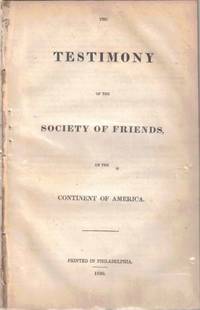
1830ref. 72555Philadelphia: United States Congress 1830. Paperback. Very good. Paperback. First Edition. 39pp; Lightly worn else very good. The Testimony reflects anguish over the "deeply affecting schism" in the Society of Friends decrying "the introduction of speculative opinions under specious colorings" and warning that "the writings of our early Friends are perveted to support those views." In addition to highlighting the correct path this piece unequivocally their just right to liberty and property violently withheld." Also printed in New York this year. Sabin 86070. United States Congress paperback
1697pp. (2), xlv, (6), 381, (3) [Publisher's Advertisements]. Foxed. Small 8vo. 19mm. Leather boards tooled in blind; later library cloth spine. Released duplicate from the Historical Society of Pennsylvania's Gilpin Library. Greatly expanded from the first edition. Some copies of the 3rd edition contain a frontis, but it apparently was not issued with the second. Charles Leslie was a celebrated non-juring divine. He distinguished himself in public religious controversy. When Ireland became disturbed in 1689, Leslie removed with his family to England, where he employed himself in writing political pamphlets (opposed to the existing government but zealous in support of the Church of England). About this time he entered into a controversy with the Quakers, said to have arisen from the circumstance of his lodging with a family of that persuasion. This family he converted. This is the first of the several treatises which he wrote against the Quakers. It was answered by George Whithead in a pamphlet entitled, "An Antidote to the Snake in the Grass." In this important Second Edition Mr. Leslie noticed this answer; but he was again assailed in a production called, 'Satan Dissolved from his Disguises of Light' which also appeared in 1696. To this, and several other attacks, Mr Leslie replied at great length in "A Defence of a book entitled the Snake in the Grass." This again provoked a host of answers, amongst which was one by the Quakers, entitled "A Switch for the Snake." To this Mr Leslie again replied in "A Second Defence, or the third and last part of the Snake in the Grass." Wing L1157; Smith, Anti-Quakeriana p. 267. Very Scarce. **PRICE JUST REDUCED! PA 59.
1849pp. 86; 40. Foxed. 12mo. 190mm. Original worn full leather binding, front board very fragile, almost detached. Small loss at tail of spine. PA 59 Rt Stk
188294p. + Full page wood engraved plates with original tissue guards. Top edge gilt. Uncut. Square 8vo. Original gilt decorated purple cloth binding, spine faded. Calling card of the author. A prominent Pennsylvanian's plea to England to allow the remains of Penn to be removed to Philadelphia. PA 59.
1945216 p. 12mo. Original cloth binding.
20008vo., with photographs and illustrations pictorial wrappers, wire-stitched as issued, a fine copy.
1968360 pages. Index. Bibliography. Map endpapers. Black and white photographic plates. Updated version of the first edition published over 41 years earlier. "A study of a little known area of religious and social history." - from page vii. Above-average wear. Usual library markings. Spine slant. Binding intact. A worthy reading copy. Book
1905392 p. + Color illustrations by George Gibbs and photographic plates. Title page printed in red and black. 8vo. Slightly soiled original publisher's blue cloth binding. Gilt decorated, with a color portrait of 'The Quakeress' on front cover. ** PRICE JUST REDUCED!! PA 58 x2
1829ref. BL4542Philadelphia:: Society of Friends 1829. 1829. Volume III only. 8vo. iii-iv 3-298 2 pp. Missing title page and pp. 1-2. Original full mottled calf red gilt-stamped spine label "Quaker"; spine damaged rubbed. Ownership signature of Fannie Comstock. As is. This serial publication survived for just four years ca.1827-1831. Contains sermons or letters written by James Cockburn Dr. John Moore Jesse Kersey Stephen Crisp Elias Hicks Edward Stabler Thomas Wetherald Amos Peaslee etc. Society of Friends, 1829]. unknown books
1953pp. xi, 243. 8vo. Original publisher's cloth binding. Head of spine slightly worn. Original priced dust jacket, very slightly chipped at edges. Sun faded. Quakers and modern affairs and social issues. PA 58.
1942319 p. + Illustrations. XLib. **PRICE JUST REDUCED!
1932pp. xx, 349 + Portrait frontis, full page plates and a folding genealogical chart. Ownership on front paste down inked out. Uncut. Top edge soiled. 8vo. Original full cloth binding, extremities slightly rubbed. Gilt lettering on spine faded. Especially useful in that it covers Penn's successors who are not included in other biographies and studies. PA 58.
1783ref. 16713London: Printed Philadelphia: Reprinted and sold by Joseph Crukshank 1783. First American edition. 209 pp. 1 vols. 8vo. Contemporary sheep. Quite rubbed surface worming on covers front free endpapers and blanks removed pencilled duplicate notation on endpaper text browned some soiling. First American edition. 209 pp. 1 vols. 8vo. First published in in London in 1773. This tract as were most of Phipps works written in defence of the Quakers and in response to Samuel Newton of Norwich. Shipton and Mooney 18139 Reprinted and sold by Joseph Crukshank unknown books
1788pp. (4), 230. Lacks fly leaves. Aged and damp stained. 8vo. 250mm. Original full leather, rubbed. Small loss at head of spine. Evans 21391. PA 61 L Stk. **PRICE JUST REDUCED!
1783ref. 24871London printed: Philadelphia: Re-Printed: and sold by Joseph Cruikshank 1783. First American edition. 4 206 pp missing 207-209. 1 vols. 8vo. Contemporary sheep. Signed on half-title "Rachael Peason Solebury Pa.". First American edition. 4 206 pp missing 207-209. 1 vols. 8vo. and sold by Joseph Cruikshank unknown
1783ref. 16713London: Printed Philadelphia: Reprinted and sold by Joseph Crukshank 1783. First American edition. 209 pp. 1 vols. 8vo. Contemporary sheep. Quite rubbed surface worming on covers front free endpapers and blanks removed pencilled duplicate notation on endpaper text browned some soiling. First American edition. 209 pp. 1 vols. 8vo. First published in in London in 1773. This tract as were most of Phipps works written in defence of the Quakers and in response to Samuel Newton of Norwich. Shipton and Mooney 18139 Reprinted and sold by Joseph Crukshank unknown
1788ref. 013273NY: William Ross 1788. Second American Edition. Hardcover. Fair. Second American edition re-printed by William Ross in NY. Original or old calf front cover detached detached ffe heavily inscribed in old script: "Thomas Clapp's book. Don't steal this book for fear of shame for here to see the owner's name from one borrows this book . and take the sense therein and then return it to the owner again. Hannah Clapp William Clapp William Ross hardcover
1854pp. 208, 27-100 [Reflections and Maxims of William Penn]. Lacks rear fly leaf. Discreet perforated XLib stamp on title page. Embossed bookseller label on first fly leaf of Hiram Young, York, PA. (Hiram Young went on to become a newspaper publisher in York). 12mo. Original full publisher's cloth binding, decorated and embossed in blind. Gilt lettered and decorated spine. Library call marks on spine. Extremities worn with slight loss. Hardbound. Very Good. **PRICE JUST REDUCED! PA 60 Mid Stk
First Edition, xii, 556, 12pp., portrait, ownership inscription of on upper blank margin of title, original brown blind-stamped cloth, lettered in gilt on spine, a nice copy. "In 1827 Walker joined the Society of Friends, his diaries contain extracts of his remarkable journeys with James Backhouse, visiting the convict settlements in Van Dieman's Land, South Wales (including, at that time, Moreton Bay), and Norfolk Island. His wife was a member of Lady Franklin's committee to visit the female prisoners. In 1843 he was appointed to a board of inquiry into conditions at the Female Factory, built by Lieutenant-Governor Arthur in 1827 in accord with Elizabeth Fry's recommendations. Worried over the growing number of prostitutes, he formed a committee to 'suppress vice' by finding employment for destitute women. In 1848 Lieutenant-Governor Denison asked him to share in the task of providing an asylum for these women, and noted in his journal: 'the very personification of a mild, benevolent, and excellent Quaker' A respected founder with Backhouse of the Society of Friends in Hobart, Walker was always ready to plead for any convict under punishment by solitary confinement or treadmill for refusing in Quaker custom to remove his hat in respect to authority, to explain to judges the Quaker aversion to oaths, or to reason against state aid to religion. Although unable to repeat his missionary journeys, he managed to visit Friends around the island and encouraged others to travel 'in the ministry' to help new Meetings on the mainland". - Australian Dictionary of Biography. Ferguson, 6473.
12mo (160 x 95 mm), iv, 108pp., disbound. Smith, J. Friends' Books, II 164.