[Rhode Island – Hazard Family – Quakers] Hazard, Gertrude M; Hazard, Anna P; Hazard, Esther R; et alBiblio.com
261 résultats
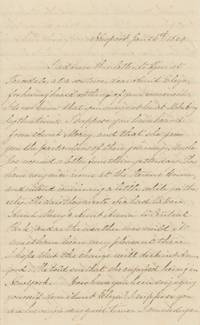
1871réf. List3241Rhode Island Massachusetts and New York 1871. Thirty-two letters two apparently missing final pages; with fifteen pages of incomplete letter material. Excellent to Near Fine. Letters from some of the young ladies of the Hazard family primarily Gertrude Minturn 1843–1877 Anna Peace 1845–1868 and Esther Robinson 1848–d. Hazard with some from other family and friends. The family was descended from Thomas Hazard one of the founding settlers of Newport Rhode Island.1 The girls were educated and often write from school; Anna and Esther attend the ‘Friends School’ in Providence which is probably the Moses Brown School and Gertrude attends Dr. Dio Lewis’s School for Young Ladies in Lexington Massachusetts. Founded by Diocletian Lewis a temperance and physical culture advocate the school incorporated his exercise system developed to condition weaker individuals. Gertrude describes a regimen of thirty minutes of walking plus an hour and a half of exercise and discusses Dr. Lewis: “Dr Lewis gives familiar lectures on any subject which the scholars propose. He is a very pleasant genial man and takes part in the games & dancing with the greatest spirit. There are about 20 scholars. Some of them board in the village but are subject to the rules of the school. This building is very large and is mostly occupied by the patients of Dr Lewis’ ‘Movement Cures’ to whom most of his time is devoted. The scholars and patients associate together. Indeed we are under very little constraint the teachers leaving our actions to be regulated by our own sense of propriety; and they seldom find occasion to reprove the scholars for misdemeanors.” November 23 1864 Meanwhile Anna and Esther’s education is more on the religious side; Esther writes: “We have not been to meeting very often since we returned from our lovely visit to Newport but the first Sunday morning I did think all the time of it as I said I was going to. We were edified this morning by a sermon from Elizabeth Meader or rather a torrent of noise so that I am nearly deafened now. I don’t think I ever heard a more horrible combination of sounds from the mouth of any human being.” January 8 1865 Though speaking in tongues is most strongly associated with Pentecostalism it is not unheard of in Quakerism. In his book of genealogy and reflections the girls’ father Thomas Hazard 1797–1886 connects the family’s “strong religious tendencies” to his own interest in spiritualism.2 This interest in mediumship comes up several times in the letters first in 1864 when one of the girls reports that “Pa writes us that at a circle which he attended a few days ago a clairvoyant medium described our house at Vaucluse perfectly” February 24 1864 and later when one of the girls attends a circle with their father in Philadelphia: “Yesterday morning Pa & I had a sitting with a Mrs. Robinson a trance speaking medium. The communication from mother was the most beautiful I ever heard. She spoke to us just as she used to on earth using the same expressions. It seemed as if I could almost see her – we are going again on Monday.” February 8 1867 That is the pair spoke to Frances Minturn Hazard who had died in 1854. Of interest to researchers of the Hazard family and Rhode Island Quakers. 1 Caroline Elizabeth Robinson The Hazard Family of Rhode Island 1635–1894 Printed for the Author 1896. 2 Thomas R. Hazard Recollections of Olden Times Sanborn 1879 228. unknown
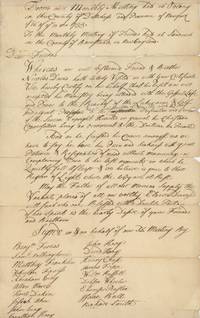
1755réf. List2976Dutchess County New York 1755. Single sheet measuring 7 ¾ x 12 ½ inches. Folded and quite torn at folds; very good. A letter signed by the members of the Oblong Monthly Meeting of Friends in New York to members of the Sandwich one in Massachusetts on the occasion of the death of Nicolas Davis 1690–1755 a member of the Sandwich meeting. Davis was well-respected in his community and occasionally traveled to minister; he died in Quaker Hill where the Oblong Meeting House is located on such a trip. The Oblong Friends remember him: “His visit was well accepted his ministry being attended with the Gospel Life and Power to the Reproof of the Lukewarm & Self Indulgent Professers to the instruction of the weak and to the Edification and Comfort of the Sincere & upright”. One of the letter’s signers Benjamin Ferriss is likely the same Benjamin Ferris who was one of the first Euro-American settlers of Quaker Hill arriving in 1728. The letter has eighteen other signatories: John Hoag Samuel Nothingham David Hoag Matthew Franklin Henry Chase Zebulon Farriss James surname illegible Abraham Ewing Wilm Buffett Allen Moore Dobson Wheeler Tim. Dakin Ebenezer Peaslee Josiah Akin Haas Bull. John Ewing Richard Smith and Jonathan Hoag. Of interest to scholars of Colonial-era Quaker history and New York State history. unknown
1715réf. WRCAM39823London 1715. Broadsheet 11 1/2 x 7 3/4 inches with printed docket title on verso. Dbd. Early folds and early stab holes in left margin. Moderate toning and foxing. Very good. In 1696 after experiencing decades of exclusion and imprisonment for conscientiously refusing to take loyalty and court oaths Parliament granted Quakers the right to take a "solemn affirmation" in legal situations in place of an actual oath. Over the next two decades numerous Quakers objected to the invocation of God's name in the official affirmation and refused it as they had the oath. In 1715 a bill was under consideration in Parliament to renew indefinitely the Quakers' right to the affirmation. The Quaker authors of the present petition support the bill but ask that it be amended with a revised affirmation that does not include the name of God. ESTC lists copies at four institutions: British Library Library of the Religious Society of Friends National Library of Scotland and Oxford. SMITH FRIENDS' BOOKS II p.265 listing its imprint at "about 1721". unknown books
1715réf. 21197London 1715. Broadsheet. 1p. plus printed docket title on verso. Dbd. Early folds and early stab holes in left margin. Moderate toning and foxing. Very good. Quakers seek relief on affirmation. In 1696 after experiencing decades of exclusion and imprisonment for conscientiously refusing to take loyalty and court oaths Quakers were granted the right by Parliament to take a "solemn affirmation" in legal situations in place of an actual oath. Over the next two decades numerous Quakers objected to the invocation of God's name in the official affirmation and refused it as they had the oath. In 1715 a bill was under consideration in Parliament to renew indefinitely the Quakers' right to the affirmation. The Quaker authors of the present petition support the bill but ask that it be amended with a revised affirmation that does not include the name of God. ESTC lists copies at four institutions: the British Library the Library of the Religious Society of Friends the National Library of Scotland and Oxford. Smith A Descriptive Catalogue of Friends' Books Vol. II p.265 listing its imprint at "about 1721". unknown books
1715réf. WRCAM39824London 1715. 4pp. Printed in two columns. Dbd. Small folio. Early folds and early stab holes in left margin. Some foxing. Very good. A rare and expansive appeal to Parliament against the 1715 bill to renew the Quakers' right to the "solemn affirmation" in place of the legal oath. In 1696 after experiencing decades of exclusion and imprisonment for conscientiously refusing to take loyalty and court oaths Quakers were granted the right by an act of Parliament to take a "solemn affirmation" in legal situations in place of an actual oath. In 1715 a bill was under consideration in Parliament to renew that act indefinitely. Significantly longer than most lobbying documents from this time this petition asks that Parliament only extend the act if the affirmation be made "of no Force where they are concern'd in Interest but where they only Affirm as Witnesses between others there being no Temptation for them to Lye when it brings no Profit to them." Many Quakers by this time had achieved significant prosperity in manufacturing and commerce adding fuel to their enemies' resentment. The author of this pamphlet charges various Friends with hypocrisy greed and swindling and reprints an earlier petition describing six widows of commanders of two "Guinea ships" allegedly defrauded by Quakers including one Quaker from Maryland. Not listed in Joseph Smith's BIBLIOTECA ANTI- QUAKERIANA or A DESCRIPTIVE CATALOGUE OF FRIENDS' BOOKS. ESTC records only one copy at Oxford there are also copies at Haverford College. unknown books
1800réf. 11885New York: Printed by Isaac Collins 1800. Hardcover. Very good. First edition. viii 141 pages. Evans 37474. Printed on heavy paper with one or two leaves bound between each of the chapters. According to a note following the introduction "The book is printed with blank pages for the purpose of making future additions which are to be inserted in the manner and in the page in which they will be directed to be placed by the yearly meeting. No other additions are to be made.". The present copy is annotated and corrected in various ways presumably by someone who attended this annual meeting. On the first free endpaper there is a contemporary annotation: "Abraham Barker Lives in Ohio Huron Co. Town of Brunson." On the blank leaf following p. 50 there is the note: " To the monthly Meeting of . . . Dear friend We the subscriber A B son of . . . . do propose taking each other in marriage between us which we submit to your approbation then dated AB / CJ"; the inscription is somewhat illegible owing to some soiling; however it follows the chapter on "Marriages" and reproduces in part the "Form of Marriage Certificate" that appears on p. 49. In the next chapter "Removals and Certificates" at the top of the page the following annotation is added: "it shall be the duty of such monthly Meeting to accept the same unless there be some manifest objections." On p. 123 in the chapter "Queries" the following annotation appears at the bottom of the page: "B. Are the answers to the Queries introduced to the Quarterly and Yearly Meetings the substance of and founded on the answers from the prepositive Meetings." On the preceding page three lines of text have been x'ed out and an "a" has been inserted before the word "priest" in the second line from the bottom and the words "or magistrate" have been crossed through. And on p. 124 the last page of this chapter the entire ten lines of text have been crossed out. Similar crossings have been made to the chapter "Meetings of Ministers and Elders". It would appear that these annotations and corrections were made by one of those attending the Meeting in New York presumably perhaps Abraham Barker. The chapters in the book cover the following topics which however do not appear in the order given in the Table of Contents: Appeals Apprentices Books Burials Certificates Civil government Children Dealing with offenders Differences and Arbitrations Diversions Defamation and detraction Days and times Distilled spirits &c. Donations Elders Gaming Meetings for worship for discipline of ministers and elders for sufferings; Ministry Meeting-houses and ground Marriages Memorials Overseers Oaths Poor Plainness Priests wages or hireling ministry Queries Requests to be received into membership Removals Scandal publick Slavery Schools Sufferings Subscriptions Scriptures of the Old and New Testament Taverns Trade and commerce Women's meetings War Wills. In the short chapter on "Slavery" it is stated: "No friend is to import buy or sell negroes or other slaves; or hire any that are held in bondage; or wake any that are young or others by indenture or otherwise unless they are first set free. Any friend disregarding the advice above expressed after deliberate dealing with except satisfaction be given is to be disowned. . . ." The Meeting House on Pearl Street was established in 1795-96 but demolished in 1828. Light foxing but a very good copy of a rare publication very few locations known including AAS and Haverford College. Printed by Isaac Collins hardcover
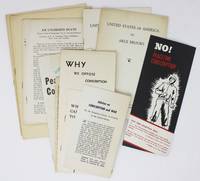
1954réf. 4307Philadelphia 1954. About very good. Thirty-five printed and typescript items approximately 150pp. total. Some staples old folds. Scattered contemporary ink stamps. Light toning and minor wear heavier in places. Scattered chipping and occasional short edge tears. A fascinating and scarce group of newsletters pamphlets and ephemera published by the American Friends Service Committee during and after World War II comprising thirty-five printed and typescript items. The Committee administered roughly one third of the camps in the Civilian Public Service system which was established to provide a means of non-military service to religious conscientious objectors during the war and also played a significant role in the anti-draft anti-conscription movement. The first group of material present here includes seven issues of the Civilian Public Service Friends Newsletter. These provide a detailed contemporary account of the overall state of the camps including camp populations incoming "campers" camp openings and closures and the financial situation. The newsletters also include news relating to the administration of the camps and developments regarding their operation and the activities of the interned objectors. Included as well are a promotional report issued on the two-year anniversary of the Service's inception and an elaborate four-page solicitation for donations to the CPS both also issued by the American Friends Service Committee. The issues of the newsletters present are: No. 5 October 30th 1942; No. 6 December 21 1942; No. 8 February 25 1943; No. 9 March 15 1943; No. 10 April 21 1943; No. 12 July 12 1943; No. 13 August 23 1943. A substantial run of a scarce and short-lived newsletter. We locate individually catalogued groups of these reports only at Bethel College and the University of Oregon and not in the Swarthmore Peace Collection. A second group of newsletters contains three issues of a weekly periodical Information and eleven issues of its monthly offshoot Information Digest dating December 1943 to July 1945 with two issues from later in 1946. These issues document the administration process of the CPS camps and contain reports on various facets of their operation including finances fundraising working and social conditions religious life and legal issues. Amongst these are reports on internal efforts and negotiations to fund the camps both within the Society of Friends and in partnership with other pacifist religious sects such as the Mennonites who were involved in camp operations. The December 2 1943 issue of Information for example contains a detailed narrative of the negotiation to fund the camps in 1944. The newsletters also contain a wealth of information on developments initiatives and daily life at the camps which include some particularly interesting reports on mental health among internees and on civil rights as the issue related to conscientious objectors but also to racial equality in the United States during the war era. OCLC locates holdings of this periodical at just a small handful of institutions. The third group of material comprises four scarce typed reports prepared and distributed by the AFSC during the war regarding the rights of conscientious objectors and their status. Three of the reports address the Selective Service Act and continued amendments thereto concentrating on the portions of the law that applied to religious objectors to military service and changes that affected objectors during the early years of the war. The first these issued in March 1942 first outlines the changes made to the draft law during December 1941 in the wake of the attack on Pearl Harbor and the declaration of war on the Axis powers and then provides an extensive step-by-step procedure for the application process to become a conscientious objector. Two further lengthy "memoranda" explain the rights of conscientious objectors as of December 1942 and March 1943 when each report was produced and gives advice for completing the objector application as well as for preparing supplementary documents and written statements. The other report in this group dated September 1941 gives an outline of the finances and disposition of the Civilian Public Service the system of labor camps for conscientious objectors on the eve of the war including lists of camps already in operation their capacities and statistical charts of objectors already registered and camp populations and assignments. These reports are quite striking as first-hand evidence of the role played by the Society of Friends administration in counseling their members to become conscientious objectors. Finally there is an interesting group of Quaker anti-conscription ephemera from World War II consisting of nine pamphlets that outline the pacifist views of the Society of Friends and the reasons behind them. The works go on to detail how these beliefs necessitate the Quakers' refusal to be conscripted into the American armed forces and defend this stance. Two pamphlets deal specifically with the opposition to peacetime conscription which became a political issue towards the end of the war. The individual titles are as follows: 1 "Why They Cannot Go to War." Philadelphia: American Friends Service Committee 1940. 2 "Why We Oppose Conscription." Philadelphia: American Friends Service Committee 1941. 3 "United States of America vs. Arle Brooks." Philadelphia: American Friends Service Committee 1941. Two copies. 4 Royden A. Maude. "An Unarmed State." Philadelphia: American Friends Service Committee N.d. 5 Muste A.J. "Conscription and Conscience." Philadelphia: American Friends Service Committee 1944. Two copies. 6 "Peace Time Conscription.A Problem for Americans." Philadelphia: American Friends Service Committee 1944. 7 "Permanent Conscription." Philadelphia: American Friends Service Committee 1945. 8 "No! To Peacetime Conscription." Philadelphia: American Friends Service Committee 1945. 9 "Advices on Conscription and War." Philadelphia: American Friends Service Committee 1954. unknown
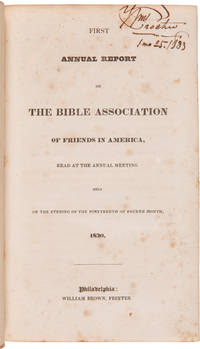
1821réf. 61985Various locations and publishers as noted below. 1821-1834. Collection of Quaker Pamphlets Compiled by a Baltimore Friend An interesting sammelband consisting of twenty-nine tracts published variously between 1821 and 1834 all relating in one way or another to the Society of Friends and bound in a matching set of two volumes. The volumes and many of the bound-in pamphlets bear the handwritten signature of "Wm Procter" and each volume of texts is preceded by a table of contents written in ink in the same hand. Some pamphlets also note the year Procter acquired them. The compiler of these two volumes was almost certainly William Procter 1780-1860 of Baltimore Maryland. Born in York England Procter arrived in Baltimore in 1796 at the age of sixteen. He married Anna Wilson in 1809 and together they had six children. Procter was a hardware merchant and an active member of the Baltimore Yearly Meeting of the Society of Friends. A death notice in the January 17 1860 issue of the Baltimore Sun described Procter as "a venerable and highly esteemed member of the Society of Friends Orthodox and the oldest hardware importer of Baltimore" distinguished for his "unobtrusive manners and integrity of character." The American Annual Monitor a publication of the Society of Friends in America noted that Procter was "much attached to our religious Society and filled many stations in the church to the satisfaction of his friends." The present collection of tracts and pamphlets reflects Procter's involvement and interest in the affairs of the Baltimore community of Friends. From the published minutes of the Baltimore Yearly Meeting documenting the activities of the Society and polemical tracts relating to the bitter theological controversies that divided the Friends community to pamphlets treating some of the issues and institutions in which members of the Baltimore Meeting were personally financially and politically invested the pamphlets herein offer a unique glimpse into American Quakerism in the 1820s and 30s. Included are pamphlets written in both condemnation and defense of Job Scott a Quaker preacher mystic and quietist from Providence Rhode Island as well as a host of pamphlets concerning the Hicksite schism that splintered the Quaker community in the 1820s. Also included is a publication commemorating the establishment of McKim's School in Baltimore a charity school funded by Quaker John McKim and his sons Isaac and William and another pamphlet on the collapse of the Union Bank of Maryland headed by Baltimore Quaker Thomas Ellicott. Most of the pamphlets were published either in Baltimore or Philadelphia with others published - one each - in Wilmington Delaware; Trenton New Jersey; and Mount Pleasant Ohio. A handful of others lack publication information. Early printer's imprints include those of William Brown Philadelphia Thomas Kite Philadelphia T. Murphy Baltimore and R. Porter & Son Wilmington. There is a total of twenty-nine separate works three of them duplicates across the two volumes fourteen in one and fifteen in the other. The titles in the order in which they appear are: First volume: 1 First Annual Report of the Bible Association of Friends in America Read at the Annual Meeting Held on the Evening of the Nineteenth of Fourth Month 1830. Philadelphia: William Brown 1830. 133pp. SMITH FRIENDS' BOOKS I:780. AMERICAN IMPRINTS 531. 2 Second Annual Report of the Bible Association of Friends in America Read at the Annual Meeting Held on the Evening of the Eighteenth of Fourth Month 1831. Philadelphia: William Brown 1831. 31pp. SMITH FRIENDS' BOOKS I:780. 3 Third Annual Report of the Bible Association of Friends in America Read at the Annual Meeting Held on the Evening of the Sixteenth of Fourth Month 1832. Philadelphia: William Brown 1832. 17pp. SMITH FRIENDS' BOOKS I:780. 4 An Appeal to the Society of Friends in Behalf of The Bible Association of Friends in America. Philadelphia: William Brown 1832. 72pp. SABIN 86036. AMERICAN IMPRINTS 11363. SMITH FRIENDS' BOOKS I:780. 5 A Declaration of the Yearly Meetings of Friends Held in Philadelphia Respecting the Proceedings of Those Who Have Lately Separated from the Society: and Also Shewing the Contrast Between Their Doctrines and Those Held by Friends. Philadelphia: Thomas Kite 1828. 32pp. SABIN 19183. AMERICAN IMPRINTS 33301. 6 The Testimony of the Society of Friends on the Continent of America. Philadelphia: Joseph Rakestraw 1830. 36pp. AMERICAN IMPRINTS 1508. SABIN 86070. SMITH FRIENDS' BOOKS I:780. 7 A Letter from Luke Howard of Tottenham Near London to a Friend in America; Containing Observations upon a Treatise Written by Job Scott entitled Salvation by Christ &c. N.p. 1825. 20pp. SMITH FRIENDS' BOOKS I:982. 8 A Letter from a Friend in America to Luke Howard of Tottenham Near London in Which the Character of Our Late Friend Job Scott Is Vindicated and Defended and His Doctrines Shown to Be Consistent with Scripture and Sound Reason. In Reply to a Letter Addressed by Luke Howard to the Author. N.p. 1826. 54pp. plus errata leaf bound in. SABIN 78289. SMITH FRIENDS' BOOKS I:943. 9 Charter of M'Kim's School Incorporated by The General Assembly of Maryland December Session 1820: with the By-Laws of the Trustees of That Institution. Baltimore: T. Murphy 1821. 15pp. including in-text illustration plus embossed seal of the school on separate slip of paper bound in. OCLC records only three copies at Yale Duke and the Library Company of Philadelphia. AMERICAN IMPRINTS 5889. 10 Owen Robert Dale: Letters Addressed to William Gibbons of Wilmington Del. in Reply to "An Exposition of Modern Scepticism;" Together with an Address to the Society of Friends and a Letter to Eli Hilles Benj. Ferris and Others. First Published in the F. Enquirer. Philadelphia: J.A. M'Clintock 1830. 24pp. AMERICAN IMPRINTS 2920. 11 Gibbons William: An Exposition of Modern Scepticism in a Letter Addressed to the Editors of the Free Enquirer. Wilmington De.: R. Porter and Son 1829. 48pp. AMERICAN IMPRINTS 38754. 12 Gould M.T.C.: The Friend or Advocate of Truth Extra. Facts from M.T.C. Gould Respecting Isaac T. Hopper caption title. Philadelphia 1831 16pp. 13 Defence of Isaac T. Hopper Against the Aspersions of Marcus T.C. Gould half title. N.p. N.d. 12pp. 14 Address of the Sufferers of the Eastern District of the City of Baltimore to the Yearly Meeting Held in Baltimore 10th Month 28th 1822. N.p. 1822. 24pp. OCLC locates only five copies. AMERICAN IMPRINTS 8778. Second volume: 15 Extracts from The Minutes of Baltimore Yearly Meeting caption title. N.p. 1833. 21pp. SMITH FRIENDS' BOOKS I:776. 16 Extracts from The Minutes of Baltimore Yearly Meeting caption title. N.p. 1831. 23pp. SMITH FRIENDS' BOOKS I:776. 17 Extracts from The Minutes of Baltimore Yearly Meeting caption title. N.p. 1830. 12pp. SMITH FRIENDS' BOOKS I:776. 18 Extracts from The Minutes of Baltimore Yearly Meeting caption title. N.p. 1829. 15pp. SMITH FRIENDS' BOOKS I:776. 19 Bates Elisha: The Incorporation of Ohio Yearly Meeting for the Purpose of Establishing a Boarding School Defended: or an Explanation of the Application Made by Friends to the Legislature of Ohio. Mount Pleasant Oh. 1833. 23pp. AMERICAN IMPRINTS 17684. 20 Foulke Joseph: Friends' Almanac for the Year of our Lord 1834. Being the Second After Leap Year…. Philadelphia: Evan Lewis 1833. 29-48pp. AMERICAN IMPRINTS 18930. DRAKE 11877. 21 Bates Elisha: A View of the Sentiments of Elias Hicks Respecting Future Rewards and Punishments. Philadelphia: Thomas Kite 1829. 16pp. AMERICAN IMPRINTS 37723. 22 Review of a Letter from Elias Hicks to Dr. N. Shoemaker. Fourth Edition. Philadelphia: Thomas Kite 1829. 28pp. AMERICAN IMPRINTS 40251. SMITH FRIENDS' BOOKS I:943. 23 A Review of Elias Hicks' Letter to Thomas Willis on the Miraculous Conception of Our Lord and Saviour Jesus Christ. Philadelphia: Thomas Kite 1829. 27pp. 24 Epistles and Testimonies Issued by the Yearly Meetings of Friends in North America; Setting Forth Their Faith Respecting the Holy Scriptures and in the Divinity and Offices of Our Lord and Saviour Jesus Christ; Shewing That the Antichristian Doctrines of Those Who Have Lately Separated from the Society are Repugnant Thereto. Philadelphia: Thomas Kite 1828. 83pp. AMERICAN IMPRINTS 33295. SABIN 86056. SMITH FRIENDS' BOOKS I:779. 25 Another copy of The Testimony of the Society of Friends on the Continent of America. Philadelphia: Joseph Rakestraw 1830. 36pp. 26 The Decision in a Cause Decided in the Court of Chancery of the State of New Jersey between Thomas L. Shotwell Complainant and Joseph Hendrickson and Stacy Decow Defendants caption title. Trenton N.J.: P.J. Gray 1832. 90pp. Likely extracted from Wood George and Isaac H. Williamson The Society of Friends Vindicated: Being the Arguments of the Counsel of Joseph Hendrickson in a Cause Decided in the Court of Chancery of the State of New Jersey between Thomas L. Shotwell Complainant and Joseph Hendrickson and Stacy Decow Defendants. By George Wood and Isaac H. Williamson Counsellors at Law. To Which Is Appended the Decision of the Court. Trenton N.J.: P.J. Gray 1832. "An important case relating to a dispute between Orthodox and Hicksite Friends over funds belonging to the Society before the division" - SABIN. AMERICAN IMPRINTS 17135. SABIN 105026. FELCONE COLLECTION 1435. 27 Another copy of Address of the Sufferers of the Eastern District of the City of Baltimore to the Yearly Meeting Held in Baltimore 10th Month 28th 1822. N.p. 1822. 24pp. 28 Another copy of Gould M.T.C.: The Friend or Advocate of Truth Extra. Facts from M.T.C. Gould Respecting Isaac T. Hopper caption title. Philadelphia 1831 16pp. 29 Johnson Reverdy: Reply to a Pamphlet Entitled "A Brief Exposition of Matters Relating to the Bank of Maryland" with an Examination into Some of the Causes of the Bankruptcy of That Institution. Baltimore: Jas. Lucas & E.K. Deaver 1834. 54251pp. AMERICAN IMPRINTS 25136. SABIN 36271. Together the pamphlets provide a comprehensive look at the Society of Friends in Baltimore and in the United States more broadly between 1821 and 1834. Bound in two volumes. Contemporary three-quarter calf and marbled boards spines gilt. Boards rubbed shelfworn corners and spine ends worn. Intermittent tanning foxing and staining. Very good overall. The American Annual Monitor for 1861; or Obituary of the Members of the Society of Friends in America for the Year 1860. No. 4 New York 1861 p.145. "Death of an Aged Citizen. – Mr. Wm Proctor sic" in The Sun Baltimore MD January 17 1860. hardcover
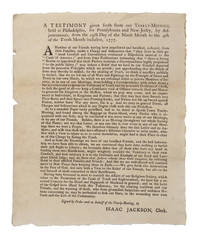
1777réf. 69134Philadelphia. 1777. Calling for the Rights of Conscientious Objectors and the Release of Exiled Quakers A rare broadside concerning the so-called "Quaker exiles" the Philadelphia Friends who were rounded up held without hearing and banished to the Virginia frontier in 1777–1778 during the height of the American Revolution. Signed in type by clerk Isaac Jackson on behalf of the Yearly Meeting the broadside calls for the release of "A Number of our Friends" who have recently "been imprisoned and banished unheard from their Families under a Charge and Insinuation that 'they have in their general Conduct and Conversation evidenced a Disposition inimical to the Cause of America.'" When war broke out between Britain and its North American colonies many Quakers remained steadfast in their religious commitment to pacifist principles refusing to pay taxes bear arms or take oaths of allegiance on behalf of the Patriot cause. This pacifism was met with suspicion by American Revolutionaries who accused Quakers of secretly supporting the British. In August and September 1777 with Philadelphia under imminent threat of capture by the enemy Quakers became the victims of growing persecution. Patriot suspicions were seemingly confirmed when on August 25 1777 the Continental Congress received a letter from Major-General John Sullivan reporting the discovery of several documents signed "the Spank-town Yearly-Meeting" implicating the Society of Friends in passing sensitive military information to the British. Never mind that no such Meeting at Spanktown existed or that the documents were likely fabricated by someone intent on maligning Quakers. The letter together with the incriminating documents were immediately referred to a committee which in its report concluded that the actions of "a number of Quakers of considerable wealth.render it certain and notorious that those persons are with much rancour and bitterness disaffected to the American cause" and that since those persons might be inclined "to communicate intelligence to the enemy and in various other ways to injure the councils and arms of America" they therefore ought to be considered a risk "to the public safety" Ford. The committee recommended that "the executive powers of the respective states.apprehend and secure all persons as well among the people called Quakers as others who have in their general conduct and conversation evidenced a disposition inimical to the cause of America" Ford. On August 28 the Congress approved the committee's recommendation. Three days later on August 31 the Supreme Executive Council of Pennsylvania in response to the resolution in Congress called for the arrest of forty-one people among them some of the city's most prominent and wealthy Quakers. Following their arrest in early September the prisoners were held for several days at the Philadelphia Masonic Lodge pending their removal to Virginia. The prisoners were offered release on condition that they swear or affirm allegiance to the Commonwealth of Pennsylvania but some refused. On September 10 the twenty remaining prisoners nearly all of them either Quakers or disowned former Quakers were banished from Philadelphia and sent to the Virginia frontier. En route the exiles were granted writs of habeas corpus by Chief Justice Thomas McKean of the Pennsylvania Supreme Court but these were denied. The next day the Pennsylvania Assembly passed a bill suspending habeas corpus entirely. The prisoners arrived in Winchester Virginia on September 29. They were released the following April in the face of mounting public pressure but only after two had died in exile. The present broadside is a product of the "extensive publishing campaign" that helped secure the Quaker exiles' release Whidbee. The broadside serves first to reiterate the Friends' position of pacifism and neutrality to remind the public that Quakers "are led out of all Wars and Fightings by the Principle of Grace and Truth in our own Minds by which we are restrained either as private Members of Society or in any of our Meetings from holding a Correspondence with either Army." The authors explain that Quakers are called "to spread the Testimony of Truth and the peaceable Doctrines of Christ to seek the good of all." They then go on to address the fabricated documents recently discovered by the Continental Army and to combat the resulting spread of misinformation: "As to a nameless Paper lately published said to be dated at Spank-Town Yearly-Meeting and found among the Baggage on Staten-Island every Person who is acquainted with our Stile may be convinced it was never wrote at any of our Meetings or by any of our Friends." The authors go on to note that "there is no Meeting throughout our whole Society of that Name; nor was that Letter or any one like it ever wrote in any of our Meetings since we were a People." Finally the Yearly Meeting pleads for the release of "our banished Friends" who they insist "have done nothing to forfeit their just Right to Liberty." OCLC locates at least six copies at Yale University the Society of the Cincinnati the Friends Historical Library Florida Atlantic University the Library of Congress and Princeton University. Additionally we find one copy at Brown University and two at the Library Company of Philadelphia. A rare broadside marking an important moment in the history of civil liberty religious freedom habeas corpus and conscientious objection in America. Old folds two horizontal and one vertical. Very minor splitting to one fold affecting text without loss. Light toning. Near fine. SABIN 94920. EVANS 15302. HILDEBURN 3638. SMITH FRIENDS' BOOKS I p.762. ESTC W5972. OCLC 1365079001 27103627 1268543044. Jack D. Marietta The Reformation of American Quakerism 1748–1783 Philadelphia: Univ. of Pennsylvania Press 1984 pp.240-44. Arthur J. Mekeel "The Relation of the Quakers to the American Revolution" in Quaker History Vol. 65 no. 1 Spring 1976 pp.3-18. Robert F. Oaks "Philadelphians in Exile: The Problem of Loyalty during the American Revolution" in Pennsylvania Magazine of History and Biography Vol. 96 no. 3 July 1972 pp.298-325. Paige L. Whidbee "The Quaker Exiles: 'The Cause of Every Inhabitant'" in Pennsylvania History: A Journal of Mid-Atlantic Studies Vol. 83 no. 1 Winter 2016 p.29. Worthington Chauncey Ford ed. Journals of the Continental Congress 1774–1789 Vol. VIII May 22–October 2 1777 Washington: Government Printing Office 1907 pp.694-95. unknown
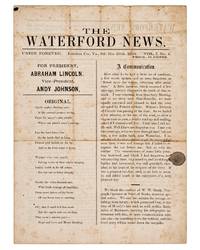
1864réf. 3090Loudon VA: Published by "Sarah Lizzie & Lida 1864. First edition. custom folder. Good. THE UNION UNDERGROUND WOMEN'S NEWSPAPER OF CONFEDERATE VIRGINIA: A remarkable Union newspaper written and edited by three young Quaker women inside Confederate Virginia - this issue prominently endorsing Abraham Lincoln for reelection. An extraordinary survival from one of the most remarkable journalistic enterprises of the Civil War: an underground Union newspaper conceived written edited and distributed by three young Quaker women living within Confederate Virginia. Sarah A. Steer 1837-1921 and sisters Elizabeth "Lizzie" Dutton 1839-1915 and Emma Eliza "Lida" Dutton 1844-1913 lived in Waterford Loudoun County a strongly Unionist Quaker community repeatedly exposed to Confederate incursions. Determined that their Union sympathies "should not be suppressed" the three women reported edited published and distributed the newspaper arranging for its printing across Union lines. Their copy was carried across the Potomac into Maryland where the paper was printed by the Baltimore American whose editor was an old friend of the Dutton family. The women themselves described the enterprise as a "hazardous undertaking." Their stated purpose was "to cheer the weary soldier and render material aid to the sick and wounded" with proceeds from the ten-cent cover price benefiting the United States Sanitary Commission. Only eight issues appeared during the final year of the Civil War. This August 1864 issue underneath the bold masthead proclaiming "UNION FOREVER" opens with a prominent political endorsement: FOR PRESIDENT ABRAHAM LINCOLN. Vice-President ANDY JOHNSON. Appearing less than three months before the presidential election the announcement was an explicit declaration of Union political allegiance by three young women publishing within a Confederate state. MOSBY'S RAIDERS AND GUERRILLA WARFARE: Several articles in this issue document the reality of guerrilla warfare surrounding Waterford. Mosby's Raiders-also called Mosby's Rangers-were Confederate cavalrymen commanded by John Singleton Mosby the officer known as the "Gray Ghost." Officially the 43rd Battalion Virginia Cavalry they specialized in quick raids behind Union lines principally in northern Virginia. They attacked supply and communication routes captured soldiers and horses and dispersed to evade pursuit. They were an organized Confederate military unit using guerrilla tactics. Under the heading "ROBBERY" the editors report that Mosby's men raided Point of Rocks and intercepted a letter containing $14 in subscriptions sent by soldiers of the 1st Eastern Shore Maryland Infantry. Their response is pointedly sarcastic: "Now this chivalric son of the South who wages no war against women appropriated the money to his own use." They nevertheless assure the soldiers that each subscriber remains entitled to "the thanks of the Editors." Elsewhere a summary of recent events recounts Mosby's July raid on Point of Rocks and describes Waterford as having been "surrounded by rebels with their bragging" and cut off from communication until Union troops returned. The paper also praises telegraph operator W. W. Shock for carrying his telegraphic equipment toward Baltimore in an effort to maintain Union communications while Confederate forces controlled the surrounding routes. WAR AS EXPERIENCED BY WOMEN: Perhaps most compelling is the opening editorial in which the editors describe the arrival of Union soldiers after Waterford had been surrounded by Confederate forces. The townspeople opened their homes and supplied the troops with food and clothing. The women recall: "Flags and handkerchiefs waved as the soldiers passed by and the citizens felt joy unspeakable." The editorial offers an unusually immediate female-authored account of civilian life in a contested Southern community: soldiers moving through the streets Confederate forces nearby shortages divided loyalties and local women participating directly in the Union war effort through journalism. NATIONAL RECEPTION - AND PRESIDENT LINCOLN: The little newspaper quickly attracted attention well beyond Loudoun County. The present issue itself notes complimentary notices in the Virginia State Journal and the Bucks County Intelligencer. More strikingly under the heading "REBEL LITERATURE" the editors reprint a notice from the Baltimore American which praises The Waterford News and identifies its editors-"Sarah Lizzie and Lida"-as "three brave warm-hearted Union girls." Its reputation spread still further. According to the Waterford history Horace Greeley's New York Tribune praised the paper while a Maryland regiment forwarded early issues directly to President Lincoln. The accompanying letter reported that by late June the "fair Editresses" had already raised nearly $1000 for the Sanitary Commission-an amount suggesting substantial circulation for such a locally produced wartime newspaper. Thus this was not merely a village newspaper operating in isolation: within weeks of its founding the work of three young women in Waterford had reached both the national press and the White House. FROM CIVIL WAR JOURNALISM TO RECONSTRUCTION: Sarah Steer's activism continued immediately after the war. She sought funds from the Freedmen's Bureau Philadelphia Quakers and local supporters to establish a school for freed children. Before the schoolhouse itself was completed she began teaching in her side yard in 1865 and is identified as the "first teacher of black children" in Loudoun County by The Waterford Foundation. The trajectory is remarkable: from editing an underground Union newspaper during the Civil War to educating formerly enslaved children at the beginning of Reconstruction. RARITY: Only eight issues of The Waterford News were published and individual original issues are exceptionally uncommon in commerce. The present issue is particularly compelling for its combination of the dramatic "UNION FOREVER" masthead explicit Lincoln-Johnson endorsement eyewitness reports of Mosby's operations substantial editorial writing by the three women themselves contemporary notices documenting the paper's national reception and the remarkable fact that earlier issues had already reached President Lincoln. The Waterford News. Vol. I No. 4. Waterford Loudoun Co. Virginia: Published by "Sarah Lizzie & Lida" August 20 1864. One single folding sheet approximately 15.5x10.75 inches creating four pages 7.75x10.75 in when folded. Some foxing and light overall toning; two minor ink blots; short separations at fold intersections without significant text loss; minor marginal handling wear. A remarkable survival. Published by "Sarah, Lizzie & Lida unknown
1855réf. BK0035New Jersey 1855. Appx. 43 items: letterbook 26 documents related to properties in New Jersey and 15 images. Letterbook 9 x 7 ¼ inches 58 pp totaling appx. 17500 words. Front cover detached and covers generally quite worn though spine intact contents excellent; overall very good plus. Document conditions vary fair to excellent with some damaged or partial generally very good minus. A full inventory of the contents of the letterbook and legal documents is available on request. Very good. A multigenerational archive of the Woolman family and its allied Hunt Burr Haines and other families documenting nearly a century and a half of Quaker family life in southern New Jersey. The collection is highlighted by a letterbook preserving copies of letters from prominent Quaker minister and colonial-era abolitionist John Woolman 1729-1772 his cousin and fellow minister Wiliam Hunt 1733-1772 and several others written to John Woolman's brother Uriah. These include a number of unpublished letters from authors including Woolman Hunt and others. The collection also contains a number of legal documents relating to family land holdings including an illustrative 1769 document concerning the division of a tract of land inherited by the Woolman brothers on the death of patriarch Samuel Woolman in 1750. Besides several memorials poems and copies of letters of Mary Peisly the letterbook contains two letters from Woolman that have not been published in full eleven unpublished letters from Hunt and two unpublished letters from friends in England concerning Woolman and Hunt's deaths there from smallpox in 1772. The letterbook was likely maintained by Uriah Woolman's wife Susanna Burr Woolman as an inscription on the first page reads "Phebe Woolman 1st Mo. 10th 1823 / given by Susana Woolman"; Susana Woolman was Phebe Woolman's great aunt. A full inventory of the contents of the letterbook and the legal documents can be found at the end of this description. Unpublished Letters of William Hunt 1758-1771 The unpublished Hunt letters come from the late 1750s to early 1770s and trace the North Carolinian's path along the Quaker networks of the US's east coast up to New York and down to the "very pleasant" Delaware capes May 5 1771 and finally to Europe. Hunt John Woolman's cousin was born in Pennsylvania and emigrated to Virginia and eventually the Quaker settlement of New Garden now Greensboro North Carolina. He began his ministry before he turned fifteen and by twenty had begun traveling to minister; his Memoirs state that he visited meetings at every North American colony.1 Like his cousin John Woolman Hunt preached against enslavement. He reported feeling so disturbed by the practice while in Pennsylvania that he nearly abandoned food and drink entirely feeling that consuming goods made by enslaved people would be participating in their oppression.2 The first two letters from Hunt in the letterbook were likely sent from home in New Garden though they indicate that he had already made at least one journey north; in the first undated letter he writes: "The little contract of firm friendship Occasion'd by our small Acquaint's in this Remote Land Induces my hand to paper at this time to Lett thee know that tho' the distance is great and the days are many since I Saw thee we being depriv'd of personal and almost litteral Converse with each other yet that Spring of infinite love that first cemented our hearts together Remains with me unchangable in the hidden Life of our God .". N.d. He states that he feels drawn "in the Spring of Life towards your Land but the Time when as Yet I know not". The next letter is dated to 1758 and also seems to report on home affairs and a visit to New Garden by Uriah Woolman: "we are well in General at this time I also heard from Cousin Grantt not long since; they were then well and settled at the Watterrees Meeting Brother Clearor had the Misfortune to have his House and most of his Household Goods Burnt and allso a pretty Compleat New House that he built since thou wast here .". August 13 1758 He again comments on coming north stating that "I dont see my way quite Cleare in Coming to that province this fall tho' I have made some preparation for it and expect it to be my Lot ere long." In 1761 he traveled to Virginia Maryland Pennsylvania and New Jersey.3 There are two letters to Woolman in the letterbook sent from this journey the first reporting on meetings: "Dear cousin by this I may inform thee that I am favour'd with health through mercy I have visitted meetings as far as Maiden Creek likely Pennsylvania and this day am going to the forest through gracious help I am come thus far pretty safe having had some satisfactory meetings; Deare Cousin it is the desire of my mind that though and I stand in real obedience to our duty which brings true peace and perfect Liberty of mind not to be crampt or fetter'd with those things that suddenly end nor subject unto our own Passions we might become freeborn of that City which John Saw .". July 31 1761 The next reports on a planned visit to the Woolmans: "I hereby convey my dear love to thee as also to lett the know that through gracious favour I am as well as common and intend to be in Town on day come Week if the Lord permitt; if thou hast opportunity please to let Cousin Asher know the Time as he desired me I may further acquaint thee that my companion intends directly home from Town and if it should be agreeable I should be glad if thou or Cousin Asher could go with me into Buck's County". August 13 1761 The letterbook states that this letter was sent from "Willinstown". This is possibly the Willistown meeting Newtown Square Pennsylvania; though that meetinghouse was constructed in 1798 its website states that there was a history of Quaker worship there before its construction.4 It could also be from Williamstown New Jersey. Both locations are fairly close to the Woolmans' Mount Holly homestead. The next two letters dated to 1766 were likely both written from home with one identified as sent from New Garden. This would have been during one of the brief periods of Hunt's life wherein he did not feel called to travel instead spending the time with his young family. In the earlier letter dated April 11 Hunt tells Woolman "I conceive my spirit often united in a secret sympathy with thy deep trials and close besetments". In the later dated letter he weighs in on the value of some land owned by Woolman: "I understood by John Unthank that thou desired I with some others would view thy Land and send an account of our Judgment upon the price it is the mind of many that One hundred pounds is the Value but I think if thou would send Orders to sell it for One hundred and twenty pounds it would fetch it readilly". September 3 1766 The next letters date from 1771 NB: four letters are missing according to the letterbook's numbering meaning likely a single page has been lost and find Hunt on the journey of ministry that would take him to England Holland and his eventual death. In January he reports: "Much esteemed Relations by these you may understand how far we have got on our journey we have been at most of the meetings along shore up to Raway likely Rahway New Jersey where Last night at New York it looks rather likely to my present view we shall return to your City towards spring in order to Embark but leave it to the wise disposer who best knows his Secret purposes concerning us". January 11 The next was written from the Delaware capes where Hunt and his companion nephew Thomas Thornburgh were aboard the Mary and Elizabeth.5 Hunt writes: "After my very dear Love saluting thee and thy Wife these may inform that we are well had a good and Comfortable Night are likely to get past the Capes this Evening Divine regard extending his sweetning presence which seems to make this little habbitation likely to be very pleasant and easey beyond what I expected". May 5 The latest unpublished Hunt letter was sent from London in June of that year and appears to be the first written to Uriah Woolman upon Hunt's and Thornburgh's arrival. Hunt is less than impressed with the English Friends: "I have to Inform thee that we are safe arrived in London having had a short and very agreeable passage we Landed in this City the 28th day att 6 OClock in the morning after parting with thee which was little more than twenty Seven days I have been at a few meetings wherein there seems a number of well disciplin'd friends but these alass are every where but small in comparison of the great number who profess the Glorious Truth but being ignorant of its working are Dead weights and Burthens to those who are Baptis'd in and with the Seed . my dear companion was very Sick the first two Weeks at Sea but after got ; Our Capt. Treated us with great respect". June 4 1771 Unpublished Letters of John Woolman 1760 and 1763 Woolman's letters follow a similar tack to Hunt's though he is more scrupulous about including the full names of Friends he encounters making them promising material for further research into the northeast's Quaker networks. He writes from Nantucket in June 1760: "My companions & I are both middling well in health and expect if way open to go from this place tomorrow Ann Grant and Mercy Richman are here and both middling well. We Samuel & I expect if Providence permit to be at New Port Quarterly Meeting on the Tenth of Next Month and then Turn homewards by the way of Oblong in York Government We were in Company at Rhode Island with J. Storer E Shipley & Th Foster at their Yearly Meeting the 16th 6mo. who are all middling and are Gone toward Boston --" June 30 1760 In this same letter the former merchant Woolman makes a remark characteristic of his views on wealth and accumulation expressed to his merchant brother Uriah: "I have had renew'd occasion since I left home to consider the excellency of that Doctrine Of being Satisfied of the Trueness of Things or in Scripture phrase 'Having food and Raiment therewith to be content' the desire of Wealth and outward Greatness leads many into snares hard to get out of; for whose sake I have in their Journey been Often sorrowful". Fixated on the Quaker belief in plain living Woolman did not object to commerce per se but instead believed that the practice could only be "safe" if "we retain a single Eye to the Real usefulness of Trade And use it no further than it may be Beneficial to True Christians" May 3 17596. In a later letter he expands: "A Belief in the Allsufficiency of God and in his care in providing for those that fear him hath often afforded comfort to me not only in regard to my self but also with Relation to my fellow creatures whom I love and who have the same need of this Fatherly help as I have. They who dwell on Lands as their Inheritance who Eat the food which they raise and wear Garments of their Own Work and of many others appear to be the least exposd to Temptation; Even these stand dayly in need of Divine Assistance to support their Minds in Uprightness before the Lord. But when I think on the Various kinds of Trafic which are in some degree connected with that spirit which works in disobedient children and on the difficulties and Temptations which attends Trade in the present Condition of Countries I have often felt a particular tenderness towards and care for those who depend on Merchandize for a living And when my mind have been thus filled with care and affection mix'd with a feeling of the Manifold difficulties Attending Business A fresh sense of Gods goodness in guiding his People in Quallifying with sound Judgment to distinguish things which differ; and in preserving them from inward dangers hath felt very precious to me and thou hath often on this Account been the Object of my hearty desires". June 4 17637 This letter is quoted partially in Geoffrey Plank's John Woolman's Path to the Peaceable Kingdom 2012 but to our knowledge has never been published in full. Woolman had had a successful retail business in Mount Holly but had mostly retired from business to devote his time to ministry. In his Journal he discusses how the experience during his merchant years of writing a bill of sale for an enslaved person belonging to a fellow Quaker had solidified his abolitionist beliefs.8 In addition he felt strongly that the drive to acquire wealth and land was in itself harmful and warned fellow Quakers against the practice including acquisition with the aim of distributing it through inheritance.9 Woolman Family Land Division Document 1769 In the context of John Woolman's beliefs the 1769 land document is especially interesting. Samuel Woolman had like many other Quakers in the area acquired significant land holdings specifically to distribute them to his sons-of which by the time John left home there were seven alongside six sisters.10 The document divides the land as follows: "Asher Uriah Jonah and Abraham Woolman Made an assay to divide their Cedar Swamp into Two Equal parts: One half to be held by Asher & Abraham. And the Other half by Uriah & Jonah. And in order thereto Run a Line though ye Swamp from the north Side about Thirteen Chains & half from ye Lower Corner of ye Upper fifty Acres: South thirty nine illegible to a post for a Corner of ye South side of ye Swamp. Which is agreed shall Stand at a Division Line between ye Two Lots; & the day following they all mett at Jonahs House; And there Unanimously agreed: that Assher & Abraham Should hold as their full part and Share of ye Swamp: That Lot which Lays on ye Easterly side of sade Line And that Uriah & Jonah shall have for their text missing Residence of sd. Swamp saying on ye text missing That part of ye lower fifty acre text missing sold. --- And also at ye Division Asher & Abraham Agrees that Uriah & Jonah shall have one half of ye part of ye money due from Jos. Moore for a Lot sold him by Company. In Consideration of ye parts being thought to be of Less Value yn-ye other. NB It is agreed yt ye above mentioned Line through ye Swamp shall be Esstablesh as it now stands & ye trees mark'd where the Line is open: without any alteration: whether ye Line should prove straight or not As a Confirmation of ye above the Parties have here unto set their hands & seals Sealed & Deliver'd Abner Woolman in the illegible of Uriah Woolman Sarah Mullen Jonah Woolman Aaron Wills Woolman" For his part John Woolman had already inherited his portion of his father's land in 1750 and it was this land that financially supported his ministry as he steered away from what he called "the road to large business."11 He turned to various vocations primarily with an eye not to accumulation but to the basic need to provide a living for his family and support his ministry mainly through small-scale agriculture and a business in tailoring. The document itself is possibly in Woolman's own hand; checking against attributed documents available online suggests a similarity between the handwritings though with differences in some letters. In fact research suggests that Woolman had drawn up a large number of legal documents in his life with seventy identified and suggesting the existence of many more.12 Moreover it is interesting to see a legal document from the family outlining the very process warned against by Woolman. Two Unpublished Accounts of Hunt's and Woolman's Deaths 1772 In 1771 Woolman would travel to England and Holland and join with Hunt and Thornburgh where like his cousin he would contract smallpox dying within a month of Hunt in the fall of 1772. Thornburgh would also die from smallpox after a visit to Europe in 1787.13 William Tuke's letter to Rubin Haines about Woolman's death included in the letterbook has been published.14 However the letterbook also contains two lengthy letters on their deaths which from our research do not seem to have been published. One was sent from James King of Newcastle to Thomas Smith of London and describes Hunt's final days and death in detail: "Wm Hunt came to my house on the 26th past from Holland with his Nephew Thomas Thornbrough. Accompanied by Morris Berbick of Settle North Yorkshire; they attended our week days meeting on the 27th Return'd to my house with several friends About a Mile from Town and dined and appear'd to be very well next day he complaind of his head and after dinner stepd into Town . And next morning he layed Longer than usual I stept into his room and found he was hott He told me he intended to go into the country to dine at my Brothers in a Carriage to prevent catching more cold; I said I could not give consent to that til my surgeon pronounced it safe for him to go; who upon paying of him a visit order'd him to keep close in bed all day being the 29th he grew worse on the 30th And then I call'd in a Physician to attend him; who discoverd the smallpox appearing on the 31st: for on the 29th & 30th he was extreamly sick and had a continual Braiding & Vomitting with a slow-fever they filled pretty well and appeard promising til Second day last the 7th Atho' they were of the confluent kind when he was first attack'd with the second feaver very smartly of the Putrid kind and indeed we almost lost hope then . The physitian attended twice a day and on the 7th three Times and staid with him from 5 till 10 OClock at Night and came next morning about 5 OClock discovering a great anxiety for the preservation of so valuable a Life And on the evening of the eighth instant I went to bed in good hopes of his getting through; but alass alass; I was call'd up before one this morning A Sudden alteration for the worse had taken place the fever run high and Just att 3 OClock he departed this Life; And make no doubt he is translated to his Eternal rest; to our deep concern and Sorrow for the Churches sake - and for the sake of his dear Wife and Eight Children but his Great Gain . Both Physician & Surgeon who constantly attended him remark'd the steady Calm and patient nammer wherein he bore his Affliction The former Saying this is a man of Men indeed the serenity of his countenance denoted the Tranquility of his mind Being rais'd from Earthly to contemplate on heavenly things - Saying about an hour before he departed on my hearing Friends Truth is over all - in a sweet frame of mind - being preserv'd sensible to the Last." September 9 1772 The second comes from Thomas Thornburgh himself. Thornburgh's letter also mentions the health of Sarah and Debbey Morris updates his recipient on the locations of Robert Willis Samuel Emlen and Samuel Neal and requests his letter be forwarded to John Pemberton Israel Pemberton John Parish and their families. He also opens with an account of Hunt's passing: "He was taken unwell the third day after our return from Holland where we spent about Nineteen days to Good satisfaction; as he express'd in his last illness on reflecting on our journey thereto; it seemed always to afford satisfaction; we thought when he was first taken ill it proceeded from a Cold he had got at Sea but in about three days it appear'd to be the smallpox; Then it was thought advisable for me to leave him which was a sore trial upon me but he would not allow me to be about him; tho' before he would always have me with him their was a skillful physician and Apothecary call'd in who did all they could but to no effect; there was two friends whom he lov'd much that attended him night and Day to the Last; He express'd much satisfaction in their Company and with their care over and for him; He was very full and continued about twelve Days in perfect resignation to the Lord's Will; And then Quietly departed this Life with these Expressions; Truth reins over all the 9th of the 9mo 1772." December 10 1772 At Hunt's funeral at the Newcastle Friends Burying Ground in September "there was a large and comfortable meeting upon the occasion in which there was several Living and Precious Testimonies born for the promotion of that Great cause for which he was engaged and did so faithfully labour to spread and propagate among the Children of Men". Thornbury then describes the final days of John Woolman: "Some time after the Burial of my Dear Uncle I came to York to their Quarterly meeting where I mett with our Aforesaid Friend he complaind a little but attended most of the sittings of the Meetings but grew worse And in a few days appear'd to be the smallpox. I was with him till after they began to come out upon which he was desireous I should leave him the perfect resignation and sweetness of his mind was truely comfortable I heard him say he did not know he had a Will in it either to Live or Die; he Continued 13 or 14 Days and then in A very sweet fame of Mind departed this Life without Sigh or Groan or Struggle; The 7th of the 10th Month and was deacently Buryd in Friends burying Ground at York the 9th of the Same; Some little time before his departure he Ask'd for Pen & Ink it being very difficult for him to speak Intelligibly And at several Times wrote thus I Believe my being here is in the Wisdom of Christ I know not as to Life or Death". Images The collection also includes thirteen images and one lock of hair held in a mother-of-pearl egg. Most are unidentified; the identified subjects belong to later generations of the Woolman family. A quarter-plate daguerreotype of Alan Wood Lukens 1836-1885 is captioned "grandfather of Rev. H.C. Lukens"; Alan Lukens's son Frank Lukens was married to Edith Starr Churchman the great-great-granddaughter of Jonah Woolman John Woolman's brother. Churchman and Lukens's child was the aforementioned H.C. Horace Churchman Lukens. A printed photograph of Edith Anna Woolman Jonah Woolman's great-granddaughter and Edith Starr Churchman's mother is captioned "grandmother of Rev. H.C. Lukens." Also identified is a framed photograph of Elizabeth M. Haines and her daughter Edith Anna Woolman. Haines was married to Thomas Burr Woolman Jonah Woolman's grandson. Unidentified are three ambrotypes four daguerreotypes three photographs one porcelain portrait and the lock of "Nana's" hair. 1 Memoirs of William and Nathan Hunt Taken Chiefly From Their Journals and Letters Uriah Hunt & Son 1858 19. 2 Memoirs 47-48. 3 Memoirs 37-38. 4 "History Of The Meeting House" Willistown Friends Meeting accessed September 7 2026 https://willistownfriendsmeeting.com/menu. 5 Memoirs 74. 6 From the letterbook; this letter appears in Friends' Review V no. 39 June 12 1852: 611. 7 From the letterbook; this letter is quoted in Geoffrey Plank John Woolman's Path to the Peaceable Kingdom University of Pennsylvania Press 2012 116 but to our knowledge has not been published in full. 8 John Woolman A Journal of the Life Gospel Labours and Christian Experiences of that Faithful Minister of Jesus Christ John Woolman Friends' Bookstore Philadelphia 1883 31. 9 Geoffrey Plank John Woolman's Path to the Peaceable Kingdom University of Pennsylvania Press 2012 91. 10 Plank John Woolman's Path 11. 11 John Woolman Memoir of John Woolman Chiefly extracted from a journal of his life and travels Tract Association of the Society of Friends 1856 13. 12 "John Woolman's Testamentary Experiences" Friends Journal 1 no. 18 October 1955 274-282. 13 Memoirs 24-25. 14 William Tuke "Letter from William Tuke On the Death of John Woolman" Friends' Miscellany vol. VIII no. 5 April 1836: 229-239. 15 Ethel Stanwood Bolton and Eva Johnston Coe American Samplers The Massachusetts Society of the Colonial Dames of America 1921 325. . unknown