Fox, CarolineBiblio.com

292 risultati
1882rif. 006205Philadelphia: J. B. Lippincott & Co 1882. Hardcover. Very Good . xxviii 378 p.; 20 cm. Publisher's dark red-brown cloth with gilt-stamped spine title; boards have bevelled edges. Black endpapers. Includes index. First American edition. Former owner's inscription on front free endpaper: "S. S. Stafford Feb. 1882." Former owner's bookplate on front fixed endpaper of Jack Fox with illustration of a fox with a book. Caroline Fox 1819-1871 a member of an English Quaker family recorded her observations of prominent scientists and intellectuals of her time including John Stuart Mill and Thomas Carlyle. Her father Robert Were Fox 1789-1877 was a geologist and inventor. In Very Good Condition: edges lightly rubbed; slightly cocked; minor loss at head of spine; clean and tight. J. B. Lippincott & Co hardcover
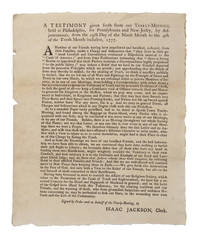
1777rif. 69134Philadelphia. 1777. Calling for the Rights of Conscientious Objectors and the Release of Exiled Quakers A rare broadside concerning the so-called "Quaker exiles" the Philadelphia Friends who were rounded up held without hearing and banished to the Virginia frontier in 1777–1778 during the height of the American Revolution. Signed in type by clerk Isaac Jackson on behalf of the Yearly Meeting the broadside calls for the release of "A Number of our Friends" who have recently "been imprisoned and banished unheard from their Families under a Charge and Insinuation that 'they have in their general Conduct and Conversation evidenced a Disposition inimical to the Cause of America.'" When war broke out between Britain and its North American colonies many Quakers remained steadfast in their religious commitment to pacifist principles refusing to pay taxes bear arms or take oaths of allegiance on behalf of the Patriot cause. This pacifism was met with suspicion by American Revolutionaries who accused Quakers of secretly supporting the British. In August and September 1777 with Philadelphia under imminent threat of capture by the enemy Quakers became the victims of growing persecution. Patriot suspicions were seemingly confirmed when on August 25 1777 the Continental Congress received a letter from Major-General John Sullivan reporting the discovery of several documents signed "the Spank-town Yearly-Meeting" implicating the Society of Friends in passing sensitive military information to the British. Never mind that no such Meeting at Spanktown existed or that the documents were likely fabricated by someone intent on maligning Quakers. The letter together with the incriminating documents were immediately referred to a committee which in its report concluded that the actions of "a number of Quakers of considerable wealth.render it certain and notorious that those persons are with much rancour and bitterness disaffected to the American cause" and that since those persons might be inclined "to communicate intelligence to the enemy and in various other ways to injure the councils and arms of America" they therefore ought to be considered a risk "to the public safety" Ford. The committee recommended that "the executive powers of the respective states.apprehend and secure all persons as well among the people called Quakers as others who have in their general conduct and conversation evidenced a disposition inimical to the cause of America" Ford. On August 28 the Congress approved the committee's recommendation. Three days later on August 31 the Supreme Executive Council of Pennsylvania in response to the resolution in Congress called for the arrest of forty-one people among them some of the city's most prominent and wealthy Quakers. Following their arrest in early September the prisoners were held for several days at the Philadelphia Masonic Lodge pending their removal to Virginia. The prisoners were offered release on condition that they swear or affirm allegiance to the Commonwealth of Pennsylvania but some refused. On September 10 the twenty remaining prisoners nearly all of them either Quakers or disowned former Quakers were banished from Philadelphia and sent to the Virginia frontier. En route the exiles were granted writs of habeas corpus by Chief Justice Thomas McKean of the Pennsylvania Supreme Court but these were denied. The next day the Pennsylvania Assembly passed a bill suspending habeas corpus entirely. The prisoners arrived in Winchester Virginia on September 29. They were released the following April in the face of mounting public pressure but only after two had died in exile. The present broadside is a product of the "extensive publishing campaign" that helped secure the Quaker exiles' release Whidbee. The broadside serves first to reiterate the Friends' position of pacifism and neutrality to remind the public that Quakers "are led out of all Wars and Fightings by the Principle of Grace and Truth in our own Minds by which we are restrained either as private Members of Society or in any of our Meetings from holding a Correspondence with either Army." The authors explain that Quakers are called "to spread the Testimony of Truth and the peaceable Doctrines of Christ to seek the good of all." They then go on to address the fabricated documents recently discovered by the Continental Army and to combat the resulting spread of misinformation: "As to a nameless Paper lately published said to be dated at Spank-Town Yearly-Meeting and found among the Baggage on Staten-Island every Person who is acquainted with our Stile may be convinced it was never wrote at any of our Meetings or by any of our Friends." The authors go on to note that "there is no Meeting throughout our whole Society of that Name; nor was that Letter or any one like it ever wrote in any of our Meetings since we were a People." Finally the Yearly Meeting pleads for the release of "our banished Friends" who they insist "have done nothing to forfeit their just Right to Liberty." OCLC locates at least six copies at Yale University the Society of the Cincinnati the Friends Historical Library Florida Atlantic University the Library of Congress and Princeton University. Additionally we find one copy at Brown University and two at the Library Company of Philadelphia. A rare broadside marking an important moment in the history of civil liberty religious freedom habeas corpus and conscientious objection in America. Old folds two horizontal and one vertical. Very minor splitting to one fold affecting text without loss. Light toning. Near fine. SABIN 94920. EVANS 15302. HILDEBURN 3638. SMITH FRIENDS' BOOKS I p.762. ESTC W5972. OCLC 1365079001 27103627 1268543044. Jack D. Marietta The Reformation of American Quakerism 1748–1783 Philadelphia: Univ. of Pennsylvania Press 1984 pp.240-44. Arthur J. Mekeel "The Relation of the Quakers to the American Revolution" in Quaker History Vol. 65 no. 1 Spring 1976 pp.3-18. Robert F. Oaks "Philadelphians in Exile: The Problem of Loyalty during the American Revolution" in Pennsylvania Magazine of History and Biography Vol. 96 no. 3 July 1972 pp.298-325. Paige L. Whidbee "The Quaker Exiles: 'The Cause of Every Inhabitant'" in Pennsylvania History: A Journal of Mid-Atlantic Studies Vol. 83 no. 1 Winter 2016 p.29. Worthington Chauncey Ford ed. Journals of the Continental Congress 1774–1789 Vol. VIII May 22–October 2 1777 Washington: Government Printing Office 1907 pp.694-95. unknown
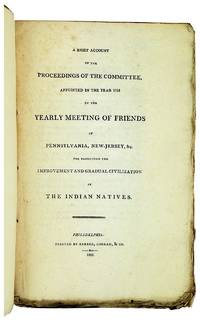
1805rif. 32962Philadelphia: Printed by Kimber Conrad & Co 1805. Very Good. Philadelphia: Printed by Kimber Conrad & Co. 1805. First Edition. Octavo; original grey wrappers; 451pp. Light wear to edges; general smudging; spine perished. Mild soiling and faint spotting else unmarked; terminal leaves unopened; about Very Good. Detailed report on the Friends' interactions with the Oneida Onandago and Cayuga nations focusing on attempts at farming and education. Includes many speeches to the Friends from Native American leaders including Chief Cornplanter with particular attention paid to farming techniques as well as trades such as blacksmithing and carpentry and a couple digressions on the effects of alcohol. Uncommon in retail. Sabin 34617. Printed by Kimber, Conrad, & Co unknown
1736rif. 000473London Eng: Assigns of J. Sowle 1736. First Edition. Very Good -. Title continued: "for Demands Recoverable by the Acts made in the 7th and 8th Years of the Reign of King William the Third for the more Easie Recovery of Tithes Church-Rates &c. Printed and Sold by the Assigns of J. Sowle at the Bible in George-Yard Lombard-Street." xii 2 189 1 p.: 1 table; 20 cm. 8vo. Half calf with six gilt-ruled spine compartments and a gilt-tooled leather label in the second compartment reading: Prosecution of Quakers. Marbled paper over boards. All page edges marbled. Inscription largely erased from front fixed endpaper. Published anonymously by Quaker Joseph Besse who produced a number of important volumes recording the legal woes of early English and Welsh Quakers. This volume describes the prosecutions of Quakers from 1696 to 1736 in England and Wales arranged alphabetically by county. Quakers were prosecuted for refusing to pay the annual tithe one tenth of their income and other support for the Church of England. In Very Good- Condition: cover is rubbed; spine is sunned; leather is starting to separated at the head of the spine and lacking small section of leather at head of spine; first and last leaves have soiling of corners and light foxing; pages are otherwise clean and tight. Assigns of J. Sowle unknown
rif. 0970137532.Gperfect. Good. Access codes and supplements are not guaranteed with used items. May be an ex-library book. unknown
1861rif. 011467New York: Tract Association of Friends / Samuel S. & William Wood 1861. 4" wide by 6" tall. Lower corners worn through else Very Good condition. Clean square tight unmarked copy. Inner hinges are sound. Biographical profiles of American Quakers who died in 1860 arranged alphabetically. Many listings are brief but others are quite substantial. For example the entry for Richard H. Thomas of Baltimore fills more than 13 pages. Original brown cloth with spine lettered in gold and covers blind-stamped. First Edition. Hardcover. Very Good condition. 204pp. Tract Association of Friends / Samuel S. & William Wood Hardcover
1856rif. 512651John W. Parker and Son 1856. Fifth Edition. Hardcover. VERY GOOD. An early printing of Trench's massively popular and influential study of the miracle accounts in the Gospels which was first published 10 years earlier in 1846. Ex-libris 'Friends' Library & Lecture Association Bristol'. 476pp. 8vo half navy polished calf over purple cloth burgundy morocco spin elabel stamped in gilt marbled edges. Extremities rubbed some typical light foxing heavier in the early pages; text clean and unmarked with sound binding. The Bristol Friends are an historic Quaker meeting first organized in 1654. This copy has their library rules bookplate to FPEP and lending label to RPEP noting 6 dates of issue from 1885-1900. John W. Parker and Son hardcover
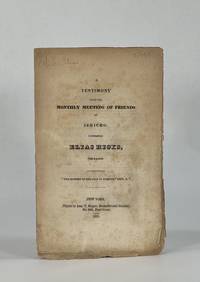
1830rif. 8959New York: Isaac T. Hopper 1830. Unbound. Very Good binding. Octavo. 8 pp. Folded sheet never bound; untrimmed. Separation at the folds of the outer two leaves; toning and soiling; pencil notations. A laudatory biography of Elias Hicks who had led a umber of Quakers into schism. Sabin 31718; American Imprints 1510. Isaac T. Hopper unknown
rif. 1332925790.Gpaperback. Good. Access codes and supplements are not guaranteed with used items. May be an ex-library book. paperback
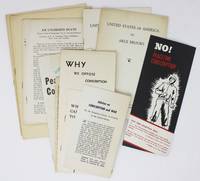
1954rif. 4307Philadelphia 1954. About very good. Thirty-five printed and typescript items approximately 150pp. total. Some staples old folds. Scattered contemporary ink stamps. Light toning and minor wear heavier in places. Scattered chipping and occasional short edge tears. A fascinating and scarce group of newsletters pamphlets and ephemera published by the American Friends Service Committee during and after World War II comprising thirty-five printed and typescript items. The Committee administered roughly one third of the camps in the Civilian Public Service system which was established to provide a means of non-military service to religious conscientious objectors during the war and also played a significant role in the anti-draft anti-conscription movement. The first group of material present here includes seven issues of the Civilian Public Service Friends Newsletter. These provide a detailed contemporary account of the overall state of the camps including camp populations incoming "campers" camp openings and closures and the financial situation. The newsletters also include news relating to the administration of the camps and developments regarding their operation and the activities of the interned objectors. Included as well are a promotional report issued on the two-year anniversary of the Service's inception and an elaborate four-page solicitation for donations to the CPS both also issued by the American Friends Service Committee. The issues of the newsletters present are: No. 5 October 30th 1942; No. 6 December 21 1942; No. 8 February 25 1943; No. 9 March 15 1943; No. 10 April 21 1943; No. 12 July 12 1943; No. 13 August 23 1943. A substantial run of a scarce and short-lived newsletter. We locate individually catalogued groups of these reports only at Bethel College and the University of Oregon and not in the Swarthmore Peace Collection. A second group of newsletters contains three issues of a weekly periodical Information and eleven issues of its monthly offshoot Information Digest dating December 1943 to July 1945 with two issues from later in 1946. These issues document the administration process of the CPS camps and contain reports on various facets of their operation including finances fundraising working and social conditions religious life and legal issues. Amongst these are reports on internal efforts and negotiations to fund the camps both within the Society of Friends and in partnership with other pacifist religious sects such as the Mennonites who were involved in camp operations. The December 2 1943 issue of Information for example contains a detailed narrative of the negotiation to fund the camps in 1944. The newsletters also contain a wealth of information on developments initiatives and daily life at the camps which include some particularly interesting reports on mental health among internees and on civil rights as the issue related to conscientious objectors but also to racial equality in the United States during the war era. OCLC locates holdings of this periodical at just a small handful of institutions. The third group of material comprises four scarce typed reports prepared and distributed by the AFSC during the war regarding the rights of conscientious objectors and their status. Three of the reports address the Selective Service Act and continued amendments thereto concentrating on the portions of the law that applied to religious objectors to military service and changes that affected objectors during the early years of the war. The first these issued in March 1942 first outlines the changes made to the draft law during December 1941 in the wake of the attack on Pearl Harbor and the declaration of war on the Axis powers and then provides an extensive step-by-step procedure for the application process to become a conscientious objector. Two further lengthy "memoranda" explain the rights of conscientious objectors as of December 1942 and March 1943 when each report was produced and gives advice for completing the objector application as well as for preparing supplementary documents and written statements. The other report in this group dated September 1941 gives an outline of the finances and disposition of the Civilian Public Service the system of labor camps for conscientious objectors on the eve of the war including lists of camps already in operation their capacities and statistical charts of objectors already registered and camp populations and assignments. These reports are quite striking as first-hand evidence of the role played by the Society of Friends administration in counseling their members to become conscientious objectors. Finally there is an interesting group of Quaker anti-conscription ephemera from World War II consisting of nine pamphlets that outline the pacifist views of the Society of Friends and the reasons behind them. The works go on to detail how these beliefs necessitate the Quakers' refusal to be conscripted into the American armed forces and defend this stance. Two pamphlets deal specifically with the opposition to peacetime conscription which became a political issue towards the end of the war. The individual titles are as follows: 1 "Why They Cannot Go to War." Philadelphia: American Friends Service Committee 1940. 2 "Why We Oppose Conscription." Philadelphia: American Friends Service Committee 1941. 3 "United States of America vs. Arle Brooks." Philadelphia: American Friends Service Committee 1941. Two copies. 4 Royden A. Maude. "An Unarmed State." Philadelphia: American Friends Service Committee N.d. 5 Muste A.J. "Conscription and Conscience." Philadelphia: American Friends Service Committee 1944. Two copies. 6 "Peace Time Conscription.A Problem for Americans." Philadelphia: American Friends Service Committee 1944. 7 "Permanent Conscription." Philadelphia: American Friends Service Committee 1945. 8 "No! To Peacetime Conscription." Philadelphia: American Friends Service Committee 1945. 9 "Advices on Conscription and War." Philadelphia: American Friends Service Committee 1954. unknown
rif. 1390660311.Gpaperback. Good. Access codes and supplements are not guaranteed with used items. May be an ex-library book. paperback
rif. 0267677456.Ghardcover. Good. Access codes and supplements are not guaranteed with used items. May be an ex-library book. hardcover
rif. 0975157906.Ghardcover. Good. Access codes and supplements are not guaranteed with used items. May be an ex-library book. hardcover
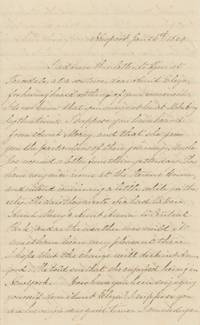
1871rif. List3241Rhode Island Massachusetts and New York 1871. Thirty-two letters two apparently missing final pages; with fifteen pages of incomplete letter material. Excellent to Near Fine. Letters from some of the young ladies of the Hazard family primarily Gertrude Minturn 1843–1877 Anna Peace 1845–1868 and Esther Robinson 1848–d. Hazard with some from other family and friends. The family was descended from Thomas Hazard one of the founding settlers of Newport Rhode Island.1 The girls were educated and often write from school; Anna and Esther attend the ‘Friends School’ in Providence which is probably the Moses Brown School and Gertrude attends Dr. Dio Lewis’s School for Young Ladies in Lexington Massachusetts. Founded by Diocletian Lewis a temperance and physical culture advocate the school incorporated his exercise system developed to condition weaker individuals. Gertrude describes a regimen of thirty minutes of walking plus an hour and a half of exercise and discusses Dr. Lewis: “Dr Lewis gives familiar lectures on any subject which the scholars propose. He is a very pleasant genial man and takes part in the games & dancing with the greatest spirit. There are about 20 scholars. Some of them board in the village but are subject to the rules of the school. This building is very large and is mostly occupied by the patients of Dr Lewis’ ‘Movement Cures’ to whom most of his time is devoted. The scholars and patients associate together. Indeed we are under very little constraint the teachers leaving our actions to be regulated by our own sense of propriety; and they seldom find occasion to reprove the scholars for misdemeanors.” November 23 1864 Meanwhile Anna and Esther’s education is more on the religious side; Esther writes: “We have not been to meeting very often since we returned from our lovely visit to Newport but the first Sunday morning I did think all the time of it as I said I was going to. We were edified this morning by a sermon from Elizabeth Meader or rather a torrent of noise so that I am nearly deafened now. I don’t think I ever heard a more horrible combination of sounds from the mouth of any human being.” January 8 1865 Though speaking in tongues is most strongly associated with Pentecostalism it is not unheard of in Quakerism. In his book of genealogy and reflections the girls’ father Thomas Hazard 1797–1886 connects the family’s “strong religious tendencies” to his own interest in spiritualism.2 This interest in mediumship comes up several times in the letters first in 1864 when one of the girls reports that “Pa writes us that at a circle which he attended a few days ago a clairvoyant medium described our house at Vaucluse perfectly” February 24 1864 and later when one of the girls attends a circle with their father in Philadelphia: “Yesterday morning Pa & I had a sitting with a Mrs. Robinson a trance speaking medium. The communication from mother was the most beautiful I ever heard. She spoke to us just as she used to on earth using the same expressions. It seemed as if I could almost see her – we are going again on Monday.” February 8 1867 That is the pair spoke to Frances Minturn Hazard who had died in 1854. Of interest to researchers of the Hazard family and Rhode Island Quakers. 1 Caroline Elizabeth Robinson The Hazard Family of Rhode Island 1635–1894 Printed for the Author 1896. 2 Thomas R. Hazard Recollections of Olden Times Sanborn 1879 228. unknown
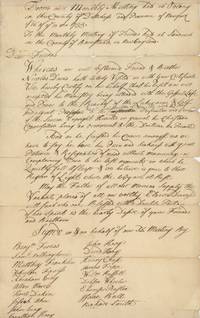
1755rif. List2976Dutchess County New York 1755. Single sheet measuring 7 ¾ x 12 ½ inches. Folded and quite torn at folds; very good. A letter signed by the members of the Oblong Monthly Meeting of Friends in New York to members of the Sandwich one in Massachusetts on the occasion of the death of Nicolas Davis 1690–1755 a member of the Sandwich meeting. Davis was well-respected in his community and occasionally traveled to minister; he died in Quaker Hill where the Oblong Meeting House is located on such a trip. The Oblong Friends remember him: “His visit was well accepted his ministry being attended with the Gospel Life and Power to the Reproof of the Lukewarm & Self Indulgent Professers to the instruction of the weak and to the Edification and Comfort of the Sincere & upright”. One of the letter’s signers Benjamin Ferriss is likely the same Benjamin Ferris who was one of the first Euro-American settlers of Quaker Hill arriving in 1728. The letter has eighteen other signatories: John Hoag Samuel Nothingham David Hoag Matthew Franklin Henry Chase Zebulon Farriss James surname illegible Abraham Ewing Wilm Buffett Allen Moore Dobson Wheeler Tim. Dakin Ebenezer Peaslee Josiah Akin Haas Bull. John Ewing Richard Smith and Jonathan Hoag. Of interest to scholars of Colonial-era Quaker history and New York State history. unknown
rif. 317297London. Good. Softcover. 30 issues mostly good-very good. . paperback
rif. 143728Philadelphia and from Various Places. 1837–1845. Approximately 145 manuscript items viz. 38 handwritten letters and 109 manuscript receipts. All in very good condition. Housed in an archival box. William P. Cresson Co. of Philadelphia was actively engaged in the hardware commission business in the 1830’s and 1840’s. The company offered a variety of products with a strong focus on metal ware household building materials and household furnishings. In the late 1840’s the firm began selling cooking stoves and became stove manufacturers and likely hollow ware manufacturers as well. During the late 1840’s and 1850’s a number of stove patents were applied for in the firm’s name. William P. Cresson manufacturer and philanthropist 1814–1892 was the son of Caleb Cresson 1775–1821. Caleb Cresson was himself a prominent and wealthy Philadelphia Quaker merchant and the husband of Sarah Emlen 1787–1870. W.P. Cresson’s family clearly enjoyed a prosperous and affluent style of living that would have been consistent with the successful endeavors of William’s father. This archive can be described as follows: I. William P. Cresson Co. Incoming Business Correspondence. 20 letters all written in 1842; 18 letters all written in 1845. Cresson had a sizeable business and this incoming correspondence records a variety of New England firms that were involved with this mid-Atlantic firm. An example of the correspondence in part: John D. Johnson writes an interesting letter to Cresson regarding brass makers and brass agents concerning manufacturing prices and the intricacies of dealing with the brass makers May 4 1842. Johnson later writes of other concerns selling brass at cheaper prices of the instability in the brass market and of a future hope: "On the whole I think that the manufacturers are beginning to have some confidence in each other and I believe the time is not very far distant when we shall all be willing to come under prescribed rules and regulations but until this can be achieved we must be somewhat irregular.” Johnson then writes briefly of “making an article for paper makers…" A one page ALS from Joel Bartlett of Harmony Maine concerns a discussion of the Cresson firm selling shank handles made by Bartlett on commission. Bartlett informs that the shank handles he is manufacturing are of high quality and is willing to send along samples. May 10 1842 On Bartlett ref. Folsom Fifty Years in the Northwest 1888 pp185–186. J. Danforth & Co. asks Cresson to sell bottles and Brittania ware and coffee pots May 12 1842. Later Danforth sent by steam boat from Middleton Connecticut “tea setts” tea pots sugars and creamers and soup bowls. In exchange Danforth asks Cresson to send along some blind fastenings saw “stretchers” and windows springs. Josiah Hayden of Haydensville wants to send Cresson cheap pens. A number of merchants ask plead for payments for goods sold or goods hoped to have been sold. Others ask for advice concerning the reduction of their manufacturing output and future trade prospects in wire and gauge metals. From Pine Plains Dutchess County New York Cresson purchased cradles scythes from Silas Harris May 29 1842. From Dotterer & Taylor of Reading Pennsylvania comes a letter of exact specifications for a proposed “15 horse engine” with three boilers June 5 1842. This is followed by an excellent letter from another steam engine manufacturer a John H. Gage in Nashua N.H. who writes to Cresson of a steam engine order and what he can offer the company at the present time June 10 1845. Another firm writes requesting Cresson to send by rail a large quantity of “cram paper” that will be suitable for packing sad irons January 24 1842. A New York entity asks Cresson to provide prices and quantity available for a large order for tea kettles coffee mills hatchets shoe blacking mill saws cow hides Eagle and New England wood screws and shank augers June 30 1845. Various other letters are devoted to outstanding debts and bills paid or not paid or agents traveling to and from delayed by various inconveniences of pre-1850 American transportation. II. William P. Cresson Family and Business Receipts 1837–1845. 109 manuscript receipts a blend of business and private household expenses. These receipts range from 1837-1845 the majority are from the late 1830’s. Among the more interesting receipts in part: Two receipts one for gold fillings “replacing part of a plug” etc. are from noted dentist Samuel Sheldon Fitch 1801–1876. S.S. Fitch was a Jefferson graduate and a pioneer in dentistry. Fitch’s A System of Dental Surgery 1829 was a standard work in its day and from its successful proceeds Fitch devoted his efforts as a publisher and patent medicine manufacturer. See Atwater I: 321–325 Receipts to benevolent societies: The Female Society of Philadelphia for the Relief and Employment of the Poor “for one large comfortable” and the Magdalen Society of Philadelphia. A receipt to Dennis Rearson for marble post stones for Laurel Hill cemetery to be cut and engraved. Jappaning 175 feet of iron chain; repairing stoves and ovens; one black Russian hat a receipt for a passage from Pittsburgh to Louisville; shovel and tong stands; “altering pew cushions” a receipt for blankets a valice trunk “to hanging 4 Looking Glasses” expenses for resetting curb stone; “2 sett dishes Brittania Ware”; etc. A receipt for US almanacs bought of Watson & Reynolds by Cresson for what appears to be H. Peale. This is possibly Henrietta Peale 1806–1892 daughter of artist Rembrandt Peale 1778–1860. Twenty-five receipts specific to purchases by Mrs. William P. Cresson record a wide variety of Philadelphia merchants and providers of household and domestic services in part: Foodstuffs purchased: Peaches raisins prunes almonds wines hams soda & water crackers sherry mustard rice etc. Household wares: gold plates moulded dishes linens gold pencils sweeping brush cut lamps cone pitcher cone boats etc. Services rendered: glazing English glass paying Sarah Binns dressmaker capes and corsets made merino shirts made etc. A receipt is also seen for altering front chamber nursery dining room parlors stair and entry carpet; fixing stair rods and fitting oil “cloaths”; putting up parlor bed and window curtains payable to a Rachael Fletcher etc. Of mention a portrait of W.P. Cresson is located at the Smithsonian and this description includes a facsimile of a daguerreotype portrait of W.P. Cresson from an online source. unknown
1847rif. 2345Boston: Printed by S.N. Dickinson & Co. 1847. A full-throated cry against slavery. The Quakers who had long opposed slavery wonder how a supposedly Christian nation could allow such evil to exist. "From the border slave states to the far south and southwest the vessels of the slave-trader regularly ply laden with youthful victims reared like cattle for the market" page 4. This pamphlet is scarce to the market. PHYSICAL DETAILS: 12mo 7 1/4 x 4 5/8 inches; 183 x 119 mm 12 pages in original printed wrappers softcover. CONDITION: Slight soiling and creasing to wrappers horizontal fold probably for mailing. Very Good or better. Printed by S.N. Dickinson & Co. paperback
rif. 0428785549.Ghardcover. Good. Access codes and supplements are not guaranteed with used items. May be an ex-library book. hardcover
1859rif. 000010694Philadelphia: Association of Friends for the Diffusion of Religious and Useful Knowledge 1859. Later edition. Hardcover. Very Good. 12mo. 2 iii-vii 1 9-103 3 pp. Brown publisher's cloth with gold lettering on the front board. Coated yellow endpapers and pastedowns. Excerpts taken from Tracts Illustrating the History Doctrine and Discipline of the Society of Friends published in London in 1851. A few nicks to the cloth; leaves show minor foxing with a contemporary gift inscription on the front flyleaf. Association of Friends for the Diffusion of Religious and Useful Knowledge hardcover
1993rif. 1672VG Softback volume featuring the life times and writings of the Quaker visionary. 293pp with index ISBN 185072136x ~ 16.00 ~ John BellersThe Improvement of Physicik Quakers Society Of Friends Immorality Raising a College Of Industry ~ Religion Sessions Book Trust paperback
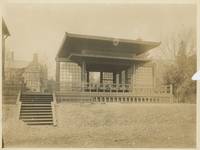
1910rif. List2847Bryn Mawr Pennsylvania; and others 1910. Eleven photographs approximately 7 x 9 ½ inch and smaller. With stamps for Brown Brothers Illustrations Bureau and E.J. Reily verso; most with captions verso. Most with chipping and wear at edges; overall good. Open-air schools became popular in the United States in the early 20th century in response to public health crises including tuberculosis.1 Conducting lessons in open-air classrooms reduced the transmission of diseases which allowed many children to attend school despite their often chronic illnesses. Offered here are eleven photographs of open-air schools three of which are identified as the Phebe Anna Thorne Model School at Bryn Mawr. The Phebe Anna Thorne Model School opened in 1913 under the direction of the College’s president Carey Thomas using funds donated by Samuel Thorne in memory of his sister Phebe Anna.2 The Thornes were an affluent New York Quaker family; Phebe Anna 1828–1909 was the only daughter to survive to adulthood and was a philanthropist and supporter of progressive social causes.3 The school was part of Bryn Mawr’s Department of Education which trained its students in teaching younger pupils rather than those of highschool or college age – the students in most of these photos are probably in about 4th or 5th grade.3 It also allowed testing of more cutting-edge pedagogical practices: the structure of the school was quite experimental including open-air classrooms outdoor naptime a flexible curriculum and less formal assessment. Of interest to scholars of the history of education especially experimental pedagogy. 1 Sherman C. Kingsley & F.B. Dresslar “Open-Air Schools” Department of the Interior Bureau of Education Bulletin 23 1916. 2 Cornelia Meigs What Makes a College A History of Bryn Mawr The MacMillan Company 1956. 3 Olive Floyd Phebe Anna Thorne: Quakeress Privately Printed in Rye New York 1958. unknown
1896rif. 17238vo Good Gilt Titles on Front Page Blue Boards HB No DJ. Edges turned in Pages Foxed Marks to Back Cover Watermark to endpapers with previous owner sig and inscription. Tissue transparency on title page. 296pp Headley Brothers hardcover
rif. 22684Philadelphia: Printed by John Richards No. 130 North Third Street. 1839. The full title is: 'An Address to the Quarterly Monthly and Preparative Meetings and the Members thereof composing the Yearly Meeting of Friends held in Philadelphia By the Committee appointed at the late Yearly Meeting to have charge of the Subject of Slavery.' 12pp 12mo. Pamphlet in original plain brown wraps. In good condition lightly aged and worn. Begins with two pages of extracts from the minutes 17 May 1839 regarding the setting up of the committee on 'the deeply interesting subject of Slavery' with reference to 'Benjamin Price Jr. Clerk' and 'Deborah F. Wharton Clerk.' The address itself 'Signed by direction and on behalf of the Committee by John Jackson Clerk' is eight pages long. Towards the beginning it notes that 'Many of our forefathers were slave-holders and the unrighteous practice of holding our fellow-creatures in bondage was not then forbidden by our discipline.' The change of policy is described with reference to 'Anthony Benezet and John Woolman'. Later the address notes: 'The advancement of this righteous concern and the increase of light upon the subject of human rights are causing this system of iniquity to totter to its base. Hence under the influence of fearful excitement many are putting forth their strength to impede the progress of principles which if ultimately triumphant will break the fetters of the slave. A part of the trading interests at the North is evidently involved with those of the South and an influence is in this way exerted against the onward course of Emancipation; thus light and darkness antagonize each other.' And later still: 'Within a few years great events hae occurred in relation to Slavery and much light has been spread on the subject. The experience derived from Emancipation in the British West Indies has opened a new era. . while we have painful evidence that a great body of slave-holders are influenced by injustice and cruelty . There are many whose consciences are burdened by a system which they derived from their ancestors . the money of the slave-trader is temptingly held up before them; . they cannot separate the tender ties of family connexion among their slaves; they dare not receive the price of blood. . We believe they are fervently desiring the deliverance of master and slave from the bondage to which both are subjected. Their hearts have bounded with joy at the success of Emancipation in the British West Indies; it has opened a door of hope thaty they also may be legally permitted to prove the advantage of requited labour over that which is extorted by the lash of the oppressor. .'. The entries on OCLC WorldCat are not clear but the item is uncommon. Philadelphia: Printed by John Richards, No. 130 North Third Street. 1839. paperback
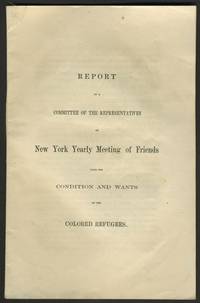
1862rif. 27695New York: The Religious Society of Friends 1862. First printing. Pamphlet. Very good condition. Three reports from the Quakers during the Civil War on their ministry amongst the "Colored Refugees" of Virginia & Washington DC reporting on the conditions and needs at Fort Monroe Camp Barker Craney Island Alexandria Hampton Norfolk etc. Conditions are tough in the refugee camps but none wish to return to where they have fled from. "Slaves have been abandoned and we must help. Don't we owe them for our prosperity--- enjoying indirectly from the unrequited labor of these people." Encyclopedia Virginia writes on their website- "In this report dated May 1864 the Committee on Colored Refugees who were representatives of the New York Yearly Meeting of Friends gives its assessment of the needs of the formerly enslaved people escaping behind Union lines and how Quaker charity efforts were meeting them in contraband camps across Virginia including Alexandria. One of their agents Harriet Jacobs wrote her own letter documenting what she saw in Alexandria and Washington D.C. For Quakers the abolition of slavery was a moral and religious imperative." Title continues: Address of the Representatives of New-York Yearly Meeting of Friends to Its Members.; Third Report of Committee of the Representatives of New York Yearly Meeting of Friends upon the Condition and Wants of the Colored Refugees 1862 Report OCLC: 21308787 8vo 30pp black title on cream paper wraps saddle stitched. Clean throughout. 1862 Address OCLC: 25519700 8vo 10pp. October 24th 1862. 1864 Third Report OCLC: 25113848 cites 9 copies; 8vo 23pp May 1864 slt. marked wrapper. All in their original self wrappers overall in very good condition. The Religious Society of Friends unknown