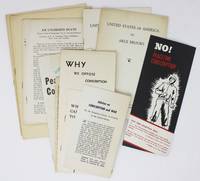
1954rif. 4307Philadelphia 1954. About very good. Thirty-five printed and typescript items approximately 150pp. total. Some staples old folds. Scattered contemporary ink stamps. Light toning and minor wear heavier in places. Scattered chipping and occasional short edge tears. A fascinating and scarce group of newsletters pamphlets and ephemera published by the American Friends Service Committee during and after World War II comprising thirty-five printed and typescript items. The Committee administered roughly one third of the camps in the Civilian Public Service system which was established to provide a means of non-military service to religious conscientious objectors during the war and also played a significant role in the anti-draft anti-conscription movement. The first group of material present here includes seven issues of the Civilian Public Service Friends Newsletter. These provide a detailed contemporary account of the overall state of the camps including camp populations incoming "campers" camp openings and closures and the financial situation. The newsletters also include news relating to the administration of the camps and developments regarding their operation and the activities of the interned objectors. Included as well are a promotional report issued on the two-year anniversary of the Service's inception and an elaborate four-page solicitation for donations to the CPS both also issued by the American Friends Service Committee. The issues of the newsletters present are: No. 5 October 30th 1942; No. 6 December 21 1942; No. 8 February 25 1943; No. 9 March 15 1943; No. 10 April 21 1943; No. 12 July 12 1943; No. 13 August 23 1943. A substantial run of a scarce and short-lived newsletter. We locate individually catalogued groups of these reports only at Bethel College and the University of Oregon and not in the Swarthmore Peace Collection. A second group of newsletters contains three issues of a weekly periodical Information and eleven issues of its monthly offshoot Information Digest dating December 1943 to July 1945 with two issues from later in 1946. These issues document the administration process of the CPS camps and contain reports on various facets of their operation including finances fundraising working and social conditions religious life and legal issues. Amongst these are reports on internal efforts and negotiations to fund the camps both within the Society of Friends and in partnership with other pacifist religious sects such as the Mennonites who were involved in camp operations. The December 2 1943 issue of Information for example contains a detailed narrative of the negotiation to fund the camps in 1944. The newsletters also contain a wealth of information on developments initiatives and daily life at the camps which include some particularly interesting reports on mental health among internees and on civil rights as the issue related to conscientious objectors but also to racial equality in the United States during the war era. OCLC locates holdings of this periodical at just a small handful of institutions. The third group of material comprises four scarce typed reports prepared and distributed by the AFSC during the war regarding the rights of conscientious objectors and their status. Three of the reports address the Selective Service Act and continued amendments thereto concentrating on the portions of the law that applied to religious objectors to military service and changes that affected objectors during the early years of the war. The first these issued in March 1942 first outlines the changes made to the draft law during December 1941 in the wake of the attack on Pearl Harbor and the declaration of war on the Axis powers and then provides an extensive step-by-step procedure for the application process to become a conscientious objector. Two further lengthy "memoranda" explain the rights of conscientious objectors as of December 1942 and March 1943 when each report was produced and gives advice for completing the objector application as well as for preparing supplementary documents and written statements. The other report in this group dated September 1941 gives an outline of the finances and disposition of the Civilian Public Service the system of labor camps for conscientious objectors on the eve of the war including lists of camps already in operation their capacities and statistical charts of objectors already registered and camp populations and assignments. These reports are quite striking as first-hand evidence of the role played by the Society of Friends administration in counseling their members to become conscientious objectors. Finally there is an interesting group of Quaker anti-conscription ephemera from World War II consisting of nine pamphlets that outline the pacifist views of the Society of Friends and the reasons behind them. The works go on to detail how these beliefs necessitate the Quakers' refusal to be conscripted into the American armed forces and defend this stance. Two pamphlets deal specifically with the opposition to peacetime conscription which became a political issue towards the end of the war. The individual titles are as follows: 1 "Why They Cannot Go to War." Philadelphia: American Friends Service Committee 1940. 2 "Why We Oppose Conscription." Philadelphia: American Friends Service Committee 1941. 3 "United States of America vs. Arle Brooks." Philadelphia: American Friends Service Committee 1941. Two copies. 4 Royden A. Maude. "An Unarmed State." Philadelphia: American Friends Service Committee N.d. 5 Muste A.J. "Conscription and Conscience." Philadelphia: American Friends Service Committee 1944. Two copies. 6 "Peace Time Conscription.A Problem for Americans." Philadelphia: American Friends Service Committee 1944. 7 "Permanent Conscription." Philadelphia: American Friends Service Committee 1945. 8 "No! To Peacetime Conscription." Philadelphia: American Friends Service Committee 1945. 9 "Advices on Conscription and War." Philadelphia: American Friends Service Committee 1954. unknown books
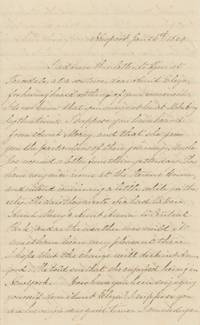
1871rif. List3241Rhode Island Massachusetts and New York 1871. Thirty-two letters two apparently missing final pages; with fifteen pages of incomplete letter material. Excellent to Near Fine. Letters from some of the young ladies of the Hazard family primarily Gertrude Minturn 1843–1877 Anna Peace 1845–1868 and Esther Robinson 1848–d. Hazard with some from other family and friends. The family was descended from Thomas Hazard one of the founding settlers of Newport Rhode Island.1 The girls were educated and often write from school; Anna and Esther attend the ‘Friends School’ in Providence which is probably the Moses Brown School and Gertrude attends Dr. Dio Lewis’s School for Young Ladies in Lexington Massachusetts. Founded by Diocletian Lewis a temperance and physical culture advocate the school incorporated his exercise system developed to condition weaker individuals. Gertrude describes a regimen of thirty minutes of walking plus an hour and a half of exercise and discusses Dr. Lewis: “Dr Lewis gives familiar lectures on any subject which the scholars propose. He is a very pleasant genial man and takes part in the games & dancing with the greatest spirit. There are about 20 scholars. Some of them board in the village but are subject to the rules of the school. This building is very large and is mostly occupied by the patients of Dr Lewis’ ‘Movement Cures’ to whom most of his time is devoted. The scholars and patients associate together. Indeed we are under very little constraint the teachers leaving our actions to be regulated by our own sense of propriety; and they seldom find occasion to reprove the scholars for misdemeanors.” November 23 1864 Meanwhile Anna and Esther’s education is more on the religious side; Esther writes: “We have not been to meeting very often since we returned from our lovely visit to Newport but the first Sunday morning I did think all the time of it as I said I was going to. We were edified this morning by a sermon from Elizabeth Meader or rather a torrent of noise so that I am nearly deafened now. I don’t think I ever heard a more horrible combination of sounds from the mouth of any human being.” January 8 1865 Though speaking in tongues is most strongly associated with Pentecostalism it is not unheard of in Quakerism. In his book of genealogy and reflections the girls’ father Thomas Hazard 1797–1886 connects the family’s “strong religious tendencies” to his own interest in spiritualism.2 This interest in mediumship comes up several times in the letters first in 1864 when one of the girls reports that “Pa writes us that at a circle which he attended a few days ago a clairvoyant medium described our house at Vaucluse perfectly” February 24 1864 and later when one of the girls attends a circle with their father in Philadelphia: “Yesterday morning Pa & I had a sitting with a Mrs. Robinson a trance speaking medium. The communication from mother was the most beautiful I ever heard. She spoke to us just as she used to on earth using the same expressions. It seemed as if I could almost see her – we are going again on Monday.” February 8 1867 That is the pair spoke to Frances Minturn Hazard who had died in 1854. Of interest to researchers of the Hazard family and Rhode Island Quakers. 1 Caroline Elizabeth Robinson The Hazard Family of Rhode Island 1635–1894 Printed for the Author 1896. 2 Thomas R. Hazard Recollections of Olden Times Sanborn 1879 228. unknown books
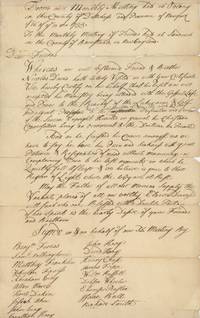
1755rif. List2976Dutchess County New York 1755. Single sheet measuring 7 ¾ x 12 ½ inches. Folded and quite torn at folds; very good. A letter signed by the members of the Oblong Monthly Meeting of Friends in New York to members of the Sandwich one in Massachusetts on the occasion of the death of Nicolas Davis 1690–1755 a member of the Sandwich meeting. Davis was well-respected in his community and occasionally traveled to minister; he died in Quaker Hill where the Oblong Meeting House is located on such a trip. The Oblong Friends remember him: “His visit was well accepted his ministry being attended with the Gospel Life and Power to the Reproof of the Lukewarm & Self Indulgent Professers to the instruction of the weak and to the Edification and Comfort of the Sincere & upright”. One of the letter’s signers Benjamin Ferriss is likely the same Benjamin Ferris who was one of the first Euro-American settlers of Quaker Hill arriving in 1728. The letter has eighteen other signatories: John Hoag Samuel Nothingham David Hoag Matthew Franklin Henry Chase Zebulon Farriss James surname illegible Abraham Ewing Wilm Buffett Allen Moore Dobson Wheeler Tim. Dakin Ebenezer Peaslee Josiah Akin Haas Bull. John Ewing Richard Smith and Jonathan Hoag. Of interest to scholars of Colonial-era Quaker history and New York State history. unknown books
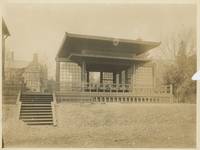
1910rif. List2847Bryn Mawr Pennsylvania; and others 1910. Eleven photographs approximately 7 x 9 ½ inch and smaller. With stamps for Brown Brothers Illustrations Bureau and E.J. Reily verso; most with captions verso. Most with chipping and wear at edges; overall good. Open-air schools became popular in the United States in the early 20th century in response to public health crises including tuberculosis.1 Conducting lessons in open-air classrooms reduced the transmission of diseases which allowed many children to attend school despite their often chronic illnesses. Offered here are eleven photographs of open-air schools three of which are identified as the Phebe Anna Thorne Model School at Bryn Mawr. The Phebe Anna Thorne Model School opened in 1913 under the direction of the College’s president Carey Thomas using funds donated by Samuel Thorne in memory of his sister Phebe Anna.2 The Thornes were an affluent New York Quaker family; Phebe Anna 1828–1909 was the only daughter to survive to adulthood and was a philanthropist and supporter of progressive social causes.3 The school was part of Bryn Mawr’s Department of Education which trained its students in teaching younger pupils rather than those of highschool or college age – the students in most of these photos are probably in about 4th or 5th grade.3 It also allowed testing of more cutting-edge pedagogical practices: the structure of the school was quite experimental including open-air classrooms outdoor naptime a flexible curriculum and less formal assessment. Of interest to scholars of the history of education especially experimental pedagogy. 1 Sherman C. Kingsley & F.B. Dresslar “Open-Air Schools” Department of the Interior Bureau of Education Bulletin 23 1916. 2 Cornelia Meigs What Makes a College A History of Bryn Mawr The MacMillan Company 1956. 3 Olive Floyd Phebe Anna Thorne: Quakeress Privately Printed in Rye New York 1958. unknown books
1860rif. 79414Philadelphia PA: Association of Friends for the Diffusion of Religious and Useful Knowledge. Very Good. 1860. Hardcover. Ex-library bound in rubbed and stained brown cloth with some scribbling to the endpages - otherwise the contents are bright with light scattered foxing. . Association of Friends for the Diffusion of Religious and Useful Knowledge hardcover books
1715rif. 21205London 1715. 4pp. Printed in two columns. Disbound. Small folio. Early folds and early stab holes in left margin. Some foxing. One of Two Known Copies A rare and expansive appeal to Parliament against the 1715 bill to renew the Quakers' right to the "solemn affirmation" in place of the legal oath. In 1696 after experiencing decades of exclusion and imprisonment for conscientiously refusing to take loyalty and court oaths Quakers were granted the right by an act of Parliament to take a "solemn affirmation" in legal situations in place of an actual oath. In 1715 a bill was under consideration in Parliament to renew that act indefinitely. Significantly longer than most lobbying documents from this time this petition asks that Parliament only extend the act if the affirmation be made "of no Force where they are concern'd in Interest but where they only Affirm as Witnesses between others there being no Temptation for them to Lye when it brings no Profit to them." Many Quakers by this time had achieved significant prosperity in manufacturing and commerce adding fuel to their enemies' resentment. The author of this pamphlet charges various Friends with hypocrisy greed and swindling and reprints an earlier petition describing six widows of commanders of two "Guinea ships" allegedly defrauded by Quakers including one Quaker from Maryland. Not listed in Joseph Smith's Biblioteca Anti-Quakeriana or A Descriptive Catalogue of Friends' Books. ESTC records only one copy at Oxford. unknown books
1715rif. 21197London 1715. Broadsheet. 1p. plus printed docket title on verso. Dbd. Early folds and early stab holes in left margin. Moderate toning and foxing. Very good. Quakers seek relief on affirmation. In 1696 after experiencing decades of exclusion and imprisonment for conscientiously refusing to take loyalty and court oaths Quakers were granted the right by Parliament to take a "solemn affirmation" in legal situations in place of an actual oath. Over the next two decades numerous Quakers objected to the invocation of God's name in the official affirmation and refused it as they had the oath. In 1715 a bill was under consideration in Parliament to renew indefinitely the Quakers' right to the affirmation. The Quaker authors of the present petition support the bill but ask that it be amended with a revised affirmation that does not include the name of God. ESTC lists copies at four institutions: the British Library the Library of the Religious Society of Friends the National Library of Scotland and Oxford. Smith A Descriptive Catalogue of Friends' Books Vol. II p.265 listing its imprint at "about 1721". unknown books
1821rif. 1015808vo leather spine label gilt lines on spine 184 pp. Top hinge cracked some minor wear to extremities volume slightly bent small hole through pages 7 and 8 some slight foxing but internally generally bright and clean. This is a collection of short biographies of notable Quakers who passed away between 1783 and 1820.While much of the text appears to talk about the personal challenges these people faced some comments are directed at their works with others including native Americans. Solomon W. Conrad, books
1880rif. 013272Cambridge MA: Printed at Riverside Press 1880. 1st Edition. Hardcover. VG. 8vo greenish-blue cloth stamped and ruled in black on cvoers gilt titles to spine xiv 236. Bookplate fron pastedown Covers miderately worn. Internals quite nice. Printed at Riverside Press hardcover books
1788rif. 013273NY: William Ross 1788. Second American Edition. Hardcover. Fair. Second American edition re-printed by William Ross in NY. Original or old calf front cover detached detached ffe heavily inscribed in old script: "Thomas Clapp's book. Don't steal this book for fear of shame for here to see the owner's name from one borrows this book . and take the sense therein and then return it to the owner again. Hannah Clapp William Clapp William Ross hardcover books
1962rif. 1161Philadelphia: American Friends Service Committee 1962. Card. Fine. Six pieces: For Algerian Refugee Children: Blankets from American Children; Bundles for boys; Sewing Bags for Algerian Refugee Girls; Tool Box Fund; Christmas: Bread for Algerian Children and The Innocent Victims - Algeria reprinted from May 6 1961 issue of Look American Friends Service Committee unknown books
1824rif. 2222184First edition thus. Folio 4 pages. Old folds. With printed signature of Josiah Forster Clerk to the Meeting. Very good light age stains. Printed by Solomon W. Conrad No. 32 Church Alley Philada. The first American printing. Quakers unknown books
1787rif. 15881Philadelphia: Printed by Joseph Cruikshank 1787 First edition. Contemporary calf burgundy morocco spine label. Octavo. With alphabetical index. Bottom corners rubbed small chip at foot of spine some light browning. Contemporary ink inscription on front free endpaper. A very good copy. An interesting collection of short biographies of early American Quaker ministers. Over fifty of the people discussed are women. Printed by Joseph Cruikshank unknown books
1791rif. 2222185First edition thus. Folio 12 1/2" x 8". 4 pages. Old folding creases. With printed signature of Philip Debell Tuckett Clerk to the Meeting. Good age soiling. Front page title reads: "The Yearly-Epistle 1791." Quakers unknown books
1706rif. 50817London T. Sowle 1706. Small 4to. No wrappers. 2111 pp. Title-page soiled. The first page with a large brownspot. Outer margins shaved with some loss of lettering. The original printing. unknown
1725rif. 035981London: Assigns of J. Sowle 1725. Second Edition Corrected . Original Full Leather. Very Good. 12 7/8" Tall. X 699 Xvi Index 4 Pp Catalog At End. Original Simple Full Calf Five Bands Morocco Spine Label Yellow Endpapers. "Second Edition Corrected". Worn Fraying At Corners Front Hinge Patly Cracked Nicely Refurbished. Contents Clean Slight Wear Pp 123-126 Partly Detached. Original Signatures Of Joseph Pike On Front Pastedown Title Page 1 And Rear Endpaper; Pike D. 1729 Wrote "An Epistle To The National Meeting Of Friends In Dublin" One Of Three Important Early Treatises On Quaker Conduct The Other Two Written By Penn And Barclay. Additional Ownership Information Of The Quakers Sarah And Margaret Beale Myrtle Hill Terrace CorkAnd John And Fanny Edmondson Dublin 1860. An Exceptional Association Copy Of An Important History. Assigns of J. Sowle hardcover
1834rif. 958101834. Third edition. Darton and Harvey London. 1834. Quarto hardback. Bound in full tan morocco gilt to contrasting maroon label piece and gilt border rules to boards. End-papers and all page edges marbled. 335 pages. Index. Presentation copy to Sir Herbert Taylor First Private Secretary to George III IV and William IV from the Quaker philanthropist Peter Bedford - inscription to front free end-paper. Extremities sl. rubbed and prelims foxed. A nice copy. hardcover
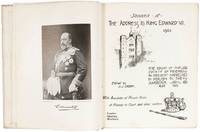
1901rif. 20890291901. London: Headley Brothers. 1901. 8vo. Original decoratively gilt-stamped white cloth the upper board somewhat marked top edge gilt; pp. 90 2 portrait photo frontis and 8 other b/w photo plates; inscribed in pencil to the recto of the ffep 'Barrow Cadbury Birmingham'; endpapers lightly embrowned else a bright copy.First edition. One of a limited edition of 250 numbered copies. This copy numbered in pencil 175. A collection of addresses made to the Sovereign between 1654 up to the address made to King Edward VII in 1902 by the Deputation of the Society of Friends The Quakers.Barrow Cadbury 1862-1958 was the head of the chocolate factory and founder of the Barrow Cadbury Trust. The Cadburys were a leading Quaker family and George Cadbury Barrow's uncle was one of the Friends that formed the deputation to Edward VII. hardcover
1895rif. 28317Philadelphia: Published for the Yearly Meeting 1895. 127 pp. 1 vols. 8vo. Original printed wrappers stapled postmark on upper cover. Some light soiling and wear to wrappers and edges else very good. 127 pp. 1 vols. 8vo. From the collection of the Seaman family of Glen Cove and Westbury Long Island and Woodbury Falls New York who were longtime members of the Society of Friends. Published for the Yearly Meeting unknown
1852rif. 28314New York: R. Craighead Printer 1852. 26 pp. 1 vols. 8vo. Original green printed wrappers. Some soiling and staining of wrappers light spotting and marginal staining of text some gnawing of edges else very good. 26 pp. 1 vols. 8vo. From the collection of the Seaman family of Glen Cove and Westbury Long Island and Woodbury Falls New York who were longtime members of the Society of Friends. R. Craighead Printer unknown
1808rif. 30732Philadelphia: Printed by Joseph Crukshank 1808. First published in London in 1795 it was first printed in America in 1799. 70pp. 1 vols. 8vo. Later grey plain wrappers. Some light discoloration and light wear else very good. First published in London in 1795 it was first printed in America in 1799. 70pp. 1 vols. 8vo. S & S 16230. S & S 16230 Printed by Joseph Crukshank unknown
1832rif. 28313New York: Published by Isaac T. Hopper 1832. 45 pp. 1 vols. 8vo. Stiff tan wrappers. Some soiling and staining of wrappers light spotting and marginal staining of text else very good. 45 pp. 1 vols. 8vo. From the collection of the Seaman family of Glen Cove and Westbury Long Island and Woodbury Falls New York who were longtime members of the Society of Friends. Published by Isaac T. Hopper unknown
1783rif. 24871London printed: Philadelphia: Re-Printed: and sold by Joseph Cruikshank 1783. First American edition. 4 206 pp missing 207-209. 1 vols. 8vo. Contemporary sheep. Signed on half-title "Rachael Peason Solebury Pa.". First American edition. 4 206 pp missing 207-209. 1 vols. 8vo. and sold by Joseph Cruikshank unknown
1910rif. 28312New York 1910. 1 vols. 4to. Grey printed board string for hanging at top. Some soiling and wear to corners else very good 2. 1 vols. 4to. From the collection of the Seaman family of Glen Cove and Westbury Long Island and Woodbury Falls NY who were longtime members of the Society of Friends. ¶ Accompanied by an illustration showing the FRIENDS' MEETING HOUSE IN NEW YORK & Seminary ca. 1910 some spotting and light soiling.¶ Also accompanied by two issues of the "FRIENDS' INTELLIGENCER" dated 28 March 1903 and 30 March 1921. unknown
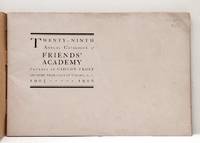
1905rif. 28307New York: Corlies Macy & Co. Incorportated Printers and Binders 1905. 35 pp. illustrated. 1 vols. Oblong 8vo. Original wrappers. Some light wear to wrappers else very good. 35 pp. illustrated. 1 vols. Oblong 8vo. From the collection of the Seaman family of Glen Cove Long Island who were longtime members of the Society of Friends and several of the Seaman children are students at the time of this catalogue and Samuel J. Seaman was a trustee. Corlies, Macy & Co., Incorportated, Printers and Binders] unknown