288 résultats
1772pp. 17, 184 + (1) Errata. Lacks first fly leaves. Age stained. 8vo. 205mm. Contemporary full roan binding. Detailed Quaker journal of travels in America and the West Indies. Includes a first-hand account of the Indian Treaty negotiations at Bethlehem. 1756-1759. Evans 12565, Sabin 90387. First American edition. Scarce. **PRICE JUST REDUCED! PA 59.
1781Two volumes in one. 538p. Disbound. Dampstain. On the front fly and title are numerous manuscript ownerships, including: William Lukens (1790's); Elizah Lukens; Mary White; et. al. John Griffith (1683-1778) was a prominent Quaker minister, originally from Wales, who settled in Uwchlan, Lionville, Chester County, PA. Evans 16793 & 17178 . Popular and informative Quaker journal that still reads well. **PRICE JUST REDUCED!
1774pp. lxxv, 371, (32) [Contents and Index]. Age stain. Early manuscript ownership of Charles West, 1783. 8vo. 205 mm. Disbound. Remnants of original (American?) leather binding. William Edmondson or Edmundson (1627-1712) was the founder of Quakerism in Ireland. He was born in Little Musgrove, Westmoreland, England, and was raised by an uncle. He joined the Parliamentary Army, and went to Scotland in 1650. He took part in the Battle of Worcester. While serving in the military, at Chesterfield, he was first introduced to Quakerism. After his discharge he went to live in County Antrim, Ireland. He established the first Meeting House in Lurgan, Ireland in 1654. He was imprisoned several times for his faith. His life was a guide to Quakers in England and America. **PRICE JUST REDUCED! PA SHELF 60 LEFT STK
1765pp. lix, 679, (xxviii). Folio. Engraved bookplate of: John Glaisyer, Chymist & Druggist, Brighton" Engraved armorial bookplate of Francis Frederick Fox. Contemporary full leather binding, joints cracked. A nice copy of an important and scarce Quaker work. George Fox (1624-1691), was the founder of the Society of Friends (Quakers). By nature serious and contemplative, at the age of 19 he entered upon a wandering quest for spiritual enlightenment. In 1646 he underwent a mystical experience that convinced him that Christianity was not an outward profession but an inner light by which Christ directly illumines the believing soul. Revelation was for Fox not confined to the Scriptures. In 1647 he began to preach. Although often the victim of mob brutality and eight times imprisoned between 1649 and 1675, Fox won many followers, especially among groups of separatists. In 1668 he prepared the first pattern of organization, which was for some years to serve as the discipline of the Society of Friends. The London Yearly Meeting was started in 1671. To confirm his followers in their beliefs and to spread the truths, Fox went in 1671 to the West Indies and to America, where he made arduous journeys to various colonies scattered between New England and North Carolina. Later he twice visited Holland. His sincerity, serenity, fearlessness, and powerful preaching are attested to by a number of his contemporaries. This Journal, with a preface by William Penn, was first published in 1694. An early owner of this book was Francis Frederick Fox (1832-1915) the 2nd son of Francis Ker Fox of Brislington House. He was an oil and colour merchant, President of the Grateful Society in 1869. Sadly, his wife Alice died in childbirth in 1870 and he was left a widower with six children. He was Master of the Society of Merchant Venturers in 1878 & 79 and Sheriff in 1894. He was a J.P. for Bristol and for Gloucestershire and an Alderman for the city from 1865. He wrote extensively on local history. Perhaps he was a descendant of the great Quaker George Fox. Smith p. 690; Sabin 25352. **PRICE JUST REDUCED! PA62
1742réf. 77443London:: T. Sowle Raylton 1742. Second edition. later old half morocco and marbled sides. Neat marginal repairs to the fore-edge of the last four leaves; extremities of the binding rubbed with the start 2" of a split at the top of one joint. . 12mo. T. Sowle Raylton, unknown
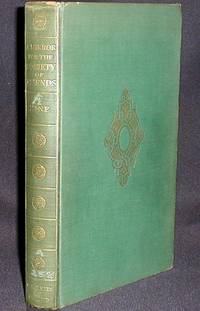
1929réf. 002150London: George Allen & Unwin 1929. Very Good -. Lucas Samuel. First published in The History of Hitchin vol. 2 1929; this separate edition published later the same year. 150 2 p.: 9 in-text drawings 13 leaves of illustrations many by Samuel Lucas; 25 cm. Green cloth with gilt-stamped spine title and decoration; gilt-stamped center medallion on both boards. Title page in red and black with decorative border. Publisher's device on page following index. Top page edges gilt. Includes bibliography and index. Faint white library call numbers on spine. Front fixed endpaper bears inscription: Friends House Preparative Meeting Library. The same with Friends House Euston Road London stamped on the front free endpaper. Former owner's inscription on front free endpaper: "Helen F. Carpenter Withleigh West Heath Rd Hampstead London NW3." A history of the Society of Friends in Hitchen Herfordshire England. In Very Good- Condition: spine is sunned slightly faded; ends of spine and corners rubbed with fraying at head of spine; remains of white call numbers on spine; cover slightly soiled; foxing primarily on first few leaves including title page; otherwise clean and tight. George Allen & Unwin unknown
réf. 0428785549.Ghardcover. Good. Access codes and supplements are not guaranteed with used items. May be an ex-library book. hardcover
1851288p. Slight foxing. 12mo. 195mm. Original full leather binding. Original leather spine label. Boards detached. PA 59
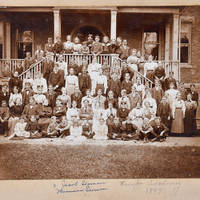
1898réf. 28311Locust Valley 1898. 1 vols. 7 7/8 x 5 7/8 inches image size. Original photograph on a slightly larger board. Some fading of image soiling of board and photograph inked identification under photo else very good. 1 vols. 7 7/8 x 5 7/8 inches image size. From the collection of the Seaman family of Glen Cove Long Island who were longtime members of the Society of Friends with the inscription on the verso reading "Presented by Laura F. Craft Ninth Mo. 10 1898 Marianne Seaman. " Laura F. Craft had attended Friends' Academy at the same time as the Seamans. unknown
1897réf. 28309Locust Valley 1897. 1 vols. 8 3/4 x 6 3/4 inches photo image. Original photograph on a larger board. Section of board broken off but present affecting upper corner of photograph some spotting and light soiling of board else very good with pencilled and pen identificatory notations. 1 vols. 8 3/4 x 6 3/4 inches photo image. The Friends' Adademy was founded by Gideon Frost and located near Locust Valley L. I. This was it's twentieth year. From the collection of the Seaman family of Glen Cove Long Island who were longtime members of the Society of Friends and several of the Seaman children are students at the time of this catalogue Edith Jacob T. Mary W. Mary E. Frederick W Samuel J. and R. Frank T. Samuel J. Seaman became a trustee several years later. Jacob and Marianne Seaman are marked on the photographs with small ink mark. unknown
1897réf. 28309Locust Valley 1897. 1 vols. 8 3/4 x 6 3/4 inches photo image. Original photograph on a larger board. Section of board broken off but present affecting upper corner of photograph some spotting and light soiling of board else very good with pencilled and pen identificatory notations. 1 vols. 8 3/4 x 6 3/4 inches photo image. The Friends' Adademy was founded by Gideon Frost and located near Locust Valley L. I. This was it's twentieth year. From the collection of the Seaman family of Glen Cove Long Island who were longtime members of the Society of Friends and several of the Seaman children are students at the time of this catalogue Edith Jacob T. Mary W. Mary E. Frederick W Samuel J. and R. Frank T. Samuel J. Seaman became a trustee several years later. Jacob and Marianne Seaman are marked on the photographs with small ink mark. unknown books
1806réf. 19256New York: Published by Samuel Stansbury Southwick and Hardcastle Printers 1806. First American edition. Frontispiece Oval portrait by P. Maverick. 1 vols. 8vo. Contemporary American mottled sheep red morocco labels. Some scuffing and rubbing of binding head of spines slightly chipped some browning spotting and offsetting of text but not offensive. A very nice copy of this interesting text. First American edition. Frontispiece Oval portrait by P. Maverick. 1 vols. 8vo. Sabin 13492 Published by Samuel Stansbury, Southwick and Hardcastle Printers unknown
1806réf. 19256New York: Published by Samuel Stansbury Southwick and Hardcastle Printers 1806. First American edition. Frontispiece Oval portrait by P. Maverick. 1 vols. 8vo. Contemporary American mottled sheep red morocco labels. Some scuffing and rubbing of binding head of spines slightly chipped some browning spotting and offsetting of text but not offensive. A very nice copy of this interesting text. First American edition. Frontispiece Oval portrait by P. Maverick. 1 vols. 8vo. Sabin 13492 Published by Samuel Stansbury, Southwick and Hardcastle Printers unknown books
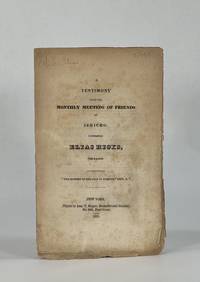
1825pp. iv, (1)-322. All edges decorated in yellow. XLib stamp of Lancaster Mechanics' Society on title page and elsewhere. XLib bookplate on front paste down. Foxed. 8vo. 220 mm. Original full leather binding, very worn. Rear board very fragile. Front board detached. Loss at head of spine. Hardbound. Binding poor. Text good. Elias Hicks (1748-1830) was a traveling Quaker minister from Long Island. In his ministry he promoted unorthodox doctrines that led to controversy, which inevitably caused the first major schism within the Religious Society of Friends. He was among the first Quaker abolitionists. S&S/AI 20880. PAIMP 22
1825pp. iv, (1)-322. All edges decorated in yellow. Foxed. Early manuscript of Deborah Gest on first fly leaf, with genealogy in pencil: 'I believe this Deborah Gest was the grandmother of Deborah Gest Pownall. The latter was the grandmother of Dorothy G. and S. Barnard Pownall'. 8vo. 220 mm. Original full leather binding, worn. Original leather spine label, spine very worn with loss at head. Hardbound. Good. Elias Hicks (1748-1830) was a traveling Quaker minister from Long Island. In his ministry he promoted unorthodox doctrines that led to controversy, which inevitably caused the first major schism within the Religious Society of Friends. He was among the first Quaker abolitionists. S&S/AI 20880. PAIMP 22
First edition, 12mo (150 x 95 mm), [3], 6-21, [1]pp., disbound. Smith, J. Friends' Books, II 566.
1830réf. 8959New York: Isaac T. Hopper 1830. Unbound. Very Good binding. Octavo. 8 pp. Folded sheet never bound; untrimmed. Separation at the folds of the outer two leaves; toning and soiling; pencil notations. A laudatory biography of Elias Hicks who had led a umber of Quakers into schism. Sabin 31718; American Imprints 1510. Isaac T. Hopper unknown
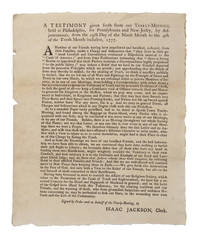
1777réf. 69134Philadelphia. 1777. Calling for the Rights of Conscientious Objectors and the Release of Exiled Quakers A rare broadside concerning the so-called "Quaker exiles" the Philadelphia Friends who were rounded up held without hearing and banished to the Virginia frontier in 1777–1778 during the height of the American Revolution. Signed in type by clerk Isaac Jackson on behalf of the Yearly Meeting the broadside calls for the release of "A Number of our Friends" who have recently "been imprisoned and banished unheard from their Families under a Charge and Insinuation that 'they have in their general Conduct and Conversation evidenced a Disposition inimical to the Cause of America.'" When war broke out between Britain and its North American colonies many Quakers remained steadfast in their religious commitment to pacifist principles refusing to pay taxes bear arms or take oaths of allegiance on behalf of the Patriot cause. This pacifism was met with suspicion by American Revolutionaries who accused Quakers of secretly supporting the British. In August and September 1777 with Philadelphia under imminent threat of capture by the enemy Quakers became the victims of growing persecution. Patriot suspicions were seemingly confirmed when on August 25 1777 the Continental Congress received a letter from Major-General John Sullivan reporting the discovery of several documents signed "the Spank-town Yearly-Meeting" implicating the Society of Friends in passing sensitive military information to the British. Never mind that no such Meeting at Spanktown existed or that the documents were likely fabricated by someone intent on maligning Quakers. The letter together with the incriminating documents were immediately referred to a committee which in its report concluded that the actions of "a number of Quakers of considerable wealth.render it certain and notorious that those persons are with much rancour and bitterness disaffected to the American cause" and that since those persons might be inclined "to communicate intelligence to the enemy and in various other ways to injure the councils and arms of America" they therefore ought to be considered a risk "to the public safety" Ford. The committee recommended that "the executive powers of the respective states.apprehend and secure all persons as well among the people called Quakers as others who have in their general conduct and conversation evidenced a disposition inimical to the cause of America" Ford. On August 28 the Congress approved the committee's recommendation. Three days later on August 31 the Supreme Executive Council of Pennsylvania in response to the resolution in Congress called for the arrest of forty-one people among them some of the city's most prominent and wealthy Quakers. Following their arrest in early September the prisoners were held for several days at the Philadelphia Masonic Lodge pending their removal to Virginia. The prisoners were offered release on condition that they swear or affirm allegiance to the Commonwealth of Pennsylvania but some refused. On September 10 the twenty remaining prisoners nearly all of them either Quakers or disowned former Quakers were banished from Philadelphia and sent to the Virginia frontier. En route the exiles were granted writs of habeas corpus by Chief Justice Thomas McKean of the Pennsylvania Supreme Court but these were denied. The next day the Pennsylvania Assembly passed a bill suspending habeas corpus entirely. The prisoners arrived in Winchester Virginia on September 29. They were released the following April in the face of mounting public pressure but only after two had died in exile. The present broadside is a product of the "extensive publishing campaign" that helped secure the Quaker exiles' release Whidbee. The broadside serves first to reiterate the Friends' position of pacifism and neutrality to remind the public that Quakers "are led out of all Wars and Fightings by the Principle of Grace and Truth in our own Minds by which we are restrained either as private Members of Society or in any of our Meetings from holding a Correspondence with either Army." The authors explain that Quakers are called "to spread the Testimony of Truth and the peaceable Doctrines of Christ to seek the good of all." They then go on to address the fabricated documents recently discovered by the Continental Army and to combat the resulting spread of misinformation: "As to a nameless Paper lately published said to be dated at Spank-Town Yearly-Meeting and found among the Baggage on Staten-Island every Person who is acquainted with our Stile may be convinced it was never wrote at any of our Meetings or by any of our Friends." The authors go on to note that "there is no Meeting throughout our whole Society of that Name; nor was that Letter or any one like it ever wrote in any of our Meetings since we were a People." Finally the Yearly Meeting pleads for the release of "our banished Friends" who they insist "have done nothing to forfeit their just Right to Liberty." OCLC locates at least six copies at Yale University the Society of the Cincinnati the Friends Historical Library Florida Atlantic University the Library of Congress and Princeton University. Additionally we find one copy at Brown University and two at the Library Company of Philadelphia. A rare broadside marking an important moment in the history of civil liberty religious freedom habeas corpus and conscientious objection in America. Old folds two horizontal and one vertical. Very minor splitting to one fold affecting text without loss. Light toning. Near fine. SABIN 94920. EVANS 15302. HILDEBURN 3638. SMITH FRIENDS' BOOKS I p.762. ESTC W5972. OCLC 1365079001 27103627 1268543044. Jack D. Marietta The Reformation of American Quakerism 1748–1783 Philadelphia: Univ. of Pennsylvania Press 1984 pp.240-44. Arthur J. Mekeel "The Relation of the Quakers to the American Revolution" in Quaker History Vol. 65 no. 1 Spring 1976 pp.3-18. Robert F. Oaks "Philadelphians in Exile: The Problem of Loyalty during the American Revolution" in Pennsylvania Magazine of History and Biography Vol. 96 no. 3 July 1972 pp.298-325. Paige L. Whidbee "The Quaker Exiles: 'The Cause of Every Inhabitant'" in Pennsylvania History: A Journal of Mid-Atlantic Studies Vol. 83 no. 1 Winter 2016 p.29. Worthington Chauncey Ford ed. Journals of the Continental Congress 1774–1789 Vol. VIII May 22–October 2 1777 Washington: Government Printing Office 1907 pp.694-95. unknown
1777réf. 69134Philadelphia. 1777. Calling for the Rights of Conscientious Objectors and the Release of Exiled Quakers A rare broadside concerning the so-called "Quaker exiles" the Philadelphia Friends who were rounded up held without hearing and banished to the Virginia frontier in 1777–1778 during the height of the American Revolution. Signed in type by clerk Isaac Jackson on behalf of the Yearly Meeting the broadside calls for the release of "A Number of our Friends" who have recently "been imprisoned and banished unheard from their Families under a Charge and Insinuation that 'they have in their general Conduct and Conversation evidenced a Disposition inimical to the Cause of America.'" When war broke out between Britain and its North American colonies many Quakers remained steadfast in their religious commitment to pacifist principles refusing to pay taxes bear arms or take oaths of allegiance on behalf of the Patriot cause. This pacifism was met with suspicion by American Revolutionaries who accused Quakers of secretly supporting the British. In August and September 1777 with Philadelphia under imminent threat of capture by the enemy Quakers became the victims of growing persecution. Patriot suspicions were seemingly confirmed when on August 25 1777 the Continental Congress received a letter from Major-General John Sullivan reporting the discovery of several documents signed "the Spank-town Yearly-Meeting" implicating the Society of Friends in passing sensitive military information to the British. Never mind that no such Meeting at Spanktown existed or that the documents were likely fabricated by someone intent on maligning Quakers. The letter together with the incriminating documents were immediately referred to a committee which in its report concluded that the actions of "a number of Quakers of considerable wealth.render it certain and notorious that those persons are with much rancour and bitterness disaffected to the American cause" and that since those persons might be inclined "to communicate intelligence to the enemy and in various other ways to injure the councils and arms of America" they therefore ought to be considered a risk "to the public safety" Ford. The committee recommended that "the executive powers of the respective states.apprehend and secure all persons as well among the people called Quakers as others who have in their general conduct and conversation evidenced a disposition inimical to the cause of America" Ford. On August 28 the Congress approved the committee's recommendation. Three days later on August 31 the Supreme Executive Council of Pennsylvania in response to the resolution in Congress called for the arrest of forty-one people among them some of the city's most prominent and wealthy Quakers. Following their arrest in early September the prisoners were held for several days at the Philadelphia Masonic Lodge pending their removal to Virginia. The prisoners were offered release on condition that they swear or affirm allegiance to the Commonwealth of Pennsylvania but some refused. On September 10 the twenty remaining prisoners nearly all of them either Quakers or disowned former Quakers were banished from Philadelphia and sent to the Virginia frontier. En route the exiles were granted writs of habeas corpus by Chief Justice Thomas McKean of the Pennsylvania Supreme Court but these were denied. The next day the Pennsylvania Assembly passed a bill suspending habeas corpus entirely. The prisoners arrived in Winchester Virginia on September 29. They were released the following April in the face of mounting public pressure but only after two had died in exile. The present broadside is a product of the "extensive publishing campaign" that helped secure the Quaker exiles' release Whidbee. The broadside serves first to reiterate the Friends' position of pacifism and neutrality to remind the public that Quakers "are led out of all Wars and Fightings by the Principle of Grace and Truth in our own Minds by which we are restrained either as private Members of Society or in any of our Meetings from holding a Correspondence with either Army." The authors explain that Quakers are called "to spread the Testimony of Truth and the peaceable Doctrines of Christ to seek the good of all." They then go on to address the fabricated documents recently discovered by the Continental Army and to combat the resulting spread of misinformation: "As to a nameless Paper lately published said to be dated at Spank-Town Yearly-Meeting and found among the Baggage on Staten-Island every Person who is acquainted with our Stile may be convinced it was never wrote at any of our Meetings or by any of our Friends." The authors go on to note that "there is no Meeting throughout our whole Society of that Name; nor was that Letter or any one like it ever wrote in any of our Meetings since we were a People." Finally the Yearly Meeting pleads for the release of "our banished Friends" who they insist "have done nothing to forfeit their just Right to Liberty." OCLC locates at least six copies at Yale University the Society of the Cincinnati the Friends Historical Library Florida Atlantic University the Library of Congress and Princeton University. Additionally we find one copy at Brown University and two at the Library Company of Philadelphia. A rare broadside marking an important moment in the history of civil liberty religious freedom habeas corpus and conscientious objection in America. Old folds two horizontal and one vertical. Very minor splitting to one fold affecting text without loss. Light toning. Near fine. SABIN 94920. EVANS 15302. HILDEBURN 3638. SMITH FRIENDS' BOOKS I p.762. ESTC W5972. OCLC 1365079001 27103627 1268543044. Jack D. Marietta The Reformation of American Quakerism 1748–1783 Philadelphia: Univ. of Pennsylvania Press 1984 pp.240-44. Arthur J. Mekeel "The Relation of the Quakers to the American Revolution" in Quaker History Vol. 65 no. 1 Spring 1976 pp.3-18. Robert F. Oaks "Philadelphians in Exile: The Problem of Loyalty during the American Revolution" in Pennsylvania Magazine of History and Biography Vol. 96 no. 3 July 1972 pp.298-325. Paige L. Whidbee "The Quaker Exiles: 'The Cause of Every Inhabitant'" in Pennsylvania History: A Journal of Mid-Atlantic Studies Vol. 83 no. 1 Winter 2016 p.29. Worthington Chauncey Ford ed. Journals of the Continental Congress 1774–1789 Vol. VIII May 22–October 2 1777 Washington: Government Printing Office 1907 pp.694-95. unknown books
1815pp. (1) [title page], (1) [Blank], (3)-7 [Introduction], (4) [Index], (9)-118, (2) [Publisher's catalogue]. Foxed. 12mo. 175 mm. Original full leather binding, worn. Front board detached. Spine very worn. Hardbound. Fair. Kersey, born in York, PA was a very prominent Quaker. He discussed Slavery with Madison in 1814. S&S/AI 35055. PALIB 4
1842120p. Foxed. 24mo. Original leather. Front board detached. Spine worn with loss. Important Quaker treatise. Chester County, PA. Apparently not in American Imprints. PA 60 Rt Stk.
19194 pages. Nice cover art. Above-average wear. 2" x 2" chunk missing from top of first page - music unaffected. Assorted peripheral openings. A worthy working copy. Sheet music
1738réf. 003373London: Assigns of J. Sowle 1738. Hardcover. Very Good . For the Testimony of a Good Conscience From the Time of Their being first distinguished by that Name Taken from Original Records and other Authentick Accounts; Volume III From the year 1660 to the year 1666." 2 546 xxviii 10 p.: 1 leaf folded; 20 cm. Signatures: B8x1 C-2H8 2I-2U4 x4 8vo. Modern calf with original original gilt-tooled spine label. The folded leaf contains the table A Summary Account of the Sufferings in the Second and Third Volumes. Contains: An Alphabetical Index of the Names of the Sufferers in the Third Volume pp. 479-546 and An Index Containing Some of the Principal Contest of this Third Volume pp. 1-xxviii. Includes Errata on first page following p. xxviii and publisher's advertisements on final 8 unpaginated pages. In Very Good Condition: very occasional soiling; folded leaf is intact and solid. A clean and tight copy of an important work in Quaker history. Assigns of J. Sowle hardcover
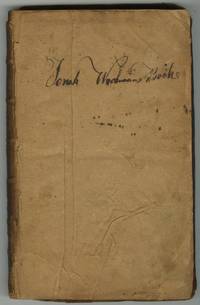
1779réf. BK0134Philadelphia: Joseph Crukshank 1779. 8vo contemporary calf 256 pp. With the ownership signatures of Jonah Woolman and Burr Woolman. Front board and preliminary page detached else good fair condition. A strong association copy of the first edition owned by Jonah Woolman 1733-1799 younger brother of the Quaker minister and abolitionist John Woolman and subsequently by Jonah's son Burr Woolman 1787-1844. Churchman and John Woolman were fellow ministers and worked together directly in the campaign against slaveholding among Friends. In his Journal Churchman records that in 1759 he and Woolman were engaged in "visiting some active members of our Society who held slaves" in Philadelphia and New Jersey; Woolman's own journal likewise records meeting Churchman by agreement in Philadelphia and spending much of a week visiting Friends who held enslaved people. The provenance connects Churchman's account to the immediate family of one of his collaborators in this work. Jonah Woolman was John Woolman's younger brother and Burr Woolman whose ownership signature also appears was Jonah's son. . Joseph Crukshank unknown
1779réf. BK0134Philadelphia: Joseph Crukshank 1779. 8vo contemporary calf 256 pp. With the ownership signatures of Jonah Woolman and Burr Woolman. Front board and preliminary page detached else good fair condition. A strong association copy of the first edition owned by Jonah Woolman 1733-1799 younger brother of the Quaker minister and abolitionist John Woolman and subsequently by Jonah's son Burr Woolman 1787-1844. Churchman and John Woolman were fellow ministers and worked together directly in the campaign against slaveholding among Friends. In his Journal Churchman records that in 1759 he and Woolman were engaged in "visiting some active members of our Society who held slaves" in Philadelphia and New Jersey; Woolman's own journal likewise records meeting Churchman by agreement in Philadelphia and spending much of a week visiting Friends who held enslaved people. The provenance connects Churchman's account to the immediate family of one of his collaborators in this work. Jonah Woolman was John Woolman's younger brother and Burr Woolman whose ownership signature also appears was Jonah's son. . Joseph Crukshank unknown books