9.885 resultados
1919ref. 124931à Lyon, chez M. P. Rusand, imprimeur-libraire, Librairie ecclésiastique de Poussielgue-Rusand 1919 72 volumes. In-8 20,5 x 12,5 cm. Reliures de l’époque composites demi-basane aubergine, dos lisses ornés de filets dorés encadrés de petits fers à froid & à partir du vol. n 48, demi-basane vert-émeraude, dos lisses ornés de filets à froid, environ 550 pp. par volume, table en fin de chaque volume. Ex-libris marquis de Monteynard.
ref. 061-Do.J. Pinsel in Grau, über roter Kreide, auf Bütten, unten signiert und datiert ?J. Wit f. 1754?. 17,7:14,4 cm. - Papier etwas vergilbt. Sehr reizvolle Zeichnung, die im Todesjahr des Künstlers entstanden ist.
ref. 65432Bombay: Printed at the Education Society's Steam Press Byculla 1893. FIRST EDITION. 8vo. xxiii2362 errata4 ads. Arabic and English text. Publisher's original red cloth binding with gilt lettering to spine and upper cover. From the library of the "Newman School of Missions" of Thabor Jerusalem with their book label to front pastedown. The Newman School of Missions was a historical institution located at a place called Thabor in Jerusalem British Palestine active at least during the 1920s to 1940s. Some rubbing and fading to cloth slightly cocked contents clean and unmarked save for one ink scribble to lower portion of page 95 generally a pleasant copy in the original cloth. An important and uncommon English translation of the Mu'allaqat 'The Suspended Odes' one of the most celebrated compilations of pre-Islamic poetry. The seven poems by Imru' al-Qais Tarafa Zuhayr Labid 'Antara Ibn Shaddad 'Amr ibn Kulthum and Harith ibn Hilliza are believed to have been hung in the Kaaba although many scholars have argued the title is less literal referring instead to suspension in the mind. Due to its renown the Mu'allaqat attracted several important commentaries by leading scholars of early Arabic poetry. This edition is translated line by line with notes alternative readings historical context etc. by Capt. F.E. Johnson. It also features an introduction and analysis by Sheikh Faizullabhai a Fellow of the University of Bombay. Bombay: Printed at the Education Society's Steam Press, Byculla, 1893. hardcover
ref. 539100Boston: Bulfinch Press / Little Brown 1995. Unbound. Very Good. Unbound proof and publisher's dummy. Proof consists of preliminary material photocopied on bifoliums followed by 326 unbound quarto sheets of text printed rectos only no illustrations wrapped in a folio sheet reproducing the book's cover. Folio sheet with some creasing on the bottom portion text with very light wear and a tiny bit of staining on the bottom edge affecting only the very corner of a few leaves overall very good or better. The publisher's dummy is a tall octavo bound in unprinted cloth and papercovered boards with 11 printed leaves bound in the front reproducing preliminary content a portion of the text and several color reproductions of Ringgold's artwork. Several of these leaves are composed of two sheets glued together and a few are printed on thicker stock; the remainder of the book is unprinted. Other than the spine and cover the dust jacket is printed a plain blue. The book is modestly worn with some splitting at the gutter where the first blank meets the first inserted leaf but sound very good or better. The dust jacket is about very good with several tiny chips and tears a couple of interior tape reinforcements and the plain lower panel of the dust jacket has three moderately sized chips one a bit dampstained about very good. Two very interesting and presumably very uncommon early formats of the noted African-American artist's autobiography. Bulfinch Press / Little, Brown unknown
ref. 222-Do.J. Feder in Braun, teils laviert, auf Bütten, auf China aufgezogen. 14,2:9,2 cm.
ref. 296-Wo.J. Aquarell über Bleistift, mit schwarzer Tuschlinie umrandet, Darstellung oben rundbogig geschlossen, auf cremefarbenem Velin, rehts unten mit Bleistift monogrammiert und datiert ?M. E. September 1839?. Darstellungsgröße 20,5:13,3 cm, Blattgröße 26:19 cm. - Papier leicht vergilbt. Literatur: Nicht im WV von S. von Blanckenhagen in: F. W. Fischer, Marie Ellenrieder. Leben und Werk der Konstanzer Malerin. Konstanz/Stuttgart, 1963. Charakteristische Arbeit der Künstlerin, entstanden während der 2. Italienreise 1838-1840, bei der sie von ihrer Schwester Josephine und einem Dienstmädchen begleitet wurde. Über diese Zeit berichtet Bärbel Kovalevski in: Marie Ellenrieder 1791-1863. Kleine Galerie. Berlin, Selbstverlag 2008, S. 42, ?Die Belastung in psychischer und physischer Hinsicht führten dazu, dass sie sich während der zweiten Italien-Reise nie so frei und glücklich fühlte, wie sie es sich in ihren Vorstellungen gewünscht hätte: Kraft und neuen Mut zu gewinnen zu weiteren größeren Aufgaben im künstlerischen Schaffen war ihr Ziel. Aber Marie Ellenrieder kehrte 1840 in die Heimat zurück, ohne den ersehnten Auftrieb und die Stärkung ihrer Kräfte erhalten zu haben. Dabei war der zweite Aufenthalt von Marie Ellenrieder in Rom von Ehrungen begleitet. Bedeutende Persönlichkeiten besuchten ihr Atelier, wie der König Ludwig von Bayern. Sie wurde am 16.4.1840 in die Congregation dei Virtuosi al Panteon aufgenommen und wird am 6.2.1841 als korrespondierendes Mitglied aufgeführt. Auch an den Ausstellungen der deutschen Künstler im Januar 1839 und am 16.3.1840 nahm sie teil.?
1986ref. 47004GOLDMANN WILHELM 07/1986. 1. softcover. Falsa ISBN: 3-442-08534-0! GOLDMANN, WILHELM paperback
1897ref. 16289Leiden and London: Brill & Porter 1897. FIRST EDITION. With 22 chromo-lithographed plates. Original publisher’s pictorial green cloth title in gilt to spine and top cover with patterned end-papers; edges stained green. Label pasted on to the front paste-down indicating that this copy is No. 26 of 170 copies of this edition with the stamp of the Librairie et Imprimerie ci-divant E.J. Brill with a signature. First edition of this beautifully illustrated work which includes not only adult birds but also their chicks and their eggs. Taken from the birds living in the Amsterdam Zoological Garden in 1872 the illustrations were commissioned by G.F. Westerman 1807-90 the director of the Gardens. Westerman wanting to enlighten the public as to the beauty of these birds appointed the great German artist and illustrator Heinrich Leutemann 1824-1905 who created fifteen of the plates. As Westerman died before the monograph was completed the Dutch naturalist Blaauw 1860-1936 stepped in and supplied the text commissioning an additional seven plates by the renowned bird artist and illustrator J.G. Keulemans 1842-1912. Only 170 copies were printed of this stunning work of which ours is number 26. Brill & Porter unknown
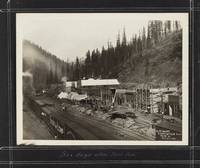
1900ref. ALB-291900. Photo album; silver prints 165. Through a myriad of images taken by H. English and A.J. Elton and compiled by F.E. Albrecht an employee at the Taft Montana Office and Commissary of the Chicago Milwaukee St. Paul & Pacific Railroad the album chronicles aspects of life in the rugged frontier town of Taft Montana in the heart of the Bitterroot Mountains dubbed by a Chicago Tribune Reporter as "the wickedest city in America." The first images show Taft following its initial fire in August of 1908 with one captioned "Out of 29 buildings 24 are occupied by saloons. This portion of Taft was completely destroyed by fire" and another evocative shot depicting two women in undergarments walking the tracks annotated "Two homeless Taft women after fire." The album captures expansions along the CMSP&PRR commonly referred to as "The Milwaukee Road" including construction views of the momentous St. Paul Pass Tunnel which linked Chicago to Seattle and passed from Taft to Grand Forks Idaho. It is said that an estimated 1000 Montenegrin immigrants were recruited for the job known for their hard-rock drilling skills. These men were led by their "king" Milosh Kolezich who was gunned down by the Tunnel Foreman Holmes "Reddy" Hayes following a dispute in Fall of 1907. Hayes hastily skipped town following the incident but returned in 1908 to resume his post wrongly assuming the Montenegrins had left the work camp. Within moments of his return a gunfight was underway in which six men were killed including Reddy Hayes. One particular photograph shows "Deputy Sherriff Callahan searching Montenegrins after murder of Foreman Hayes. Other views show the work camps in the towns of Taft and Grand Forks; scenes of workmen atop rail cars in the tunnels and "waiting for dinner the bell"; group portraits of identified employees Albrecht included and others such as Dr. L. J. Coria who ran the local hospital; shots showing the many present Saloons; and other aspects of railroad construction including wrecks and rail-laying. By the beginning of the 20th century most frontier towns that had managed to survive the end of westward expansion were becoming gentrified settling down with an influx of families and the less adventurous or desperate but not Taft. Founded as an anonymous camp in 1907 Taft was home to railroad workers attempting to extend the Chicago Milwaukee St. Paul and Pacific Railroads through the Bitterroot Mountains. John Shontz a researcher with the Milwaukee Road Historical Association said that Taft "truly was the last boom town in the American west. There were only three houses and no schools. There were bars and saloons and pool halls and prostitutes." The second biggest profession in town was prostitute and there were between 20 and 50 saloons for a population of less than 7000. The town's concentration of criminals was so high that the coming of spring and the thawing of the snow inevitably led to the discovery of dead bodies. In Taft's final spring records indicate as many as seventeen corpses were found. Legend has it that the town's name came about following a visit from then-Secretary of War and future President who described the camp as a "sewer of sin" and "a sore on the otherwise beautiful national forest." The town was named after Taft either in mocking jest or as a token of the workers' umbrage depending on which sources you consult. Ultimately like Sodom and Gomorrah the town's end was cataclysmic. There were two fires between 1907 and 1910 the latter of which devastated the town past the point of return. The last remaining buildings in Taft were flattened for the construction of the interstate in 1962 and today nothing remains of the wickedest city in America save for an exit off of I-90. 3 1/2 x 5 to 8 x 10 inches ; Each page with detailed notations recto. unknown
ref. 17700Original Artwork: Later published by George Allen and Unwin. c.1972. The original preliminary painting for the wraparound cover design of the 1973 first UK edition of Charlie and the Great Glass Elevator. The original preliminary painting for the wraparound cover design of the 1973 first UK edition of Charlie and the Great Glass Elevator. Pen watercolour and gouache on card. Measuring 25 x 35cm. Annotated and signed by the artist on verso "Elevator should be about 1/2'' higher. F. J." In excellent bright condition folded and partially split along the spine panel in production. A rare opportunity to acquire an iconic image of 20th century British children's literature. Faith Jacques 1923 - 1997 in Charlie and the Chocolate Factory 1967 was the first British illustrator of Roald Dahl's books therefore visually responsible for introducing a generation of children and adults to the world of Willy Wonka and Charlie Bucket. Further details and images for any of the items listed are available on request. All items are catalogued by humans. Lucius Books welcomes direct contact with our customers. Original Artwork: Later published by George Allen and Unwin. c.1972 unknown