37 risultati
1993rif. 45290Portland OR: Williams Publishing 1993. Paperback. 146p. very good second printing stated First Edition with number line ending in 2 trade paperback in lavender wraps. "Little Rock" is an allusion to "the gay community's role in electing Bill Clinton Williams Publishing paperback books
2000rif. 201079San Francisco: Magnus News 2000. Magazine. 32p. 8.5x11 inches photos articles resources and services opinion very good magazine in stapled newsprint pictorial wraps. The magazine attacked the dominant theories of AIDS causation. Cover story on Mark Leno. Members of ACT UP/SF published and contributed to the periodical. Magnus News unknown books
1973rif. 218238Washington DC: Off Our Backs 1973. Newspaper. 32p. folded tabloid newspaper photos illustrations news reviews services ads evenly toned lightly edgeworn 0.75 inch closed tear along fold address label on rear wrap otherwise good on newsprint. "Mary anti-Mary" a novel by Carol Anne Douglas illustrated by Mecca Reliance. Special Xmas Issue. Off Our Backs unknown books
2009rif. 325548San Francisco: City Lights Books 2009. Paperback. xvi 303p. personal inscription signed by Tommi very good first edition trade paperback in pictorial wraps. Oral histories. From the library of Jerry "The Faerie" Berbiar. City Lights Books paperback books
1998rif. 272154Washington DC: James White Review Assoc. & Phil Willkie 1998. Newspaper. 24p. folded tabloid newspaper on heavy white newsprint news fiction poetry art reviews ads services and resources very good condition. Sister of Perpetual Indulgence cover photo. James White Review Assoc. & Phil Willkie unknown books
2008rif. 307696New Jersey: S. Baker Publishing 2008. Paperback. 357p. wraps a bit handled with slightly curled corners minor rubbing to base of spine else very good. S. Baker Publishing paperback books
1928rif. 144851928. Varthema Ludovico di. The Itinerary of Ludovico di Varthema of Bologna from 1502 to 1508 1928. Limited first Argonaut Press edition of one of the earliest European firsthand accounts of Mecca and Medina originally published in Italian in 1510. Varthema an Italian traveler from Bologna entered the Islamic holy cities in 1503 after joining a pilgrim caravan from Damascus under the assumed Muslim name Yunus serving among its Mamluk military escort. His account is among the earliest recorded descriptions of the Hajj and Mecca by a European visitor who was not originally Muslim detailing pilgrimage ceremonies religious customs urban life and encounters with merchants and local authorities. His subsequent travels extended through Yemen the Persian Gulf Persia India and parts of Southeast Asia recording commercial networks religious practices military organization and maritime trade during the opening decades of Portuguese expansion into the Indian Ocean. The 1928 edition reproduces John Winter Jones's 1863 English translation prepared for the Hakluyt Society together with Sir Richard Carnac Temple's historical examination of Varthema's travels in southern Asia. Varthema Ludovico di. The Itinerary of Ludovico di Varthema of Bologna from 1502 to 1508. As Translated from the Original Italian Edition of 1510 by John Winter Jones F.S.A. in 1863 for the Hakluyt Society with A Discourse on Varthema and His Travels in Southern Asia by Sir Richard Carnac Temple. London: The Argonaut Press 1928. First Argonaut Press edition limited to 975 numbered copies printed on Japon vellum. One volume quarto 4to pp. lxxxvi 122 last blank 2 colophon blank. Illustrated with one plate five full-page maps within the pagination a facsimile of the original 1510 title page and a title-page vignette printed in blue and black; includes an index. Edited by N. M. Penzer. Original quarter vellum over blue-grey buckram boards spine lettered and ruled in gilt with rectangular gilt devices on both covers. Retains the original ribbon marker and an ownership bookplate centered on the front pastedown. Varthema's narrative follows his passage through Egypt and Syria to Medina and Mecca then southward through Yemen and Aden onward to Hormuz and Persia and across the Indian Ocean to India and Southeast Asia. His descriptions address the religious observances of the Muslim pilgrims Bedouin encounters regional customs and laws commercial products trading practices and methods of warfare. Varthema's travels took place during a period of increasing Portuguese intervention in Indian Ocean commerce shortly after Vasco da Gama's voyage around the Cape of Good Hope established a new maritime route between Europe and India. His account records the established Muslim trading networks connecting the Arabian Peninsula Persian Gulf Indian ports and Southeast Asian markets before Portuguese naval power substantially altered regional commerce. First printed in Rome in 1510 the narrative circulated in successive European editions and translations becoming an early source for European geographical knowledge of Arabia and the Indian Ocean. Sir Richard Carnac Temple's accompanying discourse examines the historical and geographical evidence for Varthema's itinerary distinguishing his observations from earlier travel accounts and evaluating his descriptions of southern Asia. The original vellum and buckram binding retains its gilt decoration ribbon marker and ownership bookplate. Overall in very good condition. unknown books
1926rif. 144221926. Gröber Karl. Bird's Eye View of Mecca 1926. Original copperplate photogravure depicting Mecca Islam's holiest city and the destination of the annual Hajj pilgrimage. The elevated view records the historic urban setting of Mecca home to the Masjid al-Haram the Sacred or Grand Mosque and the Kaaba toward which Muslims worldwide direct their daily prayers. Published in 1926 the image dates from the early rule of Abdulaziz Ibn Saud over the Hejaz following his conquest of Mecca in 1924 and assumption of the title King of the Hejaz in 1926. The illustration preserves a photographic view of the holy city during a period of political transition decades before the extensive urban redevelopment and mosque expansions of the later twentieth century. Gröber Karl photographer. Bird's Eye View of Mecca. 1926. Original copperplate photogravure after a photograph by Gröber published as an illustration in the first edition of a 1926 book containing his text and photogravures. Sheet measures approximately 8.25" x 10.25" with a printed area of approximately 8.5" x 6.25". The elevated perspective presents a panoramic view of Mecca recording the city's buildings and urban topography. The copperplate photogravure process reproduces the tonal gradations and architectural detail of the original photograph. Mecca had been under Ottoman sovereignty until the Arab Revolt of 1916 after which it formed part of the Hashemite Kingdom of the Hejaz before coming under Saudi control in 1924. Gröber's 1926 publication belongs to this transitional period in the city's modern history. The original photogravure provides a contemporary visual record of Mecca before the major architectural alterations and expansions undertaken in subsequent decades. unknown books
1926rif. 144231926. Gröber Karl. Two Views of the Mosque at Mecca 1926. Pair of original copperplate photogravures depicting the Masjid al-Haram the Sacred or Grand Mosque in Mecca Islam's holiest city and the destination of the annual Hajj pilgrimage. The mosque surrounds the Kaaba toward which Muslims worldwide turn in daily prayer. Published in 1926 the illustrations date from the early period of Saudi rule over Mecca following the city's conquest by Abdulaziz Ibn Saud in 1924. The two views record the mosque from ground-level and elevated perspectives preserving photographic documentation of the sacred precinct before the extensive architectural expansions of the later twentieth century. Gröber Karl photographer. Two Views of the Mosque at Mecca. 1926. Two original copperplate photogravures after photographs by Gröber published in the first edition of a 1926 book containing his text and photographic illustrations. Each sheet measures approximately 8.25" x 10.25" with a printed area of approximately 6.25" x 8.25". The first photogravure presents a ground-level view of the mosque recording its architecture from within the surrounding urban setting. The second provides a bird's-eye view of the mosque showing the sacred complex from an elevated perspective. Both illustrations reproduce the tonal gradations and architectural details of the original photographs through the copperplate photogravure process. The illustrations were published during a decisive period in the modern history of Mecca. Following the collapse of Ottoman authority in the Hejaz during the First World War the city came under Hashemite rule before its capture by Ibn Saud in 1924. In 1926 Ibn Saud assumed the title King of the Hejaz incorporating Mecca into the expanding Saudi state. The paired views record the mosque's architectural setting during this transition preceding the major expansion and redevelopment campaigns undertaken from the mid-twentieth century onward. Both original photogravures are in excellent condition presenting complementary perspectives of the Grand Mosque as reproduced in 1926. unknown books
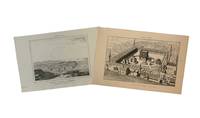
1847rif. 146231847. Mecca is the birthplace of prophet Muhammad and home to the Kaaba the holiest site while Medina is the second holiest city where the Prophet's Mosque is located.Two original steel engravings titled "Medina et Sepulcre du Prophete" and "Temple de la Mecque" issued in Picturesque Universe Paris: Firmin Didot 1847. Engraved plates measuring approximately 5" x 8.2". These mid-nineteenth-century French views present idealized yet intricately rendered representations of Islam's two holiest cities Medina and Mecca produced for a European readership at a moment of expanding Orientalist travel literature and imperial curiosity about the Islamic world. The Medina engraving offers a panoramic prospect from an elevated vantage point depicting the walled city and the Prophet's Mosque at its center approached by four travelers traversing a mountainous road some mounted on camels. The composition emphasizes distance and pilgrimage situating the sacred city within both devotional and geographic imagination. The companion engraving of Mecca presents a detailed architectural rendering of the Masjid al-Haram complex with the Kaaba prominently centered and surrounded by arcades and ancillary structures the broader urban fabric faintly delineated in the background. Produced at a time when non-Muslim access to these cities was extremely restricted such engravings mediated sacred Islamic space through European print culture shaping nineteenth-century visual conceptions of the Hijaz. As products of a major Parisian press renowned for technical excellence these steel engravings reflect both advances in reproductive printmaking and the period's fascination with global religious and cultural monuments.First engraving with loss to the lower right corner not affecting the primary architectural focal points; light age toning and minor edge wear consistent with issue; second engraving clean and well-preserved with strong plate impression. Overall very good. An evocative pair of mid-nineteenth-century European views of Medina and Mecca documenting the circulation of Islamic sacred geography within illustrated travel literature at the height of Orientalism publishing. unknown books
1790rif. 145711790. Engraved plate titled View Of The Temple of Mecca and accompanying Plan Of The Temple of Mecca circa eighteenth century represents an early modern European visual interpretation of the Kaaba and the Masjid al-Haram in Mecca Islam's most sacred site. Produced for inclusion in eighteenth-century printed works including editions of André du Ryer's French translation of the Qur'an L'Alcoran de Mahomet the engraving reflects European efforts to depict and systematize knowledge of Islamic sacred geography during a period of expanding global contact. The print supports research in Islamic studies the history of book illustration Orientalist visual culture and early modern European representations of non-Christian religious architecture. Engraved plate. Circa 1700s. Approximately 8 x 12 inches. Unmounted and unframed. The foldout plate comprises two distinct but related images: an aerial plan of the sacred precinct at Mecca and a perspectival view of the Kaaba within the Masjid al-Haram. The central structure of the Kaaba is depicted surrounded by arcaded and domed architectural elements characteristic of the sanctuary as understood in the eighteenth century. In the foreground courtyard numerous Muslim worshippers-approximately one hundred figures-are shown engaged in prayer emphasizing both ritual practice and spatial organization. The engraving was issued in connection with eighteenth-century European editions of Islamic texts including Du Ryer's influential translation and reflects the period's hybrid combination of documentary ambition and interpretive stylization. As a visual artifact circulating within early modern printed Qur'anic translations the plate documents how European readers encountered Islam through mediated imagery shaped by travel accounts diplomatic reports and secondhand description. Such engravings played a formative role in constructing Western visual conceptions of Mecca at a time when access to the holy city was restricted to Muslims. The presence of both plan and elevation view demonstrates Enlightenment-era interest in architectural order cartographic precision and comparative religion. Light age-related toning and traces of original fold at center; minor fold wear consistent with issuance as a book plate; image clear with well-preserved engraved detail. Overall very good condition. A significant eighteenth-century engraved representation of the Kaaba and Masjid al-Haram reflecting early European visual engagement with Islamic sacred space. unknown books
1921rif. 148161921. Unpublished sepia-toned photograph of pilgrims journeying to Mecca circa 1921 documents the material and spatial realities of the Hajj in the early twentieth century during a period of geopolitical transition in the Arabian Peninsula following the First World War. The image captures a vast encampment of white tents set against a rugged and mountainous landscape outside Mecca visually conveying the scale of pilgrimage infrastructure prior to modern urban expansion. Created during the years immediately preceding the establishment of the Kingdom of Saudi Arabia in 1932 the photograph supports research in Islamic religious practice the history of pilgrimage logistics and British imperial observation of the Hejaz during the inter war period. Photograph. Circa 1921. Approximately 3.5 x 5 inches. Sepia-toned silver gelatin print. The composition presents thousands of white tents clustered across uneven terrain forming a temporary city of pilgrims undertaking the religious journey to Mecca. The mountainous backdrop situates the encampment geographically within the arid environment surrounding the holy city. The photograph originates from the album of a British naval officer who traveled in the region between 1920 and 1923 providing contemporaneous visual documentation from a foreign observer during a time of shifting political authority in the Hejaz following the collapse of Ottoman control. The image appears unpublished and retains the intimate scale characteristic of personal travel albums. As a visual record predating large-scale modernization of pilgrimage facilities the photograph preserves evidence of early twentieth-century Hajj organization material culture and environmental conditions. The presence of an extensive tent city underscores both the enduring continuity of Islamic ritual practice and the logistical complexity of pilgrimage prior to the oil-era transformation of the region. Light age-related curling; minor chipping at lower edge not affecting the image area; surface otherwise clean with strong tonal range. Overall good condition. A historically significant early twentieth-century photograph documenting the lived landscape of pilgrimage to Mecca during a pivotal moment in Arabian political history. unknown books