Marracci, LudovicoAntiquariat.de

779 résultats
1698réf. 16446CBPatavii, (Padova), Typographia Seminaria, 1698. Folio Title page [1 nn. page], 45 pages, [2 nn. pages], 46 pages, [1 nn. page] 81 pages., [3 nn. pages], 94 pages, [5 nn. leaves], 126 pages., [1nn. page Appendix and 8 nn. pages INDEX] Contemporary vellum. Die Versandkosten für Kunstwerke und mehrbändige Werke können von den Standard-Versandkosten abweichen. The complete first volume of II volumes. 2 nd. edition. Good condition.
2008New Arabic Original cloth bdg. 592 p. In Arabic. Elephant folio. (49 x 35 cm). First Edition. Illuminated. Reprinted from the original manuscript of Topkapi Palace Museum dated 1584-87. The Koran known as Ahmed Karahisarî's Mushaf-i Serif is leading among the most important works created by artists, who are experts of letters of the Ottoman Palace dealing with the art of books. The work is registered at number 5 among the Hirka-i Saadet books of the Library of Topkapi Palace Museum. Its binding with golden gilded ornament, angle and border has miklep and is made of black leather and was repaired in time. Being the Koran with the largest size written in the Ottoman world, is sized 61.5x42.5 cm and consists of 300 sheets. The place of the work where the name of the calligrapher and the date of transcription would have been written, i.e. the colophon is left empty. The reason for attributing it to Ahmed Karahisarî, the famous calligrapher of the period of Kanunî Sultan Suleyman, is based on a foundation record at its beginning: in this foundation record on page 1b, it is briefly stated that the work is the Mushaf-i Serîf of Karahisarî, was kept in the sultan's treasure until then and was devoted to the Hirka-i Serîf Chamber (Private Chamber) for being recited in 1107 (1696) by Sultan Mustafa II. The beginnings of Fâtiha and Bakara chapters of the Koran, every page of which is gilded carefully, are written with celî muhakkak (large cursive style) and reyhanî calligraphy. Two opposed pages following the epigraph demonstrate a different arrangement. Here, one line each of celî calligraphy at the bottom and top and reyhanî calligraphy in a round medallion at the middle are used. In the opposed pages following this, the same arrangement is used without the medallion. Following this diversity at the beginning, the Koran is written according to a classical arrangement known as Yakut style, consisting of one line of celi muhakkak, five lines of nesih (roundish writing), one line of celî sulus (large style), again five lines of nesih and celî muhakkak calligraphy at the bottom. Ahmed Karahisarî is the most famous artist writing in this style among 16th century Ottoman calligraphers. However, it is quite surprising that the signature of Ahmed Karahisarî, who had great reputation in his time, is not seen at the end of the work. This can be explained by the failure to complete the Koran of the artist due to his death or his old age. It is possible to determine the period in which the work, accepted to be written by Ahmed Karahisarî, famous calligrapher of the time of Kanunî Sultan Suleyman, and incorporating the richest examples of Ottoman palace gilding art was completed with its main lines in the light of some documents.It is understood that 220 pages of the Koran known as Ahmed Karahisarî Mushaf-i Serif and which is one of the most valuable works of Topkapi Palace Museum were written by Karahisarî at the time of Kanunî Sultan Suleyman between 1545-55 and was left unfinished upon the death of the artist. It is also understood that the remaining 80 pages completing the Koran were possibly written by Hasan Celebi, his adoptive son, under the patronage of Sultan Murad III between 1584-87. Conjunction, drawing of rulers, gilding of every page and binding and final completion of the work was performed between 1584-1596. Murad III, who died in 1595, could not see the result of this study that he assumed the patronage of for long years.
1850Very Good Burmese Original dark brown leather with embossing on the front board with an initial-like symbol. The black script in ink with several pencil annotations on rectangular pieces of thick hand-made mulberry paper. Closed size: 38x12,5 cm. Open size: 550x38 cm. Text in Pali, written in Burmese "round" script, richly illustrated in red, black, white, and yellow from the most influential Buddhist and astrological texts of the region. Well-preserved and in very good condition. Extremely rare example of one of the longest and a richly illustrated parabaik from Burma, "reflecting an old system of Theravardan magical beliefs pertaining to Burma / Myanmar over 100 years ago". A highly collectible item from the pre-colonial period of the Konbaung dynasty, formerly known as the Alompra dynasty, the Third Burmese Empire, the last dynasty that ruled Burma/Myanmar from 1752 to 1885, Buddhist Myanmar. With its open size, it is extremely rare in length with 44 folds; "The longest one would have 64 folds" (Harvard online). The scenes might show episodes from the Buddhist folk tales popular in Burma towards the end of the 19th century including many ancient tables and ca. 40 specific depictions of Buddha's life, Buddhist practices, some historical scenes, and religious practices like sky burial scenes, etc, as well as astrological and astronomical chapters. Folding-book manuscripts (Parabaiks in Burmese) are a type of writing material historically used in Mainland Southeast Asia, particularly in the areas of present-day Myanmar, Thailand, Laos, and Cambodia. The manuscripts are made of thick paper, usually of the Siamese rough bush (Khoi in Thai and Lao) tree or the paper mulberry, glued into a very long sheet and folded in a concertina fashion, with the front and back lacquered to form protective covers or attached to decorative wood covers. The unbound books are made in either white or black varieties, with the paper being undyed in the former and blackened with soot or lacquer in the latter. Along with paper made from bamboo and palm leaves, parabaik were the main medium for writing and drawing in early modern Burma/Myanmar.
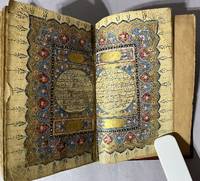
1800réf. 006923Persian Qajar Iran 1800. Leather. Very Good. Small Octavo. Qur'an - Arabic manuscript Koran. Circa late 18th-early 19th century. Small 8vo 6.5 x 4.5 inches. Complete illuminated Arabic manuscript on polished laid paper. 301leaves 602 pages ruled in red and black written in a fine black naskh script in 15 lines per page with diacritics and vocalizations in red and black ink. Verses seperated by gold circular rosettes. Surah Headings in red with illuminated cartouches opening two pages richly decorated with double-page floral and geometric illumination in gold blue red and green. Marginal decorations include floral medallions and gilded ornaments. Bound in contemporary full burgundy morocco covers pannelled in gilt with an intricate all-over lattice of floral tools spine with gilt title "The Koran" edges gilt. Binding lightly rubbed at extremities and somewhat fragile. Last leaf with open chip but on the whole well-preserved with clean leaves and vivid illumination. The stunning opening illumination and finely tooled morocco binding suggest it was produced for a wealthy patron or as a luxury devotional item. hardcover