1966rif. TB15720New York: McGraw-Hill Book Co 1966. First Edition. First printing Very good in blue cloth covered boards with the outer edges of the very faintly faded and with minor dust staining to the top edge. In a very good price clipped dust jacket with minor wear and rubbing to the ends of the spine area and nicks to the fore corners of the panels. "America's route of the ages - from Asia across Alaska down the Rocky Mountains to the plains of Texas." The 8th volume in The American Trails Series. McGraw-Hill Book Co hardcover books
1971rif. TB01441New York: McGraw-Hill Book 1971. First Edition. First printing Very near fine in black cloth covered boards but with a prior owner's name stamped on the front end paper & tape stains to both end papers. In a near fine dust jacket with the price intact but with tape stains at the flap ends where they were once taped to the end papers of the book. The tenth volume in The American Trails series which covers the "perilous trail to Montana's Gold." 306 pages including an index and bibliography. McGraw-Hill Book hardcover books
1959rif. TB25170Waterford New York: Self-published 1959. First Edition. First printing Fine in green cloth covered boards with gilt text stamped on the spine and front board. An octavo measuring 9" by 6". Without a dust jacket probably as issued; however the covers are protected by a thick acetate jacket. Laid-in is a mimeographed one page advance ad by the author for this book. Additionally the book is signed by the author on the title page. 28 pages of text including a list of references and bibliography. Illustrated with black and white photographs. Self-published hardcover books
1962rif. TB24327New York: McGraw-Hill Book Co 1962. Tenth Printing. Very good in ivory cloth covered boards with gilt text and red decorations on the spine and on the front board. In a very good price clipped dust jacket. 339 pages including an index. Illustrated with maps and line drawings. The fourth volume in The American Trails Series which deal with the various wagon roads to California from Council Bluffs St. Joseph and Indpendence. McGraw-Hill Book Co hardcover books
1962rif. TB09439New York: McGraw-Hill 1962. Sixth Printing. Fine in decorated black cloth covered boards with a prior owner's name on the first free end paper. In a near fine dust jacket with slight tanning of the spine area. The 4th volume in the Trails of America Series. The trail that started in Mexico and went north up the California coast to San Francisco. McGraw-Hill hardcover books
1995rif. TB03776New York: Random House 1995. First Edition. First printing Fine In a fine dust jacket. By the author of The Russians. Random House unknown books
1980rif. TB13511no city stated: Self Published 1980. First Edition. First printing Fine in blue cloth covered boards with white text on the spine. In a fine dust jacket. The author provides an historical account of her father's venture to Alaska during the gold rush of 1899 to assist in the development of a bank to safeguard the gold found by the miners. 153 pages including a bibliography text reproductions of contemporary photographs & illustrations by Janet K. Monteith. Self Published hardcover books
1962rif. TB02287Boston: Little Brown & Co. 1962. First Edition. First printing Fine In a near fine dust jacket with the verso of the spine area spotted but this defect does not show through. A comprehensive examination of the men who lead in the settlement of the west. Little Brown & Co. unknown books
1946rif. TB08333New York: Macmillan Company 1946. First Edition. First printing Very good in green cloth covered boards with a 1/4 inch paint stain on the front board and light shelf wear. In a very good dust jacket with a price clipped jacket flap with light spine end wear & light chipping to the panel corners. The history of that area which is now Ohio Indiana Illinois Wisconsin and Minnesota told by the author through "legends anecdotes and episodes." Macmillan Company hardcover books
1960rif. TB08252New York: Coward-McCann Inc. 1960. First Edition. First printing Fine in decorated ivory colored cloth boards with gilt text stamping on the spine and a gilt decoration on the front board. In a very good dust jacket with rubbing creasing and short closed tears at the upper edge of the spine area and rubbing to the fold to the spine from the rear panel. One of the volumes in the American Vista Series which describes the 300 year drama of the finding and developing of the Mid-West. Told with selections from narritives from the people who lived it Coward-McCann, Inc. hardcover books
1994rif. TB02437New York: Orion Books 1994. First Edition. First printing Fine in 1/4 brown cloth and charcoal gray paper covered boards. In a fine dust jacket with the price intact on the front flap. Signed by author on the title page. Sub-titled: The Life and Death of an American River. Orion Books hardcover books
1992rif. TB01869New York: Harper Collins Pub 1992. First Edition. First printing Fine In a fine dust jacket. Harper Collins Pub unknown books
1980rif. TB03573New York: Alfred A. Knopf 1980. First Edition. First printing Near fine. In a very good but price clipped dust jacket with the ends of the spine area worn but without any chipping. The story of the Forty-Niners and their quest for gold in California. Alfred A. Knopf unknown books
1967rif. TB02093Garden City: Doubleday 1967. First Edition. First printing Very good slight fading at spine ends. In a very good dust jacket 3/4' chip at spine hinge & ends worn. Doubleday unknown books
1959rif. TB22631Waterford New York: Self-published 1959. First Edition. First printing Fine in green cloth covered boards with gilt text stamped on the spine and front board. An octavo measuring 9 by 6 inches. There is a dated "June 1959" gift inscription on the front free end page. The book is in otherwise perfect condition. Without a dust jacket probably as issued; however the covers are protected by a thick acetate jacket. 28 pages of text including a list of references and bibliography. Illustrated with black and white photographs. Self-published hardcover books
1992rif. TB02985New York: Simon & Schuster 1992. First Edition. First printing Fine In a fine dust jacket. Simon & Schuster unknown books
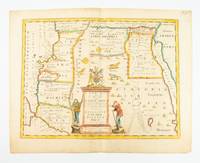
1720rif. CDB2402London or Oxford: Edward Wells ca. 1720s. 440 x 555 mm. 17 1/2 x 21 3/4". Engraved map by R. Spofforth after Edward Wells carefully hand colored. Upper right margin with the ink inscription "38" denoting the number in Wells' atlas. National Maritime Museum Catalog III 452. Lower part of blank verso faintly browned but in excellent condition the sheet fresh and clean and the engraving bold and dark. Depicting North Africa labeled with the ancient civilizations that inhabited the area this striking map employs an unusual cartographical layout and features a dedication to a tragic young prince. With ancient temples and cities marked it is from Edward Wells' "A New Sett of Maps both of antient and present geography" first published in 1700. The work was intended to educate young readers and remained in print until 1738 with editions published in both London and Oxford. Since the map has been removed from the atlas it is difficult to determine which edition it comes from. Wells 1667-1727 was a clergyman and Oxford instructor who taught the young William Duke of Gloucester son of Queen Anne to whom this volume was dedicated. Gloucester died at the age of 11 in early 1700 around the time of the original publication of this work; it is possible that the dedication was posthumous. This map has an unusual orientation. It is apportioned correctly in that the left half contains the western part of northern Africa and the right half shows the eastern part; also as expected the right half shows us north at the top in the usual way with the northern coastline running horizontally. However the image occupying the left half of the double-page spread is rotated 45 degrees to the left so that the northern coastline of the western half does not run horizontally as we'd expect but descends instead. This cockeyed arrangement presumably was dictated by the need to fit half of the vast continent onto the limited space allowed. Edward Wells unknown books
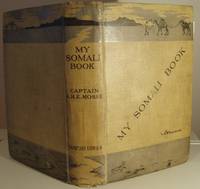
1913rif. 10070London: Sampson Low Marston & Company 1913. First Edition. First Issue. Original publisher's decorated cloth. Good; some rubbing to the binding. 8vo. The book is illus. throughout. An excellent account of big game hunting trips to a little known part of Africa. This copy is the first issue in the decorated cloth publisher's binding. Sampson Low, Marston & Company hardcover books
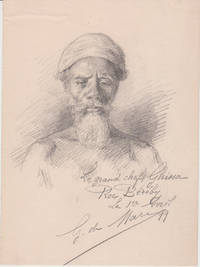
1899rif. 6400Ivory Coast: manuscript 1899. Unique. Not bound. All in very good condition. 4to. Pencil and watercolor washes. Eleven related portraits done from life completed between April and August of 1899. They are all of African men and women mostly from Roc Bereby. Each individual is identified by name and in some cases their social position. All contain full information along with the artist's name boldly inscribed in pencil in the lower right hand corner. These are historically accurate and highly accomplished portraits. They are direct honest individual character renderings without sentimentality. Each has a real immediacy. Among the subjects are : ' Le Vieux roi - Tobi ' ; ' Le Brigadier Amadi Cire ' ;' Yeppa ' ; ' Polee ' ; ' Moses Bonafacio ' ; ' Le Grand Chef Ghissa ' ; ' Yu Lou dit Blackwell ' ; etc. The overall dimensions of the sheet size is appx. 24 x 16 cm. . The purpose if any for which these portraits were done is unknown. De Mare was born in 1863 in Lucca Italy and died in a fire in Kansas City in 1907. He studied at the Ecole des Beaux Arts the Academie Julian Paris and was a member of the Chicago Society of Artists and the Municipal Arts League of Chicago. manuscript unknown books
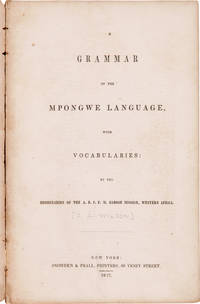
1847rif. 52605New York: Showden & Prall 1847. An Early Mpongwe-Language Grammar The earliest Mpongwe-language grammar for use among missionaries in Africa compiled by those working at the Gabun Mission operated by the American Board of Commissioners for Foreign Missions. Mpongwe was spoken along the Gabun and Ogowe rivers in French Equatorial Africa. Not in Darlow & Moule. Original marbled boards printed label on front board. Spine perished boards and front endpapers detached. Tanned scattered foxing. About good. hardcover books
rif. 570Engravings. 6pgs. No date. No place. A collection of six pages with twelve illustrations of African natives. They are from an unidentified book probably from the 18th Century and are in very fine condition overall. Some of the images show a mother breast feeding a beheading combat and royalty. A fine assembly unknown books
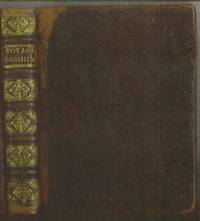
1728rif. BOOKS00671225144 contents and errata2 pages with 2 folding maps lacks frontispiece. Small Quarto 10" x 7 3/4". Rebacked in the 19th century leather retaining the original spine with raised bands and gilt decorative stamping and lettering to spine. Translated from the original Portuguese manuscripts by Jackim le Grande. First edition. Born in Lisbon he entered the Order of Jesus at the age of sixteen. In 1621 he was ordered as a missionary to India and in 1622 he arrived at Goa. With the intention of proceeding to Abyssinia whose Negus emperor Segued had been converted to Roman Catholicism by Pedro Páez he left India in 1624. He disembarked on the coast of Mombasa and attempted to reach his destination through the Galla country but was forced to return. In 1625 he set out again accompanied by Mendez the patriarch of Ethiopia and eight missionaries. The party landed on the coast of the Red Sea and Lobo settled in Abyssinia as superintendent of the missions in Tigre. He remained there until death deprived the Catholics of their protector the emperor Segued. Forced by persecution to leave the kingdom in 1634 Lobo and his companions fell into the hands of the Turks at Massawa who sent him to India to procure a ransom for his imprisoned fellow-missionaries. In this he was successful but could not induce the Portuguese viceroy to send an armament against Abyssinia. Intent upon accomplishing this cherished project he embarked for Portugal and after he had been shipwrecked on the coast of Natal and captured by pirates arrived at Lisbon. Neither at this city however nor at Madrid and Rome was any countenance given to Lobo's plan. He accordingly returned to India in 1640 and was elected rector and afterwards provincial of the Jesuits at Goa. After some years he returned to his native city and died there January 29 1678. Lobo wrote an account of his travels in Portuguese which appears never to have been printed but is deposited in the monastery of St. Roque Lisbon. Balthazar Telles made large use of the information therein in his Historia geral da Ethiopia a Alta Coimbra 1660 often erroneously attributed to Lobo see Machado's Bibliotheca Lusitana. Lobo's own narrative was translated from a manuscript copy into French in 1728 by the Abbe Joachim le Grand under the title of Voyage historique d'Abissinie. In 1669 a translation by Sir Peter Wyche of several passages from a manuscript account of Lobo's travels was published by the Royal Society translated in Melchisédech ThévenotRelation des voyages in 1673. An English abridgment of Le Grand's edition by Dr. Johnson was published in 1735 reprinted 1789. In a Mémoire justificatif en réhabilitation des pères. Pierre Paëz et Jérôme Lobo Dr. C. T. Beke maintains against Bruce the accuracy of Lobo's statements as to the source of the Abai branch of the Nile. See A. de Backer Bibliothèque de la Compagnie de Jésus edited by C. Sommervogel iv. 1893. Condition: Old stamp and inscription on title page first folding map conspicuously restored second map tear restored else a very good copy notes to front end paper in period pen else about very good. La Veuve d'Antoine-Urbain Co hardcover books
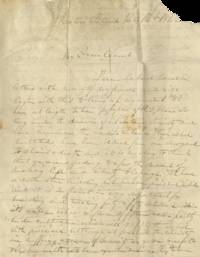
1842rif. List3738Ship Saluda Bound for Monrovia 1842. Two autograph letters signed approximately seven manuscript pages total. 1839 letter measuring 8 x 12 ¾ inches foxed with small tears at folds very good; 1842 letter measuring 8 x 10 inches tears at folds with larger tear to top right some text missing very good minus. Overall very good. A pair of letters documenting the work of Dr. Wesley Johnson 1813-1844 physician educator and colonial official associated with Bassa Cove during Liberia's formative decades. Written three years apart the letters preserve Johnson's involvement in medicine colonial administration anti-slave trade efforts agricultural reform and the establishment of one of Liberia's earliest advanced educational institutions. Born in Hillsdale New York Johnson studied medicine at Jefferson Medical College in Philadelphia under Dr. Jacob Green receiving his degree in 1837 before departing almost immediately for West Africa.1 He entered service at Bassa Cove a settlement approximately seventy miles south of Monrovia supported jointly by the New York and Pennsylvania Colonization Societies. Established as part of the larger Liberian colonization project Bassa Cove existed under difficult conditions: high mortality limited resources dependence upon outside support and periodic violence associated both with local conflict and the wider Atlantic slave trade. Johnson's responsibilities expanded rapidly after his arrival. He worked closely with Governor Thomas Buchanan and within a year had served in command of local militia forces and assumed administrative authority at Bassa Cove. Following conflict involving Theodore Canot a trader in enslaved people and violence affecting nearby settlements Johnson was reportedly injured; he shifted increasingly toward educational work becoming central to the establishment of the Ladies Liberia High School at Factory Island an ambitious project intended to educate future leadership within the colony. The earlier letter written aboard the ship Saluda on October 2 1839 finds Johnson struggling with declining health; a "bilious attack" that "was succeeded by an enlargement of the spleen" and he travelled along the coast towards Sierra Leone and Cape Mount "for my health." Even while discussing illness however Johnson remained focused on institutional work and future responsibilities: "When I return to Bassa I shall take charge of a high school about to be established there and carried on by the Ladies of Philad'a." That brief reference points toward one of the more ambitious educational efforts connected to early Liberia. Organized in Philadelphia in 1832 the Ladies' Liberia School Association sought to support educational development in Liberia through funding schools teachers and educational infrastructure.2 By the late 1830s the organization had developed a broad network of support and had undertaken plans for a secondary school at Factory Island near Bassa Cove. Johnson would become central to its implementation. He writes: "As long as I have serviceable health it is doubtless my duty to remain here for why should new persons come here continually at the risk of their lives & unacquainted with the colony or country. It seems hardly credible that I have been here more than two years already. "10th. I have been today drawing a plan of the buildings for the high school on Factory Island but this evening the vessel rolls and I cannot make straight marks & will go on with my letter. My health is better & better. I drink wine occasionally & we have five courses at dinner. I stopped at Monrovia several days as we came along and found high life at the Govt. house. When we get back to Bassa a school will give my employment & as my agency for the Col. Soc. will be exchanged for that of the Ladies Soc. of Phil. for African Education. Of this change I am glad. It will relieve me of care trouble and vexation and business which I have no means of accomplishing to my mind. "The Colony was never more prospered. Gov. Buchanan drives hard at the Slavers and they cannot stand it. You will see by the . something of what has been going on here. O that I was worth a million. I would make a great jam in Liberia. As it is I take it extempore make the best moves that I can for the time." Three years later writing from Factory Island on July 14 1842 Johnson reports that the educational institution envisioned in the earlier letter had become reality. He writes: "We have at length taken possession of this place so long under the dominion of his Satanic Majesty and have commenced the Ladies Liberia High School. Multitudes have been doomed from our door-yard to chains & death and it is consoling to think that we are affording to a few the means of making life and liberty blessings. We have a noble stone building not however finished inside and it is sufficient in every department for boarding and teaching forty or fifty scholars within its walls. Also a farm of fifteen acres partly under cultivation which will supply the school with provisions. Although at present the colonists are suffering a season of scarcity we go on comfortably. My health has been excellent since my return paper loss indeed it received an important improvement immediately after my arrival. My objects are to get the School thoroughly established an improved system of agriculture in operation and some other person properly introduced to my place & then to return to America. I should not add the last item so readily at present not knowing what circumstances may indicate of my duty but I made a general promise to my friends to return in two years. We are introducing the improved and labor saving plans and means of farming which are from five to ten times as efficient as those in common use here and as novel to the colonists as theirs would be in the good state of New York. We are in want of funds for these purposes all having been exhausted which were appropriated to them by the Ladies and I am obliged to furnish means from my own funds. We have a kind of manual labour system - the pupils work from 6 to 8 & from 4 to 6 & study from 9 to 12 2 to 4 & 7 to 8. My mode of teaching is much improved on what it was in Cin. by invention reflection & teaching others to teach and no other employment is so agreeable to me. I am father mother preceptor & religious teacher to my scholars & universal agent & factotum to the School and would to Heaven that I were better prepared for the work and could show an influential example of the power of living holiness." The physical cost of such work proved severe. Tropical illness permanently damaged Johnson's health. By the time of the present letters he was already recording prolonged illness and enlargement of the spleen. He ultimately returned to Hillsdale in 1844 and died shortly afterward at only thirty-one years old. Contemporary memorials praised both his educational work and personal sacrifice describing Liberia as having lost "a devoted friend and martyr." Taken together the letters preserve the work of an unusually capable participant operating at multiple levels of early Liberian development-physician educator administrator agricultural reformer and institution builder-while documenting educational work colonial administration medicine anti-slave trade activity and daily life through firsthand observation during Liberia's formative decades. An important Liberia grouping. 1 Otteson Ron. Ron Otteson "Dr. Wesley Johnson of Hillsdale: A Gentleman of Talent and Liberal Education" Roeliff Jansen Historical Society accessed May 22 2026 https://www.roeliffjansenhs.org/about-6. 2 Karen Fisher Younger "Philadelphia's Ladies' Liberia School Association and the Rise and Decline of Northern Female Colonization Support" Pennsylvania Magazine of History and Biography 134 no. 3 2010: 235-260. books
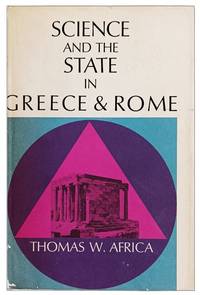
1968rif. RH1515New York:: John Wiley & Sons 1968. 1968. Sm. 8vo. 128 pp. Index. Cloth dust-jacket; light wear to jacket. Roger Hahn's copy no sig. with his pencil marginalia minor. John Wiley & Sons, (1968). hardcover books
1899rif. NF2173MAP OF THE CONTINENT OF AFRICA The Matthews-Northrup Company -Buffalo N.Y. / J. Martin Miller -Chicago IL. 1899 first edition a fine full color copy measuring approximately 22" by 17" and most suitable for framing. The Matthews-Northrup Company -Buffalo, N.Y. / J. Martin Miller -Chicago IL. unknown books