Egypt Service des Antiquites de l'EgypteBiblio.com

18.979 Ergebnisse
1987Best.-Nr. 89879Le Caire: Le Service 1987. Paperback. Very Good. photos illustrations xiv 264p. Softcover in original wrapper. 28cm. French text. Le Service paperback
1912Best.-Nr. 90121Le Caire: Imprimerie Nationale 1912. Paperback. Fair. xliv 342p. Softcover lacking almost all of original wrapper. 29cm. Minor chipping. Unopened. French text. Seven more volumes were issued over the next several years bringing the history up to 1916. Imprimerie Nationale paperback
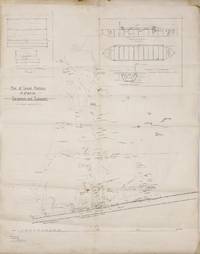
Best.-Nr. 114959A detailed map of the battleground of the failed attempt by Turkish troops to invade Egypt on 3 February 1915. At the head of the map are large sketches of 'Frame of Kerosene Tin Raft in Turkish Attack' and 'Sketch of Turkish Pontoons captured at Toussoum-Serapeum 4.2.1915'. The Australian War Memorial has one of the 24 pontoons used by the 4th Turkish Army in their attempt to cross the Suez Canal in its collection. In fact the AWM records that 'The action in which it was captured was the first in which a unit of the AIF 3 Field Company Australian Engineers was engaged and as such this trophy was the first captured by the army in the First World War. by May 1918 the Australian War Records Section was lobbying for an example to be brought back to Australia noting that while Australian involvement by 3 Field Company Engineers was small it was important'. Both Charles Bean 'The Official History of Australia in the War of 1914-18' Volume 1 Chapter VIII: 'The Turkish Expedition against Egypt' pages 140-165 and the AWM have much to say on this attack. After Turkey entered the war on 31 October 1914 one of the first objectives of both the Germans and Turks was to strike a blow against Britain in Egypt. By January 1915 a 'Turkish force of an estimated 10000 had travelled from Jerusalem to Kantara on the Suez Canal a distance of 200 miles. The force was composed of 5 percent Germans 10 percent Turks and 85 percent Bedouins and was aimed at raising anti-British feeling within the protectorate of Egypt inciting a Jihad and denying use of the canal to Allied forces. This potential threat forced the British to base up to 70000 troops in Egypt 30000 of them defending the Canal. Initially the Turks had three options: to attack from the Jordan-Mediterranean coast to Kantara through the Sinai from Beersheeba to Ismalia or from the south to Suez. Thus the British were obliged to keep options open defending all three zones along the 159 km of canal until it became obvious the Turks were marching south-west from Beersheeba heading for the central zone at Ismalia straight across the Sinai Desert. Despite being initially unconvinced that the Turks could actually organise such a crossing the British were aware of the intent; they decided to base their forces on the West Bank of the Suez using the canal as part of the defence bolstered by Royal Navy ships. This essentially meant giving up the Sinai. The force opposing the Turks mainly comprised of the 10th and 11th Divisions Indian Army. The New Zealand Wellington and Otago Battalions however assisted in the defence. The 3rd Field Company Engineers AIF were detached to operate searchlights and the Ismalia powerhouse but no other Australians were involved directly in the defence. The majority of defenders were hidden by high spoil banks thrown up on the west bank during construction of the Suez Canal. Small parties of Turks were spotted by a French seaplane on 15 January - but they missed most of the force heading out of Beersheeba and across the Sinai. This move was unexpected as most armies had moved along the coast. The Turks sent smaller parties to the southern & northern routes as a diversion and to keep the British guessing. The central party physically dragged their pontoons on wagons and artillery across the desert. Early on the morning of 3 February about 3:30 am movements and sounds were noticed by the defenders on the eastern bank and the Indian sentries started shooting. After dying down more sounds were noted a kilometre south. A Turkish pontoon landed on the west bank loaded with 25 Turks. This was charged by Punjabis and all the occupants were killed; a second crossed under fire but landed with only 10 survivors - four were captured in the morning. Pontoons were raked with shrapnel and machine gun fire killing all aboard. Many more were targeted on the east bank as their crews attempted to launch them with heavy casualties. Witnesses noted ten or eleven damaged pontoons drifting full of dead. Survivors tried to hide behind pontoons and make a dash for safety - many of these killed as well. Orders were given for Torpedo Boat 43 to blow up remaining intact pontoons. At the same time unaware of the disaster and hearing that some pontoons had already crossed the Turkish commander sent up thousands of reinforcements. The British Territorial artillery spotted them and started shooting as did the guns of the French battleship "Requin". An Indian counter-attack across the Canal took 250 prisoners and the attack ceased. The British had lost just on 160 men - the Turkish toll was ten times higher. The Turks retreated back across the desert. The Turkish performance at the Canal may have coloured Australian British and Indian attitudes to Turkish fighting ability which they brought to Gallipoli to their cost' AWM. Bean provides more and pertinent details: 'Early in January the 3rd Field Company of Australian Engineers . had been sent down to construct trenches and floating bridges at the Canal. The British authorities at once began to discover in this company men experienced in almost any work which was needed. Within a week some were detached to manipulate searchlights others had taken over the power-house at Ismailia sic others were surveying for artillery ranges or for maps while the main body was making bridgeheads at Serapeum Ismailia and Kantara and also a floating bridge for Ismailia ferry-post'. Bean's last words are also telling: 'There was a heavy fall in the current estimate of the fighting value of the Turkish Army. This was not without its influence on future events'. Those events which commenced on 25 April 1915 and reverberate to this day may go a long way to explaining why this extraordinary map appears to have been unrecorded. Bean was certainly unaware of it when he wrote his history; the AWM makes no reference to it; and Trove locates no examples. In the overall history of the First World War it may be a sideshow completely overshadowed by the Allied invasion of Turkey at Gallipoli: everything went according to the script of this dress rehearsal except the roles were reversed. unknown
1886Best.-Nr. 83474Le Caire 1886. Hardcover. Very Good. First item: 114p. Second item: 166p. Later quarter cloth with both wrappers bound in. 24 cm. Former owner's name. French text. hardcover
1883Best.-Nr. 83522Le Caire: Barbier 1883. Hardcover. Good. 566p. Contemporary quarterbinding. 17 cm. Moderate cover scuffing and wear. Inked note in French on endpaper. Hinges repaired. French text. Barbier hardcover
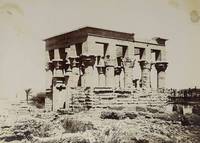
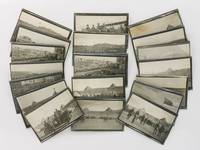
Best.-Nr. PD80Oblong Folio ca. 38 x 27 cm or 15 x 10 ½ in. 88 stiff paper leaves one blank. 87 mounted gelatin silver photographs ca. 22 x 17 cm 8 ½ x 6 ½ in. All but three images with period ink or pencil French captions on mounts. Period olive quarter morocco album with green pebbled cloth boards and spine with raised bands. Mounts slightly age-toned with minor tearing and creases on extremities not affecting photos; a few photos mildly faded but overall a very good album of interesting photos. An interesting and extensive collection of 87 large amateur gelatin silver photographs of Egypt before World War I. The album was likely compiled by French travellers on their journey up the Nile River in the early 1910s. Over 15 photographs show views from along the Nile. They include the compiler’s boats their dahabeah a river boat for use on the Nile and a small boat with two sails the First Cataract of the Nile the island of Elephantine near Aswan the river steamer Ibis villages along the Nile including a “Marabout” village and El Balyana a cable ferry a load of goglets crossing the river peasants standing on the banks women collecting water and irrigation devices. Over 20 photographs show ancient sites in Egypt including the Philae temple complex Medinet-Abou the Dendera temple complex Karnak Luxor Temple the Temple of Edfu Abydos and Esna. One photograph shows the interior of the tomb of Rameses V. Two photographs show a group of Arab women in front of a temple. Several photographs are views of Cairo including the Mosque-Madrasa of Sultan Hasan the Cairo Citadel the Mosque of Ibn Tulun the funerary complex of Sultan Qaytbay and the French Legation building. Other photographs show the Abu Haggag Mosque in Luxor built on top of ancient ruins and a quarry near Aswan. Other photographs are snapshots of daily life in Egypt. They include street scenes a Mawlid celebration “Fete des prophets” a demonstration in the streets a market in Aswan a public square in Esna a group of men sitting on the side of the road to the Pyramids of Giza a group of “fellahs” Egyptian peasants “au passage du bateau postal” and cane harvesting. Overall a very interesting collection of photographs of Egypt in the early 1910s. hardcover
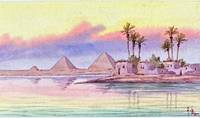
Best.-Nr. MC45Watercolour on paper ca. 6x11 cm 4 ¼ x 2 ½ in. Initialed ‘A.B.’ in the lower right corner. Period ink inscription on verso “With love and all good wishes for happier times in the near future. From Peggie”. Recently matted very good watercolour. Nice watercolour view of the Great Pyramids of Giza taken at sunset with the waters of Nile in the foreground reflecting the tender colours of the evening sky. unknown
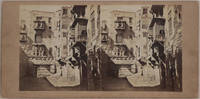
Best.-Nr. PC7Twenty pairs of albumen stereoview photographs each pair ca. 75x145 cm 3 x 5 ¾ in mounted on original grey yellow and orange cards. Over a dozen cards numbered in negative from “51” to “222” one with a signature in negative partly trimmed off; one photo with a printed caption in French in negative; one photo with a printed caption in English on the paper label attached to the card’s verso. Seventeen photos with period manuscript captions and/or numbers in English or French on the cards’ versos. One photo with a paper label of a 19th-century Vienna dealer C. Jos. Rospini on the card’s verso one photo with a photo dealer’s ink stamp dated “1965” on the card’s verso. Several images mildly faded or with minor stains otherwise a very good collection of strong stereoviews. Interesting collection of early stereoview photograph views of Cairo ancient Egyptian sites along the Nile and the Suez Canal under construction. Eleven views of Cairo two identical but mounted on different types of card – yellow or orange show the Citadel Tombs of the Califs and the streets of the old city. Eight views of the ancient Egyptian temples and sites show the Great Pyramids of Giza the Great Hypostyle Hall and other sites in Karnak the Colossi of Memnon Medinet Habu temple the Memnonium and the temple in Kirscheh. The latter stood next to the Dendur and Kalabsha temples in Nubia but was flooded with the waters of Lake Nasser after the construction of the Aswan High Dam. One stereoview depicts the works on the Suez Canal with a floating construction crane in the middle of the canal. unknown
Best.-Nr. 121058Vintage gelatin silver photographs each one approximately 99 × 147 mm extensively captioned in ink on the versos; they are dated between 19 December 1914 and 8 January 1915 shortly prior to Galagher's deployment to Gallipoli where he was killed in action on 8 May 1915 in the 2nd Division's attack on Krithia near Cape Helles. Four of the prints are slightly stained; a few have tiny ink marks on the recto identifying landmarks or soldiers; an excellent group. All but three of the captions are signed 'Fred' or initialled 'F' but all captions are in the same hand; seven are numbered in series. Seven images show Australian New Zealand and Allied troop movements in central Cairo around the coronation of the newly-installed puppet Sultan Hussein Kamel misidentified as the Khedive in the captions; nine show life in and around Mena Camp at the foot of the pyramids with numerous landmarks and several officers identified. The final six images show the visit to the camp of Sir George Reid High Commissioner in London and former Prime Minister of Australia accompanied by Brigadier General Bridges and Major General Birdwood 'This is midwinter & the temperature on this day at noon was 98 deg shade 189 in the sun' writes Galagher on a scene showing Sir George in tails and top hat. 22 items. unknown
1900Best.-Nr. 73681London: Bernard Quaritch 1900. First Edition. Hardcover. Near fine. London Bernard Quaritch 1900. Octavo viii 64 pages with approximately 500 illustrations plus 16 plates substantially reproducing the text illustrations and a frontispiece. Pictorial cloth very lightly marked and rubbed; edges slightly foxed; endpapers offset; a near-fine copy. Fraser's collection comprised some 475 scarabs and cylinders. Bernard Quaritch hardcover
Best.-Nr. 69055073-20Egypt Exploration Society. Used - Good. Former library copy. Pages intact with minimal writing/highlighting. The binding may be loose and creased. Dust jackets/supplements are not included. Includes library markings. Stock photo provided. Product includes identifying sticker. Better World Books: Buy Books. Do Good. Egypt Exploration Society unknown
1888Best.-Nr. 56383London: Wells Gardner Darton & Co. 1888. 4to. ix 1 187 7 pp. plus 4 pp. publisher’s ads. Blue-gray publisher’s cloth black ruling & gilt lettering on front cover & spine minor rubbing shelfwear slight bumping to corners still VG bright copy. First edition of this anthology of historical and descriptive sketches along with travel through Victorian Egypt by the noted journalist and manager of “The Times.” He sent newspaper and magazine reports during the Arab revolt of 1882 the subsequent British occupation and was well remembered for his telegrahpic description of the bombardment of Alexandria. Wells Gardner, Darton & Co., hardcover
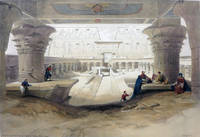
1847Best.-Nr. 26862London: F.G. Moon and Co. 1847. From the Standard Folio First Edition limited to 500 sets only. A single original hand-coloured lithographic plate drawn on stone by Louis Haghe after David Roberts' paintings done on location in 1838. Printed on a single folio sheet 23" x 17.5" the captioned image is 19.25" x 13" now presented in cream mounting boards 30" x 24" glazed behind clear mylar. Beautifully hand-coloured to the highest standards of the time. An example in excellent condition clean fresh beautifully preserved. FROM One of the most desirable of all travel and COLOURplate books. This is an especially attractive plate showing one of the best preserved temples in Egypt. The temple dedicated to the falcon god Horus was built in the Ptolemaic period between 237 and 57 BC. The temple is located on the west bank of the Nile in the city of Edfu which was known in Greco-Roman times as Apollonopolis Magna after the chief god Horus-Apollo. The temple of Edfu is the largest temple dedicated to Horus. We have a good number of impressive images from the Standard Folio Edition of this classic work available for purchase. As well as many views of Egypt there are also views available of Tyre Nubia Petra Sinai the Jordan Sidon and Baalbec. Please inquire for further details. In the course of two and a half months in 1838 traveling some 800 miles south from Cairo Roberts recorded the monumental temple sites along the Nile in more than a hundred sketches. As the first British artist to sketch the monuments of Ancient Egypt set on "Plains so vast.that until you come near them you have no idea of their magnificence" Roberts was well aware of the stir his drawings would create in London. According to John Ruskin writing in PRAETERITA Roberts's drawings "were the first studies ever made conscientiously by an English painter not to exhibit his own skill but to give true portraiture of scenes of historical and religious interest. F.G. Moon and Co. hardcover
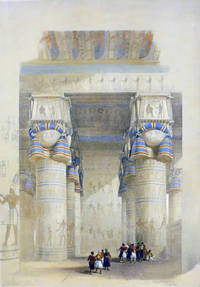
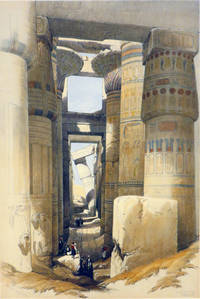
1848Best.-Nr. 26556London: F.G. Moon and Co. 1848. From the Standard Folio First Edition limited to 500 sets only. A single original hand-coloured lithographic plate drawn on stone by Louis Haghe after David Roberts' paintings done on location in 1838. Printed on a single folio sheet 23.5" x 17" the captioned image is 19.75" x 13.75" now presented in cream mounting boards 30" x 24" glazed behind clear mylar. Beautifully hand-coloured to the highest standards of the time. An example in excellent condition clean fresh beautifully preserved. FROM One of the most desirable of all travel and COLOURplate books. We have a good number of impressive images from the Standard Folio Edition of this classic work available for purchase. As well as many views of Egypt we also have available views of Nubia Petra Sinai the Jordan Tyre Sidon and Baalbec. Please inquire for further details. In the course of two and a half months in 1838 traveling some 800 miles south from Cairo Roberts recorded the monumental temple sites along the Nile in more than a hundred sketches. As the first British artist to sketch the monuments of Ancient Egypt set on "Plains so vast.that until you come near them you have no idea of their magnificence" Roberts was well aware of the stir his drawings would create in London. According to John Ruskin writing in PRAETERITA Roberts's drawings "were the first studies ever made conscientiously by an English painter not to exhibit his own skill but to give true portraiture of scenes of historical and religious interest. F.G. Moon and Co. hardcover
1847Best.-Nr. 26557London: F.G. Moon and Co. 1847. From the Standard Folio First Edition limited to 500 sets only. A single original hand-coloured lithographic plate drawn on stone by Louis Haghe after David Roberts' paintings done on location in 1838. Printed on a single folio sheet 24" x 17" the captioned image is 19" x 12.75" now presented in cream mounting boards 30" x 24" glazed behind clear mylar. Beautifully hand-coloured to the highest standards of the time. An example in excellent condition clean fresh beautifully preserved. FROM One of the most desirable of all travel and COLOURplate books. We have a good number of impressive images from the Standard Folio Edition of this classic work available for purchase. As well as many views of Egypt we also have available views of Nubia Petra Sinai the Jordan Tyre Sidon and Baalbec. Please inquire for further details. In the course of two and a half months in 1838 traveling some 800 miles south from Cairo Roberts recorded the monumental temple sites along the Nile in more than a hundred sketches. As the first British artist to sketch the monuments of Ancient Egypt set on "Plains so vast.that until you come near them you have no idea of their magnificence" Roberts was well aware of the stir his drawings would create in London. According to John Ruskin writing in PRAETERITA Roberts's drawings "were the first studies ever made conscientiously by an English painter not to exhibit his own skill but to give true portraiture of scenes of historical and religious interest. F.G. Moon and Co. hardcover
1921Best.-Nr. 43653London: Hodder and Stoughton 1921. 8vo. ix 3 336 pp. Photo frntsp. Red cloth gilt lettrng mnr rubbng edgewear hnges startng some foxng to endpapers still a G copy from the library of Humphrey Bagnall Vernon b. 1895 Lieutenant in the Grenadier Guards w/ armorial bkplate on frnt pstdn. Second edition of this fascinating posthumous memoir of these amusing series of anecdotes by one of the most important British officials of Victorian & Edwardian England. The work provides a revealing portrait of the deeply ingrained cultural biases while the Empire controlled Egypt. Of particular interest is an unconsciously biting assessment of Lord Kitchener with whom he served as Aid-de-camp in the Sudan. Hodder and Stoughton, hardcover
Best.-Nr. BN313851Der Tod im Leben: Eine vergleichende Analyse altägyptischer und rezenter ägyptischer Totenbräuche. Eine phänomenologische Studie Denkschrift der Gesamtakademie Band 27 Der Tod im Leben: Eine vergleichende Analyse altägyptischer und rezenter ägyptischer Totenbräuche. Eine phänomenologische Studie Denkschrift der Gesamtakademie Band 27 Kommission für Ägypten und Levante der Österreichischen Akademie der Wissenschaften and Shohoumi el- Nadja unknown
1984Best.-Nr. BN515202Egypt Exploration Society 1984. 1984. Softcover. Amarna Reports I Part 1 Amarna Reports I Part 1 Kemp Barry J.; Egypt Exploration Society Egypt Exploration Society paperback
Best.-Nr. BN609682Edition Bergh in Europabuch-AG; WMP-Verlagsauslieferungsdienst in Komm. Sekhet-a-ra. Tochter des Pharao. Aus dem Ägypten der Ersten Dynastie Hardcover Sekhet-a-ra. Tochter des Pharao. Aus dem Ägypten der Ersten Dynastie Hardcover Sekhet-a-ra. Tochter des Pharao. Aus dem Ägypten der Ersten Dynastie Hardcover Edition Bergh in Europabuch-AG; WMP-Verlagsauslieferungsdienst in Komm. hardcover
Best.-Nr. BN611675Carlsen. Das alte Ägypten Hardcover Das alte Ägypten Hardcover Das alte Ägypten Hardcover Carlsen hardcover
Best.-Nr. BN609947Naumann & Göbel. Das alte Ägypten Hardcover Das alte Ägypten Hardcover Das alte Ägypten Hardcover Naumann & Göbel hardcover
1987Best.-Nr. BN751205Hildesheim ; Zürich ; New York : Olms 1987. 1987. Das Lüften des Schleiers: Die Orientierungsfahrt britischer Reisender in Ägypten und Arabien; ein Beitrag zum Reisebericht des 19. Jh. Anglistische und amerikanistische Texte und Studien ; Bd. 5 Das Lüften des Schleiers: Die Orientierungsfahrt britischer Reisender in Ägypten und Arabien; ein Beitrag zum Reisebericht des 19. Jh. Anglistische und amerikanistische Texte und Studien ; Bd. 5 Britische Reisende in Ägypten / Reiseberichte - Erker-Sonnabend Ulrich Hildesheim ; Zürich ; New York : Olms unknown
1989Best.-Nr. BN750316Mainz : von Zabern 1989. 1989. Kleopatra : Ägypten um die Zeitenwende ; Ausstellung in der Kunsthalle der Hypo-Kulturstiftung München 16. Juni - 10. September 1989. Katalogred.: Dietrich Wildung ; Sylvia Schoske. Übers.: Birgit Schlessinger Kleopatra : Ägypten um die Zeitenwende ; Ausstellung in der Kunsthalle der Hypo-Kulturstiftung München 16. Juni - 10. September 1989. Katalogred.: Dietrich Wildung ; Sylvia Schoske. Übers.: Birgit Schlessinger Kleopatra / Ägypten - Wildung Dietrich Mainz : von Zabern unknown
1985Best.-Nr. BN149546Zürich : Manesse-Verlag 1985. 1985. Aus Mehemed Alis Reich : Ägypten und der Sudan um 1840. Hermann Fürst von Pückler-Muskau. Mit einem Nachw. von Günther Jantzen und einem biograph. Essay von Otto Flake Manesse-Bibliothek der Weltgeschichte Aus Mehemed Alis Reich : Ägypten und der Sudan um 1840. Hermann Fürst von Pückler-Muskau. Mit einem Nachw. von Günther Jantzen und einem biograph. Essay von Otto Flake Manesse-Bibliothek der Weltgeschichte Ägypten Sudan Reisebeschreibung - Pückler-Muskau Hermann von Zürich : Manesse-Verlag unknown
1982Best.-Nr. BN151983Köln : DuMont 1982. 1982. Entdeckungsreisen in Ägypten 1815 - 1819 : in den Pyramiden Tempeln und Gräbern am Nil. - Mit einer Geschichte der Ägyptenreisen seit dem 16. Jahrhundert von Ingrid Nowel. Giovanni Belzoni. Hrsg. von Ingrid Nowel DuMont-Dokumente : DuMont-Reiseberichte Entdeckungsreisen in Ägypten 1815 - 1819 : in den Pyramiden Tempeln und Gräbern am Nil. - Mit einer Geschichte der Ägyptenreisen seit dem 16. Jahrhundert von Ingrid Nowel. Giovanni Belzoni. Hrsg. von Ingrid Nowel DuMont-Dokumente : DuMont-Reiseberichte Ägypten Belzoni Entdecker - Belzoni Giovanni Battista und Ingrid Nowel Köln : DuMont unknown