EGYPTBiblio.com
18.494 risultati
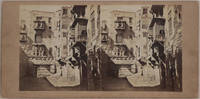
rif. PC7Twenty pairs of albumen stereoview photographs each pair ca. 75x145 cm 3 x 5 ¾ in mounted on original grey yellow and orange cards. Over a dozen cards numbered in negative from “51” to “222” one with a signature in negative partly trimmed off; one photo with a printed caption in French in negative; one photo with a printed caption in English on the paper label attached to the card’s verso. Seventeen photos with period manuscript captions and/or numbers in English or French on the cards’ versos. One photo with a paper label of a 19th-century Vienna dealer C. Jos. Rospini on the card’s verso one photo with a photo dealer’s ink stamp dated “1965” on the card’s verso. Several images mildly faded or with minor stains otherwise a very good collection of strong stereoviews. Interesting collection of early stereoview photograph views of Cairo ancient Egyptian sites along the Nile and the Suez Canal under construction. Eleven views of Cairo two identical but mounted on different types of card – yellow or orange show the Citadel Tombs of the Califs and the streets of the old city. Eight views of the ancient Egyptian temples and sites show the Great Pyramids of Giza the Great Hypostyle Hall and other sites in Karnak the Colossi of Memnon Medinet Habu temple the Memnonium and the temple in Kirscheh. The latter stood next to the Dendur and Kalabsha temples in Nubia but was flooded with the waters of Lake Nasser after the construction of the Aswan High Dam. One stereoview depicts the works on the Suez Canal with a floating construction crane in the middle of the canal. unknown
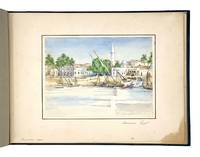
rif. MA82Nine original watercolours on paper from ca. 125x175 cm 5 x 6 ¾ in to ca. 65x125 cm 2 ½ x 5 in mounted within ink-drawn frames on the original white album leaves ca. 21x275 cm 8 ¼ x 11 in. All watercolours captioned and dated in period ink on the mounts. Period style dark green morocco album with a gilt tooled spine and cloth boards. Several leaves with minor stains on the lower blank right corners of the mounts not affecting the watercolours otherwise a very good collection. An attractive album of bright watercolour views drawn by a British traveller during his Nile cruise in the winter of 1892-1893. Dated between December 1892 and February 25th 1893 the watercolours show Assouan Aswan Cairo Girgeh Girga the ancient Thebes the Great Pyramids of Giza and the pyramids of Meidum and Saqqara. Overall a beautiful watercolour collection showing some of the iconic Egyptian sites through the eyes of a 19th-century British traveller. Captions: Assouan. Egypt. December 1892 two different views; The Nile near Thebes. February 13th 1893; Girgeh. Egypt. February 18th 1893; Pyramid of Medum. February 21st 1893 two different views; Cairo from the Nile. February 23rd 1893; Pyramid of Sakkarah. February 23rd 1893; Pyramids of Gizeh. Sunset. February 25th 1893. hardcover
1972rif. 26872London 1972-80. 4to. Richly illustrated. unknown
rif. 137984 September 1882. 2 pp. 6 x 4 inches foxed. Zaki Bey Zeki Pacha Lord Chamberlain to the Khedive of Egypt. I was coming myself for this purpose but having something to do I could not come. If you let me know the names of the Gentlemen who will come I will be very much obliged to you. unknown
rif. 24931circ. 1890. Sl. Faded Image 260 x 200mm. Mounted on card. G. circ. 1890. unknown
1900rif. 73681London: Bernard Quaritch 1900. First Edition. Hardcover. Near fine. London Bernard Quaritch 1900. Octavo viii 64 pages with approximately 500 illustrations plus 16 plates substantially reproducing the text illustrations and a frontispiece. Pictorial cloth very lightly marked and rubbed; edges slightly foxed; endpapers offset; a near-fine copy. Fraser's collection comprised some 475 scarabs and cylinders. Bernard Quaritch hardcover
1880rif. ABC_505251880. The photographs are mounted on cardstock or in a passe-partout the two largest photographs are mounted on opposite sides of the same sheet of thick cardboard. With 34 albumen prints various sizes of which most signed and captioned in French in the negative several with a manuscript caption in the lower margin. Collection of 34 loose albumen photographs of Egypt and Palestine with one view of Istanbul by some of the leading commercial photographers active in the Middle East during the late nineteenth century. The collection includes twelve photographs by Félix Bonfils six by Antonio Beato five by Pascal Sébah two by Lekegian & Cie. two by the Zangaki brothers and one by Gülmez Frères together with several unidentified photographs. Together they provide a varied picture of the subjects offered by the commercial photographic studios of Egypt and Palestine in the late nineteenth century.The photographs cover a wide range of subjects. The views of Jerusalem mostly by Bonfils include the Al-Aqsa Mosque Jaffa Gate the Antonia Fortress the Garden of Gethsemane and scenes of prayer and daily life as well as Bethlehem on Christmas Day. Egypt is particularly well represented with Beato's photographs of the pyramids at Giza and the monuments at Karnak Luxor and Medinet Habu while Sébah's views of Cairo include Khan el-Khalili Souq al-Silah an Arab cemetery a lemonade seller and Egyptian farmers. Further photographs by Lekegian & Cie. and the Zangaki brothers show street trades figures and interiors while the single Constantinople view by Gülmez Frères depicts the fortress of Anadoluhisari in Istanbul.Also included is a large double-sided mount with two photographs: a striking portrait of two seated men in traditional dress signed "B. Moey" at the lower left and on the reverse an apparently unrelated large view of a landscaped park or pleasure garden with visitors gathered around a monumental fountain.Several photographs are slightly frayed around the edges or mildly stained the large carboard photographs are with several losses around the edges most of the paper supports are somewhat browned and stained. Otherwise in good condition. unknown
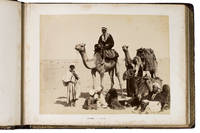
1889rif. ABC_49512Yemen Egypt and other places 1889. Contemporary burgundy/auburn gold- and blindstamped calf lozenge-patterned blindstamping. Re-backed with the original back strip laid down. Gold-stamped turn-ins white watered silk endpapers gilt edges. Oblong folio 37.8 x 28 cm. An album containing 25 albumen prints ca. 20 x 27 cm including 1 double page mounted on thick card leaves many captioned in English. Photographic record of a journey begun in Australia and taken via Aden through the Suez canal and to the Mediterranean and then on to England. While the first image shows the steamship R.M.S. Ormuz in the port of Sydney three images including a double-page spread show the port of Aden in Yemen the famous water tanks and a native of the Southern Arabian region in a studio portrait. The majority of the album is dedicated to Egypt showing Arabs on their camels the Khedive's Ismailia Palace the Suez Canal Port Said and members the local population as well as the famous pyramids. The last few photographs show the final leg of the journey Naples and ultimately Gibraltar. Among the studios identified in the photographs are those of Hippolyte Arnoux and the Zangaki brothers based at Port Said.With a near-contemporary manuscript inscription in blue ink on the verso of the first flyleaf: "Edith Elkington or Elrington Aunt Ediths voyage home - to England about 1889". Foxed throughout slightly water stained but the prints are largely clean and clear some paper repairs in the margins the last flyleaf is lacking the final leaf is nearly detached. unknown
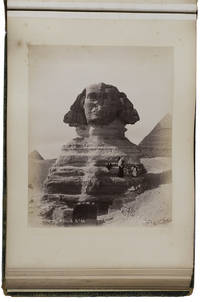
1891rif. ABC_47521Egypt: Zangaki brothers 1891. Original gold-stamped bubble-grained maroon cloth over boards modern maroon cloth spine and leather corners. Gold stamped title and year on the front white watered silk endpapers. Oblong album 31.5 x 41 cm. With 34 large albumen prints mounted on heavy cardstock leaves. Most of the photographs are numbered and captioned in French in the negative and signed 'Zangaki'. The last one is signed Sebah & Joallier. The Zangaki prints measure 22.5 x 28.5 cm; the Sebah & Joallier one is 20.5 x 26.5 cm. A large German album with 34 albumen prints of Egypt. The Greek brothers G. and C. Zangaki were photographers who worked in Egypt in the second half of the 19th century. Due to increased tourism to this region after the opening of the Suez Canal there was a large demand for souvenir photographs. Photographers like the Zangaki brothers as well as Sebah & Joallier catered to this. The Zangakis were among the first commercial photographers to produce large-scale images of Egypt. They travelled through the country with a portable darkroom to capture high-quality images of famous monuments and daily life though the latter were usually posed. These images were then printed and sold to tourists either separately or compiled into albums. According to John Hannavy the brothers "produced some of the finest images of late Victorian Egypt". The 34 photographs include: the great pyramid Cairo and the Nile dervishes and other exotic looking locals Egyptians standing on top of the sphinx obeliscs the Ramesseum Karnak temple the temple of Dendera the Great Pyramid Egyptians climbing the pyramid the mosque and tomb of Muhammad Ali Saqqara and many others.With two small library stamps on the first page not affecting the photograph. The book has been rebacked. The left side of the front board has faded and the corners are worn. Minor browning around the edges of the leaves. Back flyleaf loose. The photos are crisp and clear and the book is otherwise in good condition.l Erdem Views of Egypt by Georgios and Constantinos Zangaki: Examining a late nineteenth-century photographic album at the Art Gallery of Ontario thesis 2006; Hannavy Encyclopedia of Nineteenth Century Photography pp. 1036 1093 & 1521. Zangaki brothers, hardcover
1895rif. ABC_475631895. Oblong folio 28 x 39 cm. Contemporary gold-tooled black morocco gilt edges. With 58 photograph prints ca. 21 x 25.5 to 13.5 x 20 cm. Mounted on both sides of the leaves in the album. 60 pp. The album contains 15 silver albumen photographs of Melbourne taken mainly from the series C. Rudd's new views of Melbourne 1886-1887 by Charles Rudd 1849-1901. They show Collins Street Melbourne town hall the public library Parliament House the Court of Law Government House and various other buildings and infrastructure as well as botanical gardens such as Fitzroy Gardens. The photographs of Sydney were the work of the renowned Australian photographer Henry King 1855-1923 born in England in 1855 who emigrated to Australia with his family in 1856. He worked as a photographer at J. Hubert Newman's studio in Sydney before opening his own studio in 1880. King gained recognition for his photographic studies of Australian Aboriginal people and his scenic views of Sydney. He died in 1923 leaving behind his wife son and three daughters. His glass negatives were acquired by J.R. Tyrrell after his death and are now held by the Powerhouse Museum. King is one of Australia's most significant early photographers. The album contains seventeen of Kings photographs of the harbour including Farm Cove and the Circular Quay Government House and interior and exterior photographs of the town hall King and George Street the Mutual Life Association Building the General Post Office and the Ferner Botanical Garden. Rural New South Was appears in nine photographs including images of Illawarra National Park the Hawkesbury River and a series of outdoor photographs taken along the coast at Blackwall and dated July 1895.This curious album of 58 photographs from France Egypt and most importantly Australia opens with a section with six photos from Marseille showing street views the city harbour the Avenue du Prado and the castles.The ten photographs from Egypt depict both the cultural highlights of the country such as the Pyramids the Sphinx the Citadel of Cairo and the Palace of Gizeh as well as ordinary Arabian villages and street scenes. They stemmed from the ateliers of the Abdullah brothers of Constantinople. The Abdullah Frères namely Viçen 1820-1902 Hovsep 1830-1908 and Kevork 1839-1918 Abdullahyan were three Ottoman brothers of Armenian heritage who gained international fame as photographers during the late Ottoman Empire. Some evidence suggests that he may have collaborated with the Zangaki Brothers and he may have been the official photographer for the Universal Company of the Suez Canal. Later he worked in partnership with the British-Italian photographer Antonio Beato.With an owners inscription in pencil "a appartenu Alfred Schmid" some photographs are captioned in black ink or pencil detailing the places. With a small label from the bookshop that sold the album: "Papeterie Sauwen-Jehotte" in Antwerp. The edges are somewhat bumped and some browning and foxing throughout. Otherwise in good condition. AFRICA ART ARCHITECTURE & PHOTOGRAPHY AUSTRALIA NEW ZEALAND & PACIFIC ISLANDS EUROPE Australia Egypt France North Africa Photography unknown
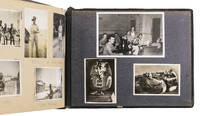
1940rif. ABC_484251940. Contemporary embossed brown calf with flowers on the front and back board and an aluminium view of David's Tower and Jerusalem's old city wall embedded in the front board. Oblong album 30 x 20 cm. With 128 gelatin silver prints most ca. 6.5 x 9.5 cm. Beautiful album with 128 photographs of Egypt and Palestine present day Israel and the West Bank during the British Mandate. It was likely compiled by a British soldier who was stationed in the Middle East during the 1940s. Some of the photographs are numbered in the negative and may have been made by important photographers active in the area at the time like G. Eric Matson and his wife Edith the founders of the Matson Photo Service. The images show Cairo and various locations in Palestine including Jerusalem Bethlehem Nazareth Tiberias Sea of Galilee Nathanya Tel Aviv the Jordan river Haifa Beirut and the Dead Sea. Other than important locations like churches and gates the photographs also show many locals including for example street barbers in Cairo shepherds and farmers in Palestine and beautifully dressed women in Haifa. In the back of the work a few dried leaves from local plants have been mounted namely orange lemon fig eucalyptus grapevine and mulberry. The eucalyptus leaf still retains some of its scent.The edges and vorners of the boards are somewhat scuffed with some loss of material at the head and foot of the spine and around the edges of the embedded aluminium plate. The photographs mounted on the inside of the front board are slightly stained the fig leaf mounted on one of the final pages is damaged and the cyprus leaf is missing. Otherwise in good condition. unknown
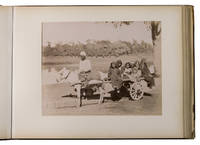
1888rif. ABC_47975Cairo 1888. 34 albumen prints ca. 22 x 27 cm mounted on cream cardstock ca. 28 x 35.5 cm. Remarkable collection of 34 stunning photographic prints of Egypt all numbered titled and signed in the negative by photographer Jean Pascal Sébah 1872-1947 who owned the leading studio for Orientalist photography. He was even named the official photographer of the Sultan of Turkey together with his business partner Polycarpe Joailllier 1848-1904. The majority of the images in the present collection show streets and buildings from lesser known Egyptian cities and scenes of daily life. Larger collections of Sébah's work are relatively rare on the market.Sébah continued the business of his father Pascal Sébah 1823-1886 one of the first photographers working in Egypt. Pascal rose to prominence because of his well-organized compositions careful lighting and quality of his prints. The majority of his photographs are of tourist destinations and locals. Jean Pascal inherited his father's good eye but was more interested in depicting lesser known locations. His photos of people also appear more spontaneous. The present collection includes photographs of El-Souroughieh street and the Khalig canal in Cairo the Virgin Mary's tree in Matariya a local with a buffalo a group of seated men in a mosque a sugarcane market locals working on a sugarcane field a group of boys fishing and the hustle and bustle along the Nile.With a small purple ownership stamp of an anchor in mirror image and the letters "S A" near the top edge of one of the photographs of the Nile. The cardstock is very slightly foxed and yellowed and has somewhat warped from past temperature fluctuations. The prints have somewhat yellowed around the edges but are otherwise in good condition.l Cf. Saretzky The history of photography online. unknown
1888rif. ABC_47975Cairo 1888. 34 albumen prints ca. 22 x 27 cm mounted on cream cardstock ca. 28 x 35.5 cm. Remarkable collection of 34 stunning photographic prints of Egypt all numbered titled and signed in the negative by photographer Jean Pascal Sébah 1872-1947 who owned the leading studio for Orientalist photography. He was even named the official photographer of the Sultan of Turkey together with his business partner Polycarpe Joailllier 1848-1904. The majority of the images in the present collection show streets and buildings from lesser known Egyptian cities and scenes of daily life. Larger collections of Sébah's work are relatively rare on the market.Sébah continued the business of his father Pascal Sébah 1823-1886 one of the first photographers working in Egypt. Pascal rose to prominence because of his well-organized compositions careful lighting and quality of his prints. The majority of his photographs are of tourist destinations and locals. Jean Pascal inherited his father's good eye but was more interested in depicting lesser known locations. His photos of people also appear more spontaneous. The present collection includes photographs of El-Souroughieh street and the Khalig canal in Cairo the Virgin Mary's tree in Matariya a local with a buffalo a group of seated men in a mosque a sugarcane market locals working on a sugarcane field a group of boys fishing and the hustle and bustle along the Nile.With a small purple ownership stamp of an anchor in mirror image and the letters "S A" near the top edge of one of the photographs of the Nile. The cardstock is very slightly foxed and yellowed and has somewhat warped from past temperature fluctuations. The prints have somewhat yellowed around the edges but are otherwise in good condition.l Cf. Saretzky The history of photography online. AFRICA ART ARCHITECTURE & PHOTOGRAPHY MIDDLE EAST & ISLAMIC WORLD Egypt Islamic Art Culture & Science North Africa Photography unknown
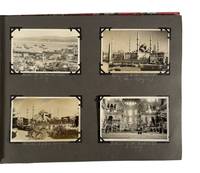
1927rif. 208311927. Photo album documenting a multi country group यातà¥à¤°à¤¾ in 1927 records interwar travel across southern Europe and the eastern Mediterranean including regions under colonial administration and recent political transition. The album follows a group of travelers moving from France through Italy Greece Turkey British administered Palestine and Egypt capturing urban landmarks archaeological sites and local populations encountered along the route. The sequence provides visual evidence of tourism infrastructure mobility and cross cultural observation during a period when former imperial territories such as Constantinople were undergoing redefinition following the dissolution of the Ottoman Empire and the establishment of modern nation states. Album contains 93 black and white silver gelatin photographs and four real photo postcards with images ranging approximately from 2.5 x 4 inches to 3.5 x 5.5 inches and one larger group photograph measuring about 9 x 7 inches. Photographs are mounted on black paper boards with handwritten captions in white pencil and interleaved tissue guards; string bound in patterned cloth boards. The album opens in Avignon with views of St. Pierre's Church and the Palais des Papes then continues through Italy with scenes of Naples and Pompeii as well as shipboard images captioned S.S. Adriatic. Subsequent sections include Athens with views of the Parthenon followed by Constantinople where four postcards depict the harbor the Sultan Ahmed Mosque and the Hagia Sophia shortly after the end of the Ottoman Empire. In British Mandate Palestine images show street scenes in Nazareth and Jerusalem including sites along the River Jordan the Western Wall and the Garden of Gethsemane alongside a captioned portrait labeled "A Jewish Maiden." The album concludes in Egypt with extensive views of archaeological and urban sites at Thebes Memphis Cairo and Luxor including the Obelisk of Hatshepsut Edfu Temple the tomb of Amenhotep II the Colossi of Memnon and the pyramids and Great Sphinx at Giza where the final group portrait shows the travelers posed on camels. Produced during the interwar period the album reflects expanding international tourism networks alongside ongoing European influence in the eastern Mediterranean and Middle East. The juxtaposition of ancient sites modern transport and local populations situates the material within broader histories of archaeology empire and travel culture in the early twentieth century. Light general wear to album and mounts; images well preserved with clear captions; overall very good condition. unknown
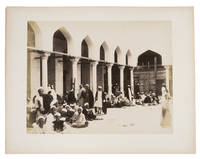
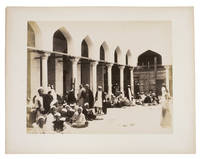
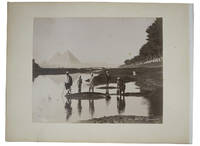
1875rif. ABC_46596Egypt 1875. A single oblong board 30 x 40 cm. Zangaki brothers 2 albumen photographic prints mounted on one board 1 on each side approx. 225 x 28 cm. 2 albumen photographic prints of a view of the Nile with pyramids in the background and the Al-Azhar mosque in Cairo by the Zangaki brothers "Adelphoi Zangaki" who were two photographers of Greek origin active in Egypt from ca. 1870 until the beginning of the 20th century. They can be grouped together with other commercial photographers who worked in Egypt during the second half of the 19th century. These photographers such as Félix Bonfils Gustave le Gray and others who were mostly of French origin were able to capitalise on the rising demand for photographic prints as souvenirs. Photographers like the Zangaki brothers often sold the albumen prints from their studios located in cities like Port Said Cairo and Suez but produced the actual photographs using the collodion process in a portable darkroom - a cart or sometimes even a boat - in the field.The brothers were quite prolific producing at least 1500 photographs of Egypt and other regions of the Middle East during the span of a few decades around the turn of the 20th century. Since these photographs were taken with the purpose of creating prints for tourists the subjects are often "quintessentially Egyptian" and sights such as the pyramids along the Nile river are captured. However they also provide a glimpse into Egyptian daily life or occasionally one can sneak a peek at one the photographers and their portable darkroom. Not much is known about the Zangaki brothers and until quite recently people thought that the photographic prints signed "Zangaki" were produced by one single person. With a tear in the lower margin not affecting the photographs some foxing remnants of white tape to one of the side margins of the board with a small blue ink mark below an inscription "Mosque of El Azhar." in the margin below the photograph of said mosque. Overall in good condition.l cf. Erdem Views of Egypt by Georgios and Constantinos Zangaki . 2009; Hannavy in: Encyclopedia of Nineteenth-Century Photography p. 1521; Perez Focus east p. 233. ABE CAT Art History ABE CAT Middle East Arabian Peninsula ART ARCHITECTURE & PHOTOGRAPHY MIDDLE EAST & ISLAMIC WORLD Art & Art History Egypt North Africa Photography unknown
1900rif. 180921900. Archive of 9 stereoview photographs bearing a double 6" x 3" inch photograph showing various scenes from turn of the century Egypt. 1896-1900. Images include the Temple of Luxor village women carrying pitchers of water on their heads a caravan at the Tomb of the Khalif's the Virgin's tree and the Great Nile Bridge. Locations are marked beneath the images in text. 5 include identifying information in multiple language on verso. Most are marked "J.F.Jarvis Publisher Washington D.C" in cursive script with small black "x" mark in corner and "Sold only by Underwood & Underwood New York London Toronto Canada Ottawa Kansas." Images are clear and detailed. Most in very good condition. unknown
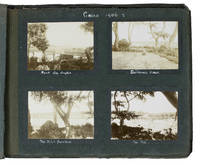
1906rif. ABC_456561906. With: 2 LEHNERT & LANDROCK. Souvenir of Cairo. 12 real artistic photos. Serie A.Egypt late 1920s. Envelope containing 12 silver gelatin prints 12 x 9 cm.3 PHOTOGRAPHY - SINGAPORE. Photograph of a woman and a baby sitting in a rickshaw with a child in front and the rickshaw puller.Singapore late 1920s. Silver gelatin print 7.5 x 12.5 cm. A four-volume photo album compiled by an unknown British woman who also seems to have taken most of the photographs illustrating travels through Egypt Italy Wales and the Isle of Wight. Although the specific background to the album is unknown a photograph of a woman holding a camera is captioned " snapshotted" suggesting that she was the compiler of the album and probably took most of the photographs herself.The first volume starts in 1906 with several photographs showing the interior and exterior of a "summer house" near the "Pont des Anglais" now called the Evacuation bridge a Cairo neighbourhood containing many riverside villas. The final part of the second volume is devoted to the Tanta fair: Egypt's largest fair which normally attracted half a million visitors. Afterwards the party visited the village of Toukh north of Cairo.The third volume opens in May 1907 with a railway visit to the village of "El-Rico" near Hosh Essa also in the Nile delta but nearer to Alexandria. Photographs depict the travelling party as well as local agriculture another wedding and a visit to the weekly market at Abou El Matamer. The final part of the album shows a visit to the Isle of Wight in August 1908.With two photographs in volume IV Cairo on the Nile torn out. Bindings slightly worn spines damaged and volume III without a spine. A few photographs somewhat worn at the edges and with a few spots but otherwise in very good condition. An extensive and remarkable photo album especially for Egypt 1906-1908.l For the excavation at Deir-el-Bahari: Naville The XIth dynasty temple at Deir el-Bahari. Part II. unknown
1885rif. 139691885. Beato Antonio. Two photographs of a Ramesses statue and monumental Egyptian architecture circa 1880s document the archaeological landscape of Upper Egypt during the expansion of commercial photography and European travel along the Nile. The images preserve the scale surface condition and immediate surroundings of ancient remains as they appeared before many subsequent excavation conservation and tourism projects altered their presentation. Their attribution to Beato connects them to a photographer who maintained a long career in Luxor and produced albumen views of Egyptian monuments for an international market supporting research into the visual reception of ancient Egypt archaeological tourism nineteenth-century photographic commerce and the documentation of historic sites. Museum collections date comparable Beato photographs of Luxor and Egyptian monuments to the 1870s and later nineteenth century. Two albumen photographs circa 1880s each measuring approximately 8½ × 10 inches and mounted recto and verso on a single 10 × 10 inch board. One photograph shows a monumental statue identified as Ramesses and bears the ink signature "A. Beato" on the image. The second presents a large Egyptian monument from a different viewpoint and appears to carry the signature "A. Beato" within the negative. The absence of more specific captions prevents a secure identification of the second structure from the available description. The paired mounting brings together two examples of Beato's emphasis on isolated architectural remains and monumental scale using the albumen process to render carved stone structural mass and the surrounding archaeological terrain with clarity. Antonio Beato worked extensively in Egypt and became particularly associated with photographic views of Luxor Karnak and nearby ancient sites; surviving institutional holdings include his photographs of Luxor Temple Karnak and the Ramesseum. Earlier scholarship sometimes confused Antonio with his brother Felice because photographs circulated under overlapping forms of the Beato name but the Egyptian subjects and "A. Beato" signatures here support attribution to Antonio whose career centered on Egypt. The mount has cockling and a bent upper corner not affecting either image; both photographs have scattered surface scratches. Photographs good mount fair. The recto-and-verso presentation offers two complementary records of ancient Egyptian monuments as they were encountered and marketed through late nineteenth-century Nile photography. unknown
1896rif. 144071896. Underwood & Underwood. Seven stereoviews of Egypt circa 1896 to 1904 record Egyptian people animals commerce Nile water gathering and ancient monuments within the American publisher's extensive photographic survey of the country. The group ranges from women drawing water from the Nile and a crowded market to the obelisk at Heliopolis and statues of Ramesses II pairing contemporary Egyptian life with the Pharaonic sites that figured prominently in Western photographic representations of Egypt. Underwood & Underwood's larger Egypt through the Stereoscope series comprised approximately 100 views produced principally between 1896 and 1904 intended to create a sequential three-dimensional photographic tour of the country. Seven original Underwood & Underwood stereoview photographs Egypt circa 1896 to 1904. Each card bears descriptive text on the verso. The subjects comprise: 1 the obelisk at Heliopolis; 2 a group of Egyptian women drawing water from the Nile; 3 an Egyptian drummer mounted on a camel with palm trees behind him; 4 a mother camel and recently born calf with the pyramids of Giza visible in the background; 5 villagers seated outside a tent captioned by the publisher "Wretchedness of the People"; 6 a large crowd gathered at a local market; and 7 statues of Ramesses II surrounded by palm trees. The views move between archaeological monuments and scenes of work transportation trade domestic life and the Nile while the stereoscopic format was designed to give viewers an illusion of spatial depth when seen through a stereoscope. Underwood & Underwood marketed stereoscopic tours as a means for audiences abroad to encounter distant countries through paired photographs and accompanying explanatory text. Institutional holdings confirm that its Egypt through the Stereoscope photographs date principally from 1896 to 1904 and encompass monuments landscapes city views people and animals. The publisher's caption "Wretchedness of the People" is particularly revealing as historical evidence of the interpretive framework imposed upon Egyptian subjects for Western consumers: rather than a neutral identification of the people pictured the wording directs the viewer toward a judgment about their material circumstances. The seven cards therefore preserve both photographic evidence of Egypt around the turn of the twentieth century and the captions through which Underwood & Underwood presented the country to its international audience. Each photograph retains descriptive text on the verso; all are in very good condition. unknown
1885rif. 140491885. Zangaki Adelphoi. Interior of the hypostyle hall at the Temple of Hathor at Dendera circa 1880s records one of Upper Egypt's major surviving temple interiors during the period when commercial photographers produced extensive visual records of Egyptian antiquities for an international audience. The Zangaki studio active in Egypt during the later nineteenth century specialized in views of archaeological sites cities landscapes and life along the Nile. This image preserves the appearance of Dendera's monumental columned interior during the same decade in which British occupation of Egypt began in 1882 and European archaeological and photographic activity in the country continued to expand. Albumen photograph circa 1880s measuring 11 x 8 inches. The view looks through the hypostyle hall of the Temple of Hathor where massive columns rise to capitals carved with the face of Hathor. Sunlight striking the columns and upper masonry emphasizes their scale while the central perspective terminates in a small doorway opening onto a darker interior containing visible rubble. The contrast between the monumental columns and the human scale of the distant doorway gives the photograph a particularly clear record of the hall's architecture and spatial arrangement. Dendera was among the Egyptian sites repeatedly photographed by commercial studios during the nineteenth century when photographs of temples and ancient monuments circulated through the developing European and American market for archaeological and travel imagery. The period also coincided with increasing European political and financial intervention in Egypt and after 1882 British military occupation; these developments formed part of the larger colonial setting in which antiquities excavated objects and photographic records circulated abroad. Small tear near the top margin; otherwise exceptionally well preserved with the architectural details and tonal contrasts remaining clear. Overall near fine condition. unknown
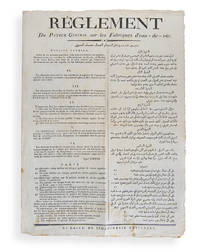
rif. 123044Cairo Egypt Impprimerie Nationale c. 1800. . Single broadside printed in parallel French and Arabic text 460 x 325 mm; type-set printed in dual French and Arabic presented in two columns leaf with wide margins uncut a little creased at outer edges and with fold lines along central horizontal and vertical folds light water-staining to lower edge overall very good condition. Napoleon Bonaparte's Egypt Campaign in 1798 lead to the establishment of the first printing press on the African continent preceding the well-known Egyptian Bulaq Press established by Muhammad Ali Pasha al-Mas'ud by over two decades. The press was predominantly formed to print proclamations and official statements in French with Arabic translations that were often poorly translated and rife with grammatical error for use as political propaganda for Napoleon's campaign in Egypt. The single-sheet documents were meant to be wall mounted and therefore are ephemeral in nature with very few copies surviving. The present example is a rare proclamation announcing the new tarifs and laws relating to the production of liquor in Egypt under Napoleonic rule. It was issued by Martin-Roch-Xavier Estève 1772-1852 the paymaster of Napoleon's Armée de l'Orient and contains six articles regulating the production and introducing tarifs of liquor production in the region. The broadside notes that distilleries need to be registered and needed to clearly distinguish themselves with large 'Fabrique d'Eau de Vie' lettering there is a stipulation that frequent inspections would be made and that the finished product needed to have a minimum of 18 percent alcohol content per volume. The raw materials listed in the proclamation include five qualities of fresh dates dried dates figs and raisins. Very scarce: No other copies located not in the Bibliotheque Nationale de France or any records showing in OCLC. Cairo, Egypt, Impprimerie Nationale, c. 1800. unknown
rif. DADAX027041536XWentworth Press 2018-07-26. hardcover. New. 6.14x1.06x9.21. Buy with confidence. Excellent Customer Service & Return policy. Wentworth Press hardcover
rif. 122404Paris Chasseriau Libraire Rue Neuve-des-Petits-Champs N° 5. 1822. 51 pages. 1 planche dépliante. 1 feuillet. 145 x 10 Cm. Broché dans sa jolie couverture imprimée d'origine. Patit manque sur la première couverture. Edition séparée de ce mémoire sur le célèbre zodiaque égyptien de Denderah de Charles François Dupuis érudit et homme de science membre de l'Institut. Ce zodiaque est un planisphère qui se trouvait au plafond d'une chapelle dédiée à Osiris. Il fut apporté en France en 1821 par l'expédition de M. Lelorrain financée par l'archéologue et littérateur Sébastien Louis Saulnier. Son étude astronomique fut confiée par l'Académie des Sciences au célèbre mathématicien Fourier et Charles-Hippolyte Paravey en avait donné une étude où il avait estimé que les zodiaques égyptiens étaient une adaptation des conceptions astrologiques. Planche dépliante représentant le zodiaque. Rousseurs mouillure claire dans la marge du fond. Paris, Chasseriau, Libraire, Rue Neuve-des-Petits-Champs, N° 5. 1822. unknown
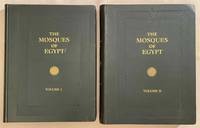
rif. M7019dRare complete set of 2 volumes. Edition limited to 1200 sets. Ordnance Survey Giza 1949-54. First edition. Large folio original cloth containing 243 plates showing mosques and architectural and decorative details 27 in colour: 216 in photogravure with sepia ink 2 in photogravure with chromolithographed colour 3 chromolithographed and 22 in halftone offset lithography after paintings by Al-Husain Fawzy. Further with about 100 offset lithographic line illustrations on the integral leaves many full-page. Vol. I: 68 pages 93 plates 2 maps and index. Vol. II: pages 69-133 plates 94-243. In the introduction Creswell writes: "Cairo possesses a most remarkable series of Muslim monuments running unbroken from the ninth to the nineteenth centuries. In the latter respect it is unique. . we need have no hesitation in saying that these two volumes constitute the finest piece of book production achieved in Egypt". Language: English. This set ships from Europe shipping costs will be updated accordingly BPF. Relevant subjects: Egypt: Medieval & Modern Egypt. unknown
1898rif. 3180331898. 25 album card leaves with 117 mounted photographs with captions in pencil below. 12 x 16-1/2 inches. Contemporary half black morocco over pebbled cloth. Extremities worn occasional foxing and thumbsoiling slight curvature to album leaves occasional toning or fading to photographs. 25 album card leaves with 117 mounted photographs with captions in pencil below. 12 x 16-1/2 inches. Anonymous album containing numerous photographs of scenery people and sport primarily in India Kashmir and surrounding area Zoji La is a high mountain pass in the Himalayas in the Indian union territory of Ladakh The Sind Valley 4 are large 11-1/2 x 9 inch plates. but with a small Egypt section at the end. Photos of campsites horses military troops picnics and gatherings cultural sights etc. many with penciled-in captions at dated 1891 in some. With at least 4 phortos of polo at Alexandria. unknown