MacriziAntiquariat.de
18 122 résultats
1979réf. 163798Hildesheim, New York : Olms, 1979. 142, 70 S. ; 22 cm OKarton
réf. 7819manuscrit sans date (début XVIIIe), reliure plein veau d'époque, dos à 5 nerfs, titres et fleurons dorés, roulette dorées sur chasses et champs, tranches rouges, 19,5x24 cm, pagination par feuilles, TOME I, partie 2 (251 à 474) : Histoire d'Egypte, 216 pages( 251 à 358) ; Histoire des Patriarches, 228 pages (359 à 472), table de l'histoire des Patriarches jusqu'à l'exode, 4 pages (473-474). TOME II, partie 1 (1 à 291) : Histoire de l'ancienne Grèce, 70 pages (2 à 36) ; Histoire d'Argos, 76 pages (37 à74) ; Histoire d'Athènes, 274 pages, (75 à 211) ; Histoire de Thèbes, 154 pages (215 à 291). TOME II, partie 2 (293 à 557) : Histoire de Lacedemone, d'Arcadie et de Troye en particulier : Histoire de Lacedemone, 48 pages (293 à 316), Histoire d'Arcadie, 10 pages (317 à 321), Histoire de Troye, 70 pages (323 à 357) ; Histoire de l'ancienne Italie, 154 pages (360 à 436) ; Histoire ancienne de la Sicile, 62 pages (437 à 467) ; Histoire ancienne de l'Affrique, des Isles de la mer méditeranée et des parties de l'Europe qui confinent à l'océan : Histoire ancienne de l'Affrique, 28 pages (469 à 482), Histoire ancienne de l'Espagne, 60 pages (483 à 512), Histoire ancienne de la Sardaigne, 8 pages (513 à 517), Histoire ancienne de la Corse, 3 pages (518 à 519), Histoire ancienne des Isles Baleaires, Majorique, Minorique et Irique, 2 pages (520), Histoire ancienne de l'Isle de Malthe, 3 pages (521 à 522) , Histoire ancienne de l'Europe, 12 pages (523 à 533) ; Histoire ancienne de la gaule, 30 pages (534 à548) ; Histoire ancienne de l'Angleterre, 16 pages (549 à 557).
1945Very Good English This rare blue-toned lithographed city map showing Nile shores on the south, Tombs of the Khalifs on the north, Railway Central Station on the west. It's folded in its publisher's wrappers. "Most interesting places in Cairo" list on the right side of the paper, up to the Oriental Philatelic House address and advertisement. On verso of the map, Oriental Philatelic House's illustrated collectible postage stamps list including completely Middle Eastern stamps like Egypt, Congress, and Commemorative Stams, Egyptian Sudanese stamps, Arabia-Hedjaz (Cradle and Home of Mohammedanism), Nejd (Wahhabi Regime), Palestine, Iraq, Packets, Transjordan, Great Libanon, and Syria. Original city map of Cairo in original publisher's wrappers. Cr. 8vo. (19 x 11 cm). In English. Oblong folio. (As open: 37 x 52 cm).
1840réf. 007517Paris, Ducollet 1840-1841, 1840. XII, 456; 612 S. Dekorative rote Lederbände der Zeit mit goldgeprägten Stehkanten, dreiseitig marmoriertem Schnitt sowie blindgeprägten Deckeln. Die 35 Briefe des französischen Reiseschriftstellers Baptistin Poujoulat (1809-1864) aus den Jahren 1836-37 schildern in der Hauptsache Kleinasien und Syrien, geben einen Abriß der türkisch-kurdischen Kriege und eine längere Beschreibung von Palmyra. Brunet 19979; "Poujoulat is a very interesting and penetrating observer" (Blackmer, p.282). Ein gut erhaltenes Exemplar mit nur leichten Gebrauchsspuren.
1887réf. 012779Wien, Alfred Hölder, 1887. XV, 172 S. Orig.-Halbleinenband mit dreiseitigem rotem Farbschnitt. "Gräfin von Hohenembs" war das Pseudonym, dessen sich Kaiserin Elisabeth ("Sissi") bediente, wenn sie - vermeintlich inkognito - auf Reisen ging. Die hier dokumentierte Rundreise hatte von Triest durch die Adria, durch die damals osmanische Ägäis über Rhodos und Cypern nach Ägypten und wieder zurück geführt. Beiliegt die Heliogravüre einer Porträtfotografie des Wiener Photographen Viktor Angerer, die Kronprinz Rudolf, den Sohn der Kaiserin, stehend mit Pelzmantel und Zigarette vor Staffage zeigt, Mit kleinem, altem Namenszug und der Vorderdeckel etwas fleckig, sonst jedoch noch schönes, gut erhaltenes Exemplar mit nur leichten Gebrauchsspuren.
1898réf. 004303Weinheim, Ackermann ohne Jahr [1898], 1898. VIII, 334 S. Orig.-Leinenband. Der Arzt und Erzähler Adam Karrillon (1853-1938) berichtet hier von der ersten seiner Reisen als Schiffsarzt, die ihn 1896 von Triest über die Adria durch Griechenland, schließlich nach Konstantinopel, Smyrna und Beirut, den Libanon nach Damaskus, Palästina und Ägypten führte. Mit altem Namensstempel und papierbedingt etwas gebräunt, sonst gut erhaltenes Exemplar mit nur leichten Gebrauchsspuren.
1985réf. 000057Frankfurt am Main, Insel, 1985. 421 S. Orig.-Leinenband mit Schutzumschlag. Der Fußschnitt mit Stempel "Mängelexemplar", sonst gut erhaltenes Exemplar mit nur leichten Gebrauchsspuren. Erste Ausgabe.
1885Very Good English Fine and attractive original panoramic photograph of Constantinople, Istanbul, printing-out paper, 4-part, buildings captioned and credits in negatives in French. 70x9 cm. A dark print. This panoramic photograph was taken by Gülmez Freres inside Robert College. Robert College was founded in Bebek by Christopher Robert, a wealthy American philanthropist, and Cyrus Hamlin, a missionary devoted to education in 1863. The Gülmez Frères were three brothers, of Armenian origin, who established a photography studio in Istanbul, Turkey in 1870. A short time later, they took photos for the Ottoman court and Sultan Abdulhamid II.
réf. 13977801Namur: Pères blancs d'Afrique, 1962 in-4, 68 pages, illustrations. Agrafé.
réf. 13978496Paris: Musée de l'Homme, Museum National d'Histoire Naturelle, 1966 in-4, nombreuses illustrations. Broché, cachet, bon état. Sommaire: Nadia KOSSIAKOV, Un répertoire-modèle de tatouage égyptien. - Marie-José TUBIANA, Danses zaghawa. - Christian MERLO et Pierre VIDAUD, Le symbolisme dahoméen, du Serpent queue-en-gueule. - Solange PINTON et Robert JAULIN, Organisation politique des Indiens Bari. - Louis CARLOZ, Poterie néo-calédonienne.
1895Very Good Turkish, Ottoman (1500-1928) Paperback. Folio. (33 x 24 cm). In Ottoman script (Turkish with Arabic letters), and bilingual text in French and Ottoman Turkish on the cover. [4] p. Paul Lange was a German musician, teacher, orchestra, and choir leader living and working in Istanbul. Lange "Europeanized" Turkish military music and was one of the pioneers to bring German and European classical music to the Ottoman capital in the years between 1880 and 1920. Lange was born in Kartzow, Prussia, the descendant of an old Prussian teacher family. He was trained at the teacher's college in Neuruppin to become a school teacher. He graduated from that college in 1879 with honors. Because of his high musical skills, he was then admitted to the "Royal Academic Institute for Church Music" in Berlin, where he received training as a church organist. In 1880, Lange moved to Constantinople, where he assumed a position as a music teacher at the German School (Alman Lisesi) as well as organist of the Chapel of the German Embassy. Subsequently, Lange also became a music teacher at various other institutes of higher education in Constantinople, including several Greek and Armenian high schools (lycées) as well as American colleges such as Robert College and American College for Girls. Lange became a successful piano teacher and subsequently also formed his private conservatory, which however had to declare bankruptcy after two years. He transformed an existing Italian orchestra into a large German-style symphony orchestra with which he conducted the first performances ever of Beethoven symphonies and Wagner operas in the Ottoman Empire, with enormous success. Finally, during his visit to Constantinople in 1898, Kaiser Wilhelm II, who had already appointed him a "Kaiserlicher Musikdirektor" in 1894, became aware of Lange and helped him gain a position as head of a naval military orchestra of the Ottoman Navy. Subsequently, he took over several other military ensembles, before finally being appointed Director of the Sultan's music after the revolution in 1908. Since then Lange carried the Ottoman Court title "Bey". As a member of the Ottoman court, Lange was allowed to stay in Istanbul by the Allied Military Administration when all other Germans and Austrians were deported from the city. When Lange died in Üsküdar, Ottoman Empire, in December 1919, he received a state funeral, and the British Embassy chaplain performed the funeral at Feriköy Protestant Cemetery. However, his widow and his youngest daughter, who had stayed with him in Istanbul, were deported to Germany only a few months later in May 1920. The German-American conductor Hans Lange (assistant of Arturo Toscanini in New York City, later conductor at the Chicago Symphony Orchestra, best known for numerous recordings with the Wagner soprano Kirsten Flagstad) was the oldest son of Paul Lange. Paul Lange was a close friend of fellow German lecturer, Dr. Friedrich Schrader, also a faculty member at Robert College in the 1890s.
1890Very Good Turkish, Ottoman (1500-1928) Paperback. Folio. (33 x 24 cm). In Ottoman script (Turkish with Arabic letters), and bilingual text in French and Ottoman Turkish on the cover. [4] p. Görög was a Hungarian composer of Hidîv [i.e. Khedive] Abbas Hilmi Pasha Anthem in Buselik, which was played in Egypt between 1892-1914. Not in OCLC. Extremely rare.
1920Very Good Arabic Original sheet music. Folio. (32 x 25 cm). In Arabic and French. 4, [1] p. Illustrated cover. Stamp on cover by 'Hanna George'. Second page has personal stamp of Messih (Publisher). [SHEET MUSIC] Mohamad Labis Seifou pour piano par Mathilde Abdel Messih.= Mohammad Labis Saife bagmat al-hejaz mousiki waz' Matilde Abdalmesih. No. 35. Printed in Egypt.
1920Very Good Arabic Original sheet music. Folio. (32,5 x 25 cm). In Arabic and French. 4, [1] p. Illustrated cover. [SHEET MUSIC] Ya taleh el-Saad Ifrahli Musique pour piano et instruments Arabes.
1920Very Good English Original bdg. HC. Oblong 4to. (21,5 x 28 cm). In English. [48] p., fully ills. First and only edition of this scarce and attractive souvenir album including 24 photogravures of general views, streets, architectural buildings, natives, and social life of Cairo, photographed, edited and published by German photograph studio of Cairo "Lehnert & Landrock". Lehnert & Landrock was a photographic studio run by Rudolf Franz Lehnert (1878-1948) and Ernst Heinrich Landrock (1878-1966) active in Tunisia and Egypt in the early 20th century, noted for producing Orientalist images. Rudolf Franz Lehnert and Ernst Heinrich Landrock produced images of North African people, landscapes, and architecture for a primarily European audience. These images were mainly distributed in monographs, though also as original prints, photogravures, and lithographic postcards. (Source: Wikipedia).
1920Very Good French Original wrappers. Oblong: 9x15 cm. In French. Very rare souvenir album of Cairo in French, consisting of 12 attractive lithograph postcards showing Cairo's streets, social life in the city, architectural buildings, the Caliph tombs, The Nile river, etc., edited by Middle Eastern photographer and postcard editors "Behar & Fils". No copy in OCLC.
1889Very Good English Original red cloth bdg. Roy. 8vo. (23 x 16 cm). In English. [xiv], 277 p., 5 military plans, (3 foldings), and 1 folding map of Sudan Campaign's military plan (57x39,5 cm). Fading on cloth, an ex-library stamp on colophon, light soiling to extremities. Otherwise a good copy. First edition of the first volume of this rare set on the Sudan Campaign, including an eyewitness account of Colvile, an English colonel (later major-general) during the campaign. The presented first volume includes that the forces of the Mahdist movement spreading across Sudan, and threatening General Charles Gordon in Khartoum, while Lord Garnet Wolseley moves slowly south down the Nile. The second and third volumes (including maps only) are missing. By 1882 the Mahdist Army had taken complete control over the area surrounding Khartoum. Then, in 1883, a joint British-Egyptian military expedition under the command of British Colonel William Hicks launched a counterattack against the Mahdists. Hicks was soon killed and the British decided to evacuate Sudan. Fighting continued however and the British-Egyptian forces which defended Khartoum in a long siege were finally overrun on January 28, 1885. Virtually the entire garrison was killed. General Charles Gordon, the commander of the British-Egyptian forces, was beheaded during the attack. In June 1885 Ahmad, the self-proclaimed Mahdi died. As a result the Mahdist movement quickly dissolved as infighting broke out among rival claimants to leadership. Hoping to capitalize on internal strife, the British returned to Sudan in 1896 with Horatio Kitchener as commander of another Anglo-Egyptian army. In the final battle of the war on September 2, 1898, at Karari, 11,000 Mahdists were killed and 16,000 were wounded. (Source: Black Past online). Henry Edward Colville was born at Kirkby Hall, Leicestershire, as the son of Charles Robert Colville and Hon. Katherine Sarah Georgina Russell. Trained at Eton, Colville entered the Grenadier Guards in 1870, followed by his assignment in 1880 as A.D.C. to General Sir Leicester Smyth commanding the forces in South Africa. Colville served in the Intelligence Department of the Suakin Expedition of 1884, distinguishing himself at the Battles of El Teb and Tamai. He was employed on special service in Sudan prior to the Nile Expedition of 1884-85 and after having served in that Expedition, he received the assignment of Chief of the Intelligence Department of the Frontier Force. Following the Battle of Ginnis in the Mahdist War, Colville was promoted to the rank of Colonel and was attached to the Intelligence Department at headquarters. In 1893 he was appointed Commissioner (Acting) for Uganda where he commanded the Unyoro Expedition receiving numerous awards and a promotion to Major General on April 12, 1898. Prior to his retirement in 1901, Colville served as Commander, Infantry Brigade, Gibraltar and Guards Brigade, and 9th Division, South Africa 1899-1900. (Source: Ladysmith & District Historical Society Online).
1932Very Good Tatar Paperback. A little split on cover. A good copy. Large roy. 8vo. (25 x 18 cm). In Tatar (with Arabic letters). 41 p. Yana milli yul.= Yana millî yol. Jahrg. 4. Januar 1932. No: 1. Chefredakteur und Herausgeber: Ayas Ishaki. Ishaki was a leading figure of the Tatar national movement, author, journalist, publisher and politician. Gayaz Ishaki was born in 1878 in the village of Yaushirma near Kazan to a Mishar Tatar family. He was home-schooled by his father at an early age and was sent to study in a madrasah (religious school). He continued his education in the Russian-Tatar teachers' school (1898-1902). Gayaz Ishaki moved to Kazan in 1904, where he became acquainted to socialists and adopted some of their views. He became involved in revolutionary activities and subsequently was arrested and sent to a prison near the city of Arkhangelsk in northern Russia in 1907. After the February revolution of 1917 he was involved in activities aimed at achieving cultural autonomy for the Volga Tatars and other Turkic peoples of Russia. As a result of his activities, the Soviet authorities started a campaign of harassment and persecution against him and his associates. He was forced to emigrate in 1920. After settling in Germany, Gayaz Iskhaki started publishing a Tatar-language magazine "Milli Yul" ("the Way of the nation") in 1928. In 1939 the magazine was closed and Iskhaki decided to immigrate to Turkey. After World War II he became involved in political activities. At this stage his main goal was the restoration of the Tatar nationhood lost in 1552 when the Kazan Khanate was defeated and occupied by the Moscow Principality. Throughout his life Gayaz Iskhaki traveled to Poland, Germany, Japan, China and Turkey where he tried to establish Tatar-language press and unite disparate Tatar emigree communities. Gayaz Iskhaki died in 1954 and was buried in Edirnekapi graveyard of Istanbul.
1932Very Good Tatar Paperback. A little split on cover. A good copy. Large roy. 8vo. (25 x 18 cm). In Tatar (with Arabic letters). 33 p. [The way of the nation] Yana milli yul.= Yana millî yol. Jahrg. 4. Dezember 1932. No: 12. Chefredakteur und Herausgeber: Ayas Ishaki. Ishaki was a leading figure of the Tatar national movement, author, journalist, publisher and politician. Gayaz Ishaki was born in 1878 in the village of Yaushirma near Kazan to a Mishar Tatar family. He was home-schooled by his father at an early age and was sent to study in a madrasah (religious school). He continued his education in the Russian-Tatar teachers' school (1898-1902). Gayaz Ishaki moved to Kazan in 1904, where he became acquainted to socialists and adopted some of their views. He became involved in revolutionary activities and subsequently was arrested and sent to a prison near the city of Arkhangelsk in northern Russia in 1907. After the February revolution of 1917 he was involved in activities aimed at achieving cultural autonomy for the Volga Tatars and other Turkic peoples of Russia. As a result of his activities, the Soviet authorities started a campaign of harassment and persecution against him and his associates. He was forced to emigrate in 1920. After settling in Germany, Gayaz Iskhaki started publishing a Tatar-language magazine "Milli Yul" ("the Way of the nation") in 1928. In 1939 the magazine was closed and Iskhaki decided to immigrate to Turkey. After World War II he became involved in political activities. At this stage his main goal was the restoration of the Tatar nationhood lost in 1552 when the Kazan Khanate was defeated and occupied by the Moscow Principality. Throughout his life Gayaz Iskhaki traveled to Poland, Germany, Japan, China and Turkey where he tried to establish Tatar-language press and unite disparate Tatar emigree communities. Gayaz Iskhaki died in 1954 and was buried in Edirnekapi graveyard of Istanbul.
1934Very Good Tatar Paperback. A little split on cover. A good copy. Large roy. 8vo. (25 x 18 cm). In Tatar (with Arabic letters). 33 p. [The way of the nation] Yana milli yul.= Yana millî yol. Jahrg. 6. Marz 1934. No: 3 (74). Chefredakteur und Herausgeber: Ayas Ishaki. Ishaki was a leading figure of the Tatar national movement, author, journalist, publisher and politician. Gayaz Ishaki was born in 1878 in the village of Yaushirma near Kazan to a Mishar Tatar family. He was home-schooled by his father at an early age and was sent to study in a madrasah (religious school). He continued his education in the Russian-Tatar teachers' school (1898-1902). Gayaz Ishaki moved to Kazan in 1904, where he became acquainted to socialists and adopted some of their views. He became involved in revolutionary activities and subsequently was arrested and sent to a prison near the city of Arkhangelsk in northern Russia in 1907. After the February revolution of 1917 he was involved in activities aimed at achieving cultural autonomy for the Volga Tatars and other Turkic peoples of Russia. As a result of his activities, the Soviet authorities started a campaign of harassment and persecution against him and his associates. He was forced to emigrate in 1920. After settling in Germany, Gayaz Iskhaki started publishing a Tatar-language magazine "Milli Yul" ("the Way of the nation") in 1928. In 1939 the magazine was closed and Iskhaki decided to immigrate to Turkey. After World War II he became involved in political activities. At this stage his main goal was the restoration of the Tatar nationhood lost in 1552 when the Kazan Khanate was defeated and occupied by the Moscow Principality. Throughout his life Gayaz Iskhaki traveled to Poland, Germany, Japan, China and Turkey where he tried to establish Tatar-language press and unite disparate Tatar emigree communities. Gayaz Iskhaki died in 1954 and was buried in Edirnekapi graveyard of Istanbul.
1964Fine Turkish Original pictorial wrappers. Oblong large 8vo. (13 x 25 cm). In Turkish. [22] p., many b/w plates. Not recorded in any platform and library, extremely rare propaganda pamphlet prepared for 60's Turkey by the UAR, The United Arab Republic. On the frontispiece, the leader of the UAR, Egyptian President Gamal Abdel Nasser's iconic words with his portrait by Moheeb. The pamphlet includes the UAR's vision usually and its social and economic policies, projects, Suez Canal, Al-Wady al-Gadid, industry, navigation, mining, oil and its industry, agriculture and agricultural reforms, livestock, culture and education, medicine, water, tourism, etc. Extremely rare.
1976Very Good Arabic Early edition of a study on Saad Zaghloul and Adly ibn Khalil Yakan hostility in Egyptian Wafd Party. Zaghloul, (1857-1927), was an Egyptian statesman and patriot, leader of the Wafd Party, and of the nationalist movement of 1918-19, which led Britain to give Egypt nominal independence in 1922. He was briefly prime minister in 1924. Adly Yakan Pasha was an Egyptian political figure. He served as the 14th Prime Minister of Egypt between 1921 and 1922, again between 1926 and 1927, and finally in 1929. This book describes in all detail the veto of Adly Pasha on the Milner Report and the conflict between him and Zaghloul. Half leather bdg. made by "Abd al-Zahir" bindery of Egypt. Six raised bands to spine with Arabic letter gilt. Cloth boards. Demy 8vo. (21 x 15 cm). In Arabic. 200 p., portaits and b/w ills. Offset lithography. First and Only Edition. Scarce. OCLC 741068965, 23485359, 236001837, 4770913140 (Arab Union Catalog). Not translated into any Western languages.
1928réf. 008459Leipzig, Baedeker, 1928. CCII, 480 S. Flexibler Orig.-Leinenband. Hinrichsen D 494. Mit kleinem Namensstempel und Reisenotizen auf dem hinteren Vorsatzpapier, insgesamt jedoch noch gut erhaltenes Exemplar mit nur leichten Gebrauchsspuren.
1894réf. 006441Leipzig, Baedeker, 1894. CLXXXVIII, 256 S. Flexibler Orig.-Leinenband. Hinrichsen D 487. Ein gut erhaltenes Exemplar mit nur leichten Gebrauchsspuren.
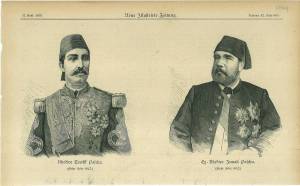
1879réf. 659AGWien - Leipzig, Neue Illustrirte Zeitung, 1879. OHolzstich. ca. 38 x 29 cm., Abbildung