Windsor, Henry HavenBiblio.com

2437 risultati
rif. 1017078947.Ghardcover. Good. Access codes and supplements are not guaranteed with used items. May be an ex-library book. hardcover
rif. 1786342774.Gpaperback. Good. Access codes and supplements are not guaranteed with used items. May be an ex-library book. paperback
rif. 1610698681.Gpaperback. Good. Access codes and supplements are not guaranteed with used items. May be an ex-library book. paperback
rif. 1591583187.Gpaperback. Good. Access codes and supplements are not guaranteed with used items. May be an ex-library book. paperback
1896rif. 004407New York: G. P. Putnam's Sons 1896. 1st Edition . Hardcover. VG- Very Good Minus/No Jacket. 8vo - over 7¾ - 9¾" tall. Signed by author to early page of vol 1 with inscription to his cousin George Palmer Putnam dated 1897. Dark burgundy cloth with dull gilt titles and decoration; light edgewear and soil; lightly bumped spine ends and corners. Bindings sound text clean. Interiors lightly toned and foxed. No stickers or stamps. Not ex-library. 459538 pp. G. P. Putnam's Sons hardcover
rif. 1107634504.Gpaperback. Good. Access codes and supplements are not guaranteed with used items. May be an ex-library book. paperback
1932rif. 011364So0uth Haven Michigan: South Haven High School 1932 Book. Very Good. Hardcover. 96 pages. In the original cloth covered boards - some staining to the rear board. Many of the photos have ink signatures by or on them. Ink presentation inscription to the front free end paper - To Dorothy Hinks from Sophie. Loosely inserted 4 page booklet - Fifty second commencement South Haven High School class of 1932. South Haven High School hardcover
1869rif. 51512170083Lee and Shepard 1869-01-01. Paperback. Good. Good hardcover. ORIGINAL1869 PRINTING. Pages are clean and unmarked. Covers show light edge wear with rubbing/light scuffing. Spine edge wear. Bumped corners. Hinge cracked but binding intact.; 100% Satisfaction Guaranteed! Ships same or next business day! Lee and Shepard paperback
rif. 9354446493.Gpaperback. Good. Access codes and supplements are not guaranteed with used items. May be an ex-library book. paperback
rif. 3744685748.Gpaperback. Good. Access codes and supplements are not guaranteed with used items. May be an ex-library book. paperback
1977rif. 016558Carlisle Barracks Pennsylvania: Strategic Studies Institute US Army War College 1977. Hardcover. Very Good/No Jacket. 4to - over 9¾" - 12" tall. 76pp.; HB library-bound paperback; green w/white; slight rub; pocket residueft.pastedwn.; usual library marks&stamps; cleantight pgs. "This special report seeks to determine the strength of Japan's democratic institutions. The report examines the organization and function of such key institutions as labor unions mass communications media business the bureaucracy political parties and the military. Strategic Studies Institute, US Army War College hardcover
rif. 112015751X.Gpaperback. Good. Access codes and supplements are not guaranteed with used items. May be an ex-library book. paperback
rif. 0916378764.Ghardcover. Good. Access codes and supplements are not guaranteed with used items. May be an ex-library book. hardcover
1940rif. 1iiDc0035New York: Crown Publishers 1940. Book. Very Good. Decorative Hardcover Canvas. Copyright 1933 by Robert Haven Schauffler. 8vo or 8° Medium Octavo: 7¾" x 9¾" tall. 560 xiv pp. A rare hard-to-find out-of-print scarce true collectible gem! A wonderful copy! Solidly bound copy with moderate external wear and use. Internal wear minimal. Copy with clean text. Moderate browning tanning foxing or discoloration on page edges not affecting text. Dust jacket torn ripped and re-taped. Over-sized and/or over weight book; may require additional postage. Please note that large and/or heavy items may incur extra shipping charge for both domestic and/or international shipments. . Crown Publishers Hardcover
1995rif. 5iiiBe0058New York: Paradox Press 1995. Book. Illus. by Robin Smith Art. Very Good. Trade Paperback. 8vo or 8° Medium Octavo: 7¾" x 9¾" tall. 93 pp. Solidly bound copy with moderate external wear crisp pages and clean text. Top right corner of front cover is creased. Paradox Press Paperback
1995rif. 5iiiBe0057New York: Paradox Press 1995. Book. Illus. by Robin Smith Art. Very Good. Trade Paperback. 8vo or 8° Medium Octavo: 7¾" x 9¾" tall. 94 pp. Solidly bound copy with minimal external wear crisp pages and clean text. Paradox Press Paperback
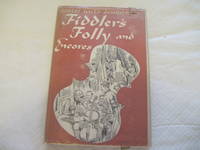
1942rif. #2519-22519Staple holes FLEP Light Toning else appears as unread & unblemished in fine reddish cloth covered boards with Very Good Poly protected DJ displaying minimal surface/edge wear as shown. Jacket has been taped to book. Illustrated with 6 drawings by Fritz Eichenberg. Synopsis: A born story teller and musician Robert Haven Schauffler has long delighted his friends with these humorous adventures which the insistence of his listeners and his publishers has finally persuaded him to put on paper. The result is an original sort of book; two short novels and briefer "Encores" with laughter and color to every page. Here for the first time appears the story – stranger than fiction – of how the author in search of a cello in Venice repeatedly spurns a black monstrosity which seems to pursue him. He reluctantly buy it regrets the bargain is saved from selling it for a song by a blind man with a perfect ear and a bed ridden fiddly doctor. The latter miraculously restores it to beauty and glorious vitality and proves it to be the oldest instrument of its kind known to exist – the "Shakespeare cello". Here too are other experiences of equal fascination. Insurance & handling is included free. Extra Charges/Fees apply on Shipments Outside The U.S. and Expedited Shipments. Oversize and/or heavy books may require additional fees. Will advise. Updated 4.20.22 . 2519-50719 #2519-22519 Updated 9.20.25 Updated 4.3.2023 Henry Holt & Co. hardcover
1915rif. P2826Used; Good. 52-A-10 John Wiley and Sons 1915 Hardcover. States "First Edition Second Thousand". No dust jacket. Previous owner's name on inside front cover. Text is clean and unmarked. Covers have moderate wear. Book Condition; Good . 1915. HARDCOVER. hardcover
rif. 1531651623.Ghardcover. Good. Access codes and supplements are not guaranteed with used items. May be an ex-library book. hardcover
rif. SL-9780761301097Millbrook Pr. library. New. In shrink wrap. Looks like an interesting title! Millbrook Pr unknown
1922rif. 32390New York: G.P. Putnam's Sons 1922. Hardcover. Second Edition in North America after the First of 1848. 5.5 x 8.75in. xvi. 230pp. Frontispiece. Publisher's cloth boards. VERY GOOD. Shows the extremities marginally shelf rubbed spine somewhat toned endpapers lightly toned otherwise the binding is strong and tight the text is clean and unmarked and the boards remain bright and distinct. As pictured. G.P. Putnam's Sons hardcover
rif. 25486No date or place. See his entry in the Oxford DNB. 1p 12mo. With mourning border. In fair condition aged and worn with remains of white 'star' wafer mounts adhering to the four corners. Beneath the underlined heading 'Note for Secretary' reads: 'The relative positions of "Iris" & "Phoebe" do not appear to agree in papers marked 2 and 4 in my letter. Please let me know which is right. / LB.' Presumably "Iris" and "Phoebe" were ships. No date or place. unknown
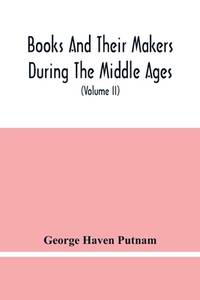
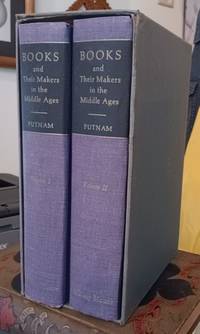
1962rif. 62100NY: Hillary House Publishers. Very Good with no dust jacket; Spines sunned slipcase worn and has splits at left side. 1962. Reprint. Hardcover. Blue cloth bindings housed in blue paper-covered slipcase. Reprint of this two-volume set of the last 1896-1897 edition. A study of the conditions of the production and distribution of literature from the fall of the Roman Empire to the close of the Seventeenth Century subtitle. Volume I covers the period 476-1600; xxvii 459pp bibliography. Volume II covers 1500-1709; x 538pp index. ; 8vo 8" - 9" tall . Hillary House Publishers hardcover
1988rif. 89085New York: Walker and Company This is a Millennium Book and a Bryon Press Book 1988. Presumed First Edition First printing. Hardcover. Very good/Very good. Ralph Reese. 8 196 4 pages. Frontispiece. Illustrations. The dust jacket has slight wear and soiling. Sticker residue inside the front cover. Publisher's Review Copy related ephemera laid in. Joe's life takes a humorous turn when he encounters a scientist with a machine that can make supermen out of ordinary "joes." Tom De Haven born 1949 is an American author editor journalist and writing teacher. His recurring subjects include literary and film noir the Hollywood studio system and the American comics industry. De Haven is noted for his comics-themed novels including Joe Gosh the Derby Dugan trilogy and It's Superman!. De Haven considers himself a narrative writer and considers the storytelling style of comics to have been a major influence on his writing. As a freelance journalist he has written criticism for publications such as The New York Times Book Review and Entertainment Weekly. De Haven's novels include the Funny Paper trilogy consisting of Funny Papers 1985 Derby Dugan's Depression Funnies 1996 and Dugan Under Ground 2001. The trilogy's storyline stretches from the beginnings of the newspaper comic strips in the 1890s to the 1970s. De Haven's awards include a fellowship from the New Jersey State Council on the Arts and he has twice won fellowships from the National Endowment for the Arts.6 His novel Depression Funnies received an American Book Award in 1997. Dugan Under Ground received the Library of Virginia Fiction Award also called the Library of Virginia Literary Awards. Ralph Reese born May 19 1949 is an American artist who has illustrated for books magazines trading cards comic books and comic strips including a year drawing the Flash Gordon strip for King Features. Prolific from the 1960s to the 1990s he is best known for his collaboration with Byron Preiss on the continuing feature "One Year Affair" serialized in the satiric magazine National Lampoon from 1973 to 1975 and then collected into a 1976 book. Reese early in his career worked in the studio of Wally Wood assisting on both mainstream and alternative-press comics and on trading cards. He went on to do mainly fantasy and horror illustrations for science-fiction magazines and black-and-white horror-comics magazines. He drew many fantasy horror and science-fiction stories for Marvel Comics DC Comics and Valiant Comics. It was a typical day in Wonder City. Joe Gosh was stuck. No job no money no girl not much of a place to live and no real prospects. Vicky Zomba the love of his life wouldn't look twice at him. Her mother wanted to make him a zombie. When his credit ran out he'd be sent to Mars to be a miner. He didn't want to go to Mars. What he needed was a sense of direction an idea of what to do with his life. What he got was a bundle of junk mail that appeared out of thin air. And that gave him the idea. It was a terrific idea. He's become famous. He's make a lot of money. He'd have job security. Vicky Zomba would go out with him. It would solve all his problems. Joe Gosh was going to be a superhero. In JOE GOSH Tom De Haven author of the acclaimed novel FUNNY PAPERS which The New York Times Book Review called "evocative and fun" looks at the reality of superpowers in a truly crazy way. Walker and Company [This is a Millennium Book and a Bryon Press Book] hardcover
1896rif. 88318Philadelphia: Published By The Author 1896. Presumed First Edition First printing. Hardcover. Fair. 88 2 pages. Illustrations. RARE surviving copy. Ex-library from the New York World newspaper's library with some of the usual library markings. Author inscription inside the front cover reads "With the compliments of the author Curtis Haven Phila. Pa. Mar. 12 1900". The book has a significant amount of wear and tear and some moisture stains. Curtis Haven was a journalist author and teacher with over twenty years' experience. He authored an impressive number of 'how-to' books and yet is largely forgotten and unknown today. The contents include Duties of the Writers on a Great Newspaper; City Editor's or Local Department; Night Editor's Department; Telegraph Editor; Editorial Department; Exchange Editor; Literary Editor; Proof Reading; and Writing Advertisements. This is a fascinating snapshot of the "Great City" newspaper business at the turn of the Twentieth Century. Journalism is the production and distribution of reports on the interaction of events facts ideas and people that are the "news of the day" and that informs society to at least some degree of accuracy. The word a noun applies to the occupation professional or not the methods of gathering information and the organizing literary styles. The appropriate role for journalism varies from country to country as do perceptions of the profession and the resulting status. In some nations the news media are controlled by government and are not independent. In others news media are independent of the government and operate as private industry. In addition countries may have differing implementations of laws handling the freedom of speech freedom of the press as well as slander and libel cases. The late 19th and early 20th century in the United States saw the advent of media empires controlled by the likes of William Randolph Hearst and Joseph Pulitzer. Realizing that they could expand their audience by abandoning politically polarized content thus making more money off of advertising American newspapers began to abandon their partisan politics in favor of less political reporting starting around 1900. Newspapers of this era embraced sensationalized reporting and larger headline typefaces and layouts a style that would become dubbed "yellow journalism". Newspaper publishing became much more heavily professionalized in this era and issues of writing quality and workroom discipline saw vast improvement. This era saw the establishment of freedom of the press as a legal norm as President Theodore Roosevelt tried and failed to sue newspapers for reporting corruption in his handling of the purchase of the Panama Canal. Still critics note that although government's ability to suppress journalistic speech is heavily limited the concentration of newspaper and general media ownership in the hands of a small number of private business owners leads to other biases in reporting and media self-censorship that benefits the interests of corporations and the government. In the 1920s in the United States as newspapers dropped their blatant partisanship in search of new subscribers political analyst Walter Lippmann and philosopher John Dewey debated the role of journalism in a democracy. Their differing philosophies still characterize an ongoing debate about the role of journalism in society. Lippmann's views prevailed for decades helping to bolster the Progressives' confidence in decision-making by experts with the general public standing by. Lippmann argued that high-powered journalism was wasted on ordinary citizens but was of genuine value to an elite class of administrators and experts. Dewey on the other hand believed not only that the public was capable of understanding the issues created or responded to by the elite but also that it was in the public forum that decisions should be made after discussion and debate. When issues were thoroughly vetted then the best ideas would bubble to the surface. The danger of demagoguery and false news did not trouble Dewey. His faith in popular democracy has been implemented in various degrees and is now known as "community journalism". The 1920s debate has been endlessly repeated across the globe as journalists wrestle with their roles. Published By The Author hardcover