2 958 résultats
réf. DADAX0190239778New unknown
réf. DADAX0231179502New unknown
réf. DADAX0415042747New unknown
réf. DADAX0415613418New unknown
réf. DADAX0415595711New unknown
réf. DADAX0367318881New unknown
réf. DADAX0520279158New unknown
réf. DADAX0367589907New unknown
réf. DADAX0333735005New unknown
réf. DADAX0367142961New unknown
réf. DADAX0230221335New unknown
réf. DADAX0230278744New unknown
réf. DADAX0415774861New unknown
réf. DADAX0520212169New unknown
réf. DADAX0275961362New unknown
réf. DADAX0312221428New unknown
réf. DADAX037550804XNew unknown
réf. DADAX0415497892New unknown
réf. 71808The contemporary album 270 × 220 mm is bound in half leather and stippled cloth; mounted on both sides of the first 25 leaves are a total of 82 vintage gelatin silver photographs. There are 16 credited to Albert or C. Albert likely Charles Albert active at various locations in North Africa from the 1890s to the 1930s; these are 170 × 120 mm or the reverse and are mainly captioned occupational or genre images. There are 26 large-format prints 180 × 260 mm or the reverse one credited to Albert and several credited to Soler Francisco Soler active from the 1890s. Soler may be responsible for most of these views of impressive buildings streetscapes and rural scenes. There are also 40 private snapshots 85 × 85 mm; internal evidence suggests they were taken by an Edwardian English family in Tunisia. Whether they were merely on holiday or long-term residents there is difficult to say but the small group of original sketches loosely inserted makes us favour the latter. There are nine watercolours and two uncoloured ink drawings mainly 150 × 200 mm with one larger one smaller; they appear to be done by a capable child possibly one of the girls featured in the last four snapshots in the album. We purchased this album in Adelaide nearly 20 years ago; unfortunately the vendor didn't know the back-story then and we are none the wiser now. Apart from a little wear to the extremities the album is in excellent condition; the contents are in uniformly fine condition. unknown
1880réf. 19253AB1880. Tunis Garrigues ca. 1880 21 : 26 cm. 11 Albumin-prints all pasted on thick cardboard. 11 Albumen prints by Garrigues Photographe actif à Tunis de 1860 jusque dans les années 1890. - Studios à Tunis au 9 avenue de France et au 2 rue de Bône. - Succursale à Vichy. - Photographe de S. A. Le Bey de Tunis. The following photographs are present: Tunis et fort Sidi ben Hassen - Acien port de Carthago - Cisterne de la Mala pre Tunis April 1897 - Bedouin riche Tunis 1897 - Carthago Cathedrale Chap. S. Louis - Carthago Cisternen 97 - Carthago Roman theatre - Campement - Grosse négresse - Jeane fille juive - Stalle des psychés Dar- el - Bey. - Some photographs with identification on the reverse side cardboards with a few stains images are fine. hardcover
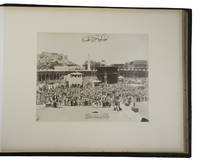
1890réf. ABC_46444Tunis: Photographie Garrigues 1890. Half black leather red buckram sides blind-stamped boards and gold-stamped spine title in gold lettering on front board marbled endpapers. Oblong album 32 x 41 cm. Album with 50 photographic prints of various sizes 13.5 x 9.5 to 29 x 21.5 cm each pasted on thick paperboard. Album with 50 late-nineteenth-century photographic probably albumen prints of scenes in Algeria and Tunisia made by an unknown photographer. Most of the photographs have a caption naming the place photographed but only 5 indicate place of production or publication of the photos. These were all produced in Tunis at least some by the French photographer J. Garrigues printed and published at his studio. Notable photographs in this album are the first showing a veiled woman a barber at work in the streets riders on their horses camels with riders and luggage the Notre Dame d'Afrique in Algiers. Other subjects include city views fairly candid photos of people in the streets landscapes and the exterior and interior of a mosque.The most remarkable print in this album actually does not fit in with the other images of places in North Africa. It is a photograph of pilgrims before the Great Mosque and Kaaba in Mecca modern day Saudi Arabia with a caption in Arabic. This photograph was taken by the first Arab photographer Al-Sayyid Abd al-Gaffar ca. 1887 making it one of the first photographs of Mecca. The present album contains this picture in its original form including the Arabic caption. An edited version of the photograph in which remnants of the Arabic caption are visible can be found in Hurgronje's Bilder aus Mekka.With a small Antwerp booksellers ticket on the front paste-down". The binding shows some signs of wear slight foxing/browning of the outer edges of the paper boards not affecting the photographic prints some prints have slightly faded edges which does not interfere with the actual image. This album with photographic prints of Algeria Tunisia and remarkably 1 of the Great Mosque and Kaaba in Mecca is overall in good condition. Photographie Garrigues, hardcover
1896réf. 56972Tours: Alfred Mame et fils Editeurs 1896. Folio. 10.5 x 14 in. 8 288 pp. Colour lithograph frontisp. w/ tissue guard title in sepia & black 3 colour litho plates printed on one-sided coated paper 1 w/ original paper flaw at fore-edge margin all preserving tissue guards 17 woodcut engraved plates numerous woodcut engravings and illustrations from photographs. Quarter simulated white calf over colour chromolithograph boards edgewear & rubbing slightly cocked some soiling & minor fraying & bumping head & foot of spine minor wear to corners still VG- sound copy. First edition of the author’s lavishly illustrated travelogue through Tunisia at the end of the 19th Century filled with firsthand observations and drawings. He describes the Jewish quarter in Tunis the city of Carthage snake charmers local folk beliefs as well as local tribes and villages across Tunisia. Vuillier 1845-1915 served during the Franco-Prussian War as an aide-de-camp chief minister of the Oran prefecture in Algeria and later studied painting under Emmanuel Lansyer debuting in 1878 with a series of Provencal and Limousin landscapes. At the same time his sketches of Algeria had drawn the attention of the publishing gian Edouart Dharton editor of Le Magasin Pittoresque and Le Tour du Monde and began publishing illustrated travelogues for them for over 27 years until his death. Alfred Mame et fils, Editeurs, hardcover
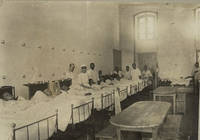
réf. PE14Oblong Quarto album ca. 20x27 cm 7 ¾ x 10 ¾ in. 25 card stock leaves. With 71 mounted gelatin silver photos including over thirty large images from ca. 12x17 cm 4 ¾ x 6 ½ in to ca. 115x145 cm 4 ½ x 5 ¾ in; the rest of the photos are from ca. 9x14 cm 3 ½ x 5 ½ in to ca. 5x7 cm 1 ¾ x 2 ½ in. All photos with period ink numbers on the mounts; ca. forty images with captions in French and/or dates on the mounts. One photo with a Serbian photographer’s smudged ink stamp on the lower margin. With a loosely inserted real photo postcard ca. 85x135 cm 3 ¼ x 5 ¼ in; dense period manuscript text in French on verso. Period light-brown full cloth album; marbled endpapers. Binding slightly soiled and rubbed on extremities one image with minor scratches to the surface a few photos mildly faded but overall a very good album of historically important photos. Historically significant collection of original gelatin silver photos documenting the French medical assistance rendered to Serbia after the Great Retreat or Serbian Golgotha of 1915-1916 during WW1. Following the October of 1915 invasion of Serbia during World War I at the hands of German Austro-Hungarian and Bulgarian armies the Serbian army retreated through Albania an event sometimes called the Albanian Golgotha. During the long march some 240000 retreating Serbs military and civilian died from the cold starvation disease and at the hands of Albanian tribesmen. <…> Because of the massive loss of life the Serbian army’s retreat through Albania is considered by Serbs to be one of the greatest tragedies in their nation’s history. The survivors of the retreat were so weakened that thousands of them died from sheer exhaustion in the weeks after their rescue " See more. “While the main camps of the recuperating army were on the island of Corfu itself a contingent was sent to Bizerte as well and many of the civilian refugees were accepted by France the sick and dying mostly soldiers were treated on Vido to prevent epidemics. In spite of Allied material help the conditions of both the improvised medical facilities and many of the patients on the island resulted in a high fatality rate” Wikipedia. The album was compiled by a French doctor who served in one of the French hospital camps for Serbian soldiers most likely established near Bizerte then in the French Protectorate of Tunisia. The loosely inserted real photo postcard depicts the compiler and a group of doctors and nurses performing surgery; the manuscript text on verso mentions the compiler’s work in Bizerte. The album opens with five portraits and scenes with starved and exhausted Serbian soldiers; one is captioned “February 6 1916 after the retreat from Serbia”. Two of the images were identified as taken at the Vido Island based on the collections of the Open Heritage Platform of the French Ministry of Culture. Most photos document the treatment of Serbian soldiers in a French hospital camp most likely located near Bizerte. The images include a series of scenes of the soldiers’ arrival in train cars their disembarking and unloading of wounded the arrival of ambulance trucks to the main entrance of the hospital and the disinfection of their clothes and belongings. The hospital building looks very similar to one of French naval establishments at Ponty Bay Bizerte see more. Six images show the interior of hospital rooms with recovering soldiers laying in beds male nurses posing next to them; one photo depict a nurse showing a gangrenous leg of a soldier. Several group portraits show recovering soldiers posing at the “Pavillon le Coueur” in front of their barracks dressed in traditional costumes playing musical instruments performing a traditional Kolo dance &c. Eleven photos document official visits reviews and charity work in the camp including “distribution of sugar” by a group of ladies – apparently French. One of the military officials was identified as Admiral Émille Guépratte 1856-1939 who then served as the maritime prefect of Bizerte one of his period photos. Over a dozen images show a Serbian Orthodox funeral service: interior of a chapel with a priest and Serbian officers a kneeling crowd at a building with a sign “Depot mortuaire” funeral procession and internment. Two photos at the rear show a Serbian cemetery at “Sidi Yaya.” Overall an important collection of original photos showing the work of a French hospital camp for Serbian soldiers in Tunisia during WW1. hardcover
1987réf. 267710PISAI 1987. Très Bon Etat de conservation ex libris intérieur très frais. in8. 1987. Broché. 113 pages. PISAI unknown
2005réf. 483061ª Ed. en español.- Barcelona: Ediciones B. Grupo Zeta 2005 pero impreso en Hong Kong.- 192 p.: Profusamente ilustrado con escenas eróticas clásicas orientales a todo color; 4º mayor 265 x 20 cm; Excelente impresión en offset texto orlado y recuadrado con filetes de diferentes colores; Cartoné Ed ilustrado.- Algo parecido al Kamasutra. Excelente estado. Las miniaturas que ilustran el libro son parte de una tradición artística que apareció en la India después de la conquista por los Persas musulmanes. Tuvieron su origen en el contacto de la cultura persa con la indo-mogol de la India en un período de la historia en el cual dentro de la tradición musulmana el arte era una expresión prohibida de la vida. EROTISMO LITERATURA ERÓTICA SEXOLOGÃA PROSTITUCIÓN Libro en español Ediciones B. (Grupo Zeta) hardcover