5 716 résultats
réf. 15818Paris, Clmann-Lévy, 1912, 1 br. in-8 de (6)-284 pages non coupées, tampon sur la page de titre: "exemplaire offert" ;
réf. 228675Paris, Calmann-Lévy, 1912 in-12, 284 pp., demi-basane verte, dos lisse, couverture conservée (reliure de l'époque).
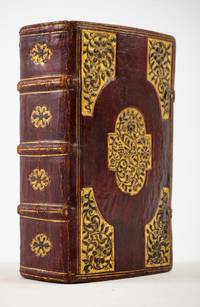
1622réf. ST20888Munich: N. Henricus 1622. First Edition in German. 160 x 100 mm. 6 1/4 x 4". 16 p.l. 699 3 pp. Translated from the Latin by Sebastian Äntzenhover. UNUSUAL AND QUITE BEAUTIFUL CONTEMPORARY GERMAN DARK RED MOROCCO GILT covers with gilt fillet border central panel with onlaid corner pieces and centerpiece of black morocco stamped in relief to an Ottoman-inspired design of flowering vines raised bands spine panels with gilt centerpiece two leather straps with silver clasps and catches all edges gilt. Title page with engraving of the Tower of Babel. Top half inch of title page cut away to remove owner inscription. VD17 12:103845E; USTC 2019170. A touch of bowing to boards spine a little crackled joints and extremities a bit rubbed occasional small round marginal marks apparently made with wax! and presumably meant to indicate textual importance other trivial imperfections but an excellent copy clean and fresh in an unrestored binding with lustrous boards glistening with gilt. This rare work on sinning through the use of wicked words is offered here in a lovely binding that is quite out of the ordinary for its time and place and that may well have a very noble provenance. "Spiritual Tongues: That is a Salutary Treatise Concerning the Poisonous Tongue of Man--How to Guard Against and Remedy It" is an examination of the sins committed through speaking written by Munich Jesuit Johannes Pelecyus 1545–1623 and first printed in Latin in 1620. Pelecyus addresses the evils of gossip slander indiscretion cursing mocking and other injurious speech. The first part of the work is a general overview of the topic from a theological standpoint while the second part is a more practical guide to types of harmful speech and specific remedies for avoiding and correcting these offenses. Pelecyus concludes with a poem "The Devil's Disease and its Remedy." The binding here is remarkable in terms of its material makeup and the conjectural origin of its design. In the first part of the 17th century morocco was not commonly used by German binders who preferred sturdier pigskin particularly for treatises like this which could be expected to see much use poisonous tongues have long been a fact of life and in need of being frequently read about. Morocco was generally reserved for presentation copies or ceremonial liturgical works. In addition to the material the decoration here is unusually lavish for a text of this sort with onlays gilt adornment and silver clasps that required time and skill from the artisan and considerable expense for the patron. Significantly the lovely relief centerpiece design on the boards here also appears on the covers of a Book of Hours originally created for Holy Roman Emperor Maximilian I 1459-1519. That volume was later acquired by another similarly named owner Duke Maximilian I of Bavaria and is now to be found in the Bavarian State Library: shelfmark BSB 2 L.impr.membr. 64. It is certainly well within the realm of possibility that our later Maximilian 1573-1651 could have owned the present poisoned tongue volume and had it dressed in its elaborate morocco attire in imitation of the original binding design on the emperor’s prayer book. Whoever was responsible for the binding they surely did extremely fine work and no doubt for an elite clientele. One other curious feature of this volume is the series of round wax dollops made in the margins which an owner the fastidious second Maximilian has used to mark passages of interest in the text. While they don't materially affect the value of the volume they are intriguing in that they inevitably call up images for us of a careful early reader systematically marking with some kind of unknown implement the parts of the text that seemed important. "Spiritual Tongues" is a rare work: USTC and OCLC find just four copies outside Germany none of them in North America and we could trace just one copy sold at auction. N. Henricus unknown books
1622réf. ST20888Munich: N. Henricus 1622. First Edition in German. 160 x 100 mm. 6 1/4 x 4". 16 p.l. 699 3 pp. Translated from the Latin by Sebastian Äntzenhover. UNUSUAL AND QUITE BEAUTIFUL CONTEMPORARY GERMAN DARK RED MOROCCO GILT covers with gilt fillet border central panel with onlaid corner pieces and centerpiece of black morocco stamped in relief to an Ottoman-inspired design of flowering vines raised bands spine panels with gilt centerpiece two leather straps with silver clasps and catches all edges gilt. Title page with engraving of the Tower of Babel. Top half inch of title page cut away to remove owner inscription. VD17 12:103845E; USTC 2019170. A touch of bowing to boards spine a little crackled joints and extremities a bit rubbed occasional small round marginal marks apparently made with wax! and presumably meant to indicate textual importance other trivial imperfections but an excellent copy clean and fresh in an unrestored binding with lustrous boards glistening with gilt. This rare work on sinning through the use of wicked words is offered here in a lovely binding that is quite out of the ordinary for its time and place and that may well have a very noble provenance. "Spiritual Tongues: That is a Salutary Treatise Concerning the Poisonous Tongue of Man--How to Guard Against and Remedy It" is an examination of the sins committed through speaking written by Munich Jesuit Johannes Pelecyus 1545–1623 and first printed in Latin in 1620. Pelecyus addresses the evils of gossip slander indiscretion cursing mocking and other injurious speech. The first part of the work is a general overview of the topic from a theological standpoint while the second part is a more practical guide to types of harmful speech and specific remedies for avoiding and correcting these offenses. Pelecyus concludes with a poem "The Devil's Disease and its Remedy." The binding here is remarkable in terms of its material makeup and the conjectural origin of its design. In the first part of the 17th century morocco was not commonly used by German binders who preferred sturdier pigskin particularly for treatises like this which could be expected to see much use poisonous tongues have long been a fact of life and in need of being frequently read about. Morocco was generally reserved for presentation copies or ceremonial liturgical works. In addition to the material the decoration here is unusually lavish for a text of this sort with onlays gilt adornment and silver clasps that required time and skill from the artisan and considerable expense for the patron. Significantly the lovely relief centerpiece design on the boards here also appears on the covers of a Book of Hours originally created for Holy Roman Emperor Maximilian I 1459-1519. That volume was later acquired by another similarly named owner Duke Maximilian I of Bavaria and is now to be found in the Bavarian State Library: shelfmark BSB 2 L.impr.membr. 64. It is certainly well within the realm of possibility that our later Maximilian 1573-1651 could have owned the present poisoned tongue volume and had it dressed in its elaborate morocco attire in imitation of the original binding design on the emperor’s prayer book. Whoever was responsible for the binding they surely did extremely fine work and no doubt for an elite clientele. One other curious feature of this volume is the series of round wax dollops made in the margins which an owner the fastidious second Maximilian has used to mark passages of interest in the text. While they don't materially affect the value of the volume they are intriguing in that they inevitably call up images for us of a careful early reader systematically marking with some kind of unknown implement the parts of the text that seemed important. "Spiritual Tongues" is a rare work: USTC and OCLC find just four copies outside Germany none of them in North America and we could trace just one copy sold at auction. N. Henricus unknown
1966réf. 100153348Service Géologique du Maroc 1966 in8. 1966. Broché. Cet ouvrage de Robert Bourrouilh publié par le Service géologique du Maroc traite des gastéropodes du Lias inférieur et moyen dans le domaine atlasique marocain. Il s'inscrit dans la série des Notes et mémoires du Service géologique et constitue une référence pour l'étude paléontologique et stratigraphique de cette région
A stunning edition of Gargantua, with 41 powerful original etchings (with aquatint) by Laszlo Barta. Edition limited to 218 copies, of which this is one of 160 numbered copies beautifully printed on fine Rives wove paper. From the collection of Romain Roels, the leading Belgian collector of modern illustrated books. Folio. FINELY BOUND IN FULL REDDISH BROWN MOROCCO WITH GREEN-GRAY MOROCCO DOUBLURES. Title on spine in palladium. Original wraps and spine bound in. Top edge gilt (with palladium, actually), other edges uncut. Matching marbled board, morocco-lined slipcase. FINE AND BRIGHT, WITH NO DEFECTS.
1949Broch?. 168 pages.
réf. 201707265Paris, Autrement - série mémoires, 1992 ; in-8, 219 pp., br. Broché très bon état n°13 fevrier 1992.
1930réf. 488171930 P., Laurens, 1930, in 8° reliure de l'éditeur, dos lisse orné, tête dorée, couverture conservée, 172 pages ; dos insolé.
1929réf. 15398Henri Laurens éditeur 1929 171 pages in8. 1929. reliure editeur demi basane à coins dos à nerfs. 171 pages. Cet ouvrage publié initialement au XXe siècle est un hommage illustré à la ville de Fès mêlant le texte de Camille Mauclair et les tableaux du peintre Joseph-Félix Bouchor. Il propose une exploration de l'architecture des monuments (comme la medersa Ben Youssef) et de l'ambiance de la ville sainte offrant un témoignage historique sur la culture et le patrimoine marocains
réf. 4225autrement série mémoire No 13 février 1992 - In 8 broché 219 pages
1951réf. 106571951. Rabat Office Marocain du Tourisme 1951 - Agrafé 21 cm x 22 cm 24 pages - Texte de François Bonjean - Photos N&B hors-texte - Très bon état
réf. QWA-11408Les Presses de l'UNESCO / Nouvelles Editions Latines, 1982, grand in-8 (23 x 18,5), 312 p., préface de Mohammed El Fasi, illustrations photos en n. et b. et coul., cartes, bon état.
réf. 13977320Paris: Nouvelles Editions Latines, Les Presses de l'Unesco, 1982 in-8, 312 pages, nombr. ill., bibliographie. Broché.
réf. ORD-11812Illustrations de J. E. Laurent. Rabat. Laurent. 1966. Gd in-8 (208 x 268mm) plein chagrin rouge, dos à 5 nerfs, fleurons, filets et titre or, plat orné au centre d'un motif oriental frappé à froid, , guirlandes et filets or d'encadrement, gardes peignées, couverture illustrée couleur conservée, 209 pages, illustrations en noir dans le texte. Il a été rajouté en tête de volume une double feuille rempliée portant une inscription en cyrillique et un ex-donno en français facilement détachable. Qq. rares rousseurs pâles sinon bel exemplaire superbement relié.
1966réf. WOC-1078Illustrations de J.E. Laurent. 7 ème édition. Oudaïa-Rabat, J.E. Laurent, 1966. Petit in-4 27x20,5cm) broché, plat supérieur orné d'une scène orientale. 209pp. Ici manque quelques feuillets du début du livre. Bon état intérieur.
1966réf. 19225J. E. Laurent 1966 Rabat (Maroc), éditions J. E. Laurent, 1966. Grand in-8 broché de 209 pp., lexique des termes arabes in fine. Illustrations de J. E. Laurent. Premier plat et page de garde un peu usagés, sans manque. Intérieur en très bon état. Sans annotations ni soulignements. Un des meilleurs livres sur la cuisine marocaine.
1947réf. 87061947 pleine reliure mar. vert (travail marocain) plat décoré. in-12, 148pp., 76 photos, Casablanca Bory 1947,
réf. 47881Paris Henri Laurens, Editeur 1951 petit in 4 (24x19) 1 volume reliure pleine basane rouge de l'époque, dos à nerfs, couverture conservée, 171 pages [1], avec 30 planches en couleur contrecollées d'après les tableaux du peintre Joseph-Félix Bouchor. Ornementations de David Burnand. Bel exemplaire, bien relié ( Photographies sur demande / We can send pictures of this book on simple request )
réf. 54903Henri Laurens Editeur 1929, in-8 carré relié demi-toile écrue avec pièce de titre en maroquin rouge, 172 p. (accroc recollé en haut du dos, sinon très bon état) Sur bon papier. Bel ouvrage à la gloire de ce haut lieu du Maroc, enrichie de trente reproductions en couleurs contrecollées du peintre Joseph-Félix Bouchor.
réf. 115642Paris, Henri Laurens 1930, 240x185mm, 171pages, broché. Bel exemplaire.
1930réf. 144135Paris, Henri Laurens 1930 In-8 24,5 x 19 cm. Reliure demi-toile beige, orné d’un petit fer doré, pièce de titre maroquin rouge, 171 pp., bandeaux et culs-de-lampe de David Burnand, 30 reproductions contrecollées de J.-F. Bouchor, table des matières.
1949réf. HIS5450MRelié, 668 pages + illustrations, paru en 1949 chez Éditions La Porte, livre en excellent état.
réf. 13983088Paris: ACR Edition, 1991 in-4, 286 pages, nombreuses illustrations en couleurs. Glossaire, bibliographie. Reliure toile, jaquette, bel exemplaire.
1969réf. DEZ-7883Neuilly, Les Editions Martinet, 1969. In-12 carré broché. 319 pp. Illustrations in et hors texte en noir et blanc de l'auteur. Edition originale. Bon état.