2 519 résultats
1947réf. 47601947 Grenoble, Arthaud, 1947, in 8, carré, 450 pages ; illustrations et cartes.
1922réf. 19601922 Paris, Plon, 1922, in 12 broché, 276 pages ; portrait en frontispice, deux gravures hors-texte ; couverture fanée.
réf. 13974175Paris: Musée de l'Homme, Museum National d'Histoire Naturelle, 1963 in-4, nombreuses illustrations. Broché. Très bon état, cachet. Sommaire: Jacques MILLOT, Sardaigne 1963. - Jacqueline DELANGE, Sur un Oshe Shango. - Françoise GIRARD, Sculptures et emblèmes funéraires des îles Salomon. - Joseph TUBIANA, Le frère de Saint Lâlibalâ. - Jacques MILLOT, Images dans le ciel. - Jacques MILLOT, Masques peints du théâtre chinois. - Henri LHOTE, Nouvelle mission au Tassili des Ajjers.
1953réf. 34471953 Paris, Arthaud (Collection "Les Clefs de l'Aventure"), 1953, in 8 broché, 266 pages, 32 photos ; jaquette illustrée en couleurs.
réf. 3202Paris / Grenoble, Arthaud, 1952 ; in-12 carré, br; -302pp.-1f.-15p l.h.t. Jaquette illustrée en couleurs. Bon état.
réf. 9607Paris, Editions Robert Laffont, 1972 13 x 22, 278 pp., illustrations N/B, broché, bon état
1945Alsatia 1945, In-8 broché sous jaquette illustrée. 302 pages + nombreuses photos. Bon état.
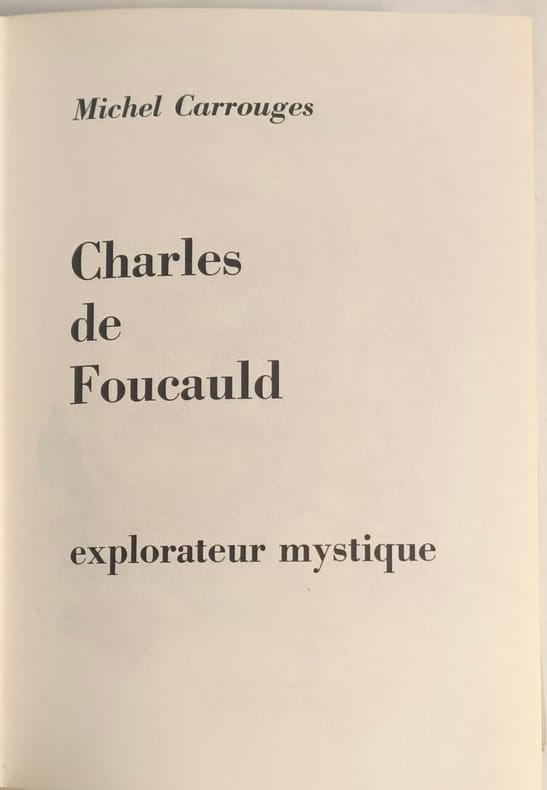
1954réf. 6107Société nouvelle des éditions 1954 381 pages in8. 1954. Reliure éditeur pleine toile sous rodhoid. 381 pages. Cette biographie de Michel Carrouges retrace la vie de Charles de Foucauld en mettant l'accent sur son itinéraire intérieur et spirituel ainsi que sur son rôle d'explorateur et d'ermite au Sahara. L'auteur présente Foucauld comme une figure à la croisée des spiritualités chrétienne et musulmane tout en adoptant un regard nuancé qui évite l'hagiographie excessive
réf. 71395Londres, george G. Harrap, 1943. 13 x 20, 200 pp., 1 carte, broché, bon état (couverture défraîchie).
réf. 6238Arthaud, Collection Sempervivum, 1952, broché avec jaquette illustrée en couleurs, 14x20 cm, 182 pages, Illustrations en héliogravures.
1947réf. 855801947 Paris, Nouvelles Editions Latines, NEL (Collection "L'Histoire Vivante"), 1947, in 8° relié d'une modeste demi-toile noire, 334 pages ; cachets.
1969réf. dd488Orstom Atlas des structures agraires au sud du Sahara Dos carré collé 1969 In-4 (21x27 cm), dos carré collé, couverture rempliée, 88 pages + 5 planches couleurs dépliantes in fine, n°3 de la collection Atlas des Structures agraires au sud du Sahara, schémas et photographies en noir et blanc hors-texte ; mors un peu frottés, quatrième plat un peu sali, bon état. Livraison a domicile (La Poste) ou en Mondial Relay sur simple demande.
1973réf. 13743ABStuttgart, Franckh'sche Ver.-Hdlg., 1973. 332 S., m. 11 Kart., 1 Zeichng. u. 131 Fotos im Text. Or.-Ln., Or.-Umschl.(dieser m. kl. Randläsuren), Deckelillustr., innen guter Zust.
1926réf. 116985Couverture souple. Revue 30 x 40 cm. 22 pages + 48 pages de publicités.
1935réf. 122822Couverture souple. Revue 20 x 30 cm. 28 pages + 28 pages d'annonces publicitaires. Légèrement défraîchie.
1935réf. 122823Couverture souple. Revue 20 x 30 cm. 28 pages + 28 pages d'annonces publicitaires. Légèrement défraîchie.
1937réf. 122856Couverture souple. Revue 20 x 30 cm. 24 pages + 20 pages d'annonces publicitaires. Petit manque à 2 pages.
1965In 8, tela, sovracc., pp. 424, sguardie ill., 226 ill. fotogr. a piena pagina f.t.Cop. di plast. trasp. amatoriale con nastro adesivo sulle band. che ha rilasciato tracce evidenti alle sguardie, per il resto buone condizioni.Luogo di pubblicazione BariEditore Leonardo da VinciAnno pubblicazione 1965Collana All'insegna dell'orizzonte 22Materia/Argomento Etnologia, Esplorazioni, Viaggi, Africa, Sahara, Congo
1959réf. 118647Couverture souple. Revue 24 x 31 cm. 1112 pages. Papier glacé. Illustrations en couleurs.
2007The first book for general readers about the storied past of one of the world’s most fabled cities. Timbuktu — the name still evokes an exotic, faraway place, even though the city’s glory days are long gone. Unspooling its history and legends, resolving myth with reality, Marq de Villiers and Sheila Hirtle have captured the splendour and decay of one of humankind’s treasures. Founded in the early 1100s by Tuareg nomads who called their camp “Tin Buktu, ” it became, within two centuries, a wealthy metropolis and a nexus of the trans-Saharan trade. Salt from the deep Sahara, gold from Ghana, and money from slave markets made it rich. In part because of its wealth, Timbuktu also became a centre of Islamic learning and religion, boasting impressive schools and libraries that attracted scholars from Alexandria, Baghdad, Mecca, and Marrakech. The arts flourished, and Timbuktu gained near-mythic stature around the world, capturing the imagination of outsiders and ultimately attracting the attention of hostile sovereigns who sacked the city three times and plundered it half a dozen more. The ancient city was invaded by a Moroccan army in 1600, beginning its long decline; since then, it has been seized by Tuareg nomads and a variety of jihadists, in addition to enduring a terrible earthquake, several epidemics, and numerous famines. Perhaps no other city in the world has been as golden — and as deeply tarnished — as Timbuktu. Using sources dating deep into Timbuktu’s fabled past, alongside interviews with Tuareg nomads and city residents and officials today, de Villiers and Hirtle have produced a spectacular portrait that brings the city back to life. ; 320 pages