20.445 resultados
1855ref. 820251855. 15" x 9-3/4" broadside text in three columns. 15" x 9-3/4" broadside text in three columns. Unrecorded Broadside Marking the Death of Nicholas I Broadside. Nicholas I 1796-1855 Emperor of Russia. Biography of the Emperor Nicholas and Sudden Deaths of the Romanoff Family! Nottingham: Printed and Published by Thomas Stevenson 1855. 15" x 9-3/4" broadside text in three columns below headline and large woodcut vignette depicting the death of Nicholas I. Moderate toning very light edgewear faint fold lines and creases to corners light foxing to lower right corner a few faint stains. Rare. $1500. This broadside was published after the death of Nicholas I from pneumonia on March 2 1855. His death occurred during the Crimean War and the Siege of Sevastopol which had been ongoing since October 1854 and ended in September 1855 six months after Nicholas's death. The broadside is mostly dedicated to a brief biographical history of the Romanov dynasty. It ends with a section headed "Latest Intelligence" containing dispatches from Berlin Warsaw Sevastopol and Marseilles. No copies located on OCLC or Library Hub. Not at the British Library. unknown books
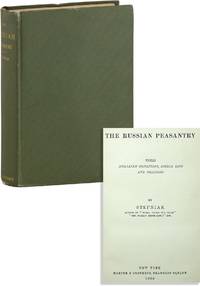
1888ref. 84805New York: Harper and Brothers 1888. First Edition. Octavo. 17.5cm. Publisher's green pebble grain cloth titled in gilt to spine. vi; 1; 401pp.6pp. ads to rear. Light rubbing to corners slight scuffing and some minor bumping to spine ends with a small spot stain at the very head of the spine small dent to upper edges of the boards; internally clean with some superficial soiling to the page edges ownership of Pennsylvania historian Gertrude Bosler Biddle to front flyleaf. A very good clean and handsome copy. WITH London: 1890-93. Three ALS autograph letters signed on folded stationery sheets as follows: 1. Dated "March 31" without year; from context ca. 1888-1890. 2pp ca. 250 words in black ink; datemarked St. John's Wood March 31. Requesting the publisher's permission to commission a German translation of his Russian Peasantry which first appeared in 1888 with a second edition in 1890. Stepniak proposes 50/50 division of royalties and identifies the translator as Victor Adler who has just been sentenced to three months in prison and thus now has "ample leisure" for undertaking the translation. Adler 1852-1918 was founder and first chairman of the Austrian Socialist Democratic Workers Party in 1888. Signed at close "S. Stepniak." Near Fine. 2. Dated November 6 1890. 1pp ca. 75 words in blue ink. Declines a request from his publisher to undertake a book on the Jewish Question: ".it is impossible for me to write upon any question upon Jews or anything else for I am quite full with preparing a series of American lectures." Signed at close "S. Stepniak." Slight smudging final two lines and left margin not affecting legibility. Very Good. 3. Dated May 15 1893. 2pp ca. 120 words in black ink. Addressed to "Dear Mrs i.e. messieurs Sonnenschein" accepting an invitation to visit but stating he cannot arrive early. Signed at close "S. Stepniak." Light soil; Near FIne. Sergei Stepniak aka Sergius; aka Sergey Stepnyak-Kravchinskii 1851-1895 made his revolutionary bones during the Narodnik Rebellion of 1877-78 by openly assassinating Nikolai Mezentsov the head of the Czar's secret police on the streets of St. Petersburg. Kravchinskii committed the act in broad daylight and made no attempt to disavow his guilt living publicly if dangerously for several months before finally escaping to Switzerland. He arrived in London around 1880 and quickly became the center of a lively Russian revolutionary exile scene. He founded the Society of Friends of Russian Freedom in 1891 and wrote a number of well-received books on revolutionary Russia including Underground Russia which had in fact been published in translation prior to his exile The Russian Peasantry 1888; and a fictionalized account of his own exploits The Career of a Nihilist 1889. He was killed somewhat mysteriously we think by an onrushing train in December of 1895 depriving him of any opportunity to witness the fruit of his labors in the Revolutions of 1905 and 1917. Dying young Stepniak did not leave a great body of manuscript material behind him and relatively few letters with good content have appeared in commerce. Harper and Brothers unknown books
1955ref. 83663New York: Henry Holt 1955. First Edition. Octavo. 21.5cm. Publisher's red cloth spine over grey paper covered boards titled in gilt to spine. Dustjacket. 315pp. Some very light soiling to the paler portions of the boards minor bumping to spine ends internally clean with some offsetting to pastedowns and a very few discrete pencil marks to margins of the prelims in a bright sharp dustjacket with some minor wear to extremities. A very good copy. A rather alarmist but for the time rational analysis of the breadth of Soviet intelligence attempts to maintain and utilize a global espionage network; covers the Atom Spy frenzy The Rosenbergs Alger Hiss etc. Henry Holt unknown books
1946ref. 83794Stanford CA: Stanford University Press for The Hoover Library on War Revolution and Peace 1946. First American Edition. Octavo. 23cm. Publisher's black cloth titled and decorated in gilt to spine. Dustjacket. xv; 658pp. Very light wear to the cloth mostly confined to some shallow cosmetic bumping to spine ends; internally clean; in a clean strong price-clipped dustjacket with some marginal fraying and isolated shallow loss to edges some toning of the spine panel and some largely unnecessary tape reinforcement to the verso of the jacket. A very good copy in a dustjacket with some light wear. A sizeable biography of the life of Ipatieff who managed to be a respected scientific figure before the Revolution and an even more respected one afterwards. It can have been no mean feat to have been head of Imperial Russian chemical warfare research during WW1 and then post-revolution to be held responsible for the revitalization of the chemical industry of the newly minted USSR. A joint memoir of the last days of Imperial Russia and the early days of the USSR with all the turbulence fear and uncertainty that must have engendered. Stanford University Press for The Hoover Library on War, Revolution and Peace unknown books
1982ref. 84404New York: Crane Russak 1982. First Thus. Octavo. 23cm. Publisher's bright red cloth titled in black to spine. Dustjacket. xxvi; 398pp. Light bumping to spine ends some very light wear to the extremities of the cloth; internally clean; in a clean sharp example of the dustjacket. A near fine copy. A study produced under the auspices of the RAND Corporation a military adjacent think-tank and research institution originally created to research and protect against future methods of warfare but later expanding into the civilian sector. Coinciding with the opening of Soviet hostilities against Afghanistan but working from a body of knowledge accumulated since the end of WW2 and the commencement of the Cold War this is an attempt to predict and understand Soviet military and strategic thinking and behavior in time of conflict. Crane Russak unknown books
1980ref. 81760Moscow: Tushino Machine Building Plant 1980's. Pasteboard box 44cm x 23cm. Name printed in stark black and white onto a stereotypically minimalist Soviet box all the more susrprising considering this is a toy for children. Light inoffensive wear to the extremities a little rubbing and scuffing to the corners clean and complete. The verso of the box lid contains a plan of the contents with item numbers and small illustrations. Inside the box liner is moulded polystyrene with spaces for the individual components ranging from pressed steel baseboards and wall/hull sections to a set of rubber tyres woven string to simulate hawsers and cables pulleys connecting rods all the necessary tools a bag of nuts bolts and other connector pieces; all mass produced in a fashion that would have even a cursory modern day child safety inspection shutting down the whole plant and issuing a warning that if your children get this for Christmas you might need to count their fingers on Boxing Day. Miraculously complete as far as can be ascertained and with very little sign of use including the plans and construction book which is complex enough to count as aggressively educational and has the original warranty sheet with inspection stamps hand stamped and dated 1992 although the slip dates the set to the 1980's laid in. The introduction to the set in the 62 page instruction book states: "The 'Yunost' contruction set is a game designed in 1944 to introduce children aged 10-15 years to the principles of technical design and construction engineering. Each set of the 'Yunost' construction set contains the most intricate parts intnded for assembling models of various mechanisms machines and industrial structures." Clearly designed as a controlled Soviet alternative to Western toys like Erector Sets Meccano and the like the principles are identical whilst the delivery is rather more tailored to a deliberately educational USSR approach to entertaining children. "Nothing without purpose" seems to have been the guiding tenet of USSR toy production approaches which became notorious for taking an existing Western temptation like Meccano or Lego or GI-Joe and adapting them to the requirements of collective adherence to the improvement of the USSR. To Western eyes a lot of this material looks like the physical representation of the "We have McDonalds at home." meme but whilst Western toy design was aimed as much at keeping kids quiet and out of the way with a side of education the Soviet philosophy seems to have been 'if a child is building a toy crane then he should be learning the principles of load bearing members understanding pulleys and getting an idea of where crane operators fit into the process of industrial engineering' whilst this approach seems to take some of the joy out of play time it also contributed to the Western paranoia that the USSR was basically a cradle to grave enemy factory. Tushino Machine Building Plant unknown books
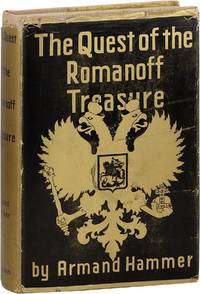
1936ref. 83612New York: The Paisley Press Inc. Succeeding William Farquhar Payson 1936. Stated Third Edition. Octavo. 21.5cm. Publisher's heavy grain pale grey cloth titled and decorated in gilt to spine and front board. Dustjacket. xi; 241pp. Some wear and discoloration to extremities very light it's a very solidly produced book so wear and tear is represented by darkening of the cloth at the edges and some softening of the spine ends rather than anything more drastic; internally clean ownership to front pastedown author's signature to front flyleaf; in a handsome example of the gold and black dustjacket with some chipping and shallow loss to the spine ends scuffing and rubbing to the gilt paper coating and some marginal creasing and soiling. A very good solid copy. Illustrated throughout with full page plates. For a man named by his father after the logo of the American Socialist Labor Party after slipping out of Odessa in the 1870's Armand Hammer's journey to become one of the world's most influential businessmen and "Lenin's Favorite Capitalist" must have been a dramatic one. His father Julius had spent much of the early 20th century consolidating his role at Allied Drug and Chemical which was essentially at times a smuggling front shipping embargoed goods to Russia during the US trade sanctions. After Julius was sentenced to 3 years in Sing Sing allegedly for a botched abortion that resulted in the death of a Russian woman from subsequent pneumonia although modern research suggests that Armand a medical student might have been the one who performed the abortion and Julius took responsibility as the qualified senior medical professional present Armand took over Allied Drug and Chemical and raised it to new heights of corporate success. During Prohibition Allied's largest seller was a essentially alcoholic ginger ale sold as a medicinal tonic to great profit. Acting under the instructions of his imprisoned father Armand began taking numerous business trips to the Soviet Union. A young J. Edgar Hoover at that point basically an analyst at the Justice Department very strongly believed that the equally youthful Hammer was a COMINTERN courier and essentially placed him under surveillance for the rest of his life. Hammer's trips to Russia were ostensibly to recoup bad debts but this quickly developed into a number of lucrative business deals not least of which was selling cheap wheat to starving famine hit areas of Russia. Hammer developed a close co-operative no pun intended relationship with Lenin which resulted in a number of very high status business contracts and deals ranging from medical import contracts to 25 year's worth of asbestos mining in the Urals; one of Hammer's greatest coups was arranging payment for various services in furs caviar jewellery and antiquities seized by the Party from its long tail of enemies making him essentially a conduit for looted and otherwise dubious art jewels and antiques. At the height of Lenin's New Economic Policy Armand Hammer was the sole trade liason between the enormity of Soviet Russia and 38 major US corporations seeking to build trade deals through him. His grasp of the downrange necessities of dealing with the Soviets; graft bribery corruption and palm greasing was legendary and by the 1970's when his methods were starting to be inspected more closely there was no doubt that Hammer's understanding of legitimate business was secondary to his instinctive abilities in the fields of corporate and beaurocratic bribery and manipulation. This book is one personal perspective on the empire of treasure that Hammer accumulated; there are others and the entangled ephemeral traces of looted artworks forged and unfinished Fabergé eggs specially manufactured jeweller's tools designed to copy Fabergé's style exactly and a wealth of other foggy rumors and suspicions ranging from Armand the KGB stooge to Armand the James Bond Villain bent on Soviet domination through capitalism will continue to follow in his wake whether he be considered a legitimate businessman or a highly successful 20th century robber baron of legendary proportions. The Paisley Press Inc. Succeeding William Farquhar Payson unknown books
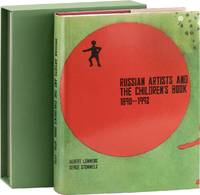
1990ref. 81719Nijmegen: LS 1990. First Limited Edition. Deluxe issue one of eleven copies in slipcase signed by both authors and issued with an original Soviet children's book in this case a copy of Kornei Chukovsky's Telefon Moscow: 1936 with illustrations by Vladimir Konashevich. Quarto 28cm; cloth hardcover dustjacket 511pp; illus. Supplemental DVD laid in as-issued. A fine copy in a crisp unworn dustwrapper and unworn slipcase. The included copy of Telefon is housed in a folding chemise designed to slip into the same slipcase as the main volume; staple-bound pictorial wrappers; 16pp light toning and wear to wrappers else Near Fine. A most desirable copy of what has become a standard English-language reference for Russian illustrated children's books. The deluxe issue is necessarily rare and seldom offered for sale. LS unknown books
1769ref. 719841769. Lausanne: Francois Grasset & Comp. 1769. Lausanne: Francois Grasset & Comp. 1769. Early French Translation of an Important Document of the Enlightenment Catherine II 1762-1796 Empress of Russia. Balthasar Joseph Anton Felix von 1737-1810 Translator. Instruction Donnee par Catherine II. Imperatrice et Legislatrice de Toutes les Russies a la Commission Etablie par cette Souveraine pour Travailler ala Redaction d'un Nouveau Code de Loix Telle Qu'elle e ete Imprimee en Russe & en Allemand Dans l'Imprimerie Imperiale de Moscow. Nouvelle Edition Augmentee. Lausanne: Chez Francois Grasset & Comp. 1769. xiv 160 i.e. 204 pp. Lacking dedication leaf and copperplate portrait frontispiece. Quarto 7" x 4-3/4". Recent period-style three-quarter calf over marbled boards raised bands and red and black lettering pieces to spine marbled endpapers untrimmed edges. Light rubbing to extremities light fading to spine. Moderate toning light foxing in a few places. $1250. Third French-language edition. An important document of the Enlightenment the Nakaz or Instruction composed by Catherine the Great served to guide the assembly summoned in 1766 to draft a new code of laws for the Russian Empire. Drawn primarily from Montesquieu as well as Rousseau Beccaria and other Enlightenment thinkers the Nakaz condemned torture and capital punishment and endorsed such principles as the equality of all before the law. Published in the principal European tongues between 1767 and 1769 it proved to be a statement to the world as much as a practical legal text. Three editions in French were published in 1769 first in Moscow then in Yverdon with a false St. Petersburg imprint and Lausanne. In 1769 Duc de Choiseul added the "libertine" Nakaz to the list of books prohibited in France. Balthasar the translator of our edition was a Swiss historian and member of the Enlightenment's international "Republic of Letters." His introduction pp. iii-iv is a notable document of the early reception of the Nakaz in Western Europe. Graesse Tresor de Livres Rares et Precieux II:80. unknown books
1893ref. 653421893. St. Petersburg: Izd. L.F. Pantelieeva 1893. St. Petersburg: Izd. L.F. Pantelieeva 1893. The Last Edition of the Nakaz Published in the Nineteenth Century Catherine II 1762-1796 Empress of Russia. Bezgin Il'ia Grigor'evich Editor. Nakaz Eja Imperatorskago Velicestva Ekateriny Vtoryja Samoderzicy Vserossijskija Dannyj Kommissii o Socinenii Proekta Novago Ulozenija. St. Petersburg: Izd. L.F. Pantelieeva 1893. 53 201 pp. Text of Nakaz in Russian with parallel French translation. Original printed stiff wrappers bound into recent quarter calf over cloth gilt fillets and lettering piece to spine endpapers renewed. Gilding mostly rubbed away from lettering piece light soiling and edgewear to wrappers moderate toning to text faint dampspotting to a few leaves. Small early owner label to front free endpaper internally clean. $1750. The last edition published in the nineteenth century. The Nakaz or Instruction is a statement of legal principles written by Catherine II between 1764 and 1766. It was among her most ambitious and significant undertakings. Infused with the ideas of the French Enlightenment and copied mostly from the work of Voltaire Montesquieu and Beccaria it was compiled as a guide for the All- Russia Legislative Commission convened by the Empress in 1767 to create a new code to replace the 1649 Muscovite Code. Revised in consultation with Frederick the Great and Voltaire the Instruction proclaimed the equality of all men before the law and denounced torture and the death penalty. Unfortunately her proposed code was never completed. The first two editions one with parallel texts in Russian and German were published in 1767. OCLC locates 1 copy in a North American law library Columbia. Another copy located at Harvard Law School. Butler The Nakaz of Catherine the Great 526 Entry 18. unknown books
1769ref. 647731769. Early French-Language Edition of Catherine's Nakaz Catherine II 1762-1796 Empress of Russia. Landres J. Rodolphe Frey de Translator. Instructions Adressees par Sa Majeste L'Imperatrice de Toutes les Russies: A la Commission Etablie Pour Travailler a L'Execution du Projet d'un Nouveau Code de Lois. Traduit de l'Allemand. "A Petersbourg" i.e. Yverdon Switzerland: s.n. 1769. 286 pp. 12mo. 6" x 4". Early quarter vellum over marbled boards untrimmed edges a few unopenened signatures. Light soiling corners lightly bumped and worn. Moderate toning to interior somewhat heavier in places some leaves have light foxing a few have light dampstaining to margins internally clean. Ex-library with a small inkstamp to title page. A handsome copy. $1000. Reissue of the first edition in French published by the St. Petersburg Academy of Sciences for private distribution in 1769. This important text also known as the Nakaz or Instruction is a statement of legal principles written by Catherine II from 1764 and 1766. Permeated with the ideas of the French Enlightenment and copied mostly from the work of Voltaire Montesquieu and Beccaria it was compiled as a guide for the All-Russia Legislative Commission convened by the Empress in 1767 to create a new code to replace the 1649 Muscovite Code. Revised in consultation with Beccaria Frederick the Great and Voltaire the Instruction proclaimed the equality of all men before the law and disapproved of death penalty and torture. Unfortunately her proposed code was never completed. Catherine's manuscript was written in French and she later produced a Russian translation. Editions in German and Russian were published in Moscow in 1767. The book was initially banned in France because it was too liberal which is why the first French-language edition was produced in Switzerland with a false imprint. French and Latin editions were eventually published in 1770. OCLC locates 6 copies of this imprint in North American law libraries Columbia George Washington University Harvard Library of Congress UC-Berkeley Yale. Butler The Nakaz of Catherine the Great 531 Entry 40. unknown books
1771ref. 647971771. Amsterdam 1771. 2nd Dutch ed. Amsterdam 1771. 2nd Dutch ed. Scarce Early French-Language Edition of Catherine the Great's Landmark Legal Treatise Issued by Marc-Michel Rey The Premier Publisher of the Enlightenment Catherine II 1762-1796 Empress of Russia. Instruction de Sa Majeste Imperiale Catherine II. Pour la Commission Chargee de Dresser le Projet d'un Nouveau Code de Loix. Amsterdam: Chez Marc Michel Rey 1771. vii 229 pp. Frontispiece engraved copperplate medallion portrait of Catherine II by C.A. Boily. Octavo 7-3/4" x 4-3/4"; 19.68 x 12.06 cm. Contemporary mottled calf blind rules to boards gilt spine with lettering piece edges rouged marbled endpapers. A few minor scuffs to boards moderate rubbing to extremities spine ends worn front joint starting at ends corners bumped and somewhat worn. Light toning to text dampstaining and light foxing to a few leaves internally clean. An attractive copy. $1250. Second Dutch edition. Known universally as the Nakaz or Instruction this monument of legal philosophy was composed by Catherine II between 1764 and 1766 as a guiding manual for the All-Russia Legislative Commission convened in 1767. Intended to replace the outdated Sobornoye Ulozheniye 1649 Muscovite Code the treatise stands as one of the most prominent practical applications of Enlightenment jurisprudence in early modern Europe. Heavily influenced by Montesquieu's De l'Esprit des Lois and Beccaria's Dei Delitti e Delle Pene the text translates radical legal theories into imperial policy. It explicitly advocated for equal protection under the law for all citizens abolition of torture and strict limitation of the death penalty prevention of crime over retributive punishment and judicial proportion between crimes and penalties. Catherine drafted the original text in French and subsequently produced a Russian translation. Following the initial 1767 Moscow printings in Russian and German regional editions proliferated across Europe. The text was famously banned in France by Louis XV due to its radical political liberalism-a censorship event that only increased continental demand. The first Dutch edition was published in Dutch translation in 1769. This 1771 imprint by Marc-Michel Rey represents the first Dutch edition printed in the original French. Publishing from Amsterdam Rey was the principal printer for ra. unknown books
1771ref. 648601771. Amsterdam: Chez Marc Michel Rey 1771. Amsterdam: Chez Marc Michel Rey 1771. Attractive Early Amsterdam Edition of Catherine's Nakaz Catherine II 1762-1796 Empress of Russia. Instruction de Sa Majeste Imperiale Catherine II. Pour la Commission Chargee de Dresser le Projet d'un Nouveau Code de Loix. Amsterdam: Chez Marc Michel Rey 1771. vii 229 pp. Copperplate portrait frontispiece. Octavo 7-3/4" x 4-3/4". Later patterned-paper covered boards calf lettering piece to spine patterned endpapers. Minor wear to spine ends and corners front joint starting at ends. Negligible light toning to text dampstaining to bottom and fore-edges of text block very faint in most places in preliminaries somewhat darker. A nice copy. $1250. Second Dutch edition. This important text also known as the Nakaz or Instruction is a statement of legal principles written by Catherine II from 1764 and 1766. Permeated with the ideas of the French Enlightenment and copied mostly from the work of Voltaire Montesquieu and Beccaria it was compiled as a guide for the All-Russia Legislative Commission convened by the Empress in 1767 to create a new code to replace the 1649 Muscovite Code. Revised in consultation with Beccaria Frederick the Great and Voltaire the Nakaz proclaimed the equality of all men before the law and disapproved of the death penalty and torture. Unfortunately her proposed code was never completed. Catherine's manuscript was written in French and she later produced a Russian translation. Editions in German and Russian were published in Moscow in 1767. Several editions followed in nations ranging from Italy to Latvia. The first Dutch edition in Dutch translation was published in Amsterdam in 1769. The 1771 Amsterdam edition was the first Dutch edition in French. It is a scarce imprint. OCLC locates 2 copies in North American law libraries Library of Congress UC-Berkeley. Butler The Nakaz of Catherine the Great 528 entry 28. unknown books
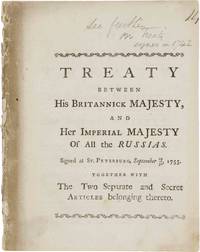
1755ref. 24182London. 1755. Detailed military alliance treaty between Great Britain and Russia setting forth the need for a capable defense force in case of attacks on dominions of both nations. One of the secret articles at the end stipulated that Great Britain shall pay Russia 100000 pounds a year to maintain a strong military force on the borders of Livonia. Quarto. Dbd. Titlepage and final leaf a bit tanned. Else quite good. unknown books
1871ref. 5818New York 1871. Good. 32pp. Original printed wrappers. Minor dust-soiling and spotting to wrappers. Some marginal insect damage to lower right corner not costing any text. Faint dampstain to upper margin of most leaves. A scarce work in which an "Evangelical Alliance" of American and British religious leaders petition Tsar Alexander II to grant religious freedom to Catholics and Protestants in 1871. The report begins with some background on the "Evangelical Alliance and Religious Liberty" religious persecution in the Baltic States some information on the penal laws in Russia and then the alliance's work in arguing for religious freedom beginning with their "Prepatory Labors" and "Meetings in London and Stuttgart" and ending with the "Final Promise of the Prime Minister" and "The Result." The latter included "partial relief" from religious persecution with hopes for "further improvements." The report is signed at the end by its President Samuel F.B. Morse. The report is followed by an Appendix printing "Prince Gortschakoff's Report to the Emperor of Russia" and three other memorials and interviews pertaining to the alliance's activities in Europe. An early example of religious diplomacy from American and British leaders. Ten copies in OCLC. unknown books
1841ref. 306977Dresden und Leipzig: Arnold 1841. First edition. Lithographic title in each volume folding plan of St. Petersburg. xii 324; viii 392 pp. 2 vols. 8vo. Original green printed wrappers ads on back wrappers; uncut and unpressed. Wrappers toned losses to spine with old repairs some marginal chipping. Internally clean. About very good. First edition. Lithographic title in each volume folding plan of St. Petersburg. xii 324; viii 392 pp. 2 vols. 8vo. The standard guide to mid-century St. Petersburg with chapters on the palaces markets street life ice-sleds the Hermitage and the notable collections of the city including a descriptive tour of libraries and archives. Arnold unknown books
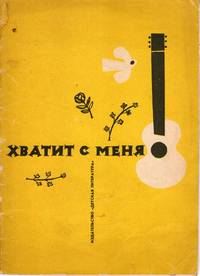
1966ref. 13401Moscow: Detskaia Literatura Children's Literature Publishing House 1966. Original illustrated wrappers stapled. Illustrated by Mark Kliachko. Front wrapper detached moderate soiling rubbing and toning. Contents a bit creased but mostly clean. Good condition. A rare Soviet anthology of African American folk poetry comprising work songs songs from the era of slavery blues texts humorous verse counting rhymes and children's folklore selected from material previously edited by Langston Hughes and Arna Bontemps in the major 1958 anthology The Book of Negro Folklore. The editors drew extensively on traditional African American stories blues rhythms and folk songs. For a Soviet child of the mid-1960s the book offered a remarkably direct encounter with the voices of Black America. There is little of the explanatory narrative framework through which the United States was so often presented to Soviet readers: here for the most part the songs speak for themselves. They evoke slave labour cotton plantations and Mississippi docks poverty exhausting work and racial inequality; yet alongside these appear humour play mockery children's rhymes and the distinctive rhythms of African American oral tradition. The work songs are particularly striking. In "Song on the River" the speaker compares the position of workers in different cities and comments with bitter irony on racial disparities in wages; in "Bales of Cotton" the monotonous movement of heavy cotton bales becomes the rhythmic principle of the poem itself. For a Soviet publisher such material naturally carried an obvious social and ideological significance. Yet the book is not reducible to a political illustration of American racism: it genuinely communicated to Russian readers something of the forms rhythms and humour of African American folk culture. The translation is by Nina Voronel a prominent Soviet translator from English. A graduate of the physics faculty of Kharkov University she entered the Literary Institute after meeting Korney Chukovsky and went on to specialise in literary translation. She became particularly known for her Russian translation of Oscar Wilde's The Ballad of Reading Gaol. Voronel later became a playwright and an active participant in the Soviet Jewish emigration movement; she left the USSR in 1974. Mark Kliachko's minimalist illustrations are constructed almost entirely from black line and solid areas of ink. Laborers carrying heavy cotton bales solitary figures animals and grotesque characters do not merely illustrate individual lines but echo the rhythm of the songs themselves. Even the cover -- a guitar a bird and a flower against a yellow ground -- gives the volume something of the character of a small graphic album rather than an ordinary Soviet collection of verse. OCLC locates only two copies outside Russia in Armenia and the United States the latter at the Bancroft Library. Detskaia Literatura [Children's Literature Publishing House] unknown books
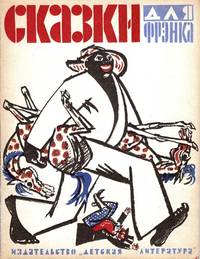
1971ref. 13402Leningrad: Children's Literature Publishing House 1971. 32pp. Quarto. Profusely illustrated by Boris Vlasov. Original pictorial wrappers printed in black brown red and blue stapled. Minor scuffing to spine minor edge wear and toning. A rare and unusual Soviet children's book devoted to African American culture. The traditional tales are set within a contemporary frame narrative as a Black family travels across the United States to Washington. A white motorist refuses to give them a lift and insults them because of their race; gradually the protagonists find themselves surrounded by marches a large encampment and groups of people making their way towards the capital. The old tales of slavery cunning strength and liberation are thus brought into direct connection with the contemporary African American struggle for civil rights. The frame story appears to allude to the 1968 Poor People's Campaign and in particular to the celebrated Resurrection City encampment in Washington. Following the assassination of Martin Luther King Jr. thousands of participants travelled to the capital from across the United States in caravans and buses and spent several weeks living in a temporary settlement erected on the National Mall demanding economic and social equality. The combination found in the book -- the journey to Washington the large camp and new groups of people continually arriving from different parts of the country -- is particularly suggestive of these events. The tales themselves however have genuine roots in African American oral tradition. One episode is recognizably related to the celebrated story of Big Sixteen a slave of supernatural strength who is capable of overcoming even the Devil. The tale was recorded by Zora Neale Hurston during her folkloric fieldwork in the American South and included in her book Mules and Men. For a Soviet publisher such material naturally carried an obvious ideological charge: racial discrimination provided a ready means of exposing the contradictions of American society. Through this ideological framework Soviet children were nevertheless introduced to African American folk culture the history of slavery and the contemporary Civil Rights Movement. The book is given particular distinction by the illustrations of Boris Vlasov 1936-1981 an important representative of the Leningrad school of graphic art of the 1960s and 1970s. Vlasov's expressive manner is especially effective here. Red blue black and white form an almost poster-like visual language. OCLC locates only one copy outside Russia held in Armenia. As such no copies in American libraries. Children's Literature Publishing House unknown books
1907ref. 653411907. The First Edition of the Nakaz Published in the Twentieth Century Catherine II 1762-1796 Empress of Russia. Chechulin Nikolai Dmitrevich 1863-1927 Editor. Nakaz Imperatritsy Ekateriny II Dannyi Kommissii o Sochinenii Proekta Novago Ulozheniia. St. Petersburg: Izd. Iurid. Knizhnago Sklada "Pravo" 1907. ii cliv 174 pp. Three folding plates of facsimile manuscript leaves. Text of Nakaz in Russian with parallel French translation. Contemporary pebbled cloth light rubbing to extremities with minor wear to spine ends and corners which are bumped. Light toning to text a few leaves have carefully repaired tears. Early inscription and owner inkstamp to title page interior otherwise clean. $1250. The first edition published in the twentieth century. Title two in the series Pamiatniki Russkago Zakonodatel'stva 1649-1832. The Nakaz or Instruction is a statement of legal principles written by Catherine II between 1764 and 1766. It was among her most ambitious and significant undertakings. Infused with the ideas of the French Enlightenment and copied mostly from the work of Voltaire Montesquieu and Beccaria it was compiled as a guide for the All- Russia Legislative Commission convened by the Empress in 1767 to create a new code to replace the 1649 Muscovite Code. Revised in consultation with Frederick the Great and Voltaire the Instruction proclaimed the equality of all men before the law and denounced torture and the death penalty. Unfortunately her proposed code was never completed. The first two editions one with parallel texts in Russian and German were published in 1767. Our 1907 edition may have been inspired by a spirit of reform fired by the Russian Revolution of 1905. OCLC locates 1 copy in a North American law library Columbia. Another copy located at Harvard Law School. Butler The Nakaz of Catherine the Great 526 Entry 19. unknown books
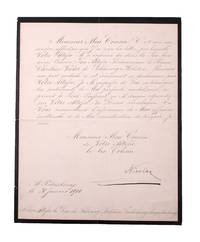
1901ref. 346384St. Petersburg 1901. One-page secretarial letter in French on mourning stationery with a secretarial copy marked in ink Copie . signé Nicolas. 1 vols. 10 x 8 inches. Old folds generally fine. With transcription and translation. One-page secretarial letter in French on mourning stationery with a secretarial copy marked in ink Copie . signé Nicolas. 1 vols. 10 x 8 inches. A formal note of condolence from Nicholas II Emperor of all the Russias styled "le bon Cousin" in the closing addressed to Ernst Gunther II 1863-1921 third Duke of Schleswig-Holstein "Monsieur Mon Cousin!" after learning of the death of Prince Christian Victor of Schleswig-Holstein a grandson of Queen Victoria and British officer who died of malaria in Pretoria on 29 October 1900. A somber and attractive autograph documenting the close connections between the royal and imperial household of prewar Europe. Provenance: Dr. Herbert Ernest Klingelhofer 1915-2015 collector and former President of the Manuscript Society bought from Karl Faber 1957 unknown books
1917ref. 318401Philadelphia: J.B. Lippincott. London : Chapman & Hall 1917. First edition. With numerous Illustrations. xi 1 232 pp. 8vo. Bound in light tan mottled modern three quarters polished calf brown leather title label and marbled boards. Fine. First edition. With numerous Illustrations. xi 1 232 pp. 8vo. J.B. Lippincott. London : Chapman & Hall unknown books
1930ref. 317605London: Herbert Jenkins 1930. First Printing. Illus. 320pp. 8vo. Bound in modern three quarters mottled brown calf marbled sides leather title label. Fine. First Printing. Illus. 320pp. 8vo. Herbert Jenkins unknown books
1880ref. 53786Moscow 1880. 10 hand-colored albumenprints some captioned in type in French and Russian. Oblong 4to. Contemporary quarter maroon morocco and boards cover titled in gilt "Photographs." Front joint cracked photographs in fine condition. 10 hand-colored albumenprints some captioned in type in French and Russian. Oblong 4to. Beautifully and finely hand-colored photographs of Moscow and St. Petersburg. Provenance: Baldur Bookshop Richmond Surrey receipt laid-in unknown books
1721ref. 262775London 1721. 43 1 pp. Removed slight foxing. 43 1 pp. ESTC N12949 unknown books
ref. 57309Second half of the 18th C. 12-1/2 x 17 inches. Bordered in green paper. Light rubbing and creasing some browning around the edges else Very Good. 12-1/2 x 17 inches. unknown books