54 résultats
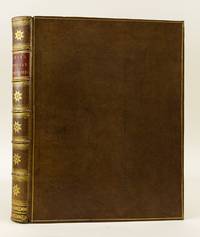
1669réf. 3916London: printed for John Starkey 1669. FIRST ENGLISH EDITION A French-language version appeared at Amsterdam in the same year. Hardcover. Fine. Bound in contemporary polished calf rebacked preserving original spine corners bumped light wear. Complete with the two engraved portraits of Charles Howard First Earl of Carlisle 1628-1685 and Tzar Aleksey Mikhaylovich 1629-1676 just shaved at fore-edge. Title a little dusty clean tear to margin of Z1 not entering the text. Fine. First edition of this eyewitness account of the official English embassy to Russia written by Guy Miege under-secretary to the English ambassador Charles Howard Earl of Carlisle. The book provides a fascinating window on the intricacies of Russian diplomatic protocols ceremonial customs and the hospitality bestowed upon high-ranking foreign dignitaries at the Russian court. "Carlisle's main responsibilities were to reciprocate the honor that Tzar Aleksey Mikhaylovich had shown to King Charles II in sending his diplomats to London as well as to build the promising momentum in their relationship by negotiating the trade privileges that the English hoped to restore. It can safely be concluded that Carlisle's diplomatic mission resulted in a great failure. Ceremonial disputes and diverging economic interests precipitated a decline in Anglo-Russian relations and left the two monarchies in a state of mutual resentment."Hennings Guy Miege obtained appointment as under-secretary to Charles Howard Earl of Carlisle in his embassy to Muscovy Sweden and Denmark and in July 1663 joined an entourage that included Andrew Marvell as chief secretary. With Carlisle's express permission Miege wrote an account of the journey subsequently published as 'A Relation of Three Embassies' 1669 which is both an attempted vindication of the ambassador's conduct in the face of Russian criticism and a lively source of impressions of Russian society and culture. He considered Muscovy a beautiful country but found its inhabitants in contrast to the Swedes coarse austere and ignorant of learning. Exhibiting a characteristic commitment to Protestantism and to constitutional monarchy he was not impressed by a religion 'that obliges its Professors to severe mortification' or by icons 'very ill-drawn and in flat painting' and dismissed a monarchy that was 'despotical and absolute' But like most 17th c. Englishmen Miege respected Russian military prowess." ODNB For a detailed account and analysis of the embassy and its repercussions see Hennings "Russia and Courtly Europe" p. 139-159. For another discussion see Dukes Herd and Kotilaine "Stuarts and Romanovs" p. 105-113. printed for John Starkey hardcover books
1919réf. 223031919. Photographs measuring 6 x 4 inches and smaller. 1 vols. Oblong 8vo 8 3/4 x 6 1/2 inches. Contemporary gray cloth ms. title to upper board upper joint wearing but holding nicely. Photographs measuring 6 x 4 inches and smaller. 1 vols. Oblong 8vo 8 3/4 x 6 1/2 inches. A rare survival from a distinguished World War One veteran. Born in India Nightingale was educated at Rugby and Sandhurst and joined the Royal Fusiliers in 1910. He survived the landing on V beach Cape Helles Gallipoli April 25th 1915 and the following year he was awarded both the Military Cross and the Legion D'Honneur for his services. Nightingale subsequently served with the 46th Battalion Royal Fusiliers in the North Russian Relief Force part of the invasion of Russia by the English Irish and the Americans. The operation was conducted under the command of General H. de V. Sadleir-Jackson. Arriving in Archangel on 5 June 1919 the 46th proceeded along the Dvina River to Osinova where preparations were made for an attack on rail and river transport. The objective was to repel the Red Army from their established positions and generally improve the position of the White Russian forces. The hope was that the NRRF would be able to subsequently withdraw without significant casualties. In addition smaller raids on Red Army positions were carried out to the south partly to destabilize them partly as reconnaissance. Nightingale was in command of the Borok Column on the right bank of the Dvina River for the August 10 offensive. The first photos are of the H.M.T. "War Summit" & H.M.T. "Pretorian" chugging through the Arctic Ocean and White Sea in Midsummer June 1919 on its way to Archangel. They were billeted at Troitsa and among the many images of the town and its surroundings is one of where the mutiny of Dyer's Battalion took place. Equally there are shots of Russian batteries Allied defenses company headquarters and regimental aid posts as well as images of the Dvina River Yaroslovskoe and Selso. A page is devoted to "Col. Davies Headquarters at Commencement of Action Aug 10th" and shows how the British troops organized themselves in the Selmenga Forest namely with three shots of "Piccadilly Circus Selmenga Forest with Shaftesbury Avenue and Regent Street." The attack commenced at noon and despite the difficulty of the terrain was successful. We know that Borok Nightingale's objective was reported captured along with 80 POWs by eleven o'clock that evening. Nightingale was evacuated in late September. This is not only a record of the battle but includes many poignant personal touches too. Namely there are several shots of men with whom he served and the Russians with whom he stayed. The captions not only name the men in each photograph but in many cases reveal their fate: "Lt Taylor killed Aug 10th Lt Grant wounded Aug 1st Capt. Driver killed Aug 10th." The album also includes a typed order - dated September 9 1919 - which is a reminder that despite the success of the August attack the Russian Civil War was ongoing and would ultimately be won by the Bolsheviks. "You will send one platoon to SELMENGA to hold the SELMENGA BRIDGE and the beach road to GORODOK. The enemy are known to be in force in the vicinity of BOROK and GORODOK and may attempt an outflanking movement . The platoon remain in position there and will withdraw when Captain de Miremont with the GORODOK Infantry comes through there tonight . The Platoon should form a right flank guard to Captain de Miremont from SALMENGA to PLESS." The photographs of Russia occupy the first half of the album the rest is devoted to Nightingale's time in Ireland with the 7th Cadet Battalion. Despite his distinguished service in the military Nightingale's fate was a melancholy one. He died in 1935 reportedly either by suicide using his own revolver of from alcoholism. unknown books
1960réf. 475Marc Chagall B. 1887 VITEBSK RUSSIA; D. 1985 SAINT-PAUL-DE-VENCE FRANCE DRAWINGS FOR THE BIBLE as published for Verve. Verve Vol. X no. 37/38. 1960. Text by Gaston Bachelard. Folio. With 24 original lithographs in color including the cover by Chagall and 96 reproductions in black and white. Complete as issued. Verve hardcover books
1803réf. ST15927London: Cadell and Davies 1803. ONE OF 60 LARGE PAPER COPIES of the "considerably enlarged" Fourth Edition ours a variant retaining the date of 1803 on the title-page rather than 1804. 330 x 252 mm. 13 x 9 7/8". xviii 4 xix 1 380 pp. Two leaves usually bound at the end and containing the "List of Principle Books Referred to in this Work" and "Works by the same Author" bound between pp. xvii and xix here. VERY FINE CONTEMPORARY SPRINKLED CALF raised bands flanked by plain and decorative gilt rules and chain roll spine panels with star centerpiece red morocco label marbled endpapers. With six engravings: five maps two folding and one view. A Large Paper Copy. Front pastedown with engraved armorial bookplate of Marcus Gage; title page with ink inscription at head: "M. Gage's Book got from Mr. Asperne London April 15th 1805." Lada-Mocarski 29 note; Howes C-834; Sabin 17309; Streeter VI 3501; Cordier Bibliotheca Sinica pp. 2447-48. ◆Small chip to tail of spine corners a bit rubbed flyleaves somewhat foxed the usual minor foxing to plates and a bit of offsetting to adjacent pages otherwise A VERY FINE COPY OF AN ESPECIALLY DESIRABLE EDITION clean and fresh internally with vast margins and the binding firm lustrous and with only very minor wear to the joints. This is an extremely well-preserved copy in an elegant contemporary binding of the most sought-after edition of a key source on Russian exploration and that country's efforts to expand trade with China and Alaska. Eminent historian William Coxe 1747-1828 studied the voyages and exploration by Bering and others to the regions of Kamchatka the Aleutian Islands and Siberia to prepare this overview of the geography and cultures of the lands between Russia and North America and to analyze the economic potential of trade--particularly in furs--with the region. According to Sabin "Mr. Coxe's book contains many curious and important facts with respect to the various attempts of the Russians to open a communication to the New World." The 1780 first edition of this work covered Russian voyages of discovery between 1740 and 1769; the 1787 third edition added a supplement comparing these explorations to those of Captains Cook and Clerke. Our much-expanded fourth edition gives in the words of the Preface "a complete series of voyages from 1711 to 1792 comprising all that is known on the subject." Some of this supplementary information was gleaned from earlier accounts by German historians G. F. Muller and P. S. Pallas and some from Coxe's own travels in Russia. According to Lada-Mocarski Coxe "also succeeded in securing additional material: for instance the narrative and maps of Krenitzin and Levashev's 'secret' expedition the first official Russian government expedition since Bering's 2nd expedition of 1741. He was able to secure this particular information not widely known at the time even in Russia from Dr. Wm. Robertson who in turn obtained it through his friend Dr. Rogerson first physician to the Empress Catherine II. . . . In view of the above additions one should consider the fourth edition of 1803 as the most desirable." He concludes: "Coxe's work particularly the fourth edition is a result of contemporary and authoritative sources translated into English not to be overlooked by scholars and collectors alike." There are also distinct aesthetic advantages to the present Large Paper version over the octavo printing. Not only is the type beautifully re-set and laid out as well as surrounded by vast margins but as Streeter notes there are two charts here that are not included in the octavo issue of 1803. The original owner of this volume Marcus Gage is known to have assembled a substantial library of beautifully cared-for books on travel and discovery see for example "Exploration & Discovery 1576-1939 Books from the Library of Franklin Brooke-Hitching" passim. Gage notes that he got the book from "Mr. Asperne"—no doubt the London publisher and bookseller James Asperne 1757-1820. ABPC and RBH find just four other Large Paper copies at auction in the past 45 years two of which had condition issues. One could wait a considerable time to find a copy as attractive and desirable as the present one. Cadell and Davies unknown books