Alexander Grand Duke of RussiaBiblio.com

20.295 Ergebnisse
Best.-Nr. B9781258834425Hardback. New. hardcover
Best.-Nr. B9781345728569Hardback. New. hardcover
Best.-Nr. 45149756like new. unknown
Best.-Nr. 46532493like new. unknown
Best.-Nr. 1390484807.Gpaperback. Good. Access codes and supplements are not guaranteed with used items. May be an ex-library book. paperback
1921Best.-Nr. 54894NY: Boni & Liveright. Very Good with no dust jacket. Boards lightly worn and soiled owner name on verso of front free endpaper pages toned.; Inscribed by the author in French to Madame Louise Knoedler on the half-title. Maroon cloth titled in gilt. Memoir by the British sculptor 1885-1970 outlining her 1920 trip to the Soviet Union and the busts she sculpted of Lenin Trotsky and other Russian historical figures.; 8vo 8" - 9" tall; 239 pages . Hardcover. 1921. Boni & Liveright hardcover
Best.-Nr. A9781345728569Hardback. New. hardcover
Best.-Nr. B9781494086312Paperback / softback. New. paperback
Best.-Nr. 1379477174.Ghardcover. Good. Access codes and supplements are not guaranteed with used items. May be an ex-library book. hardcover
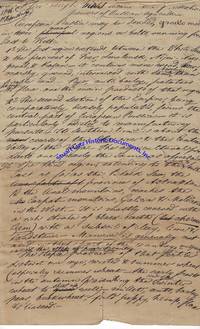
Best.-Nr. 4678JOSEPH SLOCUM 1800-1853. Slocum was a merchant from Syracuse New York who attempted to sell farm equipment to Russia in the nineteenth century. He was unable to turn a profit from his endeavors and his family fell into financial hardship. His daughter Margaret Olivia Scolum Sage became an influential philanthropist and teacher. She endowed a building and a now-defunct agricultural school at Syracuse University both named after him.Archive. 9 pieces. 1830s-40s. An archive related to Joseph Slocum and his business with Russian agriculture. There are nine letters and documents predominately letters written to Slocum from various Americans and Russians. Highlights are listed below and the best piece is the first one the lengthy manuscript detailing Russian agriculture and natural resources:Handwritten document. 4pgs. September 12 1846. St. Petersburg Russia. The four page handwritten manuscript is entitled Some Rough Hints About the Productive Power of Russian Agriculture. It states in part: European Russia it may be divided grosso muto in three great regions or belts running from East to West. 1st - The first region extends between the White Sea and the provinces of Tver Smolensk Nijni-Novogorod & Kazan - it contains more wood low marshy ground intermixed the sand Baron then arable land. Rye oats barley potatoes hemp and flax are the main products of that region. 2nd - the second section of the Empire being comparatively densely populated forms a central part of the European Russia it is particularly addicted to manufacturing pursuits. It's Southern limits is about the course of the Oka River & the Central Valley of the Volga. The agricultural products are nearly the same as aforesaid. 3rd - the third region extending to the south and southeast as far as the Black Sea the provinces of Ashnaklan and the Ural Mountains reaches the Carpathian mountains Galicia & Moldavia in the West. It is mostly covered with a rich strata of black earth with a subsoil of clay lime & sandstone. Minoru is generally not used in this part of the country vulgarly called the step or prairie count the staple products of the fertile district are rye winter and summer wheat especially summer wheat - the summer frosts in the autumn preventing the seeds of the winter week to start up well millet oats barley peas buckwheat field poppy hemp flax & linseed. Cotton & Vine are raised merely in the most remote districts of the South such as Georgia Astrakhan the territory of the Cossacks of the Don Crimea & Bessarabia. Three other very important staples of Steph region are livestock & saltworks & fisheries. The stock consists mainly of horned cattle and horses grazing in large herds on the pastorate of the steps of the Black Sea As well as on both sides a lower Volga. Sheep both Merinos Saxon & form and main object of the agricultural industry of the step and owners. The Russian or common sheep is generally the property of the peasantry. The wool and tallow are usually sent overland in the winter to the manufacturing districts of the central belt of Russia Moscow. Or exported via Odessa Taganrog Riga & Petersburg to England and France. The saltworks are especially remarkable on the left sure the Volga on the verge of the province of Astrakhan as well as near the Ural River not far from the city of Orenburg. The Lake Elton alone of a circumference of nearly 180 miles is a solid mass of salt inexhaustible in its mineral riches. The stone saltworks of Gletznaia.As well as the saltworks a Crimea produce an immense quantity of that precious mineral. Besides that all the basin of the Caspian is full of an infinity of small salt lakes. The main fisheries are at the mouth of the Volga on the Caspian they produce an enormous quantity of fish of all kind. Besides that of the fisheries of the Ural River on the Don. The main fluvial artery of Russia is the Volga it is a Mississippi of our country. Its length is upwards 3000 miles. Unfortunately it is frozen up during nearly 6 months of the year. There are but very few steamboats in it. This year a large steam tow boat has been put into action on the Volga attended with great success. The manuscript continues extolling Russias natural resources. It is uncertain who wrote it and the condition is good with folds and fold separations. A partial typewritten transcript is included.LS. 1pg. August 1843. Russia. A letter signed L. Perovsky by Russian nobleman Lev Perovski 1792-1856 as Russian Minister of the Interior. Perovski thanked Slocum: The Directo fo the AgronomicalSchool having informed me that you presented to the museum of this Institution several agronomical instrument I feel myself much gratified to acknowledge. Agronomy is crop and soil science. The letter is in very good condition with folds and short fold separations.ALS. 4pg. 5 x 8 . November 7 1846. St. Peterburg Russia. An autograph letter signed by an American working for the United States Legation at St. Petersburg. He wrote in part to Slocum: The only reproach I ever heard from the Minister as I told you at that time and which certainly stands on a misunderstanding concerns the establishment of a cast iron fabrication. The Minister is in full belief you had spoken to him about ain the Union that as soon as a new colony any where is establishedThis seemed to His Excellency excellent means to introduce in Russia and toin this way thepossibility to the peasants to have their implements cheap & well one. The letter is in fine condition.ANS. 1pg. 1834. New York. A brief note acknowledging money received from Slocum signed Ja J Roosevelt by Jacobus James Roosevelt III 1760-1847 the New York state businessman and politician who was great-grandfather of FDR. In fine condition.ALS. 1pg. June 6 1834. New York. An autograph letter signed Jab J Roosevelt by Jacobus Roosevelt. Roosevelt wrote to Slocum requesting the return of an item. In very good condition.ALS. 3pgs. October 22 1846. St. Petersburg Russia. A lengthy letter to Slocum signed Chas Cramer to Slocum. Charles Cramer 1799-1879 was an important trader to Russian and his letter concerns finance: he gave you an order for the purchase of Implements for Agricultural purposes & that he assigned you a credit againstof the Government. He fully confirmed the contents of the letter you communicated to me & promised to reply to your letterMr. Clay stated when I asked him on your behalf that he could do nothing in the case to further your interest. Major Whistler whom I called on several time but missed has not yet returned my calls. I rather think he will not be able to serve you better than I can with the Government of this EmpireWe merchants often meet with heavy losses Do consider your Adventure to Russia misfortune & think no more about it for you will not gain anything. The penciled letter is in very good condition with a tear in the address leaf.Letter. 1pg. 5 x 8 . 1846. St. Petersburg. A contemporary copy of an 1846 letter by Rhesa Griffin a Syracuse area merchant: Received St. Petersburg 31 July 1846 of the Russian Imperial Departmentfive hundred thirty six silver rubles and sixteen seven coppers in full satisfaction of all and every claim or Demand on the above Department or if any other Department of the Russian Government and in full satisfaction of all and every agreement or understanding made by me with Joseph Slocum as an agent of the Russian Government. The document is wrinkled and in very good condition. unknown
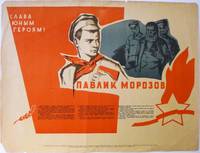
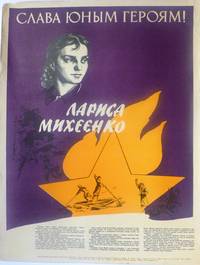
1963Best.-Nr. a11aaMoscow 1963. Poster. Good. No Binding. 1963 approx 18x23.5 inches. Printed in an edition of 20000. Closed edge tears and wrinkles repaired. Presents well. unknown
1963Best.-Nr. a11yMoscow 1963. Poster. Good. No Binding. 1963 approx 18x23.5 inches. Printed in an edition of 20000. Closed edge tears and wrinkles repaired. Nice!. unknown
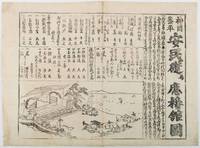
1854Best.-Nr. 177799Japan. Circa1854. Black and white woodblock kawaraban printed on two joined sheets vertical central crease 41 x 63cm a little worming mainly on margins and repaired with paper on the reverse a little light browning but still presents very well. This kawaraban reports on how foreign visitors from the United States and Russia were treated in order to keep the peace and safety of God's country Japan. It reports that foreigners had arrived in Uraga this being the time of the second visit of Perry to Japan in 1854. The kawaraban goes on to list official gifts from the Shogunate to the President and his delegation members from the United States as well as to the Russian delegation. The gifts include lacquer boxes silk textiles as well as rice and chickens for the crew. The attractive black and white image at the foot of the report depicts a meeting in Yokohama at which a high ranking Tokugawa official received foreign visitors. The visitors are shown prostrating themselves in the open outdoor space in front of the building where the official sits. . unknown
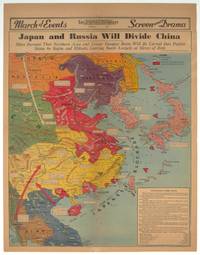
1940Best.-Nr. 209821Los Angeles.: Los Angeles Examiner. 1940. Printed colour pictorial map on a single newspaper leaf 42.3 x 39.9 cms; 54.3 x 42.5 cms sheet archivally laid down on linen slight discolouration to lower centrefold and sheet slightly age-toned but in very good condition. A striking geopolitical map by Los Angeles Examiner artist Howard Burke covering China Japan Southern Russia and the northern part of French Indochina and Siam showing how the "Aggressors Divide China." Areas under Japanese occupation are shown in red and their naval blockade shown by an arc of naval vessels with vivid arrows indicating lines of supply. Text labels including sources of agricultural and raw materials provide a dynamic overview of the geopolitical situation and show the influence of American scientific illustrator and cartographer Richard Edes Harrison who argued for examining geographic issues from multiple perspectives and Los Angeles Times artist Charles Owens. . Los Angeles Examiner. unknown
Best.-Nr. 0953949729.Gpaperback. Good. Access codes and supplements are not guaranteed with used items. May be an ex-library book. paperback
Best.-Nr. 088355447X.Ghardcover. Good. Access codes and supplements are not guaranteed with used items. May be an ex-library book. hardcover
Best.-Nr. 1935263315.Ghardcover. Good. Access codes and supplements are not guaranteed with used items. May be an ex-library book. hardcover
1959Best.-Nr. 54687Prague: Artia. Very Good in Good dust jacket. 1959. Hardcover. Boards lightly worn gift inscription on half-title pages toned jacket. toned and worn.; White cloth titled in gilt. 112 luscious photogravures of. midcentury Moscow scenes. Some fold-out pages. Text in German.; 8vo 8" - 9". tall. Artia hardcover
2016Best.-Nr. 54646Irkutsk Russia: A. M. Artyukhov. Very Good in No Dust Jacket dust jacket. 2016. Hardcover. Boards lightly worn.; Brown leatherette binding. Text in Russian. Appears. to be a book of historic postcards of Irkutsk Russia. Many illustrations.;. 8vo 8" - 9" tall; 687 pages. 5913451783 . A. M. Artyukhov hardcover
Best.-Nr. 13295RUSSIA COMPTE-RENDU DE LA COMMISSION IMPERIALE ARCHEOLOGIQUE. Pour L'Annee 1863 1864 and 1874. Folio volumes in contemporary half-morocco bindings ex-library with some cover wear. unknown
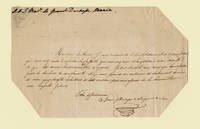
1830Best.-Nr. 101272Weimar Germany circa 1830's to 1840's. 1830's to 1840's. Very good. - Over 75 words penned in French on 5-1/4 inch high by 8-1/4 inch wide J. Whatman watermarked wove paper. The Grand Duchess of Russia & Saxony Maria Pavlovna thanks the German diplomat Heinrich von Struve for conveying a "cassette" likely a jewelry box or other decorative box from England. "Monsieur de Struve. Je vous remercie de la Complaisance et de la promptesse que vous avez mise a expedier la Cassette que vous avez recue d'Angleterre a mon Adresse et qui est arrivee heureusement a Weymar. Je suis sensible aux voeux que vous faites pour le bonheur de ma famille." roughly translated: Monsieur de Struve. I thank you for the courtesy and promptness that you showed in forwarding the little box you received from England addressed to me and which has happily arrived in Weimar. I am appreciative of the wishes you make for the happiness of my family. Signed with affection "Marie la Duchesse de Russie et de Saxes". Folded for mailing vertically & horizontally three of the blank corners have been clipped. There is a minor repair with a narrow strip of matching paper along the right edge though there remains a tiny tear to the right edge of the horizontal fold. There are remnants of paper possibly from a seal along the verso of the top left corner. Very good. Not to be confused with the later Grand Duchess of the same name Grand Duchess Maria Pavlovna of Russia & Saxony 1786-1859 was the daughter of Emperor Paul I of Russia. She married Charles Frederick Grand Duke of Saxe-Weiman-Eisenach in 1804. Through her love for culture she turned her Weimar court into a mini-St. Petersburg transforming the small duchy into a major center for the arts music and science. Maria Pavlovna supported artists and writers such as Goethe and her palace was always full of life. A talented pianist she studied under Giuseppe Sarti. Pavlovna often corresponded with Vasily Zhukovsky. Friedrich Schiller praising her talent dedicated one of his last poems to her. In her later years she appointed Franz Liszt as "Kapellmeister extraordinaire" to her court and the premiere of Wagner's Lohengrin took place in Weimar. She was the ancestor of several major European royal families her daughter marrying Kaiser Wilhelm I and their son marrying Queen Victoria's eldest daughter. Through these close ties the courts of Weimar & England often exchanged gifts such as the "cassette" mentioned in this letter. The German diplomat nobleman and mineralogist Heinrich von Struve 1772-1851 served as the Russian Minister Resident to Hamburg's Hanseatic cities handling diplomatic affairs for the Tsar. He often handled logistics communication and transport between Great Britain the northern German ports and the central states such as Weimar. Struve was one of the young Beethoven's closest friends. The English papermaker James Whatman was celebrated for inventing "wove paper" which because of its strength was highly favored by world leaders and artists such as Napoleon Queen Victoria and George Washington. [Weimar, Germany], circa [1830's to 1840's].
Best.-Nr. 148154NY: The Modern Library. Very Good in Good dust jacket. 1935. Hardback. 371 pages . 0451624173 . The Modern Library hardcover
2001Best.-Nr. 48034London: Frank Cass. Good. 2001. Hardbound. Collectible - SCARCE SIGNED BY AUTHOR; 466 pages . 0714650501 . Frank Cass hardcover
1991Best.-Nr. 56981Norwalk Connecticut: The Easton Press. 1991. Leather. V-Fine Roger Tory Peterson Field Guides of the World; 353 pages . The Easton Press hardcover
Best.-Nr. 185995278X.Ghardcover. Good. Access codes and supplements are not guaranteed with used items. May be an ex-library book. hardcover