20 399 résultats
1990Au sommaire, dossier: "Le Brésil au pluriel": "Pluralité des développements brésiliens" par Ignacy SACHS, "La conquête de l'espace brésilien" par Hervé THERY, "Autoportraits du Brésil" par Mario CARELLI; suivi de: "La rupture franco-britannique de 1940. Le conseil suprême interallié, de l'invasion à la défaite de la France" par François BEDARIDA, "Nationalisme et réactions fondamentalistes en France. Mythologies identitaires et ressentiment antimoderne" par Pierre-André TAGUIEFF, "L'affaire Rajk, quarante ans plus tard" par François FEJTÖ, "Le système Ceausescu. Utopie totalitaire et nationalisme insulaire" par Catherine DURANDIN; Enjeux: "Martin Malia dans l'historiographie soviétique" par Michel WINOCK. Français
1994Au sommaire dossier "Histoire au présent de la "political correctness"": "Des coups de canon dans le vide ? La "civilisation occidentale" dans les universités américaines" par Denis LACORNE, "Le regard en biais. Attitudes françaises et multiculturalisme américain (1990-1993)" par Marie-Christine GRANJON, "Political correctness en version originale et en version française. Un malentendu révélateur" par Éric FASSIN; "Aux sources du national-socialisme: les romans de Rudolf Herzog et la culture politique allemande" par Pascal JARDIN, "De Gaulle, l'Amérique et l'Alliance atlantique. Une relecture de la crise de 1966" par Frédéric BOZO, "Kedrovyi Sor: la vie quotidienne dans un camp du Goulag à l'époque stalinienne" par Oleg AZAROV; "L'ensemble concentrationnaire de Norilsk en 1951" par Nicolas WERTH; "Charles Seignobos revisité" par Antoine PROST. Français
1989Au sommaire: "La transparence et la mémoire - Les Soviétiques à la recherche de leur passé" par Nicolas WERTH, "Les trajectoires territoriales du sionisme" par Alain DIECKHOFF, "1942: le Comité International de la Croix-Rouge, les déportations et les camps" par Jean-Claude FAVEZ, "André Tardieu et la crise du constitutionnalisme libéral (1933-1934)" par Nicolas ROUSSELIER; Dossier "Penser le fascisme": "Giovanni Gentile, philosophe du fascisme" par Sergio ROMANO, "Luigi Sturzo et la critique de l'Etat totalitaire" par Jean-Luc POUTHIER, "Renzo De Felice et l'histoire du fascisme" par Didier MUSIEDLAK; et divers. Français
1970Au sommaire: "Pour arrêter un génocide - L'extermination des Indiens d'Amérique latine" par Michel PIERDEL; "Médecin au Biafra" par Paul SARGOS; "Sur la société capitaliste de ce temps" par Henri BARTOLI; article de Jacques JULLIARD sur les syndicats et les partis; poème de Jean-François ROLLIN; plusieurs articles sur les "Révisions du communisme": "L'U.R.S.S. et la société scientifique" par Jean-Jacques LENTZ, articles de Pierre GREMION sur "La Civilisation au carrefour" publié sous la direction du tchèque Radovan Richta, de Jean-Marie DOMENACH sur le "tournant de Garaudy" et de Henri DESROCHE sur la "foi de [Milovan] Djilas"; suivis de divers, dont critiques d'ouvrages (articles de Jean-Marie DOMENACH sur "La Justice pour tous" de Casamayor, de Jean BASTAIRE sur "la modernité d'Alain-Fournier"). Avec sa bande-annonce: "Questions du communisme: Richta - Garaudy - Djilas - Le capitalisme aujourd'hui". Français
1972Au sommaire, table-ronde sur "Le mariage en crise"; "La Fin du commencement", souvenirs de la Résistance en 1941 par Charles d'ARAGON; poème de Mohammed KHAIR-EDDINE; articles sur la censure par Jose CARDOSO PIRES et sur le rôle économique et social de la consommation par Lucien KARPIK; suivi de divers dont "chroniques" sur l'île Maurice (anonyme), sur les "Tropismes céliniens" par Philippe ALMEIRAS, d'un "document" de G.M. SHIMANOFF, "Souvenirs de la Maison Rouge", sur la psychiatrie soviétique à la solde du K.G.B., et de critiques d'ouvrages; avec la bande annonce éditeur (avec petite déchirure au pli): "Le mariage en crise - Les psychiatres du K.G.B. contre les croyants". Français
1975N°3, de mars 1975, de la revue fondée par Emmanuel Mounier et dirigée par Jean-Marie Domenach; au sommaire: table-ronde sur le thème "La crise peu à peu - Le capitalisme sans la croissance - Des redéploiements laborieux - Chômage et allergie au travail" avec Michel BEAUD, Jean BOISSONNAT, Hubert BROCHIER, Pierre-Yves COSSE, Paul THIBAUD, et article sur "Les pays de l'Est et la crise" par Pierre KENDE et Basile KERBLAY; articles d'Ivan ILLICH "Fuir la douleur ?", de Paul BADY sur "La Chine et le déclin de l'Europe"; et divers. Français
1976Au sommaire: "Le stalinisme, séquelle du tsarisme? - Le socialisme a besoin d'un tissu démocratique", entretien avec Jean ELLEINSTEIN "sur le phénomène stalinien, la démocratie et le socialisme"; article de Dick HOWARD sur Rosa Luxembourg; poèmes d'André MARISSEL; article de Jean BAUBEROT sur "Ivan Illich, l'éthique médicale et l'esprit de la société industrielle"; article de Jean TOULAT contre la dissuasion atomique française, "Dissuasion ou illusion ?"; suivis de divers dont article de Charles CONDAMINES, "Au Chili, une chrétienté triomphante ?" et critiques d'ouvrages. Français
1978N°7-8 de la nouvelle série, de juillet-août 1978, de la revue fondée par Emmanuel Mounier et dirigée par Paul Thibaud: "dans les fissures du totalitarisme... la démocratie en germes", dossier sur les sociétés d'Europe de l'Est, avec articles de Paul THIBAUD, de Cornelius CASTORIADIS sur le régime social en Russie, d'Alexander SMOLAR sur l'économie soviétique face à son projet initial, de Pierre KENDE et d'Akos PUSKAS sur les mouvements démocratiques d'Europe de l'Est, de Tibor MERAY "A la mémoire d'Imre Nagy", de Marc RAKOVSKI sur la situation en Hongrie, d'Agnès HELLER sur les principes de la "démocratie formelle", de Tadeus MAZOWIECKI sur les chrétiens et les droits de l'homme; suivi d'une poésie de Raoul BECOUSSE, de "Dieu dans l'histoire", extrait de "Ce que je crois" de Jean-Marie DOMENACH; et divers. Français
1977N°2, de février 1977, de la revue fondée par Emmanuel Mounier et dirigée par Paul Thibaud; au sommaire: "Un an avant", sur l'état de la gauche française, de Jacques JULLIARD, "Liban-Palestine - De la libération nationale à l'aliénation populaire" d'Ahmad MAROUN (pseudonyme), "L'Exigence révolutionnaire", entretien avec Cornelius CASTORIADIS "sur l'économie marxiste, sur l'impossibilité d'être à la fois révolutionnaire et dogmatique, sur une action politique qui vise à réaliser l'autonomie", "L'économie pervertie" de Georges-Hubert de RADKOWSKI, des poèmes de Mohammed KHAIR-EDDINE, "Fêtes de famille" d'Odile BOURGUIGNON, "L'indispensable démaoïsation" de Claude CADART, "Idéologie religieuse ou théologie de la révolution", article de Ferenc FEHER sur l'ouvrage de Jutta Scherrer sur l'histoire de courants intellectuels russes entre 1900 et 1917; etc. Français
1981N°4, d'avril 1981, de la nouvelle série de la revue fondée par Emmanuel Mounier et dirigée par Paul Thibaud; au sommaire: "Jacques Bidalou dans le cercle de craie" par Wladimir RABINOVITCH, "Question à propos de la révocation du juge Jacques Bidalou" par François COLCOMBET, "Du militaire, du stratégique et du politique" (ou "La stratégie comme apprentissage du réel") entretien avec Gérard CHALIAND et Claude LEFORT, "Le Kadhafisme" par Paul CHARNAY, "La langue arabe et l'absence de l'Etat" par Jean LEVEQUE, "L'Amérique super-puissance" par Norman BIRNBAUM, "Des croisés sur l'étrange lucarne - L'église électronique" (ou "L'Amérique des nouveaux prédicateurs") par Claude-Jean BERTRAND, "Figures de l'agression antisémite" par Claude GUTMAN, "La dissidence orthodoxe russe piégée par son nationalisme" par Basile KARLINSKI, poèmes d'André FRENAUD, "La Prochaine fois, le silence...", nouvelle de Bernard LEFORT; et divers. Français
1970Milano : Centro Studi Russia Cristiana, maggio 1970. N. 111, Maggio Giugno 1970, della rivista bimestrale edita dal Centro Studi Russia Cristiana. 8vo (cm 23 x 14,5 ca); brossura, p. 79 (1); alcune illustrazioni in b/n nel testo. Brossura leggermente impolverata e con un accenno di fioritura; interno in ordine. Buona copia. Contiene: Robert Hotz 'Aleksandr Tvardovskij tra la verità e il partito'; Gerhard Simon 'Chiesa Stato e Società alla vigilia della rivoluzione bolscevica'; Documenti del Samizdat, Autoeditoria dell'Unione Sovietica. 1. Petizione di 1453 madri sovietiche per il diritto di educare religiosamente i figli. 2. Sergej Zeludkov: Pensieri sulla libertà intellettuale. Risposta a A. D. Sacharov. 3. Anatolij Levitin-Krasnov: Le bratitudini; Ecumenismo: - Crisi della 'Conferenza Cristiana per la Pace'. - La Chiesa ortodossa russa e l'intercomunione; Dalla stampa sovietica: ..; Recensione: Patriarch and Prophets.
1980réf. 81760Moscow: Tushino Machine Building Plant 1980's. Pasteboard box 44cm x 23cm. Name printed in stark black and white onto a stereotypically minimalist Soviet box all the more susrprising considering this is a toy for children. Light inoffensive wear to the extremities a little rubbing and scuffing to the corners clean and complete. The verso of the box lid contains a plan of the contents with item numbers and small illustrations. Inside the box liner is moulded polystyrene with spaces for the individual components ranging from pressed steel baseboards and wall/hull sections to a set of rubber tyres woven string to simulate hawsers and cables pulleys connecting rods all the necessary tools a bag of nuts bolts and other connector pieces; all mass produced in a fashion that would have even a cursory modern day child safety inspection shutting down the whole plant and issuing a warning that if your children get this for Christmas you might need to count their fingers on Boxing Day. Miraculously complete as far as can be ascertained and with very little sign of use including the plans and construction book which is complex enough to count as aggressively educational and has the original warranty sheet with inspection stamps hand stamped and dated 1992 although the slip dates the set to the 1980's laid in. The introduction to the set in the 62 page instruction book states: "The 'Yunost' contruction set is a game designed in 1944 to introduce children aged 10-15 years to the principles of technical design and construction engineering. Each set of the 'Yunost' construction set contains the most intricate parts intnded for assembling models of various mechanisms machines and industrial structures." Clearly designed as a controlled Soviet alternative to Western toys like Erector Sets Meccano and the like the principles are identical whilst the delivery is rather more tailored to a deliberately educational USSR approach to entertaining children. "Nothing without purpose" seems to have been the guiding tenet of USSR toy production approaches which became notorious for taking an existing Western temptation like Meccano or Lego or GI-Joe and adapting them to the requirements of collective adherence to the improvement of the USSR. To Western eyes a lot of this material looks like the physical representation of the "We have McDonalds at home." meme but whilst Western toy design was aimed as much at keeping kids quiet and out of the way with a side of education the Soviet philosophy seems to have been 'if a child is building a toy crane then he should be learning the principles of load bearing members understanding pulleys and getting an idea of where crane operators fit into the process of industrial engineering' whilst this approach seems to take some of the joy out of play time it also contributed to the Western paranoia that the USSR was basically a cradle to grave enemy factory. Tushino Machine Building Plant unknown
1980réf. 81760Moscow: Tushino Machine Building Plant 1980's. Pasteboard box 44cm x 23cm. Name printed in stark black and white onto a stereotypically minimalist Soviet box all the more susrprising considering this is a toy for children. Light inoffensive wear to the extremities a little rubbing and scuffing to the corners clean and complete. The verso of the box lid contains a plan of the contents with item numbers and small illustrations. Inside the box liner is moulded polystyrene with spaces for the individual components ranging from pressed steel baseboards and wall/hull sections to a set of rubber tyres woven string to simulate hawsers and cables pulleys connecting rods all the necessary tools a bag of nuts bolts and other connector pieces; all mass produced in a fashion that would have even a cursory modern day child safety inspection shutting down the whole plant and issuing a warning that if your children get this for Christmas you might need to count their fingers on Boxing Day. Miraculously complete as far as can be ascertained and with very little sign of use including the plans and construction book which is complex enough to count as aggressively educational and has the original warranty sheet with inspection stamps hand stamped and dated 1992 although the slip dates the set to the 1980's laid in. The introduction to the set in the 62 page instruction book states: "The 'Yunost' contruction set is a game designed in 1944 to introduce children aged 10-15 years to the principles of technical design and construction engineering. Each set of the 'Yunost' construction set contains the most intricate parts intnded for assembling models of various mechanisms machines and industrial structures." Clearly designed as a controlled Soviet alternative to Western toys like Erector Sets Meccano and the like the principles are identical whilst the delivery is rather more tailored to a deliberately educational USSR approach to entertaining children. "Nothing without purpose" seems to have been the guiding tenet of USSR toy production approaches which became notorious for taking an existing Western temptation like Meccano or Lego or GI-Joe and adapting them to the requirements of collective adherence to the improvement of the USSR. To Western eyes a lot of this material looks like the physical representation of the "We have McDonalds at home." meme but whilst Western toy design was aimed as much at keeping kids quiet and out of the way with a side of education the Soviet philosophy seems to have been 'if a child is building a toy crane then he should be learning the principles of load bearing members understanding pulleys and getting an idea of where crane operators fit into the process of industrial engineering' whilst this approach seems to take some of the joy out of play time it also contributed to the Western paranoia that the USSR was basically a cradle to grave enemy factory. Tushino Machine Building Plant unknown books
1803réf. 19922London: for William Miller by Howlett and Brimmer 1803. First edition. Illustrated with 73 hand-colored stipple engravings text in both English and French. Folio bound in contemporary full blue straight-grain morocco gilt lettered in two panels richly decorated in gilt in the remaining three and on the bands; the covers with a fine gilt dentelle border enclosing a blind-tooled border gilt turn-ins a.e.g. 73 plates and 73 text leaves the text is in English on the recto and French on the verso. A very handsome copy with just light rubbing to the binding. The plates are fine and clean. With the engraved bookplate of Hugh Cecil Earl of Lonsdale. A BEAUTIFUL BOOK AND SCARCE NOW. Abbey records a copy printed for Miller by S. Gosnell and states that "the Cat. Russica records what it calls another edition in 1803 and an edition printed by Howlett and Brimmer in 1803 but other references to these have not been found" The others in the series were THE PUNISHMENTS OF CHINA THE COSTUME OF TURKEY THE COSTUME OF AUSTRIA and THE COSTUME OF GREAT BRITAIN. For a full account of the series see Abbey Travel 533. The plates for this book are closely copies but somewhat enlarged from a book by J. G. Georgi published by Müller in St. Petersburg four volumes quarto in 1776-80 under the patronage of the Empress. for William Miller by Howlett and Brimmer unknown
réf. 36910P., Mercure de France (Collection "Les plus belles pages"), 1963, in 8° broché, 239 pages ; traces de scotch à quelques pages.
réf. 42350issued by the City of Moscow in 1908 with coupons text in both English and Russian folio with attractive vignette at the head of a knight slaying a Dragon Moscow At the end of the 19th century Europe lived under the law of alliances. As Germany and Russia move away Saint Petersburg and Paris get closer. Russia needed money and France needed friends to face the Triplice Germany Austria and Italy. "Slovophily" turns into hysteria. In 1888 Moscow issued four loans of 500 million gold francs under the blessing of the French public authorities. The Franco-Russian Alliance of 1891 ensured the success of the loans which multipled. Savers then rushed to the bank counters to show their patriotism and lend to Alexander III we will even build a bridge in Paris over the Seine that bears his name and then to Nicolas II and the City of Moscow. In 1904 the Russo-Japanese war caused panic but the banks were reassuring though after the October Revolution Lenin decided to stop recognising the debts of the old regime. unknown
réf. 42351Imperial Government of Russia 4% State Loan of 1902 bond issued by virtue of the Imperial Ukase of the 1st March 1902 to realise the contribution due to Russia in compensation for the "loses incurred in consequence of the Chinese disorders." the Boxer Rebellion "the annual payments to exactly correspond with the annual payments of interest and amortisation of the part of the contribution due to Russia which China engaged to pay in virtue of the Edict of the Chinese Empoer of of the 29th May 1901." folio A consortium of Russian German and Dutch banking and financial institutions were involved in the administration of this loan and payment of interest against coupons was paid from 18th June-1st July and from 19th December-1st January at various locations. An interesting anomaly is the denomination of the bond which is stated in Reichsmarks. The Reichsmark was not formally adopted as the German currency until 1924. The bonds were negotiable and accepted as security for Government contracts for deferred excise duties and for payment of customs duties at prices to be fixed half-yearly which would be not less than 90% of the face value of the bonds. The Boxer Rebellion in China had been followed by the combined military expedition of the powers to the Relief of Peking in which the US shared and the exaction of a huge indemnity of which the States relinquished nearly half of its share as in excess of the actual losses. The US protested against Russian demands upon China and actively participated in the negotiations which resulted in Russia's agreement to evacuate Manchuria. Russian delays and their policy have led Japan to declare war Secretary of State Hay's diplomacy was influential in limiting the zone of hostilities and the good offices of President Theodore Roosevelt brought about the conference between the two powers at Portsmouth N.H. which terminated hostilities. unknown
réf. 42352issued by the Russian Government for one Billion Roubles in 1916 with 6 of the original 20 coupons still attached 1 side folio printed in Green Ink with the Czarist Eagle at the head Moscow unknown
réf. 208521À Paris, chez Treuttel et Wurtz, an X - 1802 2 vol. in-8, XI-[1]-350 pp. et 405 pp., 2 cartes dépliantes (la Russie européenne et la Russie asiatique), demi-veau blond moucheté à coins, dos lisses ornés, rubans torsadés dorés, pièces de titre et de tomaison, tranches jonquille (rel. de l'époque). Qqs rousseurs sur une carte mais bon exemplaire.
Hardcover petit in-8°, 253 pp., cartonnage toile bleue editeur, illustrations Bon etat. [CA32-4]
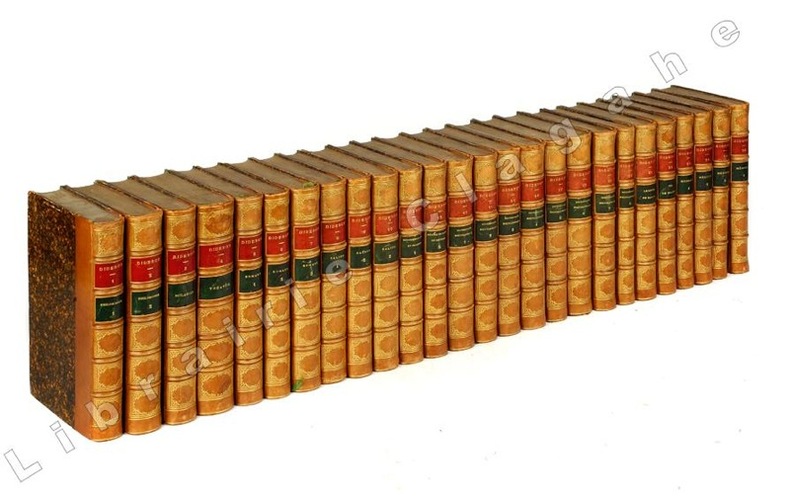
1821réf. 19877Paris, J.L.J. Brière, 1821-1823 ; 22 tomes. Suivi de : Mémoires, correspondance et ouvrages inédits de Diderot, publiés d’après les manuscrits confiés, en mourrant par l’Auteur à Grimm. Deuxième édition augmentée. Paris, Paulin, 1834, 4 tomes, soit en tout 26 tomes in-8 en reliure uniforme : demi-veau fauve, dos à nerfs décoré et doré, pièces d’auteur et de tomaison rouge et de titre vert empire, tête dorée. Cet ensemble comprend :T1-2 : Philosophie, avec la préface de Naigeon dans l’édition de 1798. Frontispice : Portrait de Denis Diderot par Mme Therbouche 1823, gravé par Bertonnier ; planche I et II dépliante montrant le système de Saunderson (pour les aveugles) ; 3 planches HT au tome II ; les quatre textes en fin de volume sont aujourd’hui attribués à Mme D’Epinay.T3 : Mélanges de littérature et de philosophie.T4 : Théâtre.T5-6-7 : Romans et Contes.T8-9-10 : Salons ; Mathématiques.T11-12 : Essai sur les règnes de Claude et de Néron ; Essai sur les études en Russie ; Plan d’une université pour le gouvernement de Russie ; Correspondance.T13 à 20 : Dictionnaire encyclopédique. T1 p.20 Tableau dépliant du Système figuré des connaissances humaines. Histoire complète de l’Encyclopédie et table des matières et table générale des articles.T21 : Oeuvres inédites de Diderot : Le Neveu de Rameau. Voyage de Hollande. Correspondance. Table générale et analytique des matières contenues dans les Oeuvres de Diderot.T22 : Mémoires historiques et philosophiques sur la Vie et les Ouvrages de D. Diderot par J.A. Naigeon. A la mémoire de D. Diderot par M. de Meister, 1786.T23-26 : Mémoires pour servir à l’histoire de la vie et des ouvrages de Diderot, par Madame de Vandeul, sa fille. Mémoires de Diderot. Lettres à Mademoiselle Voland de 1759 à 1774. Voyage à Bourbonne et à Langres. Correspondance avec Falconet. Paradoxe sur le comédien. Entretien entre D’Alembert et Diderot. Rêve de D’Alembert. La Promenade du sceptique ou les Alliées, 1747. Est-il bon ? Est-il méchant ? ou l’officieux persifleur.
1975réf. 115884London, Sotheby 1975 In-4 25,5 x 18,5 cm. Cartonnage éditeur vert-pâle, titre en noir sur le dos et le premier platornés d’un décor floral doré, 317 pp., 35 planches hors texte. Exemplaire en très bon état.
2003réf. LITTRUSSE79790724Paris, Parangon, "Biographies", 2003, 14 x 21, 518 pages sous couverture souple illustrée. Traduit du russe par Michèle Khan. Préface de Michel Parfenov. "Bientôt après l'acquisition de la propriété, survint un grand malheur. Au début du printemps 1832, un incendie attisé par un vent violent anéantit les deux hameaux. Lorsque les Dostoïevski arrivèrent dans leur domaine, ils ne trouvèrent qu'un désert semé de poutres carbonisées. Seule la maison des maîtres était demeurée intacte. Les habitations paysannes, les dépendances, les locaux d'usage domestique et même les tilleuls séculaires, brûlés, noircis, formaient un immense paysage privé de vie, funèbre, qui semblait incarner dans ses contours squelettiques la vie sans espoir des villages de serfs sur lesquels la mort régnait sans partage. Dostoïevski s'en souvint sans doute un demi-siècle plus tard quand il exprima les impressions sinistres de son enfance dans les questions angoissées de Dmitri Karamazov : " Pourquoi les mères sinistrées se tiennent-elles là ?... Pourquoi ce noir malheur les a-t-il noircies de la sorte, pourquoi ne nourrissent-elles pas leurs enfants ?... "
1902réf. 68801P.-V. Stock, éditeur, coll. « Bibliothèque Sociologique. - N° 32 » 1902 In-12. Broché, couverture imprimée, frontispice, 284 pp. Couverture fragilisée et défraîchie, intérieur en bon état.
grand in-8°, 263 pp., nombreuses illustrations en noir et en couleurs, skivertex bordeaux de l"editeur, jaquette illustree + rhodoid, emboitage. Tres bel exemplaire [109B-17] Textes de Henri Troyat, Etiemble, Jacques Madaule, Marthe Robert, Claude Roy, etc