[PHOTOGRAPHIE]Livre Rare Book

20 593 résultats
réf. 23222S.l., fin du XIXe siècle-début du XXe. Fort in-12, 42 pl., demi-basane havane, premier plat de marqueterie de bois représentant un bouquet de fleurs, le second avec une mention "Nire", tranches dorées (infimes épidermures, dos gauchi, quelques petites rousseurs et déchirures des onglets).
réf. 9690Paris, Delpire (Collection Neuf), 1955, in 4° relié pleine toile éditeur, jaquette illustrée ; petites fentes à la jaquette, avec deux traces de scotch.
1955réf. 332591955 P., Delpire (Collection Neuf), 1955, in 4° relié pleine toile éditeur (rousseurs sur les plats).
réf. GF22506Photographie format 40 x 30 cm - beau tirage plastique noir et blanc - années 1980 pour l'émission "Apostrophes"-
1952Paris, Éditions Sociales, 1952; in-8, 48 pp., broché. Très bon état.
1961Paris, Société d'Édition « les Belles Lettres », 1961; in-8, 312 pp., broché (couverture sous film adhésif transparent remplié). Collection des Universités de France « Guillaume Budé », N° 080. Édition bilingue : latin, français. 2ème édition revue et corrigé. Texte établi et traduit par Alfred Ernout, membre de l'Institut, professeur à la Faculté des Lettres de l'Université de Paris. Bon état.
réf. 28573P., Club du Livre Sélectionné, sans date, in 8° relié pleine skyvertex rouge de l'éditeur, 368 pages ; illustrations.
réf. 58265Tours, Mame, 1852, in 12 relié demi basane, dos à nerfs, orné à froid, 284 pages ; gravures hors-texte ; frottis à la reliure ; coins emmoussés.
réf. 232002Paris, s.d. (1900) in-12, XXIII pp., un f. n. ch. de table, 258 pp., un f. n. ch., avec de nombreuses illustrations dans le texte, demi-basane bouteille, dos lisse orné de filets dorés, tranches mouchetées (Saulnier et Michon). Dos uniformément insolé et passé.
réf. 201806509Moscou, Editions du progrès, 1967 ; in-8, 686 pp., cartonnage de l'éditeur. Bel état avec sa jaquette et son rhodoide.
2022réf. RUSSIEEEE369630224Paris, Talent Editions, 2022, 21 x 29,5, 376 pages cousues sous couverture souple imprimée. Traduit de l'anglais (Royaume-Uni) par Olivier Bougard et Anne Confuron. "
réf. 321942 volumes in-8, demi-toile chagrinée noir, titres dorés, (4), 523 p. et (4), 499 p. Paris, Librairie du Luxembourg (impr. de Simon Raçon), 1874.
réf. GF100344 pages en 2 feuillets in8 - 25,5x16 cm - ensemble extrait du Trombinospe par Touchatout vers 1870 -
réf. GF12266Photographie 7,5x4 cm - collée sur carton - vers 1900 -
réf. GF13217Photographie 7,5x4 cm - collée sur carton - vers 1900 -
réf. GF13218Photographie 7,5x4 cm - collée sur carton - vers 1900 -
réf. GF20534Gravure originale à l'eau forte et aquatinte - format 13,5 x 13,5 cm sur une feuille de 29,5 x 21 cm - Vers 1820 - bon état malgré quelques petites piqures marginales sans gravité -
réf. 201806507Moscou, Editions en langues etrangères, s.d. ; in-8, 418 pp., cartonnage de l'éditeur. BON ÉTAT.
réf. 201806506Moscou, Editions en langues etrangères, 1959 ; in-8, 436 pp., cartonnage de l'éditeur. Très bon état avec sa jaquettet.
2 volumes in-8, demi-toile chagrinée noir, titres dorés, (4), 523 p. et (4), 499 p. Rarissime première et unique édition. Historique classé chronologiquement. Important appareil d'appendices au tome II. L'ouvrage a été édité à la librairie polonaise du Luxembourg dirigée par W adys aw Mickiewicz, fils d’Adam Mickiewicz. Historienne, publiciste, philanthrope, née Iwanowska, Dionizja Poniatowska (1816-1868) épousa Dariusz Poniatowski. "Dzielo wyd. anonimowo, autorka Dionizja Poniatowska ustalona na podst. bibliografii i PSB" (Nukat Union Cat. of Polish Res. librs). Reliure amateur. Cachet de bibliothèques. Quelques défauts de papier. Rousseurs éparses.
réf. 194598Paris, Poulet-Malassis, 1862 in-8, 457-21 pp., avec 3 ff. de fac-similés en dépliant ; deux lignes de l'avant-propos (page chiffrée XII) ont été caviardées comme dans tous les exemplaires, demi-chagrin marine, dos à nerfs fleuronné, tranches mouchetées (reliure de l'époque). Coins abîmés, mais bon exemplaire.
réf. 236492Paris, Typographie de Firmin Didot frères, s.d. (1859) in-4, 19 pp., en feuilles, cousu.
1946réf. 108851Paris, Calmann-Lévy 1946 In-8 20,5 x 13,5 cm. Reliure demi-toile bordeaux à coins, dos lisse, pièce de titre cuir bordeaux, 486 pp., 15 planches hors-texte, 18 croquis,notes, bibliographie, table des matières. Exemplaire en bon état.
1946réf. 83794Stanford CA: Stanford University Press for The Hoover Library on War Revolution and Peace 1946. First American Edition. Octavo. 23cm. Publisher's black cloth titled and decorated in gilt to spine. Dustjacket. xv; 658pp. Very light wear to the cloth mostly confined to some shallow cosmetic bumping to spine ends; internally clean; in a clean strong price-clipped dustjacket with some marginal fraying and isolated shallow loss to edges some toning of the spine panel and some largely unnecessary tape reinforcement to the verso of the jacket. A very good copy in a dustjacket with some light wear. A sizeable biography of the life of Ipatieff who managed to be a respected scientific figure before the Revolution and an even more respected one afterwards. It can have been no mean feat to have been head of Imperial Russian chemical warfare research during WW1 and then post-revolution to be held responsible for the revitalization of the chemical industry of the newly minted USSR. A joint memoir of the last days of Imperial Russia and the early days of the USSR with all the turbulence fear and uncertainty that must have engendered. Stanford University Press for The Hoover Library on War, Revolution and Peace unknown
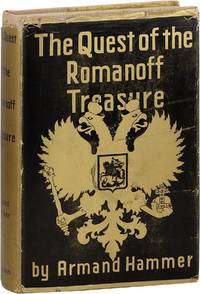
1936réf. 83612New York: The Paisley Press Inc. Succeeding William Farquhar Payson 1936. Stated Third Edition. Octavo. 21.5cm. Publisher's heavy grain pale grey cloth titled and decorated in gilt to spine and front board. Dustjacket. xi; 241pp. Some wear and discoloration to extremities very light it's a very solidly produced book so wear and tear is represented by darkening of the cloth at the edges and some softening of the spine ends rather than anything more drastic; internally clean ownership to front pastedown author's signature to front flyleaf; in a handsome example of the gold and black dustjacket with some chipping and shallow loss to the spine ends scuffing and rubbing to the gilt paper coating and some marginal creasing and soiling. A very good solid copy. Illustrated throughout with full page plates. For a man named by his father after the logo of the American Socialist Labor Party after slipping out of Odessa in the 1870's Armand Hammer's journey to become one of the world's most influential businessmen and "Lenin's Favorite Capitalist" must have been a dramatic one. His father Julius had spent much of the early 20th century consolidating his role at Allied Drug and Chemical which was essentially at times a smuggling front shipping embargoed goods to Russia during the US trade sanctions. After Julius was sentenced to 3 years in Sing Sing allegedly for a botched abortion that resulted in the death of a Russian woman from subsequent pneumonia although modern research suggests that Armand a medical student might have been the one who performed the abortion and Julius took responsibility as the qualified senior medical professional present Armand took over Allied Drug and Chemical and raised it to new heights of corporate success. During Prohibition Allied's largest seller was a essentially alcoholic ginger ale sold as a medicinal tonic to great profit. Acting under the instructions of his imprisoned father Armand began taking numerous business trips to the Soviet Union. A young J. Edgar Hoover at that point basically an analyst at the Justice Department very strongly believed that the equally youthful Hammer was a COMINTERN courier and essentially placed him under surveillance for the rest of his life. Hammer's trips to Russia were ostensibly to recoup bad debts but this quickly developed into a number of lucrative business deals not least of which was selling cheap wheat to starving famine hit areas of Russia. Hammer developed a close co-operative no pun intended relationship with Lenin which resulted in a number of very high status business contracts and deals ranging from medical import contracts to 25 year's worth of asbestos mining in the Urals; one of Hammer's greatest coups was arranging payment for various services in furs caviar jewellery and antiquities seized by the Party from its long tail of enemies making him essentially a conduit for looted and otherwise dubious art jewels and antiques. At the height of Lenin's New Economic Policy Armand Hammer was the sole trade liason between the enormity of Soviet Russia and 38 major US corporations seeking to build trade deals through him. His grasp of the downrange necessities of dealing with the Soviets; graft bribery corruption and palm greasing was legendary and by the 1970's when his methods were starting to be inspected more closely there was no doubt that Hammer's understanding of legitimate business was secondary to his instinctive abilities in the fields of corporate and beaurocratic bribery and manipulation. This book is one personal perspective on the empire of treasure that Hammer accumulated; there are others and the entangled ephemeral traces of looted artworks forged and unfinished Fabergé eggs specially manufactured jeweller's tools designed to copy Fabergé's style exactly and a wealth of other foggy rumors and suspicions ranging from Armand the KGB stooge to Armand the James Bond Villain bent on Soviet domination through capitalism will continue to follow in his wake whether he be considered a legitimate businessman or a highly successful 20th century robber baron of legendary proportions. The Paisley Press Inc. Succeeding William Farquhar Payson unknown