M Chopin; A Ubicini; M UbiciniBiblio.com
1 845 résultats
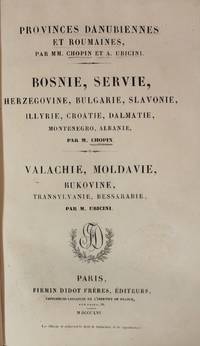
1856réf. B2302Paris: Firmin Didot Freres c. 1856. A very good copy. Edition: First edition. Binding: Contemporary ¼ morocco with blue cloth boards spine in five compartments of raised bands gilt text on two edges speckled blue. Notes: This book describes the customs and history of the people in the region and the climate and topography of the land. Size: 8vo Illustration: With 35 steel-engraved plates relating to the countries mentioned in the title and 3 folding maps. Volume: Two parts in one. Pages: P. title blank 1-494; 1-226. Category: Book Europe Balkans Firmin Didot Freres hardcover
1990réf. 2090202120415672Greenpeace Publishing Association 1990. Soft Cover. Fine. Number of books: 1 Greenpeace Publishing Association paperback
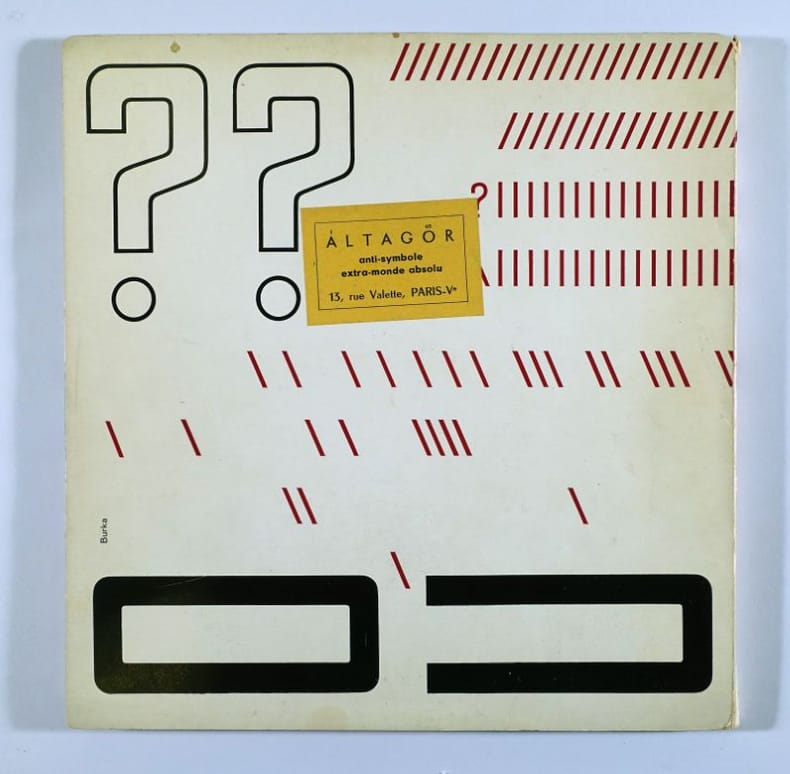
1966réf. 100299Sceaux Henri Chopin 1966 27x27cm OU Cinquième Saison n°26/27 Ce « OU » se nomme « Le homard cosmographique » et constitue le deuxième volume du « Dernier roman du monde » d'Henri Chopin. Sceaux, 1966, 272x264mm, 80p., sous couverture à rabats conçue par Burka. Participations de Edmund Allen, Roberto Altmann, Serge Béguier, Bertini, Jan Burka, Henri Chopin, John Furnival, Ilse et Pierre Garnier, Hirsal Grögereva, Jiri Kolar, Kosice, Hanjörg Mayer, Rancillac, C. Frederick, Reutersward, Rotella et Ben. Un disque 17cm contenant les poèmes phonétiques de Raoul Hausmann de 1918 à 1964 dits par lui-même, ainsi que des interventions d'Henri Chopin et Bernard Heidsieck. Exemplaire n°45/525 provenant du poète Altagor portant son ex-libris « Altagor anti-symbol extra-monde absolu 13, rue Valette Paris V », et cette dédicace : « Pour Altagor, ce homard burlesque / Henri Chopin ». (100299)
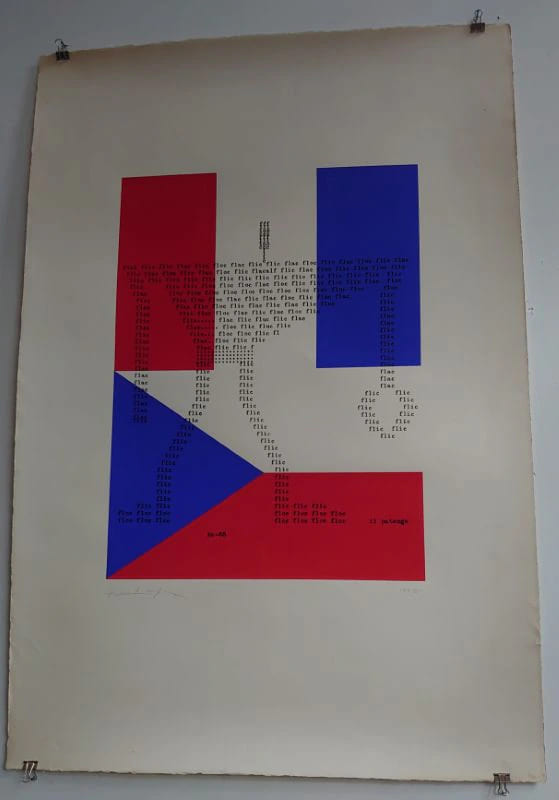
réf. 2400Flic Flac Floc… 1965. Sérigraphie originale sur papier épais légèrement effiloché, signée et datée par l’artiste au crayon. 104 x 70,6 cm. Cette grande sérigraphie d’Henri Chopin, intitulée "Flic Flac Floc" et réalisée en 1965, reflète l’esprit expérimental qui caractérise l’œuvre de cette figure de l’avant-garde européenne.
2008réf. 016415Bernard-Gabriel Lafabrie 2008 In-4 En feuilles, couverture
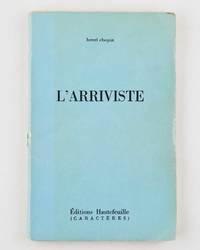
1958réf. 21235121958. Paris: Editions Hautefeuille Caracteres. 1958. 8vo. Light blue soft covers lettered in black to covers; pp. 81 7; warping to spine toning to covers creasing to front cover and wearing to edges toning to text block; very good. Inscribed copy of one of Chopin's earliest poetry books.These early poems which are focused on the body and introduce the poetic element or ""protagonist"" of the tape recorder were written by Chopin between 1951 and 1957. This collection is one of Chopin's first poetry books. This copy has been inscribed without mentioning his name to the typographer Robert Massin. At the time Chopin was working as a typographic proofreader like many others in the lettrist movement such as Altagor. paperback
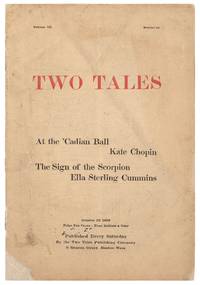
1892réf. 432439Boston: Two Tales Publishing Company 1892. Softcover. Very Good. First edition. Tall octavo. 20pp. paginated 145-164. Stapled wrappers printed in red and black. Wrappers repaired with rice paper especially on the rear wrap which has a few words lacking and a little overall soiling else very good. One of the earliest appearances in print by Kate Chopin "At the 'Cadian Ball" was one of her famous Bayou stories which later appeared in her collection Bayou Folks. It appears here in the magazine Two Tales which began publishing in 1891 and which not surprisingly published two stories in each issue the other story here is by Ella Sterling Cummins. Fragile and rare. OCLC locates four copies with BAL referencing two additional copies. Two Tales Publishing Company unknown
2009réf. SBBIH-A6LH7HZJJQZDSpartan Press 2009. sheet_music. Good. Our good condition books are generally good for reading but not for gifting or collecting. They could have imperfections such as creasing fanning inscriptions margin notes yellowing staining on edge or cover or pages bumps scuffs etc etc sometimes multiple of these. It's a wide category that encompasses anything that isn't almost-new down to anything that is slightly better than poor. We would NOT recommend gifting Good books - these should be considered reading copies. Our books are dispatched from a Yorkshire former cotton mill. We list via barcode/ISBN so please note that the images are stock images and may not be the exact copy you receive furthermore the details about edition and year might not be accurate as many publishers reuse the same ISBN for multiple editions and as we simply scan a barcode or enter an ISBN we do not check the validity of the edition data when listing. If you're looking for an exact edition please don't order at least not without checking with us first although we don't always have time to check. We aim to dispatch prompty the service used will depend on order value and book size. We can ship to most countries see our shipping policies. Payment is via Abe only. Spartan Press unknown
1575réf. 575041575. Paris 1575. 1st ed. Paris 1575. 1st ed. The First Modern Treatise on Rural Rights: Rene Choppin's Landmark 1575 Agrarian Law Choppin Rene 1537-1606. De Privilegiis Rusticorum: Lib. III. O Fortunatos Nimium Sua Si Bona Norint Agricolas Gnauosque Senes Extrema per Illos Iustitia Excedens Terris Vestigia Fecit. Paris: Apud Nicolaum Chesneau 1575 colophon: 29 November 1574. First Edition. Quarto 9" x 6-1/2"; 22.86 x 16.51 cm. xvi 248 24 pp. Contemporary limp vellum early calligraphic title to spine ties lacking. Negligible light shelfwear text block partially detached from binding. Woodcut printer device to title page woodcut decorated initials. Some toning light dampspotting and early annotations to a few leaves. A very good unsophisticated copy in its original binding. $1500. First edition of this pioneering and exceptionally rare treatise on the legal rights customary protections and social standing of the early modern rural peasantry. Rene Choppin a celebrated avocat at the Parlement of Paris was a central figure in the 16th-century "Gallican" legal tradition. Alongside contemporary jurists like Jean Bodin and Jean Bacquet Choppin worked to synthesize Roman jurisprudence canon law and regional French customary law into a cohesive national framework under royal authority. In De Privilegiis Rusticorum Choppin produced the first systematic legal work dedicated to agrarian rights. Here "privileges" refers not to aristocratic perks but to statutory legal safeguards designed to protect agricultural workers from predatory creditors excessive taxation and unlawful land seizure. Choppin framed rural labor as vital to the stability of the state arguing that the protection of farmers was essential to national prosperity. The title directly incorporates lines from Virgil's Georgics "O fortunatos nimium sua si bona norint agricolas." illustrating the Renaissance Humanist effort to reconcile classical literary ideals of pastoral life with the grit of 16th-century legal reality. Choppin argued that Justice having abandoned the corrupt cities left her final traces among the rural working class. The Biographie Universelle highlights the treatise for its enduring scholarly weight noting that it "deserves notice for the singularity of its subject" and its "profound research." Rare in commerce and in in. unknown
réf. ABE-1681946761387Boston: Two Tales Publishing Company 1892-3. A run of 37 issues of this scarce periodical. Each issue published every Saturday featured two short stories by both up and coming and established authors including E W Hornung Gilbert Parker Octave Thanet Edith R Crosby Elizabeth Stuart Phelps Julian Hawthorne and others. The July 23 1892 issue contains "Love on the Bon-Dieu' one of the earliest examples of Kate Chopin's short story writing set in the Bayou of Louisiana which would eventually form the basis of her book Bayou Folk. Spine of the Nov 19 1892 issues almost perished; moderate dampstaining to the March 25th April 1 and March 11 1893 issues some light toning to wraps in places with several issues creased vertically else a VG run overall of a very scarce periodical. OCLC locates just a handful of issues. 1st Edition. Soft cover. Very Good. Paperback
réf. 45Henri Chopin. Ensemble de treize lettres dactylographiées et signées au format A4 (1 feuillet chacune) adressées par Henri Chopin à Llys Dana entre le 2 juillet 1993 et le 17 décembre 2007. LLys Dana fut le directeur des revues de Mail Art, Le Point d'ironie et Le Sphinx. Cinq des enveloppes ont été conservées ainsi que deux photocopies des réponses de Llys Dana. Cette correspondance concerne la préparation de l'édition augmentée de Poésie sonore internationale (édition Jean-Michel Place, 1979), ouvrage considéré comme la référence en matière de poésie sonore : « Le besoin final, est d'en faire un livre de références et non un ouvrage pour auteur, d'où une sorte de sévérité...Il s'inscrit dans une démarche des revue cinquième saison, puis Ou, ensuite le livre cité, puis en 90 avoir fait entrer la PS dans 'le grand atlas des littératures' in encyclopaedia universalis, et maintenant ce travail avec la version allemande... » (2/08/1997). Au fil de ces lettres il est question de la collaboration d'Henri Chopin à la revue Sphinx, de ses participations à des évènements poétiques, d'un ouvrage publié par Francesco Conz avec notamment « 3 directions majeures : a) apologie de la femme, b) le pape Benoit ex-lieutenant SS réfugié au couvent des Saulchoir chez les Dominicains où je suivais les conférences de Jacques Maritain, et c) toute ma famille fut massacrée par les SS et moi déporté… C’était en 48, et je n’oublie rien. » (19/08/2007) et de la promotion de la poésie sonore à la radio en Autriche et en Allemagne. Rare ensemble documentant les « coulisses » de la poésie sonore.
1575réf. 575041575. Rare Treatise Dealing With Legal Rights of Farmers and Other Rural People Choppin Rene 1537-1606. De Privilegiis Rusticorum: Lib. III. O Fortunatos Nimium Sua Si Bona Norint Agricolas Gnauosque Senes Extrema per Illos Iustitia Excedens Terris Vestigia Fecit. Paris: Apud Nicolaum Chesneau 1575 colophon: 29 November 1574. xvi 248 24 pp. Quarto 9" x 6-1/2". Contemporary limp vellum early calligraphic title to spine ties lacking. Negligible light shelfwear text block partially detached from binding. Woodcut printer device to title page woodcut decorated initials. Some toning light dampspotting and early annotations to a few leaves. $2000. First edition. Choppin or Chopin was a French jurist and an avocat of the Parlement of Paris. Like Jean Bacquet and Jean Bodin Choppin drew on Roman law and feudal principles to advocate a centralized state under royal rule. De Privilegiis Rusticorum addresses legal privileges enjoyed by rural people in Roman and civil law such as access to uncultivated land. A well-written and remarkably comprehensive work it went through seven subsequent editions in Latin. Its final edition translated into French was published in 1634. This was a rarely explored topic and Choppin's treatise is the only early example we have encountered. According to the Biographie Universelle "it deserves notice for the singularity of its subject for its profound research and the decisions it contains" 8:499. All editions are scarce today and rare in North American law libraries. OCLC locates three copies of the 1575 edition at Columbia George Washington University and Harvard. Camus Profession d'Avocat 1477. unknown books
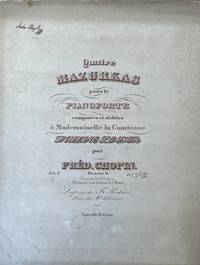
1841réf. 2301Leipzig: Kistner / Paris: Schlesinger PN 996 1841. Possessor’s inscription on title page Anton Khayll. Title page dusted tanned. Chipped edges and light foxing throughout. Spine artistically restored. Otherwise in very good condition. Folio. 5 leaves: p. 1 lith ITP pp. 2–9 engr text p. 10 blank. Title lithographed music engraved. Reprint of the second German edition only difference is the title page price in gGr added. An early edition of Chopin’s Opus 6. Provenance: Anton Khayll’s 1819 – after 1841; Viennese pianist possessor’s inscription on the title page. Grabowski-Rink 6–2a-KI. unknown
1833réf. 18021Paris: Chez Maurice Schlesinger 1833. First Edition. Used; Like New/Used; Like New. 1er Concerto pour le Piano avec accompagnement d'orchestre dedié à Monsieur F. Kalkbrenner par Fréd. Chopin. Op. 11. Disbound upright folio. 44 pp. PN M. S. 1409. From the collection of Alfred Cortot with his green stamp to the lower right of the title. Occasional fingerings and other annotations in pencil. Notes on the verso of the last page in pencil in French indicate that this copy belonged to pianist Antoine François Marmontel and suggest that the fingerings may be in his hand. Translated from the French: "This copy belonged to Marmontel judging by the dedications of the pieces bound in the same volume. Perhaps the notes in pencil are from Marmontel." Toning and foxing; wear to the spine; overall very good. 10 x 13.25 inches 25.5 x 34 cm. Grabowski & Rink 11-1-Sm. A historic copy having been owned by two of the most important pianists in history. Pianist teacher and musicologist Antoine François Marmontel became Professor of Keyboard at the Paris Conservatory in 1848 succeeding Pierre Zimmermann and beating out his former teacher Charles-Valentin Alkan. He achieved renown as a pedagogue; among his many notable students were Georges Bizet Vincent D'Indy and Claude Debussy. Marmontel was the author of a large number of pedagogical works as well as musicological works which are among the best sources for the history of the piano and pianists. One of the 20th century's most influential — yet inimitable — classical figures Alfred Cortot was born in 1877 in Switzerland to a French father and a Swiss mother and he based his long career as a pianist conductor and teacher in Paris. Cortot was one of his era's most renowned interpreters of Chopin his best recordings setting an enduring standard for poetry in motion. In 1925 the pianist made the first electrical recording of classical music for the Victor label in New Jersey featuring music by Chopin and Schumann. Among his hundreds of subsequent recordings was the first complete version of Chopin's Preludes Op. 28. In holding up Cortot as a paragon of Chopin playing even decades after his death The New York Times described his method as combining "lucidity with spontaneity. It is almost modern in its lack of sentimentality and attention to structure; yet it is unmistakably Romantic in its insistence on freedom and variety. Each line is suffused with subtle detail with interior contours and dynamic shadings. But these are not indulgent ornaments; they reveal rather than cloud the music's intentions." The Piano Concerto No. 1 in E minor Op. 11 was composed in 1830 when Chopin was twenty years old and was first performed on 11 October of that year at the Teatr Narodowy the National Theatre in Warsaw Poland with the composer as soloist during one of his "farewell" concerts before leaving Poland. The first of Chopin's two piano concertos to be published it was therefore given the designation of Piano Concerto "No. 1" at the time of publication even though it was actually written immediately after the premiere of what was later published as Piano Concerto No. 2. Chez Maurice Schlesinger unknown books
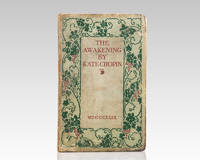
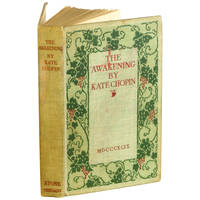
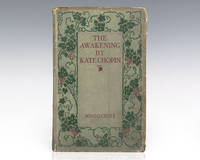
1899réf. 152246Chicago & New York: Herbert S. Stone & Company 1899. First edition of this landmark work. Octavo original green cloth stamped in dark green and red. First editions are rare. Set in New Orleans and on the Louisiana Gulf coast at the end of the 19th century the plot centers on Edna Pontellier and her struggle between her increasingly unorthodox views on femininity and motherhood with the prevailing social attitudes of the turn-of-the-century American South. It is one of the earliest American novels that focuses on women's issues without condescension. It is also widely seen as a landmark work of early feminism generating a mixed reaction from contemporary readers and critics. The novel's blend of realistic narrative incisive social commentary and psychological complexity makes The Awakening a precursor of American modernist literature; it prefigures the works of American novelists such as William Faulkner and Ernest Hemingway and echoes the works of contemporaries such as Edith Wharton and Henry James. It can also be considered among the first Southern works in a tradition that would culminate with the modern works of Faulkner Flannery O'Connor Eudora Welty Katherine Anne Porter and Tennessee Williams. In good condition with soiling and rebacked stamp of "Wilson's Library" to the title and first page. Herbert S. Stone & Company hardcover
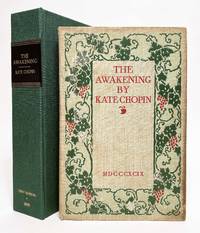
1899réf. 2554Chicago and New York: Herbert S. Stone and Co 1899. First edition. Original binding. Very Good. RARE FIRST EDITION OF CHOPIN'S GROUNDBREAKING NOVEL; A FOUNDATIONAL FEMINIST WORK. "No other American book was so maligned neglected for so long and then embraced so quickly and with such enthusiasm as Kate Chopin's 1899 novel The Awakening. And none has been so thoroughly redeemed as The Awakening. Thought vulgar morbid and disturbing in Chopin's time it has for the past quarter of a century been seen as sensitive passionate and inspiring. Forgotten for two generations it is today known by countless people in dozens of countries and Kate Chopin has become among the most widely read of classic American authors" Bernard Koloski Awakenings. Chopin's "works are widely taught at universities and have been the subject of considerable critical attention. The Awakening has been translated into several languages. Chopin is now seen as a pioneer of both American realism and feminist consciousness. To a degree that was ahead of her time she rejected both conservative and liberal didacticism and discarded traditional assumptions in an attempt to depict honestly and emphatically the inner life of women" American National Biography Online. CHOPIN KATE. The Awakening.Chicago and New York: Herbert S. Stone and Co 1899. Octavo original pictorial green cloth stamped in red and green; custom silk box. A hint of toning to spine; a handful of leaves with light dampstaining at top corner not affecting text. An outstanding copy-the finest we have seen-of an extremely difficult book to find in collectible condition. Herbert S. Stone and Co unknown
1899réf. 192104Chicago: Herbert S. Stone & Company 1899. Defining female destiny First edition a classic proto-feminist novel. From the 1970s The Awakening was heralded as a powerful early portrayal of a woman seeking sexual and spiritual freedom. On publication it was received as a well-written but morally dangerous book; one critic described the heroine as "rare in fiction but common enough in life" St Louis Republic 25 March 1899. Beginning in 1889 Chopin 1850-1904 published poetry short stories and occasional novels typically set in her native Louisiana. Her 1894 collection of short stories Bayou Folk was an immediate critical success and she "was catapulted from virtual anonymity to celebrity" ANB. However she was frustrated by trivial interpretations of her work and her output over the next years increasingly featured bold independent female characters. This trajectory reached its peak with The Awakening. Centred on a woman seeking sexual fulfilment and freedom from her societal roles including motherhood the novel was shocking to late Victorian sensibilities. Chopin found the ensuing negative reviews demoralizing and published little else for the remainder of her life. For the next 50 years Chopin and her work faded into obscurity. However with the rise of second-wave feminism The Awakening found a new audience: "No other American book was so maligned neglected for so long and then embraced so quickly and with such enthusiasm" Koloski p. 1. Chopin is now associated with the New Woman movement and is considered a pioneer of both American realism and feminist consciousness. Octavo. Original green cloth spine and front cover lettered in red pastel green ground framing covers and decorated with dark green foliage and red berries top edge gilt other edges uncut. With the bookplate of Emma H. Salisbury Peterson c.1876-1961 a doctor at the Columbus Memorial Hospital in Chicago. Contemporary gift inscription in pencil to front free endpaper. Spine faded and repaired at foot of rear joint extremities bumped with occasional spots of wear covers and outer leaves lightly foxed occasional faint damp stains to contents not affecting text: a very good copy. BAL 3246. Bernard Koloski ed. Awakenings: The Story of the Kate Chopin Revival 2009. hardcover
1899réf. 364153Chicago: Herbert S. Stone & Co 1899. First Edition. Hardcover. Very good. The uncommon first edition of this enduring Southern novel about a woman who is awakened to the possibilities of life when she falls in love for the first time with a man who is not her husband. Chopin was born in St. Louis but spent many years in Louisiana where most of her writing was set including this novel which was written after she and her family returned to Missouri. While the book generated controversy for its "immoral" premise the Mercantile Library of St. Louis initially purchased a copy and then removed it from circulation a number of early readers recognized it for its groundbreaking portrayal of a woman unwilling to be hemmed in by traditional expectations. The unnamed writer of the "Book Ways and Worldly Ways" column in the Delaware Gazette and State Journal July 13 1899 for example wrote "The topmost book on the table today recommended for summer reading is Kate Chopin's The Awakening.She writes things we women used only whisper in our boudoirs. But we women are getting on aren't we" The Newest Books column in the St. Louis Post-Dispatch quoted appreciative letters from readers in England and then concluded "Perhaps when the London critics have thoroughly explained the merits of The Awakening American critics who have shown a disposition to look askance at its frank treatment of the commonest of human experiences will discover its value as a work of art." Chopin 1850–1904 bore six children between 1871 and 1879. Her husband died in 1882 leaving her in considerable debt. As a widow she had an affair with a married man which may have inspired The Awakening. Chopin and her children soon moved back to Saint Louis where Chopin took up writing. She died in 1904 from a brain hemorrhage following a visit to the World's Fair although the two events may have been entirely coincidental. See the Salem Weekly Oregon Statesman September 16 1902. First edition first and only printing. A very good copy and far superior to most copies at auction or in the trade. This copy has a narrow tide mark on the outer page edges particularly in the first half of the book. The back cover has some ink loss probably due to an old encounter with water. However the spine retains most of its green color; the hinges are tight; and the pages have very little foxing. According to the book auction records a lesser copy made $10000 at auction in 2021. This copy has the ownership signature of Cara L. Broughton dated August 1899 about a month after the book was published. This Cara Broughton was likely the daughter of Henry Huttleston Rogers who married a British civil engineer Urban Broughton and was made Lady Fairhaven by King George. There is a label of the bookstore W. B. Clarke Co. in Boston which is probably where Broughton purchased it. It also has a penciled price of 40 pence suggesting she took the book with her to England. This copy came from the library of one-time New Yorker editor Robert Gottlieb. In addition to the better-than-usual condition this copy is attractive for its history from the bookstore to the original woman who owned it to one of the best-known literary editors of the late 20th century. Herbert S. Stone & Co hardcover
1899réf. 131587Chicago: Stone & Kimball 1899. First edition of this landmark work. Octavo original green cloth stamped in dark green and red. In very good condition. Housed in a custom half morocco clamshell box. First editions are rare especially in this condition. Set in New Orleans and on the Louisiana Gulf coast at the end of the 19th century the plot centers on Edna Pontellier and her struggle between her increasingly unorthodox views on femininity and motherhood with the prevailing social attitudes of the turn-of-the-century American South. It is one of the earliest American novels that focuses on women's issues without condescension. It is also widely seen as a landmark work of early feminism generating a mixed reaction from contemporary readers and critics. The novel's blend of realistic narrative incisive social commentary and psychological complexity makes The Awakening a precursor of American modernist literature; it prefigures the works of American novelists such as William Faulkner and Ernest Hemingway and echoes the works of contemporaries such as Edith Wharton and Henry James. It can also be considered among the first Southern works in a tradition that would culminate with the modern works of Faulkner Flannery O'Connor Eudora Welty Katherine Anne Porter and Tennessee Williams. Stone & Kimball hardcover
réf. 331691 page. Small octavo 131 x 100 mm. Dated "Paris 10 avril" 1845. In French. Chopin plans to leave Paris within three weeks most probably for Nohant George Sand's summer estate and tells his correspondent that he will be back in September or October. He thanks the addressee for the "good memories" and sends compliments to her aunt: "Je pars dans 10 ou 20 jours - Je reviens au mois de 7-embre ou 8-bre. Je vous remercie pour votre bon souvenir - et croyez-mois toujours dévoué Chopin Mille compliments à Mme votre tante." Very slightly worn; light vertical crease; minor remnants of adhesive to blank lower left corner; very slight staining to blank lower margin. Together with: A bust-length portrait etching of the composer by the German artist Wilhelm Pech 1876- image size 120 x 95 mm. sheet size 199 x 150 mm. Signed "W. Pech" in pencil at lower right below image. Upper margin slightly abraided and with remnants of adhesive to recto and verso. Provenance Previously in the collection of John and Johanna Bass founders of the Bass Museum of Art in Miami Florida. Sydow: Correspondance de Frédéric Chopin La Gloire 1840-1849 no. 579. The year of this letter saw the publication of opp. 57 the Berceuse for piano and 58 the Sonata for piano. "The Sonata no. 3 in B minor op. 58 - dedicated to Countess Emilie de Perthuis a friend and wife of the royal aide-de-camp - and the Berceuse were published to great critical and public acclaim. The Third Piano Sonata the last of this genre represented in the words of musicologist Anatole Leikin Chopin's reconsideration 'not only of sonata form but of the sonata genre as well' because 'his sonatas like his mazurkas or nocturnes are marked by a special musical idiom.' Zieliński believes that the Sonata no. 3 is Chopin's 'deepest' work." Szulc: Chopin in Paris pp. 302-303. "Most of the winter of 1845 was a time of acute illness for Fryderyk. George Sand wrote Stefan Witwicke in Freiwald Germany late in March that between Chopin's 'coughing fits and his lessons it is difficult to find a moment of peace and silence.' About the same time she informed Ludwika Chopin's sister in Warsaw that 'our dear little one was greatly tired by the severe winter . but since the weather improved he has been completely rejuvenated and revived. Two weeks of warmth helped him more than all the medicines . " " . By mid-May heat in Paris became oppressive and George and Fryderyk began to think about moving to Nohant for the summer. George had started on a new novel Isidora and hoped to complete it in peaceful Berry. Chopin too was ready to go purchasing a calèche a vehicle with a folding top to make their journey more private and pleasant than by diligences. But Dr. Papet warned them that a typhus epidemic had broken out in the region and urged a delay. Finally they left Paris on June 12 with Pauline Viardot just back from a Russian tournée joining them in Nohant a few days later." op. cit. pp. 303-305. The year 1845 was important to Chopin for another reason as it marked the beginning of a major rift in his relationship with George Sand: "When Chopin and Sand returned to Paris in August 1842 they moved to new accommodation in the Square d'Orléans close to their friends the Marlianis and also incidentally to Kalkbrenner and Alkan. It was a satisfactory domestic arrangement. But Chopin's health was giving cause for real concern and the relationship with Sand was deteriorating partly due to growing tensions within the family. All of this together with his inability to recapture his earlier fluency in composition contributed to his low spirits in the winter of 1843-4. But the hardest blow of all came in May 1844 when he learnt of the death of his father. Sand immediately whisked him off to Nohant but he refused to be consoled until his sister Ludwika to whom he had always been close announced her intention to visit France with her husband that summer. They met in Paris in July and the visitors divided their time between there and Nohant until they departed for Poland in early September. 'We are mad with happiness' Chopin wrote. But it was not to last. The winter season brought further strains in his relationship with Sand and when they set out for Nohant in June 1845 tensions within the family circle were beginning to come to a head." Kornel Michałowski revised by Jim Samson in Grove Music Online. Chopin's correspondent may very well be his pupil the Austrian pianist Friederike Müller. Friederike Müller 1816-1895 lived with three of her father's sisters in Vienna following the death of her mother. She arrived in Paris in 1839 to study with Chopin and was his pupil until 1841 and then again in the winter of 1844-1845. "She wrote a kind of diary in the form of approximately 230 letters to her Viennese aunts about her stay in Paris and her encounters with Chopin. They are an extremely valuable source for his biography . " Wikipedia. Müller often passed Chopin's best wishes on to her aunt/s in her letters. Chopin dedicated his Allegro de Concert op. 46 to her. Grabowski & Rink p. 356. unknown books