1 854 résultats
1845réf. 23128Leipzig: Breitkopf & Härtel . Paris: J. Meissonnier . Londres: Wessel & Stapleton: PN 7259 1845. Folio. Disbound. 1f. title 3-7 i blank pp. Title lithographed music engraved. Price: "15 Ngr." With publisher's handstamp to foot of title. Slightly worn soiled and creased; title slightly foxed. Second German edition. Grabowski-Rink 57-2-B&H. Chomiński-Turło p. 77. Hoboken 4 425 erroneously identified as "first German edition 1845". [PN] 7259 unknown books
1865réf. 23096Leipzig: Breitkopf & Härtel . Paris: Troupenas & Co . Londres: Wessel & Co: PN 8728 1865. Folio. Disbound. 1f. title 3-5 i blank pp. Lithographed. Price: "10 Ngr." Publisher's and "Scharfenberg & Luis New York" handstamps to foot of title. Footnote to p. 3: "Stich und Druck von Breitkopf & Härtel in Leipzig." With pencilled fingerings articulations notational corrections and other markings. Leaves detached; edges browned; tear to margin of first leaf of music with no loss. Lithographic reprint of the third German edition of 1853/54. Not in Grabowski-Rink; 35-1d-B&H should read: 35/3-1d-B&H is lithographed but otherwise different. Chomiński-Turło p. 447 third of three separate Breitkopf editions of the funeral march distinguished by footnote to p. 3. Not in Hoboken. The firm of Scharfenberg & Luis was active from 1845-66. See Howe: "Music Publishers of New York before 1850" reprinted November 1917 from the Bulletin of the New York Public Library September 1917 p. 1. [PN] 8728 unknown books
1854réf. 23100Leipzig: Breitkopf & Härtel . Paris: Troupenas . Londres: Wessel: PN 8728 1854. Folio. Disbound with remnants of sewing. 1f. title 3-5 i blank pp. Title lithographed music engraved. Price: "10 Ngr." Publisher's handstamp to foot of title. Edges browned and frayed; occasional staining. Third German edition. Not in Grabowski-Rink but see reference to third edition in description of: 35/3-1c-B&H. Chomiński-Turło p. 447 second of three separate Breitkopf editions of the funeral march distinguished by plate number and absence of footnote to p. 3. Hoboken 4 336. [PN] 8728 unknown books
1968réf. 141751New York: Edwin F. Klamus 1968. Softcover. Very Good. Reprint. Very good in wrappers. Paperback. Clean paper covers and text. Edwin F. Klamus unknown books
1988réf. 1411067New York: Greenwood Press 1988. Hardcover. Octavo 100 pages. In Very Good condition. Spine is black with yellow print on red banner. Boards in black cloth yellow print on red banner. Illustrated: b&w frontispiece and plates maps. NOTE: Shelved in Netdesk Column BB. 1411067. FP New Rockville Stock. Greenwood Press hardcover books
1894réf. 157381894. Boston and New York: Houghton Mifflin and Company 1894. 2 pp undated ads. Original olive green cloth decorated in gilt. First Edition of Kate Chopin's second but first obtainable book a collection of 23 stories and anecdotes of Louisiana local color. A native of St. Louis Katherine O'Flaherty 1850-1904 married a successful Louisiana Creole named Oscar Chopin and lived in New Orleans and on a nearby cotton plantation until his death of swamp fever in 1882 when she was 31; after two years of trying to manage the indebted plantation herself she returned with her children to St. Louis where suffering from depression she was encouraged to write as a form of therapy. Her writing career began with the now-exceedingly-rare AT FAULT St. Louis 1890 in wrappers -- and it ended due to the public shock over her fourth book THE AWAKENING 1899. She died at age 54 of a brain hemorrhage suffered at the St. Louis World's Fair. As an example of the BAYOU FOLK tales "Désirée's Baby" just twelve pages long tells of Armand an antebellum Louisiana aristocrat who over the objections of friends and family marries an adopted girl of unknown ancestry. Their newborn baby boy is definitely "dark" -- so Armand turns Désirée and the child out of his house. She did not take the broad beaten road to the far-off plantation of Valmondé. She walked across a deserted field where the stubble bruised her tender feet so delicately shod and tore her thin gown to shreds. She disappeared among the reeds and willows that grow thick along the banks of the deep sluggish bayou; and she did not come back again. Some weeks later burning old letters Armand discovers one from his mother to his father; the story ends with this quote from that letter: "I thank the good God for having arranged our lives that our dear Armand will never know that his mother who adores him belongs to the race that is cursed with the brand of slavery." This copy is very good-plus perhaps near-fine: there is scarcely any wear other than a cracked rear endpaper though as always with this olive-green cloth the spine has aged to a honey-brown. Blanck 3244. unknown books
1897réf. 157681897. Chicago: Way & Williams 1897. Original very dark blue cloth pictorially decorated in green and silver. First Edition of the author's third book which like her second book BAYOU FOLK 1894 is a collection of short stories sited in Louisiana bayou country. Katherine O'Flaherty 1850-1904 actually was born and died in St. Louis but she lived in the New Orleans area for the ten or so years she was married to a Louisiana Creole ending with his death in 1882. Her first book the novel AT FAULT St. Louis 1890 went largely unnoticed; her fourth and last book the novel THE AWAKENING 1899 was vilified at the time for its subject matter but has since come to be regarded as a major feminist work. A third collection of stories was cancelled by her publisher perhaps in response to the public outcry over THE AWAKENING and was not published until 1991 as A VOCATION AND A VOICE. Included in this volume is the famous tale "Athénaïse" -- "a short story about a willful young woman who runs away from her husband’s Louisiana plantation and lives secretly in New Orleans" KC Intl Soc -- a topic Chopin would expand upon with THE AWAKENING. This volume is a typically-artistic Way & Williams production with on both covers the same brooding bayou scene the green design is intentionally barely visible against the dark blue background -- only the silver moon and its silver reflection in the water stand out. This copy's condition is very good very minor wear at the corners; the silver pigment is slightly rubbed on the spine but less than is typical. Blanck 3245; Kraus W&W 52. unknown books
1879réf. 23069Leipzig: Breitkopf & Härtel PN C. XII.5 1879. Folio. Unbound. 1f. series title: "Friedrich Chopin's Werke. Erste kritisch durchgesehene Gesammtausgabe Band XII. Concerte und Concertstücke für das Pianoforte mit Begleitung des Orchesters . No. 5. Zweites Concert Op. 21 F moll. Partitur" 68 ii blank pp. Series title lithographed music engraved. No price. Date to foot of p. 1: "Ausgegeben 1879." Browned; some margins heavily stained; edges frayed; some offsetting; series title detached and torn at edges. Breitkopf & Härtel [PN C. XII.5] unknown books
1898réf. 202480Chicago: Way & Williams 1898. Hardcover. Very Good. Full blue cloth covers with green and silver decoration binding not signed frontispiece title page in red & black ink top edge gilt other edges untrimmed. Free front endpaper removed else a very good copy indeed. Best known for "The Awakening" which followed directly after "A Night in Acadie" Chopin is one of the premier Southern authors as well as early American feminist authors. She was not afraid to write about interracial relationships. This collection of short stories like most of her fiction is centered in Bayou Creole life. Way & Williams hardcover books
réf. 38212Boston: Ditson. Large 4to 184. AEG. Exterior worn cover detached. Some offsetting on music pages but interior VG. Ditson unknown books
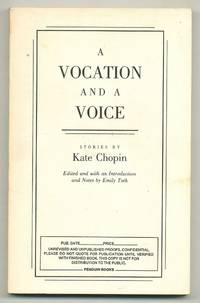
1991réf. 572168New York: Penguin Books 1991. Softcover. Near Fine. Uncorrected proof. Cream wrappers. Edited and with an introduction by Emily Toth. Toning on the spine and some spotting else about near fine. Penguin Books unknown books
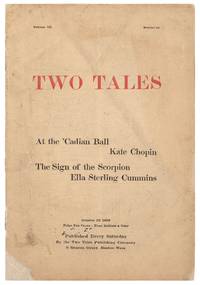
1892réf. 432439Boston: Two Tales Publishing Company 1892. Softcover. Very Good. First edition. Tall octavo. 20pp. paginated 145-164. Stapled wrappers printed in red and black. Wrappers repaired with rice paper especially on the rear wrap which has a few words lacking and a little overall soiling else very good. One of the earliest appearances in print by Kate Chopin "At the 'Cadian Ball" was one of her famous Bayou stories which later appeared in her collection Bayou Folks. It appears here in the magazine Two Tales which began publishing in 1891 and which not surprisingly published two stories in each issue the other story here is by Ella Sterling Cummins. Fragile and rare. OCLC locates four copies with BAL referencing two additional copies. Two Tales Publishing Company unknown books
1945réf. 395561Philadelphia: E.B. Swisher 1945. Softcover. Near Fine. Folio. 6pp. Illustrated cover. Fine. OCLC locates no copies of this version. E.B. Swisher unknown books
1975réf. 1338543Antwerp: Guy Schraenen 1975. Softcover. Large Octavo 8 pages. In Good plus condition. Stiff black wrappers with red text; Covers have creasing along spine and bending along tail edge of spine; Signed and numbered #174 by Henri Chopin on inside of rear cover; Henri Chopin was a French Avant Garde artis in the 1950s-70s; Shelved Case 0. 1338543. Shelved Dupont Bookstore. Guy Schraenen unknown books
1981réf. 035239NY: Bantam. 1981. First thus a Bantam Classic paperback edition. Upper outer front cover corner chipped; rubbing to front spine fold; age toning to pages. Very good. Softcover. Very Good. Bantam paperback books
1880réf. 23074Leipzig: Breitkopf & Härtel PN C. XII.6 1880. Folio. Unbound. 1f. series title: "Friedrich Chopin's Werke. Erste kritisch durchgesehene Gesammtausgabe Band XII. Concerte und Concertstücke für das Pianoforte mit Begleitung des Orchesters" 27 iii blank pp. Series title lithographed music engraved. No price. Browned; blank lower margins stained; edges frayed; some edges slightly chipped; some offsetting. Chomiński-Turło p. 165 includes date. Breitkopf & Härtel [PN C. XII.6] unknown books
1875réf. 23135S. Pétersbourg: A. Büttner PN 741. 1875. Folio. Disbound. 1f. series title 3-7 i blank pp. Series title lithographed music engraved. Price: "80c." "Valse brillante" on series title underlined in blue pencil. Extensive fingering and other markup in pencil in an unknown hand. Slightly worn soiled browned and frayed; leaves partially detached. A later Russian edition. Dated based on the works listed on the series title; the posthumous "Dernier nocturne" in C-sharp minor was not published until 1875. A. Büttner [PN 741.] unknown books
réf. 13595NY MACMILLAN 1949. FIRST EDITION VERY GOOD. F. NY, MACMILLAN, 1949 unknown books
1958Volume appartenente alla collana Le vite dei musicisti, diretta da Giulio Confalonieri. In sovraccoperta Renoir, Signora al piano, particolare. Titolo originale dell'opera edita dalla casa Gallimard di Parigi Chopin ou le poète. Traduzione a cura di Ebe Colciaghi. Sovraccoperta leggermente usurata ai margini, agli angoli e alle estremità del dorso; sovraccoperta leggermente brunita. Legature in buone condizioni con titoli e fregi solo al dorso. Pagine ben salde alla cerniera, con ampio margine, lievemente brunite, così come i tagli. Presente firma di appartenenza alla tavola del ritratto dell'artista. Numero pagine 239. USATO
2013ill., br. La tormentata vicenda umana, l'attività artistica d'interprete, la ricchezza della sua produzione d'autore hanno fatto di Fryderyk Chopin la figura simbolo del romanticismo e un artista fondamentale nella storia della musica. Questo libro non si rivolge a una ristretta cerchia di musicologi, ma ai pianisti, ai docenti di pianoforte e agli appassionati di cultura musicale; con un'indagine rigorosa e documentaria ci restituisce una biografia divenuta troppo spesso fonte di aneddotica deteriore e di facile letteratura; attraverso uno studio acuto e accurato mette in luce gli elementi architettonici dell'arte di Chopin, ne descrive e analizza in modo sintetico ed esaustivo tutte le opere. Esempi musicali, illustrazioni, una ricca bibliografia, un catalogo completo delle opere e un utilissimo paragrafo sulle edizioni a stampa più attendibili sono parte integrante del volume.
2010ill., br. Del complesso di azioni che compongono l'esecuzione pianistica, l'impiego del pedale di risonanza è quella che più di tutte viene tradizionalmente lasciata all'istinto e alla sensibilità personale dell'interprete. Questo atteggiamento è stato condiviso da molti compositori, ma non da Fryderyk Chopin, che nelle sue partiture mostra una fiducia nel segno del pedale forse superiore a quella di chiunque altro. Nonostante ciò, le sue indicazioni originali riguardo a dove mettere in pedale, dove toglierlo, e dove non usarlo vengono costantemente rilette alla luce di una tecnica di pedalizzazione moderna, o tranquillamente trascurate nei casi in cui non coincidano con ciò che l'esecutore considera un "bel pedale". In pratica, nei confronti della musica di Chopin, l'idea che alle indicazioni di pedale si debba la stessa fedeltà che si ha verso il resto del testo originale è tutt'altro che scontata, e in pianisti e didatti prevale la convinzione che i pedali indicati debbano comunque essere aggiustati. L'ipotesi su cui indaga il volume è invece diametralmente opposta. Il saggio vuole dimostrare che i segni di Chopin sono nella grande maggioranza dei casi perfettamente logici e realizzabili. Essi rispondono semplicemente ad una tecnica di pedalizzazione diversa da quella tardo-ottocentesca, e ancor più da quella moderna: diversa, ma in sé perfettamente compiuta. Presi alla lettura, i pedali di Chopin svelano la concezione estetica dell'autore più di molti altri segni della partitura.
2017br. Dalla natia Polonia come da Vienna, da Parigi come da Londra, Chopin ci offre attraverso queste lettere un dettagliato racconto della sua vita e delle sue frequentazioni, disegnando anche un prezioso profilo della società europea della prima metà dell'Ottocento. Ciò che però più rileva e sorprende è l'involontario ritratto che dà di sé stesso, assai lontano dallo stereotipo del musicista romantico e appassionato. Chopin si rivela piuttosto, in queste pagine, come un uomo equilibrato e malinconico, segnato da un virile pessimismo, ma capace anche di un'ironia corrosiva. Fryderyk Chopin nacque il 22 febbraio 1810, in un piccolo centro nei pressi di Varsavia, Zelazowa Wola. A poco più di vent'anni lasciò la Polonia per Vienna, prima tappa di un inquieto peregrinare per l'Europa. Il 17 ottobre 1849 morì a Parigi, dove riposa nel cimitero del Père Lachaise.
2010ill., br. Qual era il modo in cui Chopin eseguiva la sua musica pianistica? Come la insegnava, come voleva che fosse suonata? Per rispondere a questi interrogativi l'autore ha lavorato per lunghi anni a setacciare ogni documento edito e inedito che recasse tracce indubitabili della volontà chopiniana, e a studiare tale documentazione in dettaglio, sotto tutti gli aspetti (contesto storico, culturale, artistico e umano) in cui essi vanno collocati per essere compresi a fondo. Il risultato di questo lungo studio è un libro in cui una scelta di testi originali provenienti da allievi, colleghi pianisti o compositori, amici e ascoltatori di Chopin è collocata entro una fitta rete di note che, per così dire, li fa parlare, li forza a fornirci informazioni nuove, ricche e imprevedibili che si compongono in un ritratto a tutto tondo di Chopin, della sua poetica, della sua tecnica e della sua didattica pianistica, delle tradizioni musicali a cui amava riallacciarsi, della sua etica della musica, della 'prassi esecutiva' che grazie a questo libro può dirsi la sua, e in fine della sua presenza concreta come essere umano.
2016br. 1839, la dolce estate francese. Frédéric Chopin raggiunge George Sand a Nohant: per sette estati tornerà nella grande casa circondata da parchi e boschi, e lì comporrà le sue opere più alte, più toccanti, come la Berceuse e la Barcarola. È una stagione, questa, luminosa e torbida, malinconica ed eccitante, percorsa da fitti intrecci familiari, intimi e mondani. Ha inizio con l'incontro parigino tra la scrittrice e il compositore, prosegue con il loro sfortunato soggiorno a Maiorca - dove Chopin, ammalato, sperimenterà una visionarietà senza precedenti -, per arrivare ai pomeriggi e alle sere a Nohant, soli o circondati da un "piccolo mondo" di artisti con i quali conversare a lungo di musica e pittura, almeno fino a quando l'urgenza del comporre non costringe Chopin a chiudersi nella sua stanza e lì improvvisare, scrivere, cancellare e riscrivere. Ripercorrendo ognuno di questi passaggi, la narrazione di Piero De Martini, conoscitore quanto mai della vita e dell'opera di Chopin, torna incessantemente a un interrogativo finora poco indagato: quanto la relazione con George Sand e la vita a Nohant influirono sulla sua arte?