JOARIZTI, Adolfo (1835-1871).MareMagnum

2.836 Ergebnisse
Barcelona-Madrid, Sociedad Editorial La Maravilla-Librería Española, 1864. Dos volúmenes en folio; 542 pp. + 488 pp. Con 31 láminas litográficas aparte (de 38). Encuadernación de la época en media piel. El tomo primero bastante fatigado.
Reimpreso en Santiago, por recomendación de otros señores Obispos, en la de La Estafeta, 1814. 4to.; 209 pp. Encuadernación de época en piel.
Barcelona, Isidro Torres Oriol, s.a. (hacia 1896). Folio; 2 hs., 529 pp. Con 51 transcripciones y 117 ilustraciones entre el texto. Impresión a doble columna. Encuadernación original en tela roja estampada, realizada por A. Domingo.
Best.-Nr. ORD-9746de Mossen JACINTO VERDAGUER, Maître en Gai Savoir. Un des Quarante de l'Académie catalane. Augmenté d'une Introduction et d'Appendices. 2°édition. Paris. Léopold Cerf. 1884. Gd in-8 br. couverture imprimée en 2 couleurs, CLXXX pp. (La Renaissance de la Poésie catalane et l'Atlatide en poésie); 273pp. (le poème en catalan avec traduction juxtalinéaire en français. Petits défauts mais assez bon exemplaire. Peu courant.
Barcelona, Imprempta de Espasa Germans y Salvat, 1875. Folio; XX-392 pp. Bella impresión enmarcada, con numerosas viñetas e ilustraciones a los poemas, dibujadas por Padró, autor asímismo de una lámina aparte con el retrato del poeta. Encuadernación en media piel, de la época, con lomera profusamente ornada.
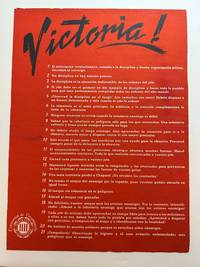
1937Best.-Nr. 11137Barcelona Spain: Comissariat de Propaganda Generalitat de Catalunya 1937. Near Fine. Propaganda poster listing 21 wartime rules of behavior to help the republican side achieve victory over the fascists during the Spanish Civil War. As follows: As with most of the Republican posters the colors of the anarchists and communists black and red figure prominently in the poster. Many of the prescriptions seem geared toward inexperienced soldiers. This feature of the prescriptions is no surprise since much of the soldiers fighting on the side of the Republicans were volunteers or militiamen who were not professionally trained soldiers. The prescriptions on the poster are as follows: "Revolutionary enthusiasm plus discipline and good military organization will defeat the enemy. Without discipline the army is not powerful. Discipline is the unquestioning execution of the commander's orders. The commander should be the first in giving an example of discipline and making everything possible so that all orders from above are accomplished perfectly. Observe discipline in the line of fire! Cartridges are expensive! You should fire at fixed targets and only when the commander orders it. The infantry is the principal weapon. The artillery and air force complement the work of the infantry. No situation is critical when the enemy's infantry is weak. Know that the cavalry is dangerous only for those that move back. A brave and firm infantry can always put it in flight. You should not avoid enemy fire but you should take advantage of the situation in order to go on the offensive to attack it better and to fire against it with greater precision. Only he who attacks triumphs. The trenches are aid for the offensive. Always try to pass from defense to offense. The reconnaissance of enemy positions will save many forces. Do continuous reconnaissance. Communicate all that you discover to your commander. Bring every prisoner to your commander. Keep a tight link between the rearguard and the advance forces in order to prevent surprises and increase the force of your blow. One bad sentry lost Chapaief. Do not forget the sentries! Do not fear the attack of the enemy from behind since you can attack them in the same way. The tank without infantry is not dangerous. Attack tanks with grenades. Do not debilitate your attack in the presence of enemy planes. On the contrary intensify it. Attack the enemy infantry that advances behind enemy planes. Every commander of militias should make the most of their free time to instruct militiamen and they on their time should do everything possible to study. Learn to shoot with precision to understand maps and to identify with a locality. Do not speak of military subjects because the hated enemies are listening. Countrymen! By practicing good hygiene and cleanliness you avoid diseases more dangerous than the enemy." SC&A UC San Diego OCLC. Near fine. Single sheet color lithograph mostly red and black 30 x 23 cm. In Spanish Catalonia. Comissariat de Propaganda, Generalitat de Catalunya unknown
1937Best.-Nr. 11137Barcelona Spain: Comissariat de Propaganda Generalitat de Catalunya 1937. Near Fine. Propaganda poster listing 21 wartime rules of behavior to help the republican side achieve victory over the fascists during the Spanish Civil War. As follows: As with most of the Republican posters the colors of the anarchists and communists black and red figure prominently in the poster. Many of the prescriptions seem geared toward inexperienced soldiers. This feature of the prescriptions is no surprise since much of the soldiers fighting on the side of the Republicans were volunteers or militiamen who were not professionally trained soldiers. The prescriptions on the poster are as follows: "Revolutionary enthusiasm plus discipline and good military organization will defeat the enemy. Without discipline the army is not powerful. Discipline is the unquestioning execution of the commander's orders. The commander should be the first in giving an example of discipline and making everything possible so that all orders from above are accomplished perfectly. Observe discipline in the line of fire! Cartridges are expensive! You should fire at fixed targets and only when the commander orders it. The infantry is the principal weapon. The artillery and air force complement the work of the infantry. No situation is critical when the enemy's infantry is weak. Know that the cavalry is dangerous only for those that move back. A brave and firm infantry can always put it in flight. You should not avoid enemy fire but you should take advantage of the situation in order to go on the offensive to attack it better and to fire against it with greater precision. Only he who attacks triumphs. The trenches are aid for the offensive. Always try to pass from defense to offense. The reconnaissance of enemy positions will save many forces. Do continuous reconnaissance. Communicate all that you discover to your commander. Bring every prisoner to your commander. Keep a tight link between the rearguard and the advance forces in order to prevent surprises and increase the force of your blow. One bad sentry lost Chapaief. Do not forget the sentries! Do not fear the attack of the enemy from behind since you can attack them in the same way. The tank without infantry is not dangerous. Attack tanks with grenades. Do not debilitate your attack in the presence of enemy planes. On the contrary intensify it. Attack the enemy infantry that advances behind enemy planes. Every commander of militias should make the most of their free time to instruct militiamen and they on their time should do everything possible to study. Learn to shoot with precision to understand maps and to identify with a locality. Do not speak of military subjects because the hated enemies are listening. Countrymen! By practicing good hygiene and cleanliness you avoid diseases more dangerous than the enemy." SC&A UC San Diego OCLC. Near fine. Single sheet color lithograph mostly red and black 30 x 23 cm. In Spanish Catalonia. Comissariat de Propaganda, Generalitat de Catalunya unknown books
Madrid, RSEHN, Palacio de Biblioteca y Museos Nacionales, 1907. 4to. mayor; 330 pp., con ilustraciones entre el texto, más 13 láminas y tres planos plegados, aparte. Ejemplar con envío autógrafo de Lucas Fernández Navarro. Cubiertas originales.
Barcelona, Imprenta de J. Verdaguer, 1845. 4to. menor; 363 pp. Ejemplar con rastros de polilla en los márgenes blancos de las quince primeras y de las últimas diez páginas, afectando ocasionalmente algunas letras. Encuadernación de época en piel. Única edición y versión española, muy rara, de la obra del gran médico homeópata y magnetizador de la sociedad parisiense, en la tradición mesmeriana, realizada por el apóstol catalán de la frenología Mariano Cubí y Soler (1801-1875), al que ayudó en esta traducción el polifacético sastre de Vilanova Magí Pers i Ramona (1803-1888) frenólogo de afición, que llegó a ser regidor del Ayuntamiento de Barcelona y cabeza de toda una saga ilustre.
Madrid, Imprenta de Fernando Cao y Domingo de Val, 1887. 4to. menor; 195 pp., 1 h., con numerosas ilustraciones entre el texto, 6 láminas, un gran mapa plegado, con ligera restauración, y 6 planos también plegados, aparte. El mapa plegado presenta mínimas pérdidas. Encuadernación en media tela.
Espira-de-l'Agly, 1878, 19 x 12,5 cm., rústica editorial con la cubierta anterior desprendida, 207 págs. (Mancha en el margen exterior de las primeras hojas sin afectar al texto y con algunas marcas ocasionales de óxido. Es obra rara, el Catálogo Colectivo solo registra ejemplares en las Bibliotecas Públicas del Seminario de Barcelona y en la Labert Mata de Ripoll).
Barcelona, Imprenta de Antonio Brusi, calle de la Libretería, 1846. Cuatro volúmenes en 4to.; 3 hs., 359 pp., 4 hs. + 359 pp., 4 hs. + 350 pp., 8 hs. + 382 pp., 7 hs. Encuadernación en media piel.
1948Best.-Nr. 17634Barcelona Editorial «Alpha» 1948
Sin lugar, (1700), 20,5 x 15 cm., 4 hojas incluso portada orlada.
Tarragona, 1947, 26 x 19 cm., 159 págs. + 3 h. + 4 láminas en colores. (Ejemplar intonso, de la tirada de 100 ejemplares numerados en papel de hilo).
Sin lugar de impresión, impresor, ni año, pero: hacia 1680. Folio; 11 páginas. Pequeña pérdida de papel en el márgen blanco de las seis primeras páginas. Cubiertas mudas en cartulina.
Barcelona: Barcinone, Typis Ioachim Verdaguer, 1830. Dos tomos en un volúmen en 4to. menor; 5 hs., 347 pp. + portada, 235 pp., 1 h., LVI pp. Encuadernación en media piel, de la época.
Best.-Nr. 9079Gounouilhou Bordeaux 1889
Madrid, en la Imprenta de Don Antonio de Sancha, 1776. 4to.; XVI-198 pp., 1 h. Encuadernación moderna, en media piel.
Sin lugar de impresión, impresor ni año, pero: Barcelona, hacia 1687. Folio; 20 páginas, numeradas. Cubiertas mudas en cartulina.
Roma, Nella Stamperia di Arcangelo Cafaletti, 1779. Dos volúmenes en 4to.; XII pp., 238 pp. + 264 pp. Enc. en piel marbreada, con lomera ornada y tejuelo.
Sevilla, Sociedad de Bibliófilos Andaluces, 1878. 342 pp., 2 hs. Edición limitada y numerada [de 300 ejemplares], ejemplar número 57. Cubiertas originales. Lomera con pérdidas de papel.
Best.-Nr. GF271741 page in4 - bon état -
Madrid, en la Imprenta de Sancha, 1808. 4to. menor; 1 h., XXVI-475 pp., la última, de Indice, con pérdida de texto. Encuadernación en piel marbreada de la época, con tejuelo.
Barcelona, Salvat Editores, 1926-1941. Cinco volumenes en 4to. mayor; 460 pp., con 636 ilustraciones.y 43 láminas + 516 pp., con 570 ilustraciones y 36 láminas + 468 pp.,. con 493 ilustraciones y 32 láminas + 428 pp., con 474 ilustraciones y 26 láminas + 516 pp., con 614 ilustraciones y 23 láminas. Encuadernación original en tela estampada.