(IRELAND -- SCOTLAND -- Map)Biblio.com
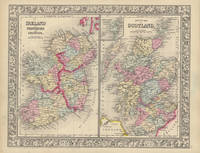
1860Best.-Nr. 45844New York: S. Augustus Mitchell Jr. 1860. Folio 15¼" X 12¼" image area 13½" X 10½". Hand colored. Very good. Mild age toning. Attractive nicely-colored side-by-side map of these United Kingdom countries from the 1864 edition of "Mitchell's New General Atlas Containing Maps of the Various Countries of the World Plans of Cities Etc." Handsomely colored and with fine decorative border. S. Augustus Mitchell, Jr. unknown
1977160 pages. Index. Bibliography. Fascinating black and white photographic plates. "Few people realize that until the beginning of this [the 20th] century the Hebridean island of St. Kilda, lying 110 miles west of the Scottish mainland, was inhabited by people who in many ways had more in common with the primitive tribes of the Amazon Delta than with the city-dwellers of their own country." - dust jacket. "This esoteric fragment of history is one of the most compulsively readable and alluring books I have perused in years." - dust jacket. Former library copy with usual markings and front free endpaper removed. Dust jacket now preserved in archival-grade Brodart. Binding intact. A worthy reading copy. Book
1977No marks or inscriptions. No creasing to covers or to spine. A very clean very tight copy with bright unmarked boards and no bumping to corners. 208pp. A historical, topographical and cultural account of the Scottish islands of Eigg, Rum, Canna, Muck, Coll and Tiree.
19418vo., First Edition, fore-edges lightly browned; original cloth, backstrip lightly faded else a very good, clean copy in dustwrapper, the latter repaired, frayed and creased at edges.
19308vo., First Edition, with a portrait frontispiece in photogravure (original tissue guard present), title in red and black, and 7 plates in photogravure (all original tissue guards present); original blue ribbed cloth, crest blocked in gilt on upper board, gilt back, a very good, bright, clean copy. Provides 'reliable information on the campaign which preceded Culloden in 1746 by the commander of a volunteer regiment of cavalry' (Pargellis & Medley). This copy was formerly in the library of William Lumsden Walker (1919-2005), formerly Consultant Child and Adolescent Psychiatrist, Royal Hospital for Sick Children and Southmead Hospital, Bristol, and bears his signature on front free endpaper. Very scarce. See Pargellis & Medley, 3321.
Best.-Nr. 1396429 Gilmore Place Edinburgh. 14 August 1820. 1p. 4to. 26 lines closely and neatly written. Good on disbound leaf of aged and worn paper. The letter begins: 'Gentlemen The Patents Models Advertising and plates &c of the engine to which the accompanying descriptions not present refer and which the note in the Edinburgh Philosophical Journal shows how the first trial succeeded has been much more expensive than I calculated on or had any idea of - From the number of enquiries however the chances of a tolerable return are considerable; but like all other things much different from established custom it will require time before it can be known and adopted to reimburse me.' As it would prove expensive to borrow 'by bills at short dates the money that may be still necessary to enable me to appear as the respectable profession of an Engineer requires and also to defray the expence of the further promulgation of the machine' he asks for a loan of £400 with Sir Alexander Jardine Bart. of Applegarth as guarantor. He believes he can 'fill it up by Martinmas 1822'. He concludes: 'I am not known to many in this town and intimate only with three who were schoolfellows of mine and should you wish any reference I have no doubt you will consider the report of any of them above suspicion'. From a collection of papers from the Bank of Scotland. Blackwood's Edinburgh Magazine carried a report on Dickson's 'patent Water Engine' in its issue for September 1820 praising its 'great convenience' for those who 'wish a small power for useful purposes exercise or amusement'. 29 Gilmore Place, Edinburgh. 14 August 1820. unknown
1971Best.-Nr. 984N12Oxford: Clarendon Press 1971. Cloth. Near Fine/Near Fine. 7.5" by 5". Unknown. A scarce book on the fascinating and mysterious The Kingis Quair attributed to James I of Scotland. Analysis introduction and notes by scholar John-Norton Smith. A scarce book on the intriguing medieval poem The Kingis Quair attributed to James I of Scotland with analysis and notes by medievalist John Norton-Smith. Published by Clarendon Press in 1971.In the publisher's original turquoise cloth in the original unclipped dust wrapper. Contains a frontispiece of King James I of Scotland.Attributed to James I of Scotland the semi-autobiographical poem narrates his imprisonment in England from the age of eleven to thirty. James also tells of his falling in love with English noblewoman Joan Beaufort and a dream vision in which he learns about good and bad fortune from Minerva. The poem incorporates the popular Chaucerian style with the original Middle Scots dialect. The result is a fascinating poem that Norton-Smith helps the reader to understand. In the publisher's original turquoise cloth in the original unclipped dust wrapper. Externally in excellent condition. The dust wrapper is bright and clean with sunning to the spine and extremities. End papers are bright and clean with the rare spot to extremities. Marginal dirt trapped in top fore-edge. Internally firmly bound. Pages are bright and clean. Near Fine Clarendon Press hardcover
1971Best.-Nr. mon0000991265Clarendon Press Oxford 1971. Hardback. Very Good. in x in x in. First edition first printing. Pages clean and bright no markings light wear to edges. Binding tight.rnIn removable protective plastic jacket. Clarendon Press, Oxford hardcover
1990Best.-Nr. 13076Glasgow: Hunterian Art Gallery 1990. Softcover. G May have minor damage to wraps; Interior is clean and tight. Black wraps. 56 pp. 7 bw 28 color plates. Two-page introduction biography extensively annotated selection of lovely plates and chronology. [Hunterian Art Gallery] paperback books
Best.-Nr. 13965First Letter: No place. 25 July 1837. Second Letter: Edinburgh. 31 July 1837. Both 1p. foolscap 8vo and disbound. Both in good condition on aged paper with loss at edge from disbinding causing slight loss of text in second letter. Letter One: Docketed on reverse of second leaf 'James Smith July 25 1837 Report on City Improvements.' The document begins: 'Having carefully examined the state No. IV. made up by the Improvement Commissioners and submitted to the Bank of Scotland &c and also inspected the works with Mr Geo. Smith Architect for the Commissioners I take leave to submit the following observations thereon'. Three numbered paragraphs follow on 'the Estimates' 'work yet to be executed on the south approach and in Victoria Street in opening up these streets for paving' and 'the Assets' the last sixteen lines long. Letter Two: Addressed to Blair on reverse of second leaf. Continuing from the first letter he gives as his opinion that there 'will be a shortcoming in the returns <.> liquidate the engagements fo the Commissioners'. He suggests as 'the safest course for the Bank to pursue . a partial completion of the Works Viz - Partially completing George IVth. Bridge and Victoria Street leaving out the Mound Corn Market and the Charity Workhouse Road'. The final paragraph begins: 'it is evident to me were this not done a greater loss will in all probability have to be sustained because without opening up these streets the Returns by paving cannot be made available'. He recommends that 'the Commissioners husband well their resources by a rigid economy'. First Letter: No place. 25 July 1837. Second Letter: Edinburgh. 31 July 1837. unknown
Best.-Nr. 13894On letterhead of the Secretary of State for Scotland Scottish Office Fielden House 10 Great College Street London SW1. 24 April 1952. 1p. 12mo. In fair condition on aged and creased paper. After thanking him for his assistant Stuart informs Moore that he is 'delaying a further approach to the Council until you tell me that the new Provost has been appointed and you have been able to make unofficial approaches to him about a Deputation meeting me in Edinburgh'. Annotated in pencil by Moore. On letterhead of the Secretary of State for Scotland, Scottish Office, Fielden House, 10 Great College Street, London, SW1. 24 A unknown
1750Best.-Nr. 65569Ohne Ort, um 1750. Bild ca. 12,6 x 7,3 cm, Blatt ca. 16,5 x 9,5 cm. 1 Blatt, verso weiß.
2006Appears unread. No marks or inscriptions. A lovely clean very tight copy with bright unmarked boards and no bumping to corners. Dust jacket not price clipped or marked or torn or creased with very minor traces of storage. 189pp. Biography of Scottish football legend Jimmy Delaney who played for Celtic, Manchester United as well as his national team of Scotland.
Best.-Nr. 94592Publications de l'Université des Langues et Lettres de Grenoble, 1979, 265 p., broché, bon état.
1979Best.-Nr. LFA-126717874Un ouvrage de 266 pages, format 145 x 205 mm, illustré, broché, publié en 1979, Université des Langues et Lettres de Grenoble, bon état
2018Best.-Nr. 500298072Baumhaus 2018 272 pages 15 6x21 5x2 6cm. 2018. Relié. 272 pages.
Best.-Nr. 19212Edinburgh Scotland 'Monday afternoon'. 12 June 1843. . 2pp. 12mo. In fair condition aged and worn. On a bifolium docketed with the date on the second leaf. He writes that he has 'taken Trinity Grove' and that he has 'looked at your grass at Denham Green - and found it has been so neglected that it is scarcely good for any thing - We will see how it looks by the time we go down'. His daughter 'thinks she will try to keep the cow on the lawn of Trinity Grove assisted by cabbage leaves &ct from the Garden'. [ Edinburgh, Scotland? ] 'Monday afternoon'. [ 12 June 1843. ] unknown
Best.-Nr. 0852442467.Gpaperback. Good. Access codes and supplements are not guaranteed with used items. May be an ex-library book. paperback
Best.-Nr. 14276Print. Illus. by Homer & Lee NY Engravers. Good. No Binding. Circa 1870s sized about 8 x 10.5 inches engraved by Homer & Lee NY. Overall sharp and bright with minor soiling at upper margin. Suitable for framing. unknown
Best.-Nr. 21228On letterhead of The University Glasgow. 14 March no year. 2pp 12mo. Bifolium. In good condition lightly aged. He sends her belated thanks for her 'kind compliance with Mrs. Caird's request'. His wife has been very ill since he received her letter but he believes that 'the critical stage of the disease is fairly over; & besides her illness the death of an old servant has left me little time to attend to other engagements'. Mrs Caird is 'much gratified' that Marshall is 'to share in management of her stall'. The letter concludes: 'The other ladies will correspond with you in due time as to particular arrangements.' Caird's wife whom he married in 1858 was born Isabella Glover. On letterhead of The University, Glasgow. 14 March [no year]. unknown
Best.-Nr. 14053Tibbermore near Perth Scotland. 16 December 1830. 4pp. 4to. Bifolium with the last page of text cross-written over the first and the valediction and signature cross-written over the second. In fair condition on aged paper with short closed tears along crease lines of the second page. Addressed on reverse of second leaf with red wax seal and postmarks to 'John Inglis Esq Balliol College Oxford' and redirected to 'Loganbank'. Neatly and closely written in a somewhat difficult hand made worse by the cross-writing the letter begins: 'Having never heard a word about you my dearest Johnny since the morning you left this in J Lindsays Gig I began to feel a kind of ignorant impertinence to know something of your movements at Oxford if you are in the way of getting a prize this year'. The rest of the letter is filled with family news of which the following is a sample: 'Mary has been inviting Meg to pay her a visit in Maitland St but her going depends entirely on Papa continuing to improve in the first place she goes to St Andrews with John to visit the Cooks and will probably proceed from thence to Edinh. if all things go smoothly. I trust Papa will not prevent her as a change to a town is certainly agreeable in Winter.' The ODNB sketches out Inglis's education: 'He went to Edinburgh high school and then to the University of Glasgow. From there he proceeded in November 1828 to Balliol College Oxford as a Snell exhibitioner. He graduated BA in 1833 and MA in 1837 and was admitted a member of the Faculty of Advocates in July 1835.' Tibbermore [near Perth, Scotland]. 16 December [1830]. unknown
Best.-Nr. 19151Stanford Lincolnshire . 18 August 1865. 4pp. 12mo. Bifolium on grey paper. In good condition with traces of mount along one edge of verso of last leaf. Being away from home and his papers he cannot answer all the recipient's questions but 'it will be enough if I say that I shall not require an Organ & that the Illustrations to my lecture would or might be made to consist exclusively of unaccompanied vocal music mostly English. The effect of some pieces might be increased by being performed chorally - say with three or four good voices to a part but they will all admit of performance by one voice to a part'. He assumes that St Andrew's Hall 'can hardly be worse adapted for speaking in than the room in which I lecture sometimes at Edinburgh which is cruciform & holds 2500 people'. He comments on the practice of lecturing before concluding with the suggestion that 'all the Illustrations might be very safely left to the Cathedral Choir'. Stanford [ Lincolnshire ]. 18 August 1865. unknown
Best.-Nr. 13984Tynron Cottage Thornhill Dumfries and Galloway Scotland. 4 January 1801. 1p. foolscap 8vo. In fair condition on lightly-aged paper. Addressed on reverse of second leaf with red ink postmark and broken black wax seal to 'David Williamson Esqr Advocate George's Square Edinh'. There is no indication in the letter that the two men are kinsmen. 'My Dear Sir I am happy to inform you that the ship called the Nevis Planter sails from Liverpool for St. Kitts on the 12th. Inst - with your approbation I propose sailing with her - Mr. Wilson mentioned to me that he wrote you 10 days ago requesting power to draw upon you for a sum to defray my expences your answer was expected to be here 4 days ago but as it has not arrived I presume Mr. W. may draw upon you - theres no time for delay.' If he cannot get a boat from Dumfries to Liverpool he will take a coach: 'its a mere trifle from Carlisle'. He has 'got a case with bottles' and would like 'to take a few Gallons of Whisky out with me the Idea of it is ten times more than the worth Thinking that you would not refuse me such a small request I have presumed to take it & have sent it off with 6 Gall:' He concludes by asking him to write to Wilson upon receipt of the letter: 'we shall have it here on Tuesday or probably Sunday'. Williamson was certainly in the West Indies in 1805 when his son also John was born to Jane Russell in Blackdam. John Williamson the younger died in Jamaica in 1850. Tynron Cottage [Thornhill, Dumfries and Galloway, Scotland]. 4 January 1801. unknown
Best.-Nr. 19927Ayr Scotland . 31 August 1837. The Hudson Memorial Church in Bangalore founded in 1904 commemorates Hudson's work at he Wesleyan Mission Canarse Chapel. The present item dating from an earlier part of Hudson's career casts an interesting light on the practicalities of religious administration in Scotland in the Georgian period. 3pp. 4to. Bifolium. Addressed on reverse of second leaf with remains of red wax seal and postmark to 'Mr. John Ward Park Lane Lightmoor Near Shiffnall Shropshire L B.' Docketed: 'Particulars as to income &c &c'. He has not been 'indifferent' to Ward's 'very trying affair'. Later in the letter he comments: 'Yours is not the only case of Scotch Chapels that has made my heart to bleed. … Methodism ought not to be carried on at the cost of such sacrifices as yours.' Nevertheless he fears that nothing can be done regarding Ward's 'noble offer'. He presents in columns headed 'Yearly Income' and 'Yearly Expenditure' 'as correct a statement' as he can give: 'We have a good Chapel which will seat about five hundred persons two small houses a stable and a piece of ground let for building situated in the best part of the town.' He continues with reference to 'the collections' an 'application for a larger grant from Conference' the fact that 'a considerable number of our people have been in a state of great poverty' 'the income of our Circuit' 'poor Scotch stations' weavers 'the Trustees 'Captain Howie' 'letting public money go into the hands of poor men' the fact that 'the Episcopalians wanted the Chapel' 'the President'. Ayr [ Scotland ]. 31 August 1837. unknown
Londres, Thomas Nelson & Sons Ltd., 1951. 4to. menor; 170 pp., 2 hs., con un mapa del Imperio Romano. Encuadernación original en cartoné.