180 résultats
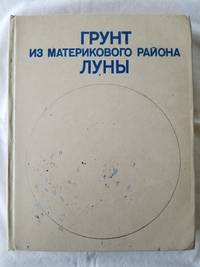
1979réf. 1641Moscow: Nauka / Ðаука 1979. First edition. Hardcover. Good. Tan flexi-bound hardcover first edition. Text in Russian. A good only copy of this scarce publication from the USSR on lunar soil samples. Minor musty smell. Corners heavily bumped and soil to the front cover and the text block edges. Flexible binding is solid and pages are firmly bound in. Interior appears to be unmarked. Bumping to the lower corners of the pages. One miscut page is creased toward the final gathering of the book. Filled with charts graphs and some black and white photos. 708 pp. title page in English and Russian but the text is solely in Russian. Hard to find in any condition. Nauka / Ðаука hardcover
réf. P5852Moscow: Ministerstvo elektrostantsii SSSR 1958. Oblong folio 24.5 × 36 cm. Original silver embossed blue cloth with blue printed dust wrapper in protective card case; 197 pp. Illustrated profusely from photographs in black and white with captions. Small closed tears to front and back dust wrapper; card case rubbed and lightly soiled; lacking titl leaf; else a very well preserved copy. This impressively illustrated album exhibited at the Soviet Pavilion during the Brussels World's fair in 1958 is filled with maps graphs drawings and photographs that tell the story of the electrical production of the Soviet Union. The album opens with a famous quotation from Lenin: "Communism is Soviet power plus the electrification of the whole country." The following pages contain graphs indicating rapid growth of electrical production maps that show the reach of electrical power and photographs of the enormous machines that service major urban centers like Moscow as well as entire regions like the Don Basin DONBAS. Typical for the Thaw and in contrast to similar albums form the heydays of the 'five year plans' all mentions of Stalin are conspicuously absent and the album is focused on images over text clearly trying to appeal to an international audience in keeping with new international policies of Nikita Khrushchev 1894-1971. Khrushchev came to power after the death of Stalin in 1953 and in his 1956 "secret speech" denounced Stalin's cult of personality and isolationist policies setting in motion the period known as the Thaw 1956-1968. Changing the international image of the Soviet Union was a major focus for Khrushchev and he saw international participation in cultural events as key. The Soviet presence at the Brussels World's fair in 1958 was a great success with the Soviet pavilion winning a grand prix and exhibiting among other technological innovations a facsimile of Sputnik a satellite that had gone into space in the previous year. Another grand prix went to the Volga Hydroelectric Station Volga GES images of which are richly represented in this album. unknown
1958réf. 055782Cairo: The USSR Embassy Press Office in the United Arab Republic UAR 1958. 1st Edition . Hardcover. Very Good. 8vo - over 7¾ - 9¾" tall. Contemporary full green cloth in Egyptian style contemporary white endpapers gilt lettering of title on front board and gilt decorations on spine. Original pictorial cover saved inside. Roy. 8vo. 24 x 17 cm. In Arabic. 88 p. 12 b/w ills. including drawings and reproduced photographic plates. Extremely rare unrecorded first issue of this Soviet propaganda organ published in Cairo the centre of the UAR by the USSR Propaganda Press Office with a striking cover design depicting the Sputniks in space celebrating the third anniversary of the Kosmicheskaya programma SSSR. The content begins with a comparison between the Soviet and American satellites. A full-paged photograph shows the Muscovites reading newspapers about the launch of the third Soviet satellite into space. In the periodical many details such as the construction processes and technical specifications of the satellites are explained as well as a striking history of the Soviet Space Program. Relations between Russia and Egypt have a long history dating back to before the 16th century. In the 1950s Gamal Abdel Nasser's independent and anti-imperialist policy earned him enthusiastic support from the Communist government of the USSR. In 1955 Egypt made a major arm deal with the Soviet Union and from then teams of Egyptian officers were trained in Eastern Bloc countries. Czechoslovak instructors also came in 1956 to train Egyptian personnel in the use of Soviet weapons. When France attacked Egypt during the Suez Crisis the USSR threatened to use destructive weapons i.e. nuclear weapons for the defence of Egypt. The degree of the Soviet approval of the Egyptian leader's policies culminated rather controversially in the award of the highest Soviet decoration the star of the Hero of the Soviet Union with the Order of Lenin to Nasser during Nikita Khrushchev's visit to the country in 1964. Kosmicheskaya programma SSSR i.e. The Soviet Space Program was the national space program of the Union of Soviet Socialist Republics USSR active from 1955 until the dissolution of the Soviet Union in 1991. After WWII the Soviet and US space programs both utilized German technology in their early efforts. Eventually the program was managed under Sergei Korolev who led the program based on unique ideas derived by Konstantin Tsiolkovsky sometimes known as the father of theoretical astronautics. Contrary to its American European and Chinese competitors who had their programs run under a single coordinating agency the Soviet space program was divided and split among several internally competing design bureaus led by Korolev Kerimov Keldysh Yangel Glushko Chelomey Makeyev Chertok and Reshetnev. The Soviet space program served as an important marker of Soviet claims to its global superpower status. Wikipedia. As of May 2024 not in OCLC and KVK. The USSR Embassy Press Office in the United Arab Republic (UAR) hardcover
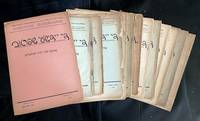
1930réf. 42139Kiev: Katedr far Yidisher Kultur ba der Ukr. Visnshaftl. Akademye Filologishe Sektsye 1930. Paper Wrappers. 1st edition. Original printed publisher’s color paper wrappers 4to large ca 72-116 columns ca 36-58 pages per issue. 28 cm. In Yiddish. Title translates roughly as “The Yiddish Language.” Succeeded in 1931 by “Afn shprakhfront.”Di Yidishe Shprakh was a “Yiddish linguistic journal published in Kiev from 1927 to 1930. A bimonthly journal Di yidishe shprakh The Yiddish Language was published by the cooperative publishing house Kultur-lige and was the main philological publication of the Kiev Yiddish academic center. Its editor was the veteran Yiddishist Nokhem Shtif a founder of YIVO who had returned to Kiev from Germany in 1926. The journal’s inaugural issue March–April 1927 was published under the auspices of the Central Yiddish Bureau of the Ukrainian Commissariat for Education. With the next issue Di yidishe shprakh was an organ of the Chair and from July to October 1929 it was an organ of the Institute for Jewish later Proletarian Jewish Culture at the Ukrainian Academy of Sciences. Initially defined as a 'journal for practical Yiddish linguistics' from May to June 1927 it appeared as simply a 'journal for Yiddish linguistics. 'Shtif distinguished three language registers: the vernacular of the old generation partly represented in the works of Sholem Aleichem and predecessors; the highbrow language of modern writers such as Dovid Bergelson; and the contemporary 'culture language' most notably of the press. Although Shtif sought to target speakers of the mass 'culture language' the journal’s circulation hovered around 500 copies read mainly by Yiddish teachers.Apart from Shtif who published articles on various language-planning problems the most active contributors to Di yidishe shprakh were Ber Slutski Ayzik Zaretski Elye Falkovitsh Lipe Reznik and Shimen Dobin. In early 1929 Moscow literary critic Aron Gurshteyn criticized the journal for its purist approach to language planning. In the July–October 1929 issue Shtif published his article 'Di sotsyale diferentsiatsye in yidish' The Social Differentiation in Yiddish heralding an intensification of Soviet linguists’ anti-Hebraist campaign. That issue of Di yidishe shprakh adopted completely reformed Soviet spelling omitting for example final consonant letters.Although the last—twenty-fifth—issue of the journal was dated November–December 1930 it included materials from the First All-Union Yiddish Language Conference convened in Kiev from 8 to 13 February 1931 that issue is present here. Published under the imprint of the Central Publishing House this issue also signaled the demise of the remaining vestiges of the Kiev Kultur-lige. Yoysef Liberberg’s article 'Far parteyishkayt in der yidisher visnshaft-arbet' For a Party Approach to Yiddish Linguistics marked a full break with YIVO scholars particularly with YIVO director Max Weinreich whom Liberberg ridiculed for presenting Yiddish as an emanation of the Ashkenazic Jews’ soul. The Yiddish Language Conference decided to change the name of the journal. Between 1931 and 1939 it appeared sporadically under the title Afn shprakhfront On the Language Front reflecting its new more aggressive and politically charged approach' Gennady Estraikh in YIVO Encyclopedia of Jews in Eastern Europe 2010. For more see David Shneer “Yiddish and the Creation of Soviet Jewish Culture 1918–1930” Cambridge and New York 2004. SUBJECTS: Yiddish language -- Periodicals. Title also listed on covers in Russian “Ievreis'ka Mova” and German “Jiddische Sprach”. OCLC: 22840298. Most holdings in OCLC appear to be fragmentary. Covers are browning and fragile as expected but are otherwise very well preserved with very little edgewear. Internal text pages are also toning but remain relatively strong as pulp paper. Very important journal scarce in this degree of completeness Note that Estraikh suggests a circulation of only 500!. B YID-43-5-E. Kiev: Katedr far Yidisher Kultur ba der Ukr. Visnshaftl. Akademye, Filologishe Sektsye unknown
1965réf. mon0000121503PROGRESS PUB. 1965-01-01. Hardcover. Good. 2.5000 in x 8.5000 in x 5.9000 in. No DJ. Mild shelf wear and fading to both volumes. Former owner's name on inside cover otherwise pages clean. Cup mark on volume one's cover. PROGRESS PUB. hardcover