257 résultats
1761réf. 49243Cambridge: John Baskerville 1761. First Baskerville edition third title impression with the price of 8s. 6d. on the title page 8vo without sections x2b 2N-2Q as often; contemporary blue goatskin with elaborate gilt border gilt-decorated spine in 7 compartments a.e.g. marbled endpapers; boards and spine worn armorial bookplate of the Hon. Charles Hope Weir followed by an inscription by his great great grandson Harry Lloyd Neruey under it. A good sound copy. Gaskell 12. John Baskerville unknown books
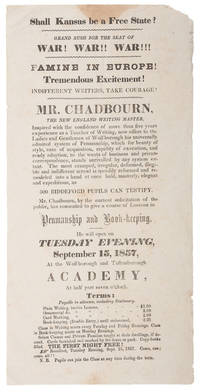
1857réf. List317New Hampshire 1857. Broadside advertisement 5 ½ x 11 inches. Very Good. An unusual advertisement for a penmanship instructor a Mr. Chadbourn announcing the opening of his academy on September 15 1857 in Wolfborough New Hampshire. The broadside states “Inspired with the confidence of more than five years experience as a Teacher of Writing now offers to the Ladies and Gentlemen of Wolfborough his universally admired system of Penmanship which for beauty of style ease of acquisition rapidity of execution and ready adaptation to the wants of business and private correspondence stands unrivalled by any system extant.” An interesting relic from the middle of the Bleeding Kansas period which would serve as a harbinger for the bloodiness of the American Civil War. A very good example with a chip with loss to upper corner and some toning to head but attractive and well preserved. Unrecorded in OCLC. unknown books
1648réf. 200414London: Not Identified 1648. Hardcover. Good Boards are in great condition; textblock edges are darkened/scuffed/smudged; FRONTIS IS NOT PRESENT; interior is toned and foxed; binding is solid. Brown leather boards with mounted red title card with gilt lettering; 268 10 pp.; FRONTIS IS NOT PRESENT. This is a beautifully rebound original copy of this scarce book. "The Eikon Basilike.The Pourtraicture of His Sacred Majestie in His Solitudes and Sufferings is a purported spiritual autobiography attributed to King Charles I of England. It was published on 9 February 1649 ten days after the King was beheaded by Parliament in the aftermath of the English Civil War in 1649. Written in a simple moving and straightforward style in the form of a diary the book combines irenic prayers urging the forgiveness of Charles's executioners with a justification of royalism and the King's political and military programme that led to the Civil War." -- Wikipedia. [Not Identified] hardcover books
1677réf. 1345415London: printed by John Bill Christopher Barker Thomas Newcomb and Henry Hills printers to the Kings most Excellent Majesty 1677. Hardcover. Quarto 24 pages; VG; Bound by Jon Robbins in modern preiod-style diced calf. Text block age-toned and foxed with minor chipping to edges. Table of articles: p. 23-24. Several ink annotations to title page. JR Consignment. . ESTC R2560; Wing C4002. The Thirty-nine Articles of 1563. 1345415. Special Collections - Downstairs. printed by John Bill, Christopher Barker, Thomas Newcomb, and Henry Hills, printers to the Kings most Excellent Majesty hardcover books
1893réf. 3292171893. framed. near fine. Document signed July 15 1893 the day after their marriage while on their honeymoon tour. Framed with three photographs; the wedding party Victoria Mary in wedding dress and portrait of George V. Decorative Elaborate decorative frame. Please inquire for more information. George V George Frederick Ernest Albert was King of the United Kingdom and the British Dominions and Emperor of India from 6 May 1910 until his death in 1936. Mary of Teck Victoria Mary Augusta Louise Olga Pauline Claudine Agnes was Queen of the United Kingdom and the British Dominions and Empress of India from 6 May 1910 until 20 January 1936 as the wife of King-Emperor George V. unknown books
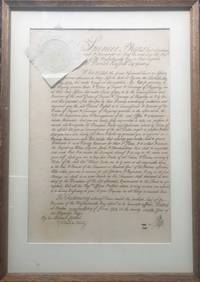
1753réf. 65805Boston 1753. Folio 14 ½ x 9 ½ inches. One-page approximately 300 words in part: "You are to account for all Collections & Payments & pay in all such Moneys as shall be in your hands as the Treasurer shall demand it according to the Directions of the Act aforesaid & pursuant to the trust in your reposed." Willard 1681-1756 served in the office of Secretary from his first commission in 1728 until his death in 1756. Despite his long service manuscript items by Phips are scarce in trade ABPC records but two in the past 45 years 1976-2019. Matted glazed and framed. A little chipping along the right edge some loss to a half-dozen letters but an attractive colonial display manuscript. unknown books
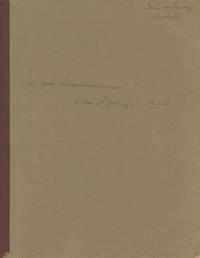
1926réf. List3141Quincy Massachusetts: unpublished 1926. 201 pp cardstock wraps. Normal wear to wraps; overall Near Fine. Alice Brackett White Coolidge 1864–1927 was a Boston socialite of the prominent Richardson family; her grandfather was merchant and Massachusetts State Legislator Jeffrey Richardson. Coolidge was also the author of three children’s books: The Bunnies of Evergreen Village 1917 The Refugees in Evergreen Village 1918 and Evergreen Village to the Rescue 1922. Offered here is Coolidge’s unpublished memoir of her early life written in 1926 titled My Early Reminiscences. The memoir recalls Coolidge’s childhood and teen years spent mainly in Massachusetts New Hampshire and Maine. Her recollections typically involve extensive descriptions of the houses at which her family stayed the scenery around them and the various families they met and visited with. Given her position in society her acquaintances are sometimes quite influential people: Princeton president John Grier Hibben enjoys Coolidge’s fishcakes; Trinity Church rector Phillips Brooks gives her grandfather an “excellent pew” in the newly-finished church; pioneering doctor Alfred Worcester mistakes red pepper for mercury in a scientific demonstration at her school; and she recalls brief correspondences with John Greenleaf Whittier and William James. Coolidge also took dance lessons from Augustus Papanti whom she describes as “one of the thinnest men I ever saw” who was “very melancholy. I hardly remember his ever smiling”; and remembers Judge Charles Devens for “his great stature his charming face his courtliness of manner and his really boyish simplicity in entering into our evening games” including a game of “mind reading” which Devens played “with zest.” One of her longtime friends was Rear Admiral John E. Pillsbury. She recalls: “Mr. Pillsbury as a young naval man a brother-in-law of my uncle Dr. Richardson used to take me out in the swan-boats on the Public Garden Pond. Later he went through all the ranks up to being retired as a Rear Admiral but time and circumstances never changed him. We always met at Thanksgiving and Christmas dinners and always talked at great length. . He was a wonderfully interesting lovable man and very modest and unassuming and shy. I always considered him one of my best friends though older by many years than I.” Another interesting New England figure Coolidge encountered was Joseph Lee. She describes Lee’s hotel in Newton: “The house where we stayed was kept by a remarkable man named Joseph Lee. He was a mulatto much above many of his kind and his wife was a handsome woman partly Indian. They did the cooking and he waited on table with a colored maid to help him. In fact there were no white women in the house. The cooking was delicious.” Lee was born enslaved in South Carolina freed in 1865 and went on to invent the automatic bread kneading and bread crumbing machines. Though nearly all of her childhood was spent in New England she also remembers being invited to visit Charles Joseph Bonaparte in Baltimore: “We had never been so far south except to Washington and I felt a curious feeling of being in a different atmosphere from any I had known. . We were met at the station by Mrs. Bonaparte in a large roomy covered vehicle with two horses. The coachman and footman were in the Bonaparte colors -- a deep wine color. The footman I well remember. He was a light-colored young negro very handsome and smiling and excited over having young ladies from the North. . All the servants were colored and lived in cabins near the house. . I never knew Mr. Bonaparte in public life so my memories of him are quite intimate and I fancy I saw much of his real self. . His mind was very active. He used to talk or listen as he walked and he moved his head in a curious way from one side to the other with a slightly rolling motion which was distinctly individual. . I never saw him irritated or excited and he was always very simple. In the group picture we had taken at the Maplewood he sat down cross-legged on the piazza floor like a boy. That was in about 1887. I suppose in public life or in law he was different but he was very equable and charming as we met him in his home and at the mountains. Most of all I admired his sweet tender ways with his flower-like wife.” This was not too long after the end of Reconstruction and Coolidge remarks on the tense atmosphere: “Mrs. Bonaparte had warned me to be careful about questions regarding the North and South as the ‘feeling’ had not yet died away. I was so glad she had warned me. A gentleman slipped in and sat down beside me to watch a parade and whispered in my ear as the bands had been playing ‘Dixie’ how glad he was to meet a Northerner. I was glad to meet him too although I remember neither his name nor face but I felt I breathed freer in his sympathetic locality. . I had no idea that this feeling still remained as far North as Baltimore and of course I remembered how our Massachusetts troops had been fired upon in Baltimore at the outset of the war but I was admonished and very wise and only returned my unremembered neighbor’s greeting with a sympathetic word and look.” Besides individuals Coolidge does cover a few historical events including the Great Boston Fire of 1872: “Oh! a horrible sight met our eyes. Back of the opposite houses in Park Square was a background of sheets of red flames and heavy black smoke rising high into the air. . On the Parade Ground all was in confusion and the sight was very sad and never-to-be-forgotten. It was literally covered with boxes and bales of furniture and sad forlorn desperate looking people crouching or sitting or standing amidst what they had saved from their homes . At night . the whole city was in darkness as there was no gas.” The family also frequently stayed at hotels in the White Mountains of New Hampshire and Coolidge recalls the “overwhelmingly tragic” effects of the 1867 sale of this land to logging companies; she writes that looking out from the Flume House in Franconia “all about were brown scarred places marking the woodchoppers’ work which was cutting away our beautiful trees for lumber”. In this memoir Coolidge supplies detailed remembrances of the private personalities of influential figures of Gilded Age New England. We find two copies of My Early Reminiscences on OCLC. Of interest to historians of the era especially as told through the perspective of a young woman. unpublished unknown books
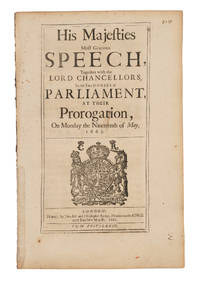
1662réf. 751521662. Charles II and the Earl of Clarendon Address the Cavalier Parliament Charles II 1630-1685 King of England. Hyde Edward 1st Earl of Clarendon. His Majesties Most Gracious Speech Together with the Lord Chancellors To the Two Houses of Parliament At their Prorogation On Monday the Nineteenth of May 1662. London: Printed by John Bill and Christopher Barker 1662. 23 1 pp. Folio 10-3/4" x 7". Disbound stab-stitched pamphlet. Moderate toning light foxing leaves separating but secure first leaf reinforced at gutter on recto handwritten folio numbers in ink to upper right corners. $650. Only edition. Delivered at the end of the first session of the Cavalier Parliament this speech followed the passage of many acts consolidating the king's power and restricting religious freedom including the Corporation Act the Act of Uniformity and the Quaker Act. Charles II's speech primarily focuses on the "Affection and Kindness" of Parliament in awarding him generous revenue while the longer speech of Edward Hyde cites Machiavelli "an Author much studied of late in this Kingdom" in a warning to listeners against being complacent during peacetime. English Short-Title Catalogue R16202. unknown books
1628réf. 1354293London: Bonham Norton and John Bill 1628. Presumed First. Hardcover. Small Quarto 5.75 in x 7.5 in; VG; Bound in modern marbled boards; Text block with only the slightest age-toning; 4 45 1 pages. RW Consignment. 1354293. Special Collections - Downstairs. Bonham Norton and John Bill hardcover books
1902réf. 408491Cambridge: Harvard Illustrated Magazine 1902. Unbound. Near Fine. Broadside. Measuring 8" x 14". Printed in red and yellow on thin card stock. Modest age-toning and three tiny tack holes near fine. Decorated with a very attractive illustration of the Egyptian goddess Isis with wings spread over the word "Jan." presumably indicating the January issue. The illustration is signed in print "George Allan England '02" along with two Chinese characters. England attended Harvard University where he received Bachelor of Arts and Master of Arts degrees. However he is better known as a socialist politician and writer; he was the author of several books of speculative fiction and science fiction as well as collections of detective stories. His story "The Thing from - 'Outside'" appeared in the first issue of the first science fiction magazine Amazing Stories. In his day he was considered one of the closest rivals to Edgar Rice Burroughs. This advertising poster exhibiting his artistic skill is presumably very uncommon. Harvard Illustrated Magazine unknown books
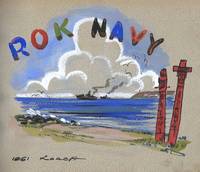
1961réf. 41436np 1961. Near fine. Album belonging to Sergeant John A. England United States Army from his 1960 trans-Pacific cruise aboard the U.S.N.S. General Edwin D. Patrick a WWII-era transport ship based out of San Francisco. A contingent from the Republic of Korea Navy was aboard and the album focuses heavily on the Korean sailors and their interactions with American servicemen. A brilliant hand-painted title illustration in acrylic titled 'ROK NAVY' and two additional vignette works in the same medium illuminate the album. The images are clear and well composed creating a significant record of U.S.-Korean relations and of the Edwin D. Patrick which was the longest surviving of the P2 carriers in the U.S. fleet launched in 1945 decommissioned in 1968 and sent to scrap in 2010. Hardcover. Oblong folio commercial album measuring approximately 10.5" x 14.5". Green faux-leather covered boards string bound. 24 card leaves 21 with 77 black and white snapshot photographs each measuring approximately 5" x 3.5" recto mounted loosely in corners. Final 3 leaves blank an additional 3 photographs laid-in; 80 prints total. Hand-painted title illustration to first endpaper two vignette scenes on first and fourth leaves. Mild edge wear to album exterior otherwise generally near fine. unknown books
1863réf. 37487Boston 1863. Folio broadside 9-1/4" x 13-1/2". Printed beneath the caption in three columns each column separated by a rule. Blank upper left corner with a slight smudge. Very Good plus. The Society founded in 1863 published numerous articles supporting the Union emancipation and victory. Its folio broadsides are far scarcer than the octavo imprints of the Loyal Publication Society in Philadelphia. The first of several articles reports on the stunning election results in Pennsylvania and Ohio: "The people of this country-- the great democratic masses-- without regard to parties or prejudices are determined to maintain their government in all its integrity and strength. Both the peace men of the North and the war men of the South received a stunning blow yesterday." In Ohio the traitor Vallandigham "has been beaten by an unprecedented majority." And in Pennsylvania the Copperhead Woodward has been repudiated. Another article expresses hope that the small farmers of the South and "are thoroughly tired of the war." The final article reports on Kentucky's Joseph Holt's advocacy of the use of Negro soldiers. Sabin 52696 reference. unknown books
1688réf. 758771688. A Call to Allow "Willing and Able" Protestants to Hold Public Office William III 1650-1702 King of England. His Majesties Most Gracious Speech to Both Houses of Parliament On Saturday the Sixteenth of March 1688. London: Printed by Charles Bill and Thomas Newcomb 1688 i.e. 1689. 4 pp. Folio 10-3/4" x 6-3/4". Disbound bifolium pamphlet. Light toning leaves nearly separated faint dampstain to bottom margin. $650. Only edition one of two issues. A request by William III that Parliament might "leave Room for the Admission of all Protestants that are willing and able to Serve" in public office while continuing to "sufficiently Provide against Papists." This ultimately resulted in the Act of Toleration which allowed certain groups of nonconformist Protestants freedom of worship but continued to exclude dissenters and Roman Catholics from public office. English Short-Title Catalogue R507163. unknown books
1762réf. 48821Cambridge: printed by John Baskerville printer to the university 1762. First duodecimo Baskerville edition 12mo 198 leaves collating as in Gaskell; the title a cancellans as described by Gaskell with the price of "five shillings unbound"; bound with: Sternhold Thomas & John Hopkins. The Whole Book of Psalms Collected into English Metre. Birmingham: printed by John Baskerville 1762. 55 of 61 leaves wanting K2-L6; first Baskerville edition; together in contemporary full red morocco elaborate gilt borders on covers gilt-decorated spine in 6 compartments without letters a.e.g.; extremities lightly rubbed but generally a very good copy in a nice binding. Gaskell 20 "Baskerville agreed with the University to print an edition of 4000 copies" and 21 respectively. printed by John Baskerville, printer to the university unknown books
1683réf. 65703Oxford: printed at the Theatre; London sold by Thomas Guy at ye Oxford Arms on ye westside of Royal Exchange in Cornhil 1683. Folio in 6s 1 leaf unsigned engraved title page a-bâ´ A-MⶠN¹ Aa-HhⶠIi-Mmâ´ Nn-OoⶠPpâ´ Qq² Llâ‚ incorrectly signed L; engraved title page with top 1¼" excised likely to remove a previous owner's name pp. 306 15 7; contemporary and almost certainly original full black paneled goat with gilt floral sprays and lozenges the central gilt panel enclosing a gilt supralibros of a rampant lion holding a patriarchal cross; gilt-decorated spine in 7 compartments black leather label in 1 a.e.g.; small chips and cracks at spine ends joints starting at the ends corners a little smushed the whole rubbed and worn but the binding remains sound. Ostensibly Wing B-3672. Of this issue 328 pages only UCLA and the University of Bristol in OCLC. printed at the Theatre; London, sold by Thomas Guy at ye Oxford Arms on ye westside of Royal Exchange, in Cornhil unknown books
1915réf. 19738Saint Louis: William K. Bixby Printed by the Torch Press Cedar Rapids 1915. One of 200 copies printed. Frontispiece portrait facsimile of the letter. 1 vols. 4to. Original cream boards stitched. Some light discoloration else a very good copy. One of 200 copies printed. Frontispiece portrait facsimile of the letter. 1 vols. 4to. With a very interesting 8-page 8vo autograph letter from Charles L. Freer the eminent American collector written from London May 1902 to W. K. Bixby regarding his visit with Whistler. He describes his pursuit of Whistler's art works and writes Bixby to say that he has arranged for Bixby to purchase "Grey & Silver Pourville." Freer's extensive Whistler collection with his other fine collections were presented to the Smithsonian Institution to form the Freer Gallery of Art in Washington. Bixby's "Privately Printed Books" p. 15 William K. Bixby [Printed by the Torch Press, Cedar Rapids] unknown books
1970réf. CAT0131New England 1970. Two plastic albums 10 ½ x 11 inches. A lovingly arranged and annotated product of someone’s obsession with New England’s churches. Nearly all photos 3 ½ square. A few of the churches have multiple photos. Most photos are shot from a similar three quarters frontal view though some are frontal. The repeated perspective shows a respect for the vernacular forms though it is unclear if the photographer’s interests were architectural or historical in nature. The photographer travelled throughout New England with the breakdown of churches as follows: 206 in Massachusetts forty-six in Connecticut forty-eight in Maine eighty-six in New Hampshire sixteen in Rhode Island and six in other states. A fine collection impeccably preserved in the original albums which read “Memories” on the front. unknown books
1635réf. 827351635. Edinburgh 1683. 13-1/2" x 11. Edinburgh 1683. 13-1/2" x 11.". Rare Broadside Recording a Proclamation of Charles II Enacted to Protect the Textile Industry Broadside. Charles I 1600-1649 King of England. A Proclamation Discharging Merchants and Other Traffickers to Sell or Exchange any Prohibite Commodities With Themselves Or Amongst Others. Edinburgh: Printed by the Heir of Andrew Anderson Printer to His Most Sacred Majesty 1683. 13-1/2" x 11" 34.3 x 28 cm broadside removed from volume with loss of most of imprint statement at foot text in single column below headline and large woodcut royal arms eight-line woodcut initial. Moderate toning lightly soiled horizontal fold line through center some edgewear along left margin "94" and "August 1683" in early hand along right margin. $750. Only edition one of two issues the other published in London. Intended to support domestic textile production this broadside was sent to sheriffs and other law enforcement officials throughout Scotland. The salutation line in our copy is blank. An act from September 1681 and a proclamation from the year before prohibited the importation and sale of certain fabrics. However it permitted merchants to sell any imported stock that remained. By 1683 sufficient time had elapsed to liquidate this stock but it was apparent that many were continuing to import textiles in violation the law. The present broadside decrees that merchants cannot buy or sell any "Cloaths Stuff Sarges serges Holland Cambridge Silk-stockings or any Goods made of Wool or Lint" unless they can prove they were either made in the kingdom or lawfully imported before the prohibition. As for any remaining imported stock permission is granted to the Merchants Burgesses of Edinburgh to sell it until November 1. Afterwards it will be "Confiscat Burnt and Destroyed and the Persons guilty otherwise punished." Both issues of this broadside are rare. OCLC Steele and the English Short Title Catalogue locate four copies of ours National Archives of Scotland National Library of Scotland Harvard Business School two copies. Steele A Bibliography of Royal Proclamations of the Tudor and Stuart Sovereigns III:2552. English Short-Title Catalogue R183441. unknown books
1635réf. 774751635. London: Robert Barker 1635. 15-1/2" x 11-1/4. London: Robert Barker 1635. 15-1/2" x 11-1/4". "To Confirme to His Subiects Their Defective Estates" Broadside. Charles I 1600-1649 King of England. By the King. A Proclamation Declaring His Maiesties Royall Grace and Pleasure To Confirme to His Subiects Their Defective Estates in Their Lands and Possessions By His Commission Lately Renewed and Enlarged to That Purpose. London: Imprinted.by Robert Barker Printer to the Kings Most Excellent Maiesty And by the Assignes of Iohn Bill 1635. 15-1/2" x 11-1/4" broadside text in single column below headline and large woodcut royal arms ten-line woodcut initial. Moderate toning faint horizontal fold line through center faint dampstaining to lower quarter of sheet chipping to edges with loss to imprint statement at foot of text bottom edge repaired. $750. This proclamation announced one of the king's strategies during his period of personal rule to raise revenue without reconvening Parliament. It established a commission which for fees paid would cure defective titles. There are two versions of this broadside; one has the initials "C" and "R" above the royal arms the other does not. Ours is the version without the initials. Both are rare; fewer than 5 copies of either are listed on OCLC and the ESTC. OCLC locates 1 copy in North America identical to our version at Yale. English Short-Title Catalogue S3584. unknown books
1635réf. 757411635. London: Robert Barker 1632. 15-1/4" x 11-3/4" 2 ff. London: Robert Barker 1632. 15-1/4" x 11-3/4" 2 ff. Stricter Enforcement of Lenten Laws Broadside. Charles I 1600-1649 King of England. By the King. A Proclamation Commanding the Due Execution of the Lawes Made Against Eating and Selling of Flesh in Lent And Other Times Prohibited. London: Imprinted.by Robert Barker and by the Assignes of Iohn Bill 1631 i.e. 1632. 15-1/4" x 11-3/4" 2 ff. broadside text in single column below headline and large woodcut royal arms 8-line woodcut initial. Moderate toning very light foxing and soiling single horizontal fold line to each sheet. Housed in 13-1/4" x 9-1/2" buckram folder with red morocco spine label. $750. In England the traditional Lenten fast was not only a matter of private religious observance but enforced public practice. The prohibition of eating or selling meat on designated fasting days referred to as "fish-days" in this broadside was backed up by statutory and royal authority and beginning in 1632 under Charles I somewhat strictly enforced. OCLC locates 3 copies of this broadside in North America Harvard Yale Huntington Library. The ESTC adds a North American copy at Folger Shakespeare Library. English Short-Title Catalogue ESTC S122791. unknown books
1797réf. 341884London: Printed by C. Whittingham for T. Heptinstall 1797. Hardcover. Near Fine. First edition thus. 12mo. ix 15 347 1 91 5 pp. 19 cm. Issued with a separate title page for A New Version of the Psalms of David by N. Brady and N. Tate H.D. Symonds 1796. In contemporary straight grained black morocco double fillet gilt borders on both boards gilt turn-ins gilt spine title all edges gilt marbled endpapers. Owner's name and address in neat ink on the front paste down. With an attractive contemporary dark red morocco bookplate: "Charlotte Godwin 1798" in gilt with double fillet gilt borders and decorative motif on the front pastedown. Corners bumped with moderate scattered foxing to the text pages else a beautiful fine copy with an interesting early American bookplate. The Godwin family was one of the first to settle in the Eastern Shore region of Virginia. Scarce. OCLC locates only one holding. Printed by C. Whittingham, for T. Heptinstall hardcover books
1835réf. 177521835. Garrison William Lloyd associated. Third Annual Report of the Board of Managers of the New England Anti Slavery Society 1835 an early institutional document of organized abolitionism that records the structure leadership and expanding influence of the New England Anti Slavery Society during a formative stage of the movement. Issued four years after the Society's founding in 1831 under the leadership of William Lloyd Garrison editor of The Liberator the report documents the transition from localized reform efforts to a coordinated national campaign through affiliated societies. The text situates abolition as a moral and political imperative asserting the rapid growth of antislavery sentiment and anticipating legislative abolition. Garrison and Knapp. Third Annual Report of the Board of Managers of the New England Anti Slavery Society. Boston: Garrison and Knapp 1835. First edition. Pamphlet. The report includes the Society's constitution lists of officers detailed subscription and donation records and a treasurer's report alongside rosters of life and honorary members. Named figures include William Lloyd Garrison Moses Brown Thomas Clarkson Josiah Wedgwood and William Wilberforce linking American abolitionist organizing to transatlantic reform networks. The closing statement declares "Thousands and tens of thousands of conscientious persons are already beginning to look upon slaveholding in its true light as an atrocious crime. it will have been abolished by the State legislatures" expressing confidence in the accelerating spread of antislavery conviction. Published in 1835 the same year the New England Anti Slavery Society reorganized into the Massachusetts Anti Slavery Society the report documents a critical moment of institutional consolidation and expansion within the abolitionist movement. The inclusion of financial records and membership lists provides evidence of the material and social networks sustaining reform while the ideological language reflects the shift toward immediatism that defined Garrisonian abolitionism. Later plain wrappers; light wear with clean and stable text. Overall very good condition. unknown books
1919réf. 348420Boston: Small Maynard & Company 1919. Hardcover. Near Fine/Very Good. First edition. Slight mustiness else fine in very good dustwrapper with small nicks and tears and some overall soiling. Scarce in jacket. Small, Maynard & Company hardcover books
1611réf. 751911611. The Creation of Baronets Under James I James I 1566-1625 King of England and Ireland. His Majesties Commission to All the Lords And Others of the Privie Counsell Touching the Creation of Baronets Whereunto are Annexed Divers Instructions And His Majesties Letters Patents Containing the Forme of the Said Creation. Also the Forme of an Oath to be Taken by the Said Baronets. London: Imprinted by Robert Barker 1611. iv 18 p. 18 18-38 2 39-44 pp. First leaf blank signed "A". Lacking final leaf a blank. Quarto 7-1/4" x 5-1/2". Stab-stitched pamphlet bound into modern three-quarter calf over marbled boards gilt and blind fillets and gilt title and publication date to spine. Moderate toning to interior light soiling to first leaf a small repair to its verso minor smudges to title page and following leaf. A handsome copy. $850. Only editions. Enactments dealing with the creation of the baronetage by James I. The title of baronet "a new dignitie between Barons and Knights" was established by letters patent as a way for James to raise revenue quickly without Parliament. Initially prospective baronets were required to pay enough money to "maintaine the number of thirtie foote-Souldiers in Ireland" for three years at a rate of eight pence per day men badly needed to maintain English control in Ulster. The second title largely reprints the letters patent of the first title and includes some additional clarification about matters of precedence. There are 1274 baronets on the Official Roll of the Baronetage today. English Short-Title Catalogue S122652 S100729. unknown books
1785réf. 52084London: A. Hogg 1785. Hardcover. Very good condition. Folio. 12 i-xvi 9-46 57-417 3: ads; directions to book-binder; list of subscribers. 38 engraved plates. Contemporary calf lightly rubbed and scuffed spine with raised bands. Red silk ribbon marker. Text with occasional smudges and mild marginal dampstains or spotting but overall clean and crisp. A very good copy complete with all 36 plates called for in the instructions and 2 additional. 11 of the plates are bound consecutively in the preliminaries rather than placed in the text; these 11 plates all have relatively simple borders in contrast with the ones properly placed. Sumptuously illustrated Church of England prayer book with a substantial apparatus of theological historical and critical commentary. Issued in 36 numbered parts the text is complete despite the gap in pagination between pages 46 and 57. The anomalous pagination of the preliminaries is explained in the binder's directions: "N.B. Place the Act for the Uniformity of Common-Prayer &c. and the Tables of Proper Lessons Feasts Fasts Kindred and to find Easter-Day viz. 5O and 5P i.e. 4 leaves of part 36 immediately after the Preface before the Calendar." References: ESTC T82283. A. Hogg hardcover books