Princess Charlotte of PrussiaBiblio.com

953 Ergebnisse
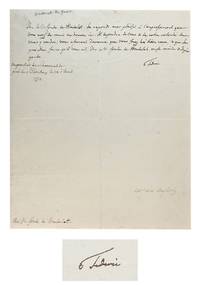
1815Best.-Nr. 3633626/03/1815. In 1815 Berlin had been liberated from Napoleon for just 2 years and the Palais am Wilhelmsplatz in Berlin was a key aristocratic residence near the Wilhelmstrasse which was becoming a hub for government and high society. This area was crucial for military leadership and elite housing near the Brandenburg Gate often used by Prussian royal families and high-ranking officials during the post-Napoleonic era. Composed just days after Napoleon Bonaparte returned to power in France March 1815 and Prussia had reason to fear another invasion this letter offers a glimpse into the private concerns of the Prussian royal family at a moment of major European upheaval. Despite the looming political crisis the correspondence reflects the everyday workings of aristocratic patronage property management and family influence within the Prussian court. Princess Charlotte Autograph letter signed March 26 1815 to Prince Friedrich of Prussia just 6 days after Napoleon's arrival in Paris for his famed 100 days. ""Esteemed uncle A gray eternity has passed since my eyes last gazed upon your gentle countenance I feel anxious and I long to see you again. Two matters urge me today to burden you with my lines; firstly to find out about your health and how my uncle is doing; and secondly it is a request to you on behalf of Ms. von Kleist who would so much like to live in some rooms in your unused Palais at the Wilhelmsplatz. Aunt Hußen has already written to you in this regard and you didn’t know whether the King would allow it. Now I received a letter from Papa yesterday who told me that he cannot grant the request as it concerns the Johanniter Palais and is therefore at the disposal of his brother Heinrich; so he leaves it up to you and as one can see he will not mind; and is it not true that you are not using the whole large building at all and that you will heed my request all the more so since it is your aunt Auguste’s wish I am counting on your generosity and kindness my one and beloved uncle and I am waiting for a favorable response; as I am kissing your gracious hands in my mind until it can soon be done in actuality – your Charlotte"" <img class=""alignnone wp-image-25018 size-post-window"" src=""https://cdn.raabcollection.com/wp-content/uploads/20231204144051/Folder-site-11-1600x1327.jpg"" alt=""historical memorabilia dealer"" width=""1600"" height=""1327"" /> unknown
1778Best.-Nr. 173569N: N 1778. dated 14th April 1778 Headquarters at Schonwalde near Silberberg expressing pleasure at his desire to come and join him. Single sheet 22.7 cm. x 19 cm. 7 lines written on one side with creases. Frederick II King of Prussia known as Frederick the Great 1712-1786 was ' a brilliant military campaigner who in a series of diplomatic stratagems and wars against Austria and other powers greatly enlarged Prussia's territories and made Prussia the foremost military power in Europe Britannica'. lang2057 The recipient probably Vicomte de Houdetot often spelled Houdelot belonged to a prominent French aristocratic family. N unknown
1900Best.-Nr. 1649241900-01. Ten-thousand words of musings on democracy aristocracy and plutocracy An extensive manuscript being Kaiser Wilhelm's unpublished translation into German of an article covering political theory from the English journal The Quarterly Review. The original article by Goldsworthy Lowes Dickinson published in the October 1900 issue of the journal pp. 359-80 was nominally a review of eight recent books on political philosophy among them Heinrich von Treitschke's Politik E. L. Godkin's Problems of Modern Democracy and Theodore Roosevelt's American Ideals. In practice as standard for the Quarterly Review the article used the reviewed works as a starting point for a wider discourse. The article would have clearly appealed to the Kaiser. It begins by asking whether political philosophy even exists and the author notes that historically political philosophy is characterized by absolutism. However he observes that there is now a shift towards relativism. The trend in modern politics is the state's growing power and size those in control increasingly influenced by plutocracy. He argues that the House of Commons gradually ceded its power to the Cabinet risking a shift in British democracy towards the American plutocratic system. The solution is to preserve an aristocracy but one based on training and ability rather than birth. Wilhelm has dated the first page "25.12.1900" and "2.2.1901" and the last page "17.2.1901" presumably the dates between which he translated it. The lengthy project totalled around ten thousand words. He has made a few corrections and underlined some words for emphasis. Generally the manuscript is written confidently in Wilhelm's bold hand. Wilhelm had an English mother the eldest child of Queen Victoria and spoke English fluently though from his boyhood preferred the Prussian militarist and autocratic teachings of his tutors to the British liberalism of his mother. Wilhelm had been Kaiser for 13 years when he undertook the translation and his reasons for doing so are unknown. He was always deeply interested in political ideas the preservation of the German order and in Britain's development and its threat to German power. A typed transcript of the German translation and a photocopy of the Quarterly Review article is included. Manuscript 38 bifolia with full-page manuscript on 77 pages and running heading "Politik" on first page of each except the first; page size 235 x 202 mm; Wilhelm's coat of arms embossed in silver at head. Housed in custom quarter leather solander box. Very light soiling. In excellent condition. hardcover