Haak.Venise.Livre Rare Book

2 156 résultats
réf. 50710Leide.Chez C.Haak.1762.In-folio en veau raciné.115 figures en taille-douce dont 2 planches de Venise,rempliées et gravées..Doubles pages.Sous-titre en français,latin,italien.Edition originale avec des plans et des figures précises.Légère restauration invisible.Tranches rouges.Dos à 5 nerfs avec caissons ornés de fleurons dorés.Pièce de titre en maroquin.Très bel exemplaire.
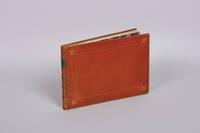
1825réf. 4504048Probably Venice 1825. A few spots but generally in fine condition the watercolours well preserved and bright. Oblong small quarto album 185 x 275mm containing forty-six watercolours of various sizes and shapes ranging from delicate circular vignettes to larger scenes of urban and theatrical life elegantly bound in nineteenth-century ochre morocco with ornate gilt decoration. A beautiful suite of watercolours including a superb series of scenes of a contemporary Venetian commedia dell'arte troupe by the Venetian painter and engraver Novelli. Featuring images from both the stage and street-performance including acrobatics and conjuring each of the 46 deftly drawn images of which 11 are signed is of considerable quality. Francesco Novelli 1764-1836 vividly and imaginatively illustrated Algarotti's Opere 1791-94 assisting his father Don Quixote 1819 and Gil Blas 1820. He is also known for illustrating works such as the Fasti Veneziani 1794 hinting at his abiding interest in the theatre and the performing arts. One of Novelli's most important teachers was the French artist Vivant Denon who visited Venice in the 1790s. Denon seems to have had a formative influence on Novelli's career not least because he introduced his pupil to the engravings of Rembrandt. This rare and exceptional collection provides a wonderful insight into Italian theatre in its golden age. The album includes an incomparable collection of Novelli's watercolours with the greatest number being piquant images of a Venetian troupe of the commedia dell'arte with especially fine depictions of Pierrot himself as well as other key figures such as Columbine and Harlequin. It includes a remarkable series of scenes from a stage play as well as studies of the individual performers. Indeed many of these images are so precisely rendered that it is likely that Novelli depicts a well-known troupe perhaps one with which he was personally connected. The remaining images cover all aspects of contemporary life including several military vignettes perhaps scenes from the diorama as well as charming rural scenes. Several show Novelli's work at its most sympathetic especially in his animated studies of street vendors and town squares. It is also likely that many of these scenes derive from a period when the troupe was on the road especially as some of the liveliest show street performers conjurors and Punch and Judy shows. These scenes reveal Novelli at the height of his powers especially his skill in capturing the energy and fascination of the crowds that gathered to watch the impromptu performances. Unpublished although the compilation of the album suggests that publication might originally have been Novelli's intention. This is a superb collection of images by one of the pre-eminent artists of his generation providing an insight into Novelli's involvement with the Venetian theatre as well as giving a unique opportunity to study the daily life of a travelling group of European artists and musicians at the turn of the nineteenth century. Make-up of the album:- • three portraits of peasants: • a fishmonger with his left sleeve hanging loose • a peasant women with a cob of corn • a profile of a woman in an elaborate scarf • a uniformed cuirassier rejects the entreaty of a woman • a lively scene at the market with a grenadier a Pierrot and a harlequin • a crowd gathers around a conjuror in the town square • children animatedly watch a Punch and Judy show • a street performer shows a dancing bear while an urchin shows a monkey • two small round scenes: • the first of a cavalry charge • the second a peaceful domestic scene around the hearth • an infantry charge perhaps a real scene or a diorama • three generations of women interior • a lively outdoors scene of the stables • two women work inside a darkened barn • four liveried horses with a cart full of hay • two small round scenes: • a scene in the yard of a hostelry • cooking in a well-provisioned kitchen • two small square scenes: • infants and burghers at a Punch and Judy show • small children crowd around an itinerant projectionist • two small square scenes: • dancing a lively jig • the children of the house at lessons • two small square scenes: • a muzzled bear is made to dance • masked members of a commedia dell'arte troupe enjoy a repast • two small square scenes: • a corpulent gent mounts his horse • a befrocked gentleman loses his hat in an impromptu swing • two small square scenes: • a mother with swaddled child and infant greets some friends • a game of cards • two small square scenes: • Pierrot chased by a 'dog' • Pierrot discovers Harlequin and Columbine with stylized cartouche but no caption • three medium square scenes: • the 'dog' seems to have caught Pierrot • Pierrot greets Columbine • Pierrot astride the 'dog' • two small square scenes: • a strongman lifts four children on a table by his teeth • Columbine's lover hides by pretending to be a sofa • two small square scenes: • Pierrot performs a balancing act • Pierrot discovers Harelquin and Columbine asleep • two small square scenes: • Pierrot accosted by a Satyr • Pierrot offers his hat to the 'dog' • two small square scenes: • an acrobat assumes a pose • a different acrobat stands on his hands • two small square scenes: • a female contortionist performs a trick with four glasses and a hoop • a female acrobat balances on the low-wire • two small square scenes: • one of the troupe strikes a pose • Pierrot discovers a skeleton in his closet • two small square scenes: • the skeleton torments Pierrot at table • Pierrot poses . unknown
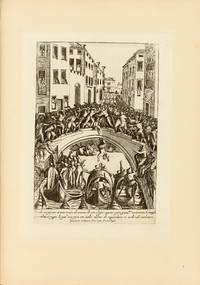
réf. NY24Venice Giacomo Franco Forma in Frezzaria al Insegna del Sole con privilegio s.d. 1610. Small folio volume. "1 . title engraved with same view of Venice than the one for "Habiti delle Donne" 1 l. not numbered dedication to Vincent de Gonzague de Mantoue dated 1st January 1610 and printed in roman characters 25 plates out of pagination and not numbered. Those plates represent 34 figures of men and women in very rich Venitian costumes life scenes festivities." Colas n° 1108. 360 x 260 mm. Dimensions of the engravings: 258 x 190 mm. Very rare first edition of one of the most famous books on Venice its festivities costumes and activities around 1600. Colas Bibliographie Générale du Costume n°1108 col. 384-5; Katalog Der Freiherrlich Von Lipperheide'schen Kostümbibliothek repr. 1963 n°1324 p. 527. "This collection offers great interest in the costumes of Venice during its greatness. It is sought after today especially as it has become extremely rare ". Vinet Bibliographie méthodique des Beaux-Arts. This collection is so rare that Brunet never found a complete copy and only described an incomplete one Brunet II 1378. As for Vinet he doubts the number of plates following the number 24 with a "" Vinet col 283 n° 2291. The copy of the British Museum only contains 20 plates out of 25 and one title leaf is missing. Title engraved with a birds 'eye view of Venice on an architectural frame with a view of the Rialto bridge and 24 extremely fine engravings. The book shows in an extraordinary detailed way the various festivities processions and past times of the city as well as great moments in its history. "Assimilated to the genre of the costume book the work by Giacomo Franco 1556 - 1620 drawer and engraver born in Venice also shows engravings of a strong interest for the history of manners and customs of the Serenissima in the 16th and 17th centuries: festivals entertainment maritime games regattas… and carnival. The 1610 edition is probably the first. The number and order of the engravings vary greatly from one edition to another and between copies of the same edition. The copy is composed of 26 copper plates including one double plate all except one signed by Giacomo Franco. The engraving named Feste che si sogliono fare per la città della caccia del toro amazzar la Gata col capo raso pigliar l'anadre pigliar l'occa nell'acqua et altro features games with animals: a bear fighting with dogs a tied up cat a goose being plunged into water a duck hanging from a mast and a chased bull. Attested since the Middle Ages bull hunting is a traditional carnival game in the Renaissance particularly in Rome and Venice". Virtual exhibition organized by the Mazarine Library Libri italiani lecteurs français "Balls festivals and banquets". "This book of engravings depicts the costumes festivals and social life of early seventeenth-century Venetians. There is no text other than a short descriptive sentence at the bottom of each engraving. Major Venetian landmarks are easily recognizable and the small ovoid map on the title-page is regarded by some scholars as an important example of early Venetian cartography. Very little is known about the Venetian engraver Giacomo Franco. The son of painter Giovanni-Battista Franco 1510-1561 with whom he began his artistic training at the age of eleven he worked as a painter engraver woodcutter and dealer in graphics and books. For a while he studied in Bologna with Agostino Carracci 1557-1602. In the early 1580s they opened a private teaching academy that soon became a center for progressive art. In their teaching they laid special emphasis on drawing from life and clear draughtsmanship became a quality particularly associated with their school. In 1595 Franco took over his father's workshop and eventually became a well-known publisher. Although he was not documented as belonging to the booksellers' or printers' guilds he is recorded in 1606 and again in 1619 as belonging to the painters' guild. Franco's determination to be recognized as an artist is reflected in his will in which he refers to himself as a "designer." The Habiti d'huomini is a potpourri of depictions of Venetian costumes processions and celebrations. Citizens are seen watching regattas fighting on bridges conversing in the Piazza San Marco and on the Rialto Bridge and marching in ceremonial procession into the Doge's Palace with flags flying and horns and flutes playing. Even the ubiquitous laundry is seen hanging on the line in the background. Men with rifles hunt ducks in the lagoon. The Doge's mighty Bucintoro warship returns from battle escorted by gondolas and saluted by cannon explosions. Carnival of course has a page of its own which depicts citizens in masks some of whom seem to be making best use of the cover of darkness to contact a prospective lover. The appropriately dressed widow is pictured heavily veiled and a married gentlewoman has two outfits from which to choose one for inside the house another for outside. The men are almost as ornately dressed as the women. The Doge in his palace wearing fine brocade and a crown moves his hand in a sort of blessing as – through a window behind him – life in the Piazza San Marco goes on". The Boston Athenaeum Museum "From the middle of the 15th century the Venetian institutions came to maturity which allows Venice to parade every week in the fullness of its myth under the eyes of the Venetians and the whole world Urbi et orbi - including the Turks and the Chinese. Venice then shows itself united eternal strong and indestructible. " One of the great moments of this frenzied proclamation of the political perfection of Venice is the rite of the trionfo - or ducal procession - where hierarchy order harmony and collective respect are the characteristics of this state liturgy. This urban rite we could even say ritual is a great moment in the political life - and in the life itself - of Venice. Indeed the ducal procession is intended to be a proclamation of the cohesion of the State and its strong structure in the eyes of the Venetians as in the eyes of foreigners who will necessarily receive echoes. The Milanese Pietro Casolo passing through Venice at the end of the 16th century was impressed by the unchanging - and disciplined - ordering of these Venetian processions: In my opinion one man seemed to rule all things and he was obeyed by all without resistance. It filled me with admiration as I have never seen such a discipline at similar shows. They walk two by two behind the doge in a completely different order from what I have seen in many religious or secular courts where as soon as the prince has passed everything goes in all directions and in disorder. Here in front and behind everything is as in a perfect order as possible. The ordering and place of each are not the result of chance but the result of a rigorously thought out and unchanging ceremony. This immutability is demonstrated by the existence of commented engravings that is to say that the artists note the order of the succession of the characters as an element as perennial as the architectures that frame this ceremony. An example the engraving of Giacomo Franco which shows us the beginning of the procession which enters the basilica. The frieze arrangement evokes the Roman triumphs of the Ara Pacis or Trajan's Column." Marie-Viallon The Ducal procession in Venice. Precious and beautiful copy coming from the library of the 19th century A. Brölemann with ex-libris. Français : Venice Giacomo Franco Forma in Frezzaria al Insegna del Sole con privilegio s.d. 1610. Petit in-folio. " 1 f. titre gravé avec la même vue de Venise que pour " Habiti delle Donne " 1 f. non chiffr. dédicace à Vincent de Gonzague de Mantoue datée du 1er janvier 1610 et imprimée en caractères romains 25 planches h. t. gr. non chiffr. Ces planches portent 34 figures d'hommes et de dames dans de très riches costumes vénitiens des scènes de mœurs des réjouissances. " Colas n° 1108. Le présent exemplaire compte 1 titre gravé avec vue de Venise et 24 planches portant 30 figures d'hommes et de dames ; manquent le feuillet de dédicace et une planche portant 4 figures mais le nombre et l'ordonnancement des gravures sont très variables entre les exemplaires d'une même édition " this fine collection of detailed views and scenes of Venetian life and costume was issued with varying numbers of plates ". Qq. rousseurs en marge du frontispice. Le tout monté sur grand papier et relié vers 1850 par Duru en demi-maroquin rouge à coins. 360 x 260 mm. Dimensions des gravures : 258 x 190 mm. Edition originale rarissime de l'un des livres les plus célèbres sur Venise ses fêtes costumes et activités vers l'année 1600. Colas Bibliographie Générale du Costume n°1108 col. 384-5; Katalog Der Freiherrlich Von Lipperheide'schen Kostümbibliothek repr. 1963 n°1324 p. 527. " Ce recueil offre un grand intérêt pour les costumes de Venise pendant sa grandeur. On le recherche aujourd'hui d'autant plus qu'il est devenu d'une extrême rareté ". Vinet Bibliographie méthodique des Beaux-Arts. Ce recueil est si rare que Brunet n'a jamais rencontré d'exemplaire complet et ne décrit qu'un exemplaire incomplet Brunet II 1378. Quant à Vinet il doute du nombre de planches faisant suivre le chiffre 24 d'un " " Vinet col 283 n° 2291. L'exemplaire du British Museum ne contient que 20 planches sur 25 et il manque le feuillet de titre. Titre gravé avec vue à vol d'oiseau de Venise dans un cartouche architectural surmonté d'une vue sur le pont du Rialto et 24 gravures extrêmement fines. Le livre montre avec un détail extraordinaire les différentes festivités processions et temps passés de la ville ainsi que de grands moments de son histoire. " Assimilé au genre du livre de costumes l'ouvrage de Giacomo Franco 1556 - 1620 dessinateur et graveur né à Venise montre également des gravures d'un fort intérêt pour l'histoire des mœurs et coutumes de la Sérénissime aux XVIe et XVIIe siècles : fêtes divertissements joutes maritimes régates… et carnaval. L'édition de 1610 est probablement la première. Le nombre et l'ordonnancement des gravures sont très variables d'une édition à l'autre et entre les exemplaires d'une même édition. L'exemplaire exposé comporte 26 planches gravées sur cuivre dont une double planche toutes sauf une signées de Giacomo Franco. La gravure intitulée Feste che si sogliono fare per la città della caccia del toro amazzar la Gata col capo raso pigliar l'anadre pigliar l'occa nell'acqua et altro met en scène des jeux avec des animaux : un ours se battant avec des chiens un chat ligoté une oie que l'on plonge dans l'eau un canard accroché à un mât et un taureau pourchassé. Attestée depuis le Moyen Âge la chasse au taureau est un jeu traditionnel du carnaval à la Renaissance en particulier à Rome et à Venise ". Exposition virtuelle organisée par la Bibliothèque Mazarine Libri italiani lecteurs français " Bals fêtes et banquets ". "This book of engravings depicts the costumes festivals and social life of early seventeenth-century Venetians. There is no text other than a short descriptive sentence at the bottom of each engraving. Major Venetian landmarks are easily recognizable and the small ovoid map on the title-page is regarded by some scholars as an important example of early Venetian cartography. Very little is known about the Venetian engraver Giacomo Franco. The son of painter Giovanni-Battista Franco 1510-1561 with whom he began his artistic training at the age of eleven he worked as a painter engraver woodcutter and dealer in graphics and books. For a while he studied in Bologna with Agostino Carracci 1557-1602. In the early 1580s they opened a private teaching academy that soon became a center for progressive art. In their teaching they laid special emphasis on drawing from life and clear draughtsmanship became a quality particularly associated with their school. In 1595 Franco took over his father's workshop and eventually became a well-known publisher. Although he was not documented as belonging to the booksellers' or printers' guilds he is recorded in 1606 and again in 1619 as belonging to the painters' guild. Franco's determination to be recognized as an artist is reflected in his will in which he refers to himself as a "designer." The Habiti d'huomini is a potpourri of depictions of Venetian costumes processions and celebrations. Citizens are seen watching regattas fighting on bridges conversing in the Piazza San Marco and on the Rialto Bridge and marching in ceremonial procession into the Doge's Palace with flags flying and horns and flutes playing. Even the ubiquitous laundry is seen hanging on the line in the background. Men with rifles hunt ducks in the lagoon. The Doge's mighty Bucintoro warship returns from battle escorted by gondolas and saluted by cannon explosions. Carnival of course has a page of its own which depicts citizens in masks some of whom seem to be making best use of the cover of darkness to contact a prospective lover. The appropriately dressed widow is pictured heavily veiled and a married gentlewoman has two outfits from which to choose one for inside the house another for outside. The men are almost as ornately dressed as the women. The Doge in his palace wearing fine brocade and a crown moves his hand in a sort of blessing as – through a window behind him – life in the Piazza San Marco goes on". The Boston Athenaeum Museum " Dès le milieu du XVe siècle les institutions vénitiennes sont parvenues à maturité ce qui permet à Venise de parader chaque semaine dans la plénitude de son mythe sous les yeux des Vénitiens et du monde entier Urbi et orbi - y compris les Turcs et les Chinois. Venise se montre alors unie forte éternelle et indestructible." Un des grands moments de cette proclamation forcenée de la perfection politique de Venise est le rite du trionfo - ou procession ducale - où hiérarchie ordre harmonie et respect collectif se veulent les caractéristiques de cette liturgie d'État. Ce rite voire rituel urbain est un grand moment de la vie politique - et de la vie tout court - de Venise. En effet la procession ducale se veut une proclamation de la cohésion de l'État et de sa forte structuration aux yeux des Vénitiens comme aux yeux des étrangers qui en recevront nécessairement des échos. Le milanais Pietro Casolo de passage à Venise à la fin du XVIe siècle a été impressionné par l'ordonnancement immuable - et discipliné - de ces processions vénitiennes : Selon moi un seul homme semblait ordonner toutes choses et il était obéi de tous sans résistance. Cela m'a rempli d'admiration car je n'ai jamais assisté à une telle discipline lors de spectacles similaires. Ils marchent deux par deux derrière le doge dans un ordre tout différent de ce que j'ai vu dans de nombreuses cours religieuses ou profanes où dès que le prince est passé tout part dans tous les sens et en désordre. Ici devant et derrière tout est aussi parfaitement en ordre que possible. L'ordonnancement et la place de chacun ne sont pas le fruit du hasard mais le résultat d'un cérémonial rigoureusement pensé et immuable. Cette immuabilité est démontrée par l'existence de gravures commentées c'est-à-dire que les artistes notent l'ordre de la succession des personnages comme un élément aussi pérenne que les architectures qui encadrent cette cérémonie. Un exemple la gravure de Giacomo Franco qui nous montre le début de la procession qui entre dans la basilique. L'ordonnancement en frise évoque les triomphes romains de l'Ara pacis ou de la colonne Trajane. " Marie-Viallon La procession ducale à Venise. Précieux et bel exemplaire provenant de la bibliothèque du XIXe siècle A. Brölemann avec ex-libris. hardcover
1697In-4° oblungo, occhietto inciso, titolo a stampa, legatura in pergamena, nervi al dorso, 1 carta di spiegazioni, 60 tavole (di cui 9 ripiegate), titolo inciso (Navigli del Giappone), 12 tavole, titolo inciso (Barche di Venezia), 2 carte di spiegazioni, 11 tavole (di cui 2 ripiegate). In totale 83 tavole di navi (di cui 11 ripiegate). Edizione originale estremamente rara. L’unico esemplare conosciuto nelle biblioteche pubbliche è quello della Marciana a Venezia. L’altro esemplare citato da Armao (Correr) non esiste più in questa biblioteca. Quello della Marciana ha solo 74 tavole. Armao, pp 171-72 conta 86 tavole (oltre al testo e il titolo). Crediamo che si tratti d’un errore: anche il numero di tavole ripiegate dato da Armao è inferiore a quello dell’esemplare in questione. Presente qualche piccolo restauro a due o tre tavole, altrimenti esemplare fresco proveniente dal Dipartimento Idrografico di Russia, di cui porta il timbro al verso del titolo: si ricorderà come quest’opera venne composta dal Coronelli per la Nazione Moscovitica, come è indicato nel titolo, v. Armao p.171.: “Vivissimo era a Venezia l’interesse per la costruzione di navi e quando il Governo veneto affidò al suo cosmografo e lettore di geografia l’istruzione di un gruppo di ‘cavalieri moscoviti’ inviati a venezia da Pietro il Grande nel 1697, Coronelli curò il disegno di tutta una serie di navigli che fece poi incidere su rame”. V. “Il P. Vincenzo Coronelli nel III centenario della nascita” p. 357 n.41, che dà la seguente collazione: tav. 71+15 e pp 2+4 In-4 ° oblong, engraved half title, printed title, vellum binding, bands on spine, 1 explanation leaf, 60 plates (9 of which folded), engraved title (Navigli of Japan), 12 plates, engraved title (Boats of Venice), 2 explanatory leaves, 11 plates (2 of which folded). In total 83 plates of ships (11 of which folded). Extremely rare original edition. The only copy known in public libraries is that of the Marciana in Venice. The other copy cited by Armao (Correr) no longer exists in this library. The Marciana one has only 74 plates. Armao, pp 171-72 has 86 plates (in addition to the text and title). We believe this is an error: even the number of folded tables given by Armao is less than that of the specimen in question. There are some small restoration with two or three plates, otherwise a fresh copy from the Hydrographic Department of Russia, whose stamp is on the back of the title: this work was composed by Coronelli for the “Nazione Moscovitica”, as indicated in the title , v. Armao p.171 .: “The interest in the construction of ships was very high in Venice and when the Venetian government entitled its cosmographer and geographer to the instruction of a group of 'Muscovite knights' sent to Venice by Pietro the Great in 1697, Coronelli oversaw the design of a whole series of ships that he then engraved on copper ". V. "Father Vincenzo Coronelli on the third centenary of his birth" p. 357 n.41, which gives the following collation: tav. 71 + 15 and pp 2 + 4
PARIS, Lib.Bachelin-Déflorenne - 1875 - In-8 - Reliure 1/2 chagrin rouge, coins frottés - Dos à nerfs - T. IX - 558 pages, y compris table - BON EXEMPLAIRE