1.283 resultados
1821ref. 58446London: Roswell and Martin 1821. Second edition. Profusely illustrated with engravings maps and two folding plans. xxxi 275 pp. 1 vols. Thick 4to 25 x 16 cm. Three-quarter red morocco marbled boards ornate gilt spine t.e.g. Extremities rubbed portion of spine label chipped off some very faint foxing. Plates clean. Very Good. Second edition. Profusely illustrated with engravings maps and two folding plans. xxxi 275 pp. 1 vols. Thick 4to 25 x 16 cm. Roswell and Martin unknown books
1830testo in francese e italiano in folio, legatura in piena pelle con sottile cornice oro ai piatti, titolo e fregi oro al dorso, frontespizio in francese con vignetta incisa, secondo frontespizio in italiano con differente vignetta incisa, pp. 54 di testo su due colonne (italiano e francese), a seguire le tavole - spellature soprattutto ai bordi dei piatti (più gravi al piatto post.) e alle cuffie, fioriture (principalmente ai margini delle pagine), minime rotture ai bordi di alcuni fogli, alcune con restauro coevo
1861In-8 gr. (mm. 271x170), 8 voll., cartonato muto coevo (dorsi sciupati), titolo oro su tassello al dorso. Straordinaria raccolta di 800 belle tavv. f.t., inc. in rame al tratto, riprodotte da "Le antichità di Ercolano, il Museo Borbonico et tous les ouvrages analogues, augmenté de sujets inédits, gravés au trait sur cuivre par H. Roux Ainé". L'opera e' cosi' suddivisa: "Peintures: Décorations architecturales. Compositions de plusieurs figures. Tableaux, paysages. Figures isolées. Frises, mosaiques - Bronzes: Statues. Bustes, lampes. L'ultimo vol., "Le Musée secret", raccoglie, in 60 tavv., la collezione di opere erotiche del Museo Reale di Napoli. Tutte le tavv. sono ampiamente descritte. "Magnifique ouvrage" come cita il Graesse,I,297; Brunet,I,666; che riportano la prima edizione del 1837-40. Alcune fioriture intercalate nel testo, ma certamente bell’esemplare marginoso.
Ricerche e digressioni varie: geologiche, topografiche, orografiche, idrauliche, storiche, archeologiche. Libri sei, nell'ultimo libro si riscontra una Guida sommaria. Napoli Tip. Morano e Veraldi 1894. In-8 gr.; pp. XI + (1) + 147 + (1), con 9 tavv. ripieg. ft. (la tav. VI risulta riparata al verso); leg. mezza perg. con punte a cinque scomparti con tasselo dorato e fregi in oro e piatti marmorizzati e copp. originali conservate (lievi fioriture e bruniture). L'A. con il presente lavoro vuole dimostrare l'inesattezza che le acque della foce del Sarno incanalate avessero potuto alimentare tutte le fontane di Pompei e molto meno i castelli acquari.
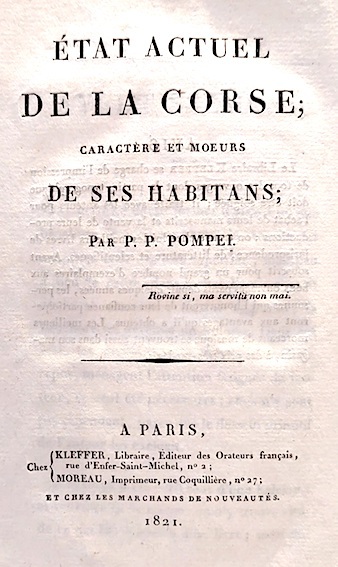
1821ref. 14828Kleffer, Moreau Paris 1821 1 vol. In-8 broché de VI 316 pp., couverture muette, pièce de titre en papier.
1933Mm 230x295 Due volumi nella loro brossura originale con titolo al dorso e al piatto: vol. I, "Testo" di xi-507 pagine con 189 figure in nero nel testo; vol. II, "Tavole" con 65 tavole in nero e a colori. Leggere, tenui fioriture concentrate nel primo tomo, peraltro l'opera è in buone condizioni nelle sue legature ben salde.Spedizione i n 24 ore dalla conferma dell'ordine.
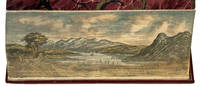
1868ref. FF2551London:: Bell and Daldy 1868. 1868. Thick 8vo. xvi 579 1 pp. 277 woodcuts 8 illus. including frontispiece reattached and large folding plate at rear showing excavations at Pompeii; lacks facing tissue to frontispiece; occasional light foxing. With a handsome full crushed crimson morocco gilt rules surround corner fillets raised bands all edges gilt. Armorial bookplate of Lank. Very good. With a fine fore-edge painting in watercolors found hidden under the gold showing Lake 'Massawhippy' sic The Lake Massawippi Eastern Townships Quebec Canada is painted after an engraving by S. Bradshaw and published by George Virtue 1841 after a drawing by William Henry Bartlett. The image appeared in Bartlett's Canadian Scenery 1842. / This fore-edge painting has been in a private collection for an unknown period of time; the date painted is unknown but likely in the range of the 1960s or 1970s. Thomas Henry Dyer 1804-1888 was an English historical and antiquarian writer. Bell and Daldy, 1868. hardcover
1868ref. FF2551London:: Bell and Daldy 1868. 1868. Thick 8vo. xvi 579 1 pp. 277 woodcuts 8 illus. including frontispiece reattached and large folding plate at rear showing excavations at Pompeii; lacks facing tissue to frontispiece; occasional light foxing. With a handsome full crushed crimson morocco gilt rules surround corner fillets raised bands all edges gilt. Armorial bookplate of Lank. Very good. With a fine fore-edge painting in watercolors found hidden under the gold showing Lake 'Massawhippy' sic The Lake Massawippi Eastern Townships Quebec Canada is painted after an engraving by S. Bradshaw and published by George Virtue 1841 after a drawing by William Henry Bartlett. The image appeared in Bartlett's Canadian Scenery 1842. / This fore-edge painting has been in a private collection for an unknown period of time; the date painted is unknown but likely in the range of the 1960s or 1970s. Thomas Henry Dyer 1804-1888 was an English historical and antiquarian writer. Bell and Daldy, 1868. hardcover books
Portfolio con sei finissime cromolitografie su disegni di Vincenzo Loria che mostrano alcuni scorci di Pompei. Senza data ma del 1890 circa. Vincenzo Loria (Salerno 1849-La Spezia 1939) pittore italiano specializzato nella pittura di genere e di paesaggio. Nella città natale iniziò a dedicarsi alla pittura sotto la guida del maestro francese Leon Richter, per poi studiare a Napoli presso l'Accademia di Belle Arti, dove, allievo di Domenico Morelli, si distinse per la padronanza acquisita nella tecnica dell'acquerello. Successivamente dipinse su commissione per amatori stranieri e ricchi galleristi, tra cui si ricorda Luigi Pisani, che acquistò numerose opere per la sua galleria fiorentina di Borgo Ognissanti. Nel 1890 Loria aprì a Napoli un'importante galleria d'arte che diventò presto uno dei punti di riferimento della scuola napoletana del secondo Ottocento. Lo studio di Loria era frequentato da illustri personalità italiane e straniere, non solo europee: nobili, industriali, politici. Antica nota manoscritta con titolo dell'incisione al verso (Casa Cornelio Rufo, Strada di Sepolcri, Casa Meleagro, Anfiteatro, Tempio di Venere, Foro civile). Le incisioni montate su cartoncino sono contenute all'interno di un album privo di indicazioni editoriali tranne la scritta in oro Pompei al piatto anteriore In buone condizion Copertina in tela con titolo in oro al piatto anteriore in buone condizioni generali con lievi usure ai margini e dorso. Legatura assente. Dim. Incisioni 21,5x27 cm. Cartoncino 32,5x40,5 cm. Album 35x41 cm. Peso Kg. 1,400. Portfolio with six very fine cromolytographs after drawings of Vincenzo Loria featuring some views of Pompei. No date but of 1890 circa. Vincenzo Loria (1850 – 1939) was an italian painter, active mainly as a watercolor artist in Naples. Born in Salerno, he went to Naples and studied under professor Domenico Morelli, painting genre subjects sometimes in oil, but more commonly in watercolor. He exhibited at Turin, Milan, Venice, and yearly at the Naples Promotrice. Antique handwritten note with title of engraving in the verso (Casa Cornelio Rufo, Strada di Sepolcri, Casa Meleagro, Anfiteatro, Tempio di Venere, Foro civile). The engravings are mounted on cartonboard in a portfolio inside an album without editorial indications apart for the golden writing Pompei in the front plate. In good conditions. Cloth cover with golden title in the front plate in good general conditions lightly worn in the extremities. Binding lacks. Dim. Incisioni 21,5x27 cm. Cartoncino 32,5x40,5 cm. Album 35x41 cm. Weight Kg. 1,400.
1870ref. 21956Paris Firmin-Didot et Cie 1870 in-8 bradel 8 volumes, reliure bradel (bradel binding) grand in-octavo (27,5 x 18,5 cm), dos long (spine without raised band), titre frappé or (gilt title), pièce de titre sur fond orangé (label of title) avec filet or (label of title with gilt line), haut du dos du tome 1 épidermé et coiffe supérieure du tome 8 manquante, recouvert de papier peigné (cover with painting paper) marron-clair et marron-foncé, toutes tranches non-rognées, RECUEIL GÉNÉRAL DES PEINTURES, BRONZES, MOSAIQUES, ETC..., découverts, jusqu'a ce jour, et reproduits d'après Le antichità di Ercolano, il Museo Borbonico et tous les ouvrages analogues augmenté de sujets inédits gravés au trait sur cuivre par H. Roux ainé et accompagné d'un texte explicatif par M. L. Barré (soit 794 planches hors-texte en noir), Comprend : T. I. "Peintures, 1ère sér. : décorations architecturales", 1870, (XXIII-134 p.-[108] f. de pl.) ; T. II. "Peintures, 2e sér. : compositions de plusieurs figures", 1870 (263 p.-[90] f. de pl.) ; T. III. "Peintures, 2e et 5e sér. : tableaux, paysages", 1870 (104, 49 p., pl.) ; T. IV. "Peintures, 3e sér. : figures isolées", 1870 (232 p.-[123] f. de pl.) ; T. V. "Peintures, 4e et 6e sér. : frises, mosaïques", 1870 (111, 45 p., pl.) ; T. VI. "Bronzes, 1ère sér : statues", 1870 (213 p.-[110] f. de pl.) ; T. VII. "Bronzes, 2e et 3e sér. : bustes, lampes", 1870 (230 p.-[100] f. de pl.) ; T. VIII. "Musées secrets", 1872 (230 p.-[60] f. de pl.), 1870-72 Paris : Firmin-Didot et Cie Editeurs,
1832ref. 8313Neapel, Stamperia Reale, 1832. 1 Bl., 91, XXIV S. 11 (1 kolorierte) teils gefalt. Kupfertafeln. Kl.-4°. HLdr. der Zeit mit Rückentitel (fleckig, beschabt und etw. bestoßen).
1892ref. 002820Paris, Calmann Lévy, 1892
ref. 106393Paris, Librairie Firmin-Didot et Cie, 1875-1878, 8 volumes in-4 de 275x175 mm environ, de 100 à 250 pages par volume, cartonnage marbré avec titres dorés sur le dos, sur pièce de titre cognac. Complet des 794 planches (+ 6 bis), soit 800 planches. Rare ensemble complet des 8 tomes, le dernier concernant l'Erotica (Musée Secret) est très difficile à trouver. Des rousseurs, gardes brunies, un dos et une coupe accidentés, coiffes et mors frottés, l'impression est un peu plus claire sur certaines planches, sinon bon état.
Pompeia. Trattato pittorico, storico e geometrico. Opera disegnata negli anni dal 1829 al 1834. Firenze, a spese dell'Autore, s.a. In folio; pp.60,5. Due frontespizi con differenti vignette incise all'acquaforte. Testo su due colonne in italiano e francese. 81 tavole incise in rame all'acquatinta ed al tratto, di cui tre spieghevoli e due con coloritura coeva. Quarantotto sono vedute e scene della cittadina vesuviana. Le altre con pitture, utensili, mosaici e piante geografiche. Esemplare nitido con ampi margini. Qualche rara fior. Mezza pelle coeva, dorso con titolo e fregi in oro. Opera rara a trovarsi completa di tutte le tavole. Furcheim, pag. 72; Lozzi 3757, nota.
1827ref. 194726Bruère éditeur Bruère éditeur, Everat imprimeur 1827. Grand In-4 carré broché, sous couverture d'attente bleue. Faux-titre, titre, 110 pages et 60 planches hors-texte gravées à l'aqua-tinta, accompagnées de notices et de dissertations. Divisé en 12 cahiers : Dissertations historique sur l'Antiquité de la ville de Naples. Grottes de Pausilyppe, dissertation historique sur l'Ancienne Capour, dissertation sur l'Ile de Caprée, dissertation sur la ville d'Herculanum. Dissertation sur l'origine de pompéi. Dissertation sur l'origine de l'art dramatique et sur celle des théâtres. Dissertation historique sur le Vésuve, dissertation sur le culte d'Isis. Dissertation sur les amphithéâtres et sur les combats des gladiateurs. Dissertations sur les monumens en général. Dissertation su l'attaque et la défense des places. Dissertation sur la maison d'Arrius Diomèdes dans le moment de l'éruption de 79. Dissertation sur les volcans en général. Dissertation sur Pozzuoli. Dissertation sur les évènemens historiques dont la Campanie fut le théâtre, et sur les hommes illustres dont elle fut le séjour. Chaque Dissertation est suivie de notes relative au cahier, les planches sont insérées en suivant. Ouvrage d'iconographie archéologique et pittoresque représentatif du goût pour l'Antiquité néoclassique et le Grand Tour sous la Restauration, consacré aux vestiges antiques de la baie de Naples (Pompéi, Herculanum, Pozzuoli, Baïes). Gravures au burin ou à l'eau-forte (parfois rehaussées ou sur papier de Chine selon les tirages) offrant un témoignage précieux sur l'état de conservation des fouilles napolitaines dans les années 1820. Quelques rousseurs claires, néanmoins très bon exemplaire, rare complet.
1933In-4 p., 2 volumi, mz. pergamena edit. con ang., tagli super. dorati. Il vol. di testo: pp. XI,508, con 1 tavola a colori, 186 ill. in b.n. e alc. figure che riproducono iscrizioni. Il vol. di tavv.: 6 pp.nn. (frontesp. e Indice), con 65 pregevoli tavole di cui 15 a colori. Importante studio sul ricco vasellame di argenteria scoperto nella “Casa del Menandro”, una delle più belle e ricche dimore gentilizie di Pompei. Esso comprende anche la descrizione della casa, delle sue strutture e architetture, della sua decorazione parietale e musiva, delle altre opere d’arte e delle suppellettili di uso domestico che vi si rinvennero. Bella edizione in tiratura di 480 esempl. numerati. Il ns., 251, è ben conservato.
[Figurato Pompei] (32x47,5) bella mz. pergamena fine '800, grande tassello al dorso in pelle e oro. Due frontis, + pp. 60, pp. 6 + 1 tav. a colori + 5 tav. + 10 tav.+ 17 tav. + 48 tav. I due frontis, in italiano e in francese, sono completamente incisi e portano due piccole vedute diverse. Testo bilingue a due colonne. Tre tavole sono doppie due a colori, tre sono posposte per errore, le 48 vedute in fine, sono incise all' acqua tinta da Paolo Fumagalli e firmate. Prima edizione rara di questa imponente opera iconografica di Pompei che illustra piante, oggetti archeologici, mosaici, vedute e suggestivi scorci delle rovine. Fu ristampato nel 1830 e nel 1834. Opera assolutamente completa delle 81 tavv. complessive citate dal Lozzi, Furcheim e Mugnaini che riporta edizioni successive. Bellissimo esemplare fresco e nitido. * Lozzi 3757 con ampie note; * Furcheim p. 72 " on touvè des exempaires avec plus ou moins de planches". Manca a molta bibliografia consultata.[f47] Libro
1827Brière éditeur, Everat imprimeur 1827. Grand in-4 carré broché, sous couverture d'attente bleue. Faux-titre, titre, 110 pages et 60 planches hors-texte gravées à l'aqua-tinta, accompagnées de notices et de dissertations. Divisé en 12 cahiers : Dissertations historique sur l'Antiquité de la ville de Naples. Grottes de Pausilyppe, dissertation historique sur l'Ancienne Capour, dissertation sur l'Ile de Caprée, dissertation sur la ville d'Herculanum. Dissertation sur l'origine de pompéi. Dissertation sur l'origine de l'art dramatique et sur celle des théâtres. Dissertation historique sur le Vésuve, dissertation sur le culte d'Isis. Dissertation sur les amphithéâtres et sur les combats des gladiateurs. Dissertations sur les monumens en général. Dissertation su l'attaque et la défense des places. Dissertation sur la maison d'Arrius Diomèdes dans le moment de l'éruption de 79. Dissertation sur les volcans en général. Dissertation sur Pozzuoli. Dissertation sur les évènemens historiques dont la Campanie fut le théâtre, et sur les hommes illustres dont elle fut le séjour. Chaque Dissertation est suivie de notes relative au cahier, les planches sont insérées en suivant. Quelques rousseurs claires, néanmoins très bon exemplaire, rare complet.
18212 volumi, 47 x 31 cm, rilegatura coeva in cartone ricoperto con etichetta cartacea manoscritta al dorso. Opera divisa in tre parti, ognuna col suo frontespizio. Volume 1, contiene tomo I e parte prima del tomo II p. xxiv, ciii, (5), 107. Volume 2 contiene, parte seconda, terza e quarta del tomo II; p. (4), 108-370, (2) (a numerazione continua dal vol. 1). In totale 208 figure artistiche, finemente incise in rame su tavole fuori testo, alcune delle quali ripiegate. Molte grandi vignette, testsatine e finalini, sempre incisi in rame. La tavola con figura 93 è postposta alla 94. Lievi bruniture a poche carte e timbretto di possesso privato ai due frontespizi. Rilegature in carta azzurrina con qualche traccia d'uso e piccole mancanze al dorso del secondo volume. Esemplare molto buono in barbe dai larghi margini.
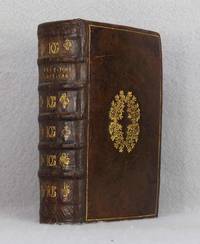
1624ref. 1205Lyon, Pierre Rigaud, 1624 ; in-12 de 561, [13] pp., reliure de l’époque maroquin brun, les plats et le dos, muet, couverts de décors dorés, blason au centre des plats, restes d’attaches en fils d’or, tranches dorées.
ref. ORD-8537Sans lieu ni date, ni mention d'éditeur, tirage albuminé ca 1880. Album à l'italienne (225 x 186) percaline rouge ornée sobrement à froid, titre en lettres dorées, page de titre et 45 superbes photos (144 x 104mm) collées sur bristol dans un encadrement doré. Photos non signées mais attribuables à Giogio SOMMER. On y trouve notamment la célèbre photo du chien fossilisé. Très bel exemplaire. Rare.
1583ref. ST15026Paris: Arnold Sittart 1584; Heidelberg: Peter Santandrea 1583. 178 x 111 mm. 7 x 4 3/8". 14 p.l. cccix pp. 13 leaves last blank; lxxv 10 ccxvi 22 pp.; 2 leaves 84 pp.; 1 1-196 18 pp.; 62 pp. Two works in several parts bound in one volume. With annotations and commentary by Antonio Augustin Joseph Scaliger and Fulvio Orsini. Pleasing contemporary calf covers with central gilt wreath of olive branches raised bands spine panels gilt with cipher "D C G" at center flanked by a palmette and a vegetal trefoil gilt titling bottom panel with "OD" and "I8" on either side of the cipher. Printers' devices on the title pages decorative woodcut initials and headpieces. Front pastedown with what appear to be early library shelf markings; one page with neat early marginalia. Adams V-590 and F-390. Covers slightly marked spine with a bit of superficial crackling and with one short crack in the middle of bottom panel the text with faint browning and isolated minor soiling a few leaves with long shallow creases not affecting legibility otherwise in excellent condition the binding solid and without significant wear and the leaves generally clean fresh and smooth. This glossary of recondite Latin words and phrases was no doubt bound for a contemporary bibliophile with an extensive library. The "OD" and "I8" at the bottom of the spine appear to be the indication of a shelf location--not something frequently encountered on spines of this period. This designation and the location notation on the front pastedown that clearly relates to it "Arm. 0. Tab 4. Loc. 18" suggest a library of some complexity and an educated owner who believed in careful organization. While we have not been able to identify "D C G" she would seem also to have been a person of taste and good sense. The binding is attractively decorated while still being practical for scholarly use. The work itself has gone through a number of changes of fortune. The story begins when Verrius who lived in the time of Augustus compiled a valuable work full of information on everything from grammar to mythology. Unfortunately his text has been largely lost; the authentic fragments fill only the first few leaves of our volume. His work was epitomized by Festus a ca. third century scholar but Festus was not a very good epitomizer and to make matters worse all of his entries have been lost up to the letter "M." Luckily an epitome of the epitome from "A" to "Z" had been made by Paul the Deacon in the eighth century. Valuing the handbook for its information on the writing of correct Latin Renaissance scholars went to work on this puzzle in the 15th century and a first version of Paul was published by Zarotus in Milan in 1471. Later scholars published Festus and the great French classicist Joseph Scaliger 1540-1609 was largely responsible for bringing definitive order out of chaos. His scholarly edition reconstructs the work of Festus as far as one can filling in the gaps caused by missing pages in the manuscript with conjectures and rectified material from Paul. Peter Santandrea unknown
1583ref. ST15026Paris: Arnold Sittart 1584; Heidelberg: Peter Santandrea 1583. 178 x 111 mm. 7 x 4 3/8". 14 p.l. cccix pp. 13 leaves last blank; lxxv 10 ccxvi 22 pp.; 2 leaves 84 pp.; 1 1-196 18 pp.; 62 pp. Two works in several parts bound in one volume. With annotations and commentary by Antonio Augustin Joseph Scaliger and Fulvio Orsini. Pleasing contemporary calf covers with central gilt wreath of olive branches raised bands spine panels gilt with cipher "D C G" at center flanked by a palmette and a vegetal trefoil gilt titling bottom panel with "OD" and "I8" on either side of the cipher. Printers' devices on the title pages decorative woodcut initials and headpieces. Front pastedown with what appear to be early library shelf markings; one page with neat early marginalia. Adams V-590 and F-390. Covers slightly marked spine with a bit of superficial crackling and with one short crack in the middle of bottom panel the text with faint browning and isolated minor soiling a few leaves with long shallow creases not affecting legibility otherwise in excellent condition the binding solid and without significant wear and the leaves generally clean fresh and smooth. This glossary of recondite Latin words and phrases was no doubt bound for a contemporary bibliophile with an extensive library. The "OD" and "I8" at the bottom of the spine appear to be the indication of a shelf location--not something frequently encountered on spines of this period. This designation and the location notation on the front pastedown that clearly relates to it "Arm. 0. Tab 4. Loc. 18" suggest a library of some complexity and an educated owner who believed in careful organization. While we have not been able to identify "D C G" she would seem also to have been a person of taste and good sense. The binding is attractively decorated while still being practical for scholarly use. The work itself has gone through a number of changes of fortune. The story begins when Verrius who lived in the time of Augustus compiled a valuable work full of information on everything from grammar to mythology. Unfortunately his text has been largely lost; the authentic fragments fill only the first few leaves of our volume. His work was epitomized by Festus a ca. third century scholar but Festus was not a very good epitomizer and to make matters worse all of his entries have been lost up to the letter "M." Luckily an epitome of the epitome from "A" to "Z" had been made by Paul the Deacon in the eighth century. Valuing the handbook for its information on the writing of correct Latin Renaissance scholars went to work on this puzzle in the 15th century and a first version of Paul was published by Zarotus in Milan in 1471. Later scholars published Festus and the great French classicist Joseph Scaliger 1540-1609 was largely responsible for bringing definitive order out of chaos. His scholarly edition reconstructs the work of Festus as far as one can filling in the gaps caused by missing pages in the manuscript with conjectures and rectified material from Paul. Peter Santandrea unknown books
1543ref. 888° mm 151x104; cc. 32. Marca tipografica al frontespizio. Margine superiore un poco rifilato. Pergamena posteriore. Seconda edizione del dialogo albertiano - meglio conosciuto sotto il titolo di Theogenius - dopo quella che priva di dati tipografici ISTC cataloga come: "Florence 1500" cfr. L.B. Alberti Opere volgari II Rime e trattati morali a cura di C. Grayson Bari 1966 p. 409. Il Theogenius rappresenta un capitolo poco noto della fortuna e dell'influsso dell'epicureismo nel Quattrocento. In questo dialogo infatti l'Alberti illustra diversi temi dell'etica epicurea e traduce alcuni versi del De rerum natura di Lucrezio S. Gambino Alberti lettore di Lucrezio: motivi lucreziani nel "Theogenius" "Albertiana" IV 2001 pp. 69-84. Leon Battista Alberti's Theogenius revived and revised the ancient view developed in the Hellenistic age according to which philosophy aims to form rather than inform people showing them how to cultivate a specific attitude towards existence through a rational comprehension of the nature of humanity and its place in the cosmos. This view of philosophy as a way of life was challenged by the development of scholastic philosophy seen as a body of speculative doctrines and professional skills ancillary to the superior wisdom of theology. Nevertheless it survived thanks to Renaissance humanists like Petrarch Alberti Erasmus and Montaigne. On the influence of Lucretius on Italian Humanism after Poggio Bracciolini's discovery of the only surviving manuscript of De rerum natura 1417 cf. A. Brown The Return of Lucretius to Renaissance Florence Harvard University Press 2010 and S. Greenblatt The Swerve: How the Renaissance Began London 2011. Appresso Paulo Girardo, [colophon:] per Venturino Rosinello