29 324 résultats
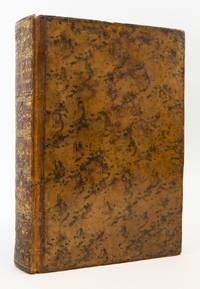
réf. 34351ARDENE Jean Paul de Rome d'. TRAITE DES TULIPES. Avignon: Louis Chambeau 1760. 12mo. Nineteenth-century cloth spine marbled boards. 252 4 pages 2 folding plates. First edition. Written by this noted French priest and botanist this is only the second book devoted entirely to the tulip. The first also by Ardene was published in 1754. The text offers a detailed history of the flower instructions on its care and cultivation and a glossary of technical terms. Rare. Only four copies cited by OCLC as being in American libraries. Folding plates by P. Duflos. Very good. unknown books
1612réf. 4992Rome: Nicoli van Aelst Roma formis "1560" but ca. 1585- 1612. THIRD STATE of FOUR. The first state had no explanatory text. The second with the text and "Formis Antoni Lafrerij Sequani MDLX". In this third state the Lafréry address has been erased though the date "MDLX" has been preserved and Nicolas van Aeslt's publishing information has been engraved at the lower left. A fourth state described by Rubach n. 376 has Gio. Battista de Rossi's address in place of van Aelst's. Hardcover. Fine. A fine example of a late impression the sheet untrimmed. Light marginal soiling. Early fold visible on verso but no crease visible on the recto. Watermark "fleur-de-lis in a circle" A view of the cortile of Palazzo Farnese. Construction of the palazzo designed by Antonio da Sangallo the Younger 1484-1536 with modifications and additions by Michelangelo began in 1517. By the time of its completion in 1589 Jacopo Vignola and Giacomo Della Porta had also worked on the project. The courtyard is partly the work of Sangallo who designed the ground floor and first floor while the second floor was built according to the designs of Michelangelo who took over the project upon Sangallo's death in 1546. Of the two ancient statues of Hercules shown in the cortile the one on the right is the famed Farnese Hercules now in Naples which caused a sensation upon its discover in 1546. The inscription reads: "Palatij Farnesij Romae non procul a reliquiis Theatri Pompei olim e solidissimo Tiburtino lapide non minore architecturae commendatione ab Antonio Sangallo inchoati quam stupendo artificio per Michaelem Angelum omnibus numeris consumati quantum artificio diligentia assequi potuit interioris partis expressio atque in intimo eius ambulacro duarum Herculis statuarum icones." Translation: "An image of the interior part with two statues of Hercules in its lower portico of Palazzo Farnese in Rome located not far from the remains of what was in the past the theater of Pompey; begun -in very solid travertine stone- by Antonio Sangallo with no less architectural art than when finished with astonishing craft and all possible diligence by Michelangelo." The publisher Nicolas van Aelst emigrated to Rome from his native Brussels in the mid 1580s. He "established his home and workshop in a house situated between the now vanished church of San Biagio della Fossa and the church of Santa Maria della Pace near Piazza Navona. The building was the property of the church of Santa Maria dell'Anima to whom the printed paid an annual rent of 30 scudi." Van Aelst died at Rome on 19 July 1613. For more see Lorizzo "Nicolas van Aelst's Will and a List of his Plates" Print Quarterly March 2014 Vol. 31 No. 1 March 2014 pp. 3-20. In 1585 Claudio Duchetti produced a copy of this plate. That version was subsequently printed by Orlandi 1602 and Van Schoel. Nicoli van Aelst, Roma formis, "1560", but ca. 1585- hardcover books
1550réf. 4841Rome: Antonio Lafreri 1550. Hardcover. Fine. First state. With Lafreri's excudit: "Ant. LafrerI FormIs Romae MDL" at lower right. Watermark "Duck in a Circle"cf. Woodward 79-80. A fine impression rich in tone with light marginal foxing and light soiling particularly in the lower right corner and some trivial surface soiling to the image. An iconic image of the statue known as Pasquino by far the most famous of Rome's 'statue parlanti' talking statues and the eponymous originator of the pasquinade genre. The statue was discovered in 1501 in the Parione district of Rome. Cardinal Oliviero Carafa "the embodiment of humanist ideals centering on the revival of antiquity"Reynolds erected the statue next to his palace near Piazza Navona on the site of today's Palazzo Braschi where it stands to this day. As early as 1501 satirical poems in Latin and Italian variously celebrating or criticizing the pope clergy and nobility or lampooning private individuals were affixed to the statue. By 1508 the statue had become the focus of a yearly celebration held on St. Mark's Day during which the statue was dressed as a Roman deity or other mythological figure and anonymous writers attached to it poems written in the "voice" of the statue. In 1511 Pasquino was dressed as Grief mourning the death of Cardinal Carafa. In 1549 the year before this print was published Pasquino famously opined on the death of Pope Paul III: 'Here was buried a certain Paul/ a fraud a fox thief murderer;/ Here famous in the mouth of Pasquino/ There suffering in the mouth of the devil." The artist responsible for this print has included a number of pasquinades in Latin and Italian shown on bits of paper attached to the walls of Carafa's palace. The ground in front of the statue is strewn with props a reference to the costumes worn by Pasquino during the St. Mark's Day celebration. In the distance are two pairs of men the first standing in the piazza and the second strolling towards the statue. Carafa's arms are visible in the shadow on the statue's base. Lafreri's print is a close copy of one published in 1542 by Antonio Salamanca Lafreri's rival and eventual business partner. The identity of the artist is unknown. Among those to whom the plate has been attributed are Enea Vico and Nicolas Beatrizet. In the same year 1550 that he produced his Pasquino print Lafreri issued a related print the Marforio another of Rome's talking statues with whom Pasquino frequently held "conversations". The origin of the name "Pasquino" has been debated from the very early 16th century with no definitive conclusion having been reached. The sculpture itself comprises two figures believed to be either Menelaus cradling the dead Patroclus or Ajax holding the dead Achilles. The primary inscription is a sonetto caudato. Io non son come paio un Babbuino stroppiato senza piedi et senza mani Nemen con glialtri membri sconci et strani La simmia son di Niccolo Zoppino. Ma son quel famosissimo Pasquino Che tremar faccio i Signor piu soprani et stupir forastieri et Paesani quando compango in volgare o in Latino. La mia persona è fatta in tal maniera Per i colpi e hor questo hor quel in accocca Per ch'io dico i lor falli a buona cera. Ma infin ch'io ha l'usata lingua in bocca Non ne fo stima anchor che 'l resto pera et sempre cantaro Zara a chi tocca Che se la gente sciocca Non si vuol rimaner de i falli suoi Chi terrà me' che no 'l ridica poi. I am not as I seem a Babbuino crippled without hands or feet Nor with obscene and strange exotic parts am I the Ape of Nicolò Zoppino But I am that most famous Pasquino who makes the most prominent men shiver. and astonishes the out-of-towners and my fellow citizens when I compose in vernacular or in Latin. My persona was shaped in this way: by the blows I take from here and from there because I reveal their sins But as long as I have the use of the tongue in my mouth I do not care even if the rest of my body perishes and I will continue to sing whatever happens and the people who are offended must deal with it. Because if stupid people do not want to keep their sins to themselves Who is going to stop me from telling them The one that was sure to attract the most attention reads: Pasquin tu fuste et sarai semper un pazo Ti sai in ogni forma trasformate Se ti voi alle donne grato fare Per che non ti trasformi int' Vn Ca Pasquino you always were and always will be an idiot. You know how to transform yourself into any form If you want to please women Why don't you turn yourself into a dck Pasquino & Marforio: Witnesses to a Rivalry Prelude to a Partnership: The engravings of Rome's talking statues Pasquino and Marforio published in 1550 bear witness to the rivalry between the two leading Roman print publishers of the mid-16th c. Antonio Salamanca 1479-1562 and Antonio Lafreri 1512-1577 and to the vast publishing phenomenon that came to be known as the "Speculum Romanae Magnificentiae" The Mirror of Roman Magnificence". In the years following the sack of 1527 the Spanish emigree Antonio Salamanca began producing engravings of Roman subjects with regularity prior to the sack such prints were few and appeared sporadically. In the 1540s another emigree printer the Frenchman Antonio Lafreri Antoine Lafréry began a rival enterprise copying many of Salamanca's engravings. The Marforio and Pasquino images that Lafreri lifted from Salamanca both date to this period. In 1553 the two competing Roman publishers entered into a contractual alliance for twelve years "with the explicit purpose of printing and selling copperplate prints of ancient and modern subjects. When the contractual agreement between Salamanca and Lafreri was established in 1553 the underlying principle of the "Speculum" was in place: it was to be a corpus of documentary prints of ancient and modern Roman subjects mainly in folio."Parshall Lafreri's and Salamanca's engravings illustrating the ancient and modern marvels of Rome tombs temples palaces baths statuary obelisks columns inscriptions frescoes etc. were purchased by tourists as souvenirs studied by antiquarians used as models by artists and architects and circulated as virtual visits for armchair travelers beyond Rome. By the late 1570s collectors could also purchase an engraved title page while selecting prints for their own Speculum collections. As a result Lafreri's customers or those of his heirs Salamanca had died in 1562 and Parshall suggests that the title was only in use after Lafreri's death in 1577 collected images to suit their own needs or taste. After the death of Lafreri two-thirds of the existing copper plates went to his heirs and another third was sold to other publishers. These new owners continued to print the existing images while still producing new prints. The Marforio print offered here is in the second state with the name of one of these later publishers Pietro de Nobili added. "Print collecting in the Renaissance is not very well understood mainly because prints were numerous comparatively inexpensive and therefore rarely inventoried. They are less likely than other sorts of objects to come down to us with a clear indication of their original setting. Nevertheless the evidence of a few large collections from the sixteenth century does suggest some consistent patterns most notably that prints accumulated in substantial numbers tended to be compiled in albums where they were organized by subject- matter and scale. There is still much to learn about how such collecting practices evolved and the development of a market to serve them."Parshall "Antonio Lafreri's Speculum Romanae Magnificentiae" Print Quarterly March 2006 Vol. 23 No. 1 pp. 3-28. Antonio Lafreri hardcover books
1552réf. 4344Rome: Antonio Lafréry 1552. Hardcover. Fine. First state of three. A rich impression with wide margins light marginal foxing and a little light soiling extreme upper margin a little ragged. Inscribed on the pedestal: "LVPAE ROMVLVM ET REMVM VRBIS CONDITORES LACTANTIS ANTIQVVM AC AENEVM IN CAPITOLIO SIGNVM." Ancient bronze image of the she-wolf nursing Romulus and Remus founders of the city on the Campidoglio. Signed "ANT. LAFRERII FORMIS ROMAE MDLII". An icon of central importance to the mythology and history of the city of Rome and an artwork that served as the nucleus of Europe's first public museum. This print attributed to the French emigree engraver Nicolas Béatrizet was issued by Lafréry in 1552 the year before he agreed to a partnership with his rival Antonio Salamanca. After Lafréry's death the plate passed to his nephew Claudio Duchet. It was reprinted by Giovanni Orlandi in 1602 and afterwards before 1622 by Hendrick van Schoel. The first definitive reference to this statue of the she-wolf the twins are Renaissance additions dates to the late 12th- or early 13th century. In his "Mirabilia Romae" the Oxford pilgrim Master Gregorius describes that statue in the portico of the Lateran Palace at which time it was in a damaged state broken off at the feet. According to Gregorius the wolf served as a pendentive to another now lost statue that of a ram which the wolf seemed to stalk. In 1471 Pope Sixtus IV reg. 1471-1484 bequeathed the statue and four other ancient bronzes -the spinario the Camillus and the bronze head and hand holding a globe of Constantine- to the people of Rome to serve as the core of the nascent Capitoline Museum the first public museum in Europe. A long inscription at the entrance of the Palazzo dei Conservatori documents this event and describes Sixtus' donation as an act of restitution of the city's ancient patrimony to its people: "Ob immensam benignitatem Aeneas insignes statuas priscae excellentiae virtutisque monumentum - Romano populo unde exorte fuere restituendas condonandasque censuit." The she-wolf was placed on a platform projecting from the façade of the Palazzo dei Conservatori Sixtus had given 100 gold florins to the Conservatori specifically for the relocation and installation of the statue. A drawing by Heemskerck from the mid-1530s shows the sculpture in that location. In the middle of the 16th century it was moved to a loggia where Aldrovandi saw it prior to 1556. The loggia was later walled in to create an enclosed chamber known as the sala della lupa in which the she-wolf still resides. Antonio Lafréry hardcover books
réf. B306662-1Roma 1980. Printed in red blue and black on card stock in the shape of a pyramid with blue color at apex; flower borders on recto. This invitation card was designed by Mario Diacono for the inaugural opening of his gallery in Rome and at the same time an opening announcement card for Mauro Biuzzis exhibition TAU. The T is printed inside the U on the recto and the A on the verso. Nulla alle Spalle 1976-1979 e allora Vuoto in Asse printed on a background of brick-like rectangles. The shape and imagery of the invitation are reminiscent of Freemasonry specifically the Triple Tau referring to the primary emblem of Royal Arch Masonry. The use of Freemasonry symbols at the time of the opening of the Rome gallery is significant as Diacono would continue his interest in these throughout his life. This copy with a flap taped to the verso pointing to the black pyramid tip with the evenings performance program: Pause ad orecchio. Igor Strawinsky Apollon Musagète.Premier Tableau Prologue. Naissance dApollon.Second tableau: Variation dApollon. Roma, 1980. unknown books
1729réf. 4449Rome: Nella Stamperia di Gio. Battista de Caporali per andare all'Orso 1729. FIRST EDITION. Hardcover. Fine. Bound in later carta rustica. A fine fresh copy on crisp paper. Very faint soiling to upper margin. A large historiated initial decorative head- and tail-pieces. With the arms of Cardinal Polignac on the title page. A very rare account of the elaborate transformation of Piazza Navona to celebrate the birth of the Dauphin Louis son of King Louis XV of France 1715-1774 and his royal consort María Leszczyńska 1703-1768. The Rococo painter Pier Leone Ghezzi 1674-1750 charged with staging the events had the piazza "restored" to its ancient glory as the stadium of Domitian the foundations of which are buried beneath the piazza and give the modern space its distinctive oblong shape. The spectacle was captured by the Roman painter Giovanni Paolo Pannini 1691-1765 who produced a painting of the Piazza in its glory of which two copies exist. One is in the Louvre the other in the National Gallery of Ireland. The piazza was transformed by the erection of magnificent columns quadriform temples all painted to look like marble monumental statuary and fountains that flowed with wine which was distributed to the spectators. The center-piece of the scene Bernini's Fountain of the Four Rivers; Borromini's church of Sant'Agnese served as the imposing backdrop for this splendid display. All of these elements including the inscriptions the symbolism of the statuary the royal blazons the festoons of laurel flowers and flowers that unified the components the torches and candelabra that illuminated the whole scene the various instruments played etc. etc. are described in detail. The performances are also described. Musicians played from elevated stages delighting the crowd with song. There were fireworks conducted by the papal bombardieri of Castel Sant'Angelo a cavalry parade and a dramatic performance written by the celebrated librettist Pietro Metastasio 1698-1782 with music by Leonardo Vinci 1690-1730. The performance took place in the French ambassador's residence Palazzo Altemps at the northern end of the piazza. The final page of the account names the performers the set designer and the engineers in charge of the fireworks. The second part of the volume comprises sonnets composed in honor of the Dauphin the boy's mother María Leszczyńska and the French ambassador to the Vatican Cardinal Melchior di Polignac. Nella Stamperia di Gio. Battista de Caporali, per andare all'Orso hardcover books
1754réf. 46429London: Printed for W. Innys J. and P. Knapton S. Birt et al. 1754. Very Good. London: Printed for W. Innys J. and P. Knapton S. Birt et al. 1754. Twelfth Edition Corrected and Improved. Octavo; bound in modern quarter calf with five raised bands and gitl stamping to spine; new endpapers; 16; xxx; 375; 26 appendices collated and complete. 14 plates 8 of which are folding includes frontispiece. Light wear and some light spotting to boards; binding sound; tear to top edge of front free endpaper; shorter tear and light wear along top of frontis page; pages age-toned else unmarked; a Very Good copy of Kennett's impressive work on Ancient Rome which remained popular and in print for decades after its original publication in 1696. Printed for W. Innys, J. and P. Knapton, S. Birt et al. unknown books
1557réf. ST16379-032Basel: Hieronymus Froben 1552; Venice: Jacopo Strada 1557. FIRST COMPLETE AND FIRST ILLUSTRATED EDITION of the first work; FIRST EDITION Second Issue of the second work. 330 x 215 mm. 13 x 8 1/4". 108 leaves; 8 p.l. 192 181-228 pp. 99 leaves index. Two works in one volume. 18th century marbled calf rebacked original backstrip laid down flat spine in compartments formed by decorative leafy rules and featuring large floral ornaments at center two morocco labels marbled end papers. Printer's device on titles and on final leaf of first work fine large and small mostly historiated woodcut initials and MORE THAN 100 FINE WOODCUTS mostly large or full-page IN FIRST WORK several signed by "C S" perhaps Conrad Schnitt or Christoph Schweizer ILLUSTRATING BUILDINGS OCCUPATIONS MILITARY MACHINES COSTUMES etc. some cuts repeated one cut printed upside down; 369 numismatic woodcuts in text of second work 262 of these including repetitions with medallion portraits and 107 with names only. Front flyleaf with early ink inscription of a library number; third leaf of first work and 10th leaf of second work with the crowned "L" library stamp of the Lamoignon Library. VD16 N 1884; Schweiger II 618; Brunet IV 111; Graesse IV 691 all for first work; Mortimer Italian 322 a later edition with copies of these cuts 355; Adams N-354 P-195. ◆Original spine leather somewhat dried and eroded covers slightly pitted and marked but the binding entirely firm with only superficial wear to joints and certainly agreeable. First title a little smudged and foxed a few other trivial imperfections but A REMARKABLY FRESH CLEAN AND SMOOTH COPY INTERNALLY AND WITH FINE IMPRESSIONS OF THE CUTS. This is a very attractive copy with distinguished provenance of two works with considerable data relating to and shedding substantial light on the politics government provincial administration and military establishment of Rome as well as other aspects of Roman life. The first work here is an anonymous early fifth century Roman state handbook more commonly known as the "Notitia Dignitatum" edited by Siegmund Ghelen Gelenius ca. 1477 - ca. 1554 and Beatus Rhenanus 1485-1547 from a lost Medieval manuscript. It is arranged according to the provinces of the Roman Empire and their cities. The second work is a synopsis of Roman history from Romulus through the reign of Habsburg emperor Charles V in the 15th century. Its first section is based on the "fasti consulares" inscriptions from the Arch of Augustus in the Roman forum listing all Roman consuls from 483 B.C. to 19 A.D. These relics were discovered in the 1540s when the forum was being quarried for building materials. The compiler of this work Panvinio 1529-68 was an Augustinian monk devoted to antiquarian studies who spent considerable time in Italy recording inscriptions on ancient monuments medals and other surfaces. He recognized the "fasti consulares" fragments recovered from the ruins and worked frantically to save them. They were restored by Michelangelo and added to the collection of what became the Capitoline Museum. Panvinio also used the coins and medals collected by Strada the publisher as a source for this compilation. A considerable portion of the interest and value in this volume today resides in the woodcuts. Copied from the original illustrations in an early manuscript of the work now lost; the cuts in the first work include many depictions of books showing several different kinds of decorated bindings. The illustrations also provide many details of Roman dwellings costumes and objects used in private religious and military life. Excepting the fact that they have produced books on basically the same subject our two printers could hardly be more different. Whereas the Swiss Froben was one of the giants of Renaissance printing and a great promoter of learning the Venetian Strada apparently spent much of his time speculating in the antiques market being one of the first merchants to make a business of selling Italian antiques to foreigners. Our copy comes from the collection of the great bibliophile Antoine Moriau 1699-1759 who leased the stately Hôtel d'Angoulême Lamoignon in Paris to house his library of 14000 books and more than 2000 manuscripts. The second work here is rare. Hieronymus Froben, 1552; Venice: Jacopo Strada unknown books
2004réf. 25442New York: Columbia University Press 2004. Very Good. New York: Columbia University Press 2004. First Thus Wrapper Issue. Octavo; publisher's glossy grey decorative card wrappers; xxxiv406pp. The whole somewhat warped from exposure to damp ownership signature to half title else Very Good internally clean and sound. Forms part of the series The Records of Western Civilization. Columbia University Press unknown books
1971réf. 56191London: Wolfe Publishing Limited 1971. First Edition. 8vo. yellow cloth in dust jacket; 254 pages. Very Good covers nice; contents clean & tight; very nice d/j. Wolfe Publishing Limited unknown books
1982réf. 214994Roma Rome Italy: De Luca 1982. Softcover. VG-. Some light scuffing around the edges and bumping to the wraps at head/tail of spine. Square quarto. Softcover. White wraps with color illustration. 471 pp. Over 15 illustrations in black and white. French and Italian. Exhibition held at Accademia di Francia a Roma April - May 1982 to commemorate the 300th anniversary of the death of Claude Lorrain. At head of title: Accademia di Francia a Roma. Features work of 13 artists. De Luca paperback books
réf. B306599-1Roma 1981. 4pp. 4to. Self-wraps. printed in silver on black. Roma, 1981. paperback books
réf. B29706-2Roma De Luca 1971. 21 97pp. 408 illus. Sq. 4to. Wraps. Roma (De Luca), 1971. paperback books
1996réf. 203931New York: The Museum of Modern Art MoMA 1996. Hardcover. VG. Violet cloth with illustrated dustjacket with BW printed photograph on front. 112 pp. with 87 bw photographs. In 1990 Thomas Roma began a series of photographs of houses of worship in Brooklyn once called the "City of Churches." The project was decisively changed when the pastor of a black Christian congregation invited Roma instead to photograph the Sunday service itself. Over the next three years Roma made pictures of more than one hundred and fifty services in fifty-two black Christian churches in Brooklyn - a year of Sundays. Come Sunday presents a generous selection of those pictures. An essay by Henry Louis Gates Jr. introduces the photographs by exploring the many dimensions of "The Church" in African American life history and culture. The Museum of Modern Art (MoMA) hardcover books
1996réf. 201417New York: The Museum of Modern Art MoMA 1996. Softcover. VG. Softcover with BW printed photograph on front. 112 pp. with 87 bw photographs. In 1990 Thomas Roma began a series of photographs of houses of worship in Brooklyn once called the "City of Churches." The project was decisively changed when the pastor of a black Christian congregation invited Roma instead to photograph the Sunday service itself. Over the next three years Roma made pictures of more than one hundred and fifty services in fifty-two black Christian churches in Brooklyn - a year of Sundays. Come Sunday presents a generous selection of those pictures. An essay by Henry Louis Gates Jr. introduces the photographs by exploring the many dimensions of "The Church" in African American life history and culture. Signed copy. The Museum of Modern Art (MoMA) paperback books
2010réf. 194626Philadelphia Pennsylvania: Fleisher/Ollman Gallery 2010. Softcover. VG scuffs marks smudges & foxing to wraps. rubbing to corners. white wraps w/ black illustration & printing. 28 pgs w/ bw & color illustrations; posable paper figuerine. Printed on the occasion of John Ollman's 40 years at Fleisher/Ollman Gallery; exhibition held September 23 through November 27 2010. Illustrated throughout. Includes paper figurine of John Ollman holding a potted flower and gardening shears. A nice collectable of the Philadelphia art scene. Fleisher/Ollman Gallery paperback books
1968réf. 182942Roma: De Luca 1968. Softcover. VG slight wear to covers. Yellow wraps. 63 pages 70 unnumbered leaves of plates : chiefly illustrations. Text in Italian. Exhibition organized by the Municipal Department for Antiquities Fine Arts and Cultural Problems held in Palazzo delle Esposizioni. Includes Exhibition of projects for the new headquarters of parliament offices. De Luca paperback books
1925réf. 173213Milano / New York: Ulrico Hoepli / Weyhe 1925. Second Edition Ampliata. Hardcover. VG old publisher's stock with occassional small foxing spot here and there otherwise unused. Green cloth with inset black background label on front cover with gilt bordeer and gilt lettering. Giltlettering on spine. 381 pp. profusely illustrated in bw with 356 pp of bw photographs usually more than 1 to a page and 6-pages of color illustrations at rear. Text entirely in Italian. This book is comprised chiefly of bw illustrations with 6 pages of color illustrations at the rear. Italian furntiture and architectural details in wood. Ulrico Hoepli / Weyhe hardcover books
1983réf. 169238Fribourg/Geneva: Liber 1983. Hardcover. VG/VG- light scuffing and soiling to dj minor wear to edges and corners. Black cloth boards with gilt stamped lettering. White and color-photographic dust jacket with forest green lettering. 94 pp. Color illustrations. Translated by Evelyn Rossiter. Liber hardcover books
2015réf. 160037Blurb 2015. Hardcover. As New INSCRIBED BY PHOTOGRAPHER on first flyleaf. White & illus. paper boards 48 pp BW illus. Presents examples of big tree photography as rendered by American photographer Stuart Rome. Intriguing. This copy INSCRIBED BY THE PHOTOGRAPHER on the first flyleaf. Scarce. Blurb hardcover books
2002réf. 158692New York: Powerhouse Books 2002. Hardcover. Fine but art school ex-lib. copy with usual marks. Red boards with bw photo and yellow lettering. 80 pp. with bw photos throughout. Photos by Thomas Roma. A father-son collaboration of photos and descriptions of life in their neighborhood. Powerhouse Books hardcover books
1982réf. 133452Roma Rome Italy: De Luca 1982. Softcover. Good loss of cover at top of front hinge scuffing to exposed text block. May have very minor library stamp on back of title page or inside rear cover. White wraps with color illustration. 471 pp. Over 15 illustrations in black and white. French and Italian. Exhibition held at Accademia di Francia a Roma April - May 1982 to commemorate the 300th anniversary of the death of Claude Lorrain. At head of title: Accademia di Francia a Roma. Features work of 13 artists. De Luca paperback books
1953réf. 201781953. Softcover. Good Back cover bent; Some foxing to pages. Color wraps. Unpaginated. Color and bw plates. Text in English and Italian. paperback books
1989réf. 309561989. Softcover. VG. Bw ill. stapled wraps. Unpaginated. Numerous bw ills. Text in Italian. paperback books
1969réf. 104741969. Softcover. VG slight wear to cover slight library writing on lower cover. Color wraps. 102 pp. 6 color 45 bw plates. paperback books