LAURO Giacomo (1561-1645/50)MareMagnum

30 005 résultats
1615Tavola tratta dal celebre Antiquae urbis splendor di Giacomo Lauro, opera di grande importanza storica e archeologica che l’autore iniziò nel 1612. Il titolo intero è: Antiquae urbis splendor, hoc est praecipua eiusdum templa, amphitheatra, theatra, circi, naumachie, arcus triumphales, mausolea aliaque sumptuosiora aedificia, pompae item triumphalis et colossaearum imaginum descriptio; opera & industria Iacobi Lauri Romani in aes incisa atque in lucem edita. Addita est breuis quaedam et succincta imaginum explicatio in qua regum consulum imperatoruq; res gestae et rei romanae origo progressus incrementum, ac finis cu almae urbis antiquor. ac modernor. vestigior. additione utcunq; hoc insequenti anno 1630 reperiutur, et ex veteru ac recentior. historiar. monumentis clare ostenditur. Il libro ha una lunga e varia storia di pubblicazione, a partire dal 1612, anche se il lavoro di Lauro sul libro precede la sua pubblicazione di almeno diciotto anni. Il libro fu stampato per la prima volta da Giacomo Mascardi, e originariamente conteneva solo due parti, anche se nel 1615 si era allargato a una terza parte. La prima parte conteneva 37 incisioni, con una dedica al re Sigismondo III di Polonia, datata 1614, e un ritratto datato 1609 (preso in prestito da un altro libro di incisioni). La seconda parte conteneva un ritratto di Carlo Emanuele I, duca di Savoia, datato 1613, e 41 incisioni. Vale la pena notare che questi primi due libri erano entrambi dedicati alla nobiltà polacca, probabilmente a causa del fatto che Lauro aveva goduto di patrocinio dall'incisione di battaglie polacche all'inizio della sua carriera. La terza parte, aggiunta più tardi, era dedicata a Ranuccio Farnese, uno dei maggiori mecenati di Lauro più tardi nella sua vita, e conteneva 40 incisioni. Il numero di tavole incluse in ciascuna delle precedenti edizioni dell'opera di Lauro (stampate alla Camera Apostolica nel 1614 in quattro parti, e stampate di nuovo lì nel 1621 in tre parti) fu finalmente stabilito nel 1628 con l'aggiunta del quarto e ultimo libro per un totale di 166 incisioni, che è il numero generalmente accettato per quante incisioni totali Lauro produsse per quest'opera. L'edizione pubblicata da Vitale Mascardi e curata da Giovanni Alto uscì nel 1637. Alto ha aggiunto un indice finale e numerato ciascuna delle incisioni, 2-167, per quest'ultima edizione. Incisione in rame, stampata su carta vergata coeva, con margini, in ottimo stato di conservazione. Plate taken from the important Antiquae urbis splendor by Giacomo Lauro. The full title is: Antiquae urbis splendor, hoc est praecipua eiusdum templa, amphitheatra, theatra, circi, naumachie, arcus triumphales, mausolea aliaque sumptuosiora aedificia, pompae item triumphalis et colossaearum imaginum descriptio; opera & industria Iacobi Lauri Romani in aes incisa atque in lucem edita. Addita est breuis quaedam et succincta imaginum explicatio in qua regum consulum imperatoruq; res gestae et rei romanae origo progressus incrementum, ac finis cu almae urbis antiquor. ac modernor. vestigior. additione utcunq; hoc insequenti anno 1630 reperiutur, et ex veteru ac recentior. historiar. monumentis clare ostenditur. The book has a long and varied history of publishing, beginning in 1612, though Lauro’s work on the book predates its publishing by at least eighteen years. The book was first printed by Giacomo Mascardi, and it originally only contained two parts, though by 1615 it had expanded to a third part. The first part contained 37 engravings, with a dedication to King Sigismund III of Poland, dated 1614, and a portrait dated 1609 (borrowed from another book of engravings). The second part contained a portrait of Charles Emmanuel I, Duke of Savoy, dated 1613, and 41 engravings. It is worth noting that these first two books were both dedicated to Polish nobility, probably due to the fact that Lauro had enjoyed patronage from engraving Polish battles early in his career. The third part, added later, was dedicated to Ranuccio Farnese, one of Lauro’s greater patrons later in his life, and contained 40 engravings. The number of plates included in each of the earlier editions of Lauro’s work (printed at the Camera Apostolica in 1614 in four parts, and printed there again in 1621 in three parts) was finally settled in 1628 with the addition of the fourth and final book for a total of 166 engravings, which is the generally accepted number for how many engravings total Lauro produced for this work. The edition published by Vitale Mascardi and curated by Giovanni Alto was released in 1637. Alto added a final index and numbered each of the engravings, 2-167, for this latest release. Copperplate, printed on contemporary laid paper, with margins, good condition. Rossetti, Rome: A Bibliography. Vol. 3. (2000) p. 39-40.; Buckley, The Splendors of Ancient Rome: A Seventeenth Century View. The Splendors of Ancient Rome (1974); Laura Di Calisto, Lauro Giacomo in Dizionario Biografico Degli Italiani_ Vol. 64. (2005).
1615Tavola tratta dal celebre Antiquae urbis splendor di Giacomo Lauro, opera di grande importanza storica e archeologica che l’autore iniziò nel 1612. Il titolo intero è: Antiquae urbis splendor, hoc est praecipua eiusdum templa, amphitheatra, theatra, circi, naumachie, arcus triumphales, mausolea aliaque sumptuosiora aedificia, pompae item triumphalis et colossaearum imaginum descriptio; opera & industria Iacobi Lauri Romani in aes incisa atque in lucem edita. Addita est breuis quaedam et succincta imaginum explicatio in qua regum consulum imperatoruq; res gestae et rei romanae origo progressus incrementum, ac finis cu almae urbis antiquor. ac modernor. vestigior. additione utcunq; hoc insequenti anno 1630 reperiutur, et ex veteru ac recentior. historiar. monumentis clare ostenditur. Il libro ha una lunga e varia storia di pubblicazione, a partire dal 1612, anche se il lavoro di Lauro sul libro precede la sua pubblicazione di almeno diciotto anni. Il libro fu stampato per la prima volta da Giacomo Mascardi, e originariamente conteneva solo due parti, anche se nel 1615 si era allargato a una terza parte. La prima parte conteneva 37 incisioni, con una dedica al re Sigismondo III di Polonia, datata 1614, e un ritratto datato 1609 (preso in prestito da un altro libro di incisioni). La seconda parte conteneva un ritratto di Carlo Emanuele I, duca di Savoia, datato 1613, e 41 incisioni. Vale la pena notare che questi primi due libri erano entrambi dedicati alla nobiltà polacca, probabilmente a causa del fatto che Lauro aveva goduto di patrocinio dall'incisione di battaglie polacche all'inizio della sua carriera. La terza parte, aggiunta più tardi, era dedicata a Ranuccio Farnese, uno dei maggiori mecenati di Lauro più tardi nella sua vita, e conteneva 40 incisioni. Il numero di tavole incluse in ciascuna delle precedenti edizioni dell'opera di Lauro (stampate alla Camera Apostolica nel 1614 in quattro parti, e stampate di nuovo lì nel 1621 in tre parti) fu finalmente stabilito nel 1628 con l'aggiunta del quarto e ultimo libro per un totale di 166 incisioni, che è il numero generalmente accettato per quante incisioni totali Lauro produsse per quest'opera. L'edizione pubblicata da Vitale Mascardi e curata da Giovanni Alto uscì nel 1637. Alto ha aggiunto un indice finale e numerato ciascuna delle incisioni, 2-167, per quest'ultima edizione. Incisione in rame, stampata su carta vergata coeva, con margini, in ottimo stato di conservazione. Plate taken from the important Antiquae urbis splendor by Giacomo Lauro. The full title is: Antiquae urbis splendor, hoc est praecipua eiusdum templa, amphitheatra, theatra, circi, naumachie, arcus triumphales, mausolea aliaque sumptuosiora aedificia, pompae item triumphalis et colossaearum imaginum descriptio; opera & industria Iacobi Lauri Romani in aes incisa atque in lucem edita. Addita est breuis quaedam et succincta imaginum explicatio in qua regum consulum imperatoruq; res gestae et rei romanae origo progressus incrementum, ac finis cu almae urbis antiquor. ac modernor. vestigior. additione utcunq; hoc insequenti anno 1630 reperiutur, et ex veteru ac recentior. historiar. monumentis clare ostenditur. The book has a long and varied history of publishing, beginning in 1612, though Lauro’s work on the book predates its publishing by at least eighteen years. The book was first printed by Giacomo Mascardi, and it originally only contained two parts, though by 1615 it had expanded to a third part. The first part contained 37 engravings, with a dedication to King Sigismund III of Poland, dated 1614, and a portrait dated 1609 (borrowed from another book of engravings). The second part contained a portrait of Charles Emmanuel I, Duke of Savoy, dated 1613, and 41 engravings. It is worth noting that these first two books were both dedicated to Polish nobility, probably due to the fact that Lauro had enjoyed patronage from engraving Polish battles early in his career. The third part, added later, was dedicated to Ranuccio Farnese, one of Lauro’s greater patrons later in his life, and contained 40 engravings. The number of plates included in each of the earlier editions of Lauro’s work (printed at the Camera Apostolica in 1614 in four parts, and printed there again in 1621 in three parts) was finally settled in 1628 with the addition of the fourth and final book for a total of 166 engravings, which is the generally accepted number for how many engravings total Lauro produced for this work. The edition published by Vitale Mascardi and curated by Giovanni Alto was released in 1637. Alto added a final index and numbered each of the engravings, 2-167, for this latest release. Copperplate, printed on contemporary laid paper, with margins, good condition. Rossetti, Rome: A Bibliography. Vol. 3. (2000) p. 39-40.; Buckley, The Splendors of Ancient Rome: A Seventeenth Century View. The Splendors of Ancient Rome (1974); Laura Di Calisto, Lauro Giacomo in Dizionario Biografico Degli Italiani_ Vol. 64. (2005).
1567Veduta tratta da "Urbis Romae aedificiorum illustriumquae […] supersunt reliquiae summa cum diligentia a Joanne Antonio Dosio stilo ferreo ut hodie cernuntur descriptae et a Jo Baptista de Cavaleriis aeneis tabulis incisis repraesentatae", la nota raccolta di antichi edifici romani pubblicata dal Cavalieri nel 1569 da disegni dell'architetto e scultore Giovanni Antonio Dosio. Incisione su rame, impressa su di un foglio di carta vergata coeva, rifilato alla linea marginale, in buono stato di conservazione. View from Urbis Romae aedificiorum illustriumquae [...] supersunt reliquiae summa cum diligentia Joanne Antonio Dosio iron stylus ut hodie cernuntur descriptae et Jo Baptista de Cavaleriis Aeneis tabulis incisis repraesentatae," collection of ancient Roman buildings published by Cavalleris in 1569 after drawings by the architect and sculptor Giovanni Antonio Dosio. Etching and engraving, printed on a sheet of contemporary laid paper, trimmed close to the platemark. In very good condition.
1823Litografia in coloritura coeva del divertimento del popolo durante il Sabato Santo, Era usanza nel giorno del Sabato Santo, in segno di giubilo per la resurrezione del Salvatore, far scoppiare per le vie cittadine dei petardi con grande divertimanto di grandi e piccoli
1971In folio (42x32) tiratura limitata a mille esemplari. esemplare n 977; cartonato con stampa e legatura in tutta pelle dalla SAGDOS Officine Grafiche e Legatoria di Brugherio (Milano); splendide tavole a colori su carta speciale della Cartiera Ventura; pp.44 . 72c. di tavole; ottimo
1820204 p. 12 mo. 19 cm. Foxed. Very nice modern buckram binding. The text is a sort of catechism on Roman history and culture. ** The publisher is of special interest - Daniel Rapine, was a bookseller and printer whose bookshop was located on Capitol Hill as early as 1801. The site was later engulfed in an expansion of the capitol building.During the War of 1812 (1812 & 1813) he served as Mayor of Washington. SCARCE. **PRICE JUST REDUCED! SMALL BOX 7
1962réf. 156761New York: Cooper Square Publishers 1962. XI, (1), 519 Seiten. 8° (17,5-22,5 cm). Orig.-Leinenband - Clothbound Edition [Hardcover / fest gebunden].
1703réf. 013968London: printed by A. and J Churchill at the Black Swan in Pater Noster Row 1703 Book. Good. Hardcover. viii 154 pages. Either ESTC N17836 without the errata slip mentioned there; or also issued as part of Vol 3 of the Collection of Voyages and travels published by Awnsham and Churchill in 1704. Most likely the second. Star chart on page 42. Some pages have ink stains. Damp staining to the lower part of the first 8 pages. Small amount of worming to the lower inner corners of pages 89-154 but well clear of the text. In modern half leather binding with a lightly faded spine. New end papers. printed by A. and J Churchill at the Black Swan in Pater Noster Row hardcover
réf. 45740442like new. unknown
réf. 45740442-nnew. unknown
1980réf. 164858New York: Crown Publishers 1980. 1st U.S. Edition; First Printing. Hardcover. Very Good in a Near Fine dust jacket. Owner name on FEP.; 8.6 X 5.7 X 0.8 inches. Crown Publishers hardcover
1979réf. Q-0517539802Crown 1979-12-12. Hardcover. New. In shrink wrap. Looks like an interesting title! Crown hardcover
réf. 91245Roma, Tipografia Delle Belle Arti, 1848, 3 volumes in-8 de 223x143 mm environ, 679, 555 et 753 pages, demi vélin crème à coins, dos lisses portant titres et tomaisons dorés sur pièces de titre rouges et pièces de tomaisons vertes, ornés de fers et filets dorés. Des tampons de bibliothèque (annulés), traces d'anciennes étiquettes sur les mors-peaux débordant sur le cartonnage, légères rousseurs sur les tranches, quelques erreurs de pagination (593 au lieu de 393 et 354-355 au lieu de 534- 535), petite déchirure p. 405 sans manque de texte, sinon bon état. Texte en italien.
1971réf. R100079915Epesa. 1971. In-12. Broché. Etat d'usage, Tâchée, Dos satisfaisant, Intérieur frais. 202 pages - coins frottés - livre en espagnol.. . . . Classification Dewey : 460-Langues espagnole et portugaise
1899Ottima copia gr.2300- timbro di biblioteca estinta
1995Fine English Paperback., Fine., 24 x 16 cm., [14], 238, [43] p., b/w ills., "Anadolu mimari bezemeleri; Roma çagi Lotus - Palmet örgesi.", Cevat Basaran, Atatürk Üniversitesi Yayinlari, Erzurum, 1995. ARCHAEOLOGY Anatolian civilizations Roman art History of art Decoration.
19821^edizione - in8° - brossura editoriale - n. pagine non indicato - numerose foto in b / n - pagine pubblicitarie - condizioni eccellenti
19842 volumi, 22 cm, belle rilegature editoriali in similpelle rossa con titolo, fregi e cornice impressi in oro al piatto e al dorso, p. 557; 507. Ristampa anastatica dell'edizione del 1907. Alcune tavole in nero a piena pagina.
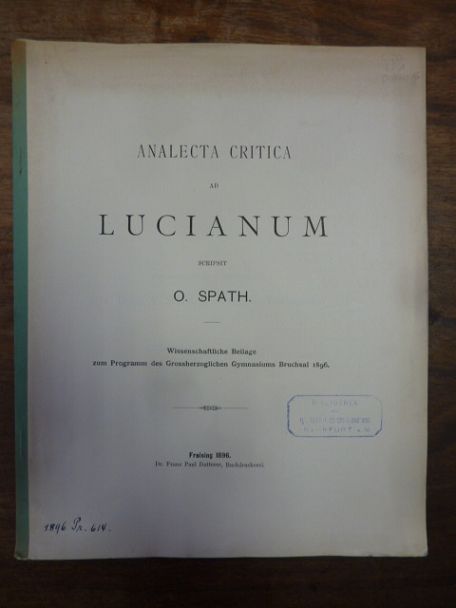
1896réf. 266CBFreising, Franz Paul Datterer (= Progr. No. 614), 1896. kl.4°, 30 S., original Heft mit Papierrückenstreifen, Erstausgabe schöner alter Stempel der Lehrerbibliothek eines alteingesessenen Frankfurter Gymnasiums und handschriftl. Notiz (1896 Pr. 614) auf Titelseite, kaum altersspurige Broschur (leichte Eselsohren an der rechtun unteren Heftkante) (Li1, Ordner15)
1885réf. 296599Ad Claras Aquas Quaracchi : ex Typographia Collegii S. Bonaventurae 1885. First Edition. Hardcover. Worn set bound in full buckram with gilt-blocked titles to the spines. Some wear and tear as with age. Remains well preserved overall; tight bright clean and sharp-cornered. Provenance; from the library of S. Mariae Angelorum Liberpolitani with its bookplate. Physical description; 6 vols. ; 27 cm. Notes; Text in Latin. Subject; Franciscans History. Ad Claras Aquas (Quaracchi) : ex Typographia Collegii S. Bonaventurae hardcover
1980Mm 195x285 Brossura editoriale con bandelle di pp. 150, con illustrazioni in bianco e nero. Contributi in inglese, italiano e tedesco. Ottimo. SPEDIZIONE IN 24 ORE DALLA CONFERMA DELL'ORDINE.
marca, 2009. In -4°, pp. 119 con 51 illustrazioni e disegni n.t. Bross. edit. Stato di nuovo.
1986Mm 195x285 Brossura editoriale con bandelle di pp. 180 con illustrazioni in bianco e nero. In lingua originale inglese, italiana e tedesca. Ottimo. SPEDIZIONE IN 24 ORE DALLA CONFERMA DELL'ORDINE.
1997Mm 195x285 Brossura editoriale con bandelle di pp. 188, con illustrazioni in bianco e nero. Piccole abrasioni al piatto anteriore, contributi in italiano, inglese, francese e tedesco. SPEDIZIONE IN 24 ORE DALLA CONFERMA DELL'ORDINE. WORLDWIDE DELIVERY
1987Mm 195x285 Brossura editoriale con bandelle di pp. 203 con illustrazioni in bianco e nero. Contributi in Italiano ed inglese. Opera in buonissime condizioni. SPEDIZIONE IN 24 ORE DALLA CONFERMA DELL'ORDINE. WORLDWIDE DELIVERY