FAGIOLO Marcello (testo di)MareMagnum
TORSELLI Giorgio.MareMagnum
Ville di Roma.
1968In-4° pp. 285 con moltissime foto in nero n.t. Legatura edit. con sovrac. illustrata.

Libreria Gullà · Italie24,00 €
30 521 résultats
2001In-4 (cm. 31.30), cartonato editoriale, sovracoperta editoriale illustrata, custodia in cartoncino, pp. 286, (2), con numerose illustrazioni in bianco e nero ed a colori nel testo. Fotografie di Roberto Schezen. Prima edizione italiana. Scollamento della custodia; peraltro, volume allo stato di nuovo (brand new copy).
LEGATURA EDITORIALE RIGIDA IN MEZZA PELLE CON PIATTI IN TELA VERDE, CONSERVATA LA FASCETTA EDITORIALE CON IL TITOLO. IMPRESSO IN MILLECENTO ESEMPLARI DALLA STAMPERIA VALDONEGA SU CARTA APPOSITAMENTE FABBRICATA DALLA CARTIERA MAGNANI. LEGATURA ESEGUITA DA MARIO RIGOLDI. CON 21 TAVOLE DOPPIE numero pagine: 65 formato: 37X25.8 stato conservazione: BUONO, DORSO IN PELLE SCOLORITO
1983In-4 p., tela editoriale, sovracoperta, astuccio, pp. 525, con tavole a colori e in bianco e nero, rilievi, disegni con piante, prospetti di 15 ville maggiori; le minori, circa 70, sono sinteticamente descritte ed illustrate in bianco e nero con planimetrie. Volume della collana "Ville italiane". In ottimo stato (fine copy).
1968In-4° carrè, pp. 287 con moltissime ill. anche a col. n.t. Leg. edit. con sovrac. ill. e custodia.
1968In-4° pp. 285 con moltissime foto in nero n.t. Legatura edit. con sovrac. illustrata.
1970In-4 p., tela editoriale, sovracoperta, astuccio, pp. 525, con tavole a colori e in bianco e nero, rilievi, disegni con piante, prospetti di 15 ville maggiori; le minori, circa 70, sono sinteticamente descritte ed illustrate in bianco e nero con planimetrie. Volume della collana "Ville italiane". In buono stato (good copy).
1983Cartonato con legatura in tela. sovracoperta illustrata cofanetto in cartone; fotografie e tavole a colori e bn; pp.526; ottimo
1970Cartonato con legatura in tela. sovracoperta illustrata cofanetto in cartone; fotografie e tavole a colori e bn; pp.526; ottimo
1968BUONO STATO
1975In-4, tela editoriale, sovracoperta, pp. 370, con l'illustrazioni a colori e in bianco e nero di 122 ville (le maggiori sono ampiamente commentate). Volume della collana "Ville Italiane". In buono stato (good copy).
1975Cartonato con legatura in tela. sovracoperta illustrata con cofanetto rigido; illustrazioni a colori e bn; pp. 372; ottimo
1778Pagine: 148 . Formato: in folio . Rilegatura: Cartonato marmorizzato moderno con dorso in pelle amaranto . Stato: Discreto . Caratteristiche: Rilegatura moderna. Tracce evidenti di umidità e gore d'acqua. Bruniture. Si tratta del solo testo privo delle 425 tavole. Frontespizio del primo tomo strappato. . Note epoca: #
1998Paris, Mengès, 1998; in-folio, 400 pp., reliure d'éditeur pleine toile, sous jaquette. Traduction de l'italien par Jean-Philippe Follet. Il serait fastidieux de donner la liste des palais et villas contenues dans le sommaire. Magnifique ouvrage sur l'architecture à Rome. Photographies de Massimo Listri. Très bon état.
2013réf. S8217Athens: National Hellenic Research Foundation 2013. Meletemata Series No. 68. Conference Proceedings. Papers mostly in Greek. Soft cover 28 cm 816 pp. ill.; net weight 3220 gr. ISBN: 978-960-9538-19-0 As that of other provinces of the Empire the rural economy of Greece underwent many changes as well with important implications for the strategies and organization of the production as well as for the distribution and consumption of goods. Thanks to the extraordinary mass of archaeological data collected in Greece in the last decades and to the possibility of applying both more sophisticated research instruments and more profitable methods of approach and analysis of these data a re-examination of a regional case study such as Roman Greece is now more feasible. The publication in this volume of material remains -remarkable both for number and quality from various in size productive complexes- and the synthetic studies on the other hand will provide students of the ancient world with an invaluable material which will greatly contribute to a better understanding of the economic organization of this part of the Roman Empire. It will also represent a point of reference for the study of both the rural world and more specific the economy of the cities of a small but not insignificant Roman administrative unit. CONTENTS: Annalisa MARZANO Le "villae rusticae" romane e la loro dimensione economica: uno sguardo alla penisola italiana Athanasios RIZAKIS Rural structures and agrarian strategies in Greece under the Roman Empire Sofia ZOUMBAKI In Search of the Horn of Plenty: Roman entrepreneurs in the agricultural economy of the province of Achaia Francesco CAMIA & Athanasios RIZAKIS Notes on the imperial estates and valorisation of public lands in the province of Achaia ΜαÏία ΣΤΑΥΡΟΠΟΥΛΟΥ-ΓΑΤΣΗ & ΓεωÏγία ΑΛΕΞΟΠΟΥΛΟΥ Î‘Î³Ïοικίες της ΠάτÏας και της χώÏας της Μιχάλης ΠΕΤΡΟΠΟΥΛΟΣ Μόνιμες εγκαταστάσεις και κινητά ÏƒÎºÎµÏη για την αγÏοτική παÏαγωγή στις ÏωμαϊκÎÏ‚ αγÏοικίες της ΠάτÏας Ζωή ΑΣΛΑΜΑΤΖΙΔΟΥ-ΚΩΣΤΟΥΡΟΥ Ρωμαϊκές αγÏοικίες στην ΚοÏινθία: η πεÏίπτωση του ΛουτÏακίου Ζωή ΑΣΛΑΜΑΤΖΙΔΟΥ-ΚΩΣΤΟΥΡΟΥ Ρωμαϊκές αγÏοικίες στο νομό ΚοÏινθίας Ελένη ΣΑΡΡΗ Λείψανα αγÏοτικής εγκατάστασης στη θέση "Αγ. Παντελεήμων-Βίλλα" ΚÏανιδίου Ελένη ΣΑΡΡΗ Î‘Î³ÏοτικÎÏ‚ εγκαταστάσεις της Ïωμαϊκής εποχής στην ΑÏγολίδα Όλγα ΨΥΧΟΓΙΟΥ Ίχνη Ïωμαϊκών αγÏοικιών στην ΕÏμιονίδα Μιχάλης ΠΕΤΡΟΠΟΥΛΟΣ Γενική Î¸ÎµÏŽÏηση της αγÏοτικής παÏαγωγής στην ΑÏκαδία των Ïωμαϊκών χÏόνων Σταμάτης ΦΡΙΤΖΙΛΑΣ Î‘Î³Ïοικία στη θέση Βελιγοστή Î‘Ïκαδίας Λεωνίδας ΣΟΥΧΛΕΡΗΣ Î‘Î³ÏοτικÎÏ‚ και βιοτεχνικές εγκαταστάσεις στην Ασεατική Î§ÏŽÏα της νότιας ΑÏκαδίας και στη Βελμινάτιδα ΧώÏα της βοÏειοδυτικής Λακεδαίμονος Ελένη ΖΑΒΒΟΥ Î‘Î³Ïοικίες και εÏγαστηÏιακÎÏ‚ εγκαταστάσεις στη Λακωνία των Ïωμαϊκών χÏόνων 1ος αι. π.Χ.-6ος αι. μ.Χ. Δημοσθένης ΚΟΣΜΟΠΟΥΛΟΣ Η Μεσσηνιακή γη και οι αγÏοτικÎÏ‚ εγκαταστάσεις κατά τη Ïωμαϊκή πεÏίοδο Ολυμπία ΒΙΚΑΤΟΥ Ρωμαϊκές αγÏοικίες στην Ηλεία Domenico D'ACO L'Attica in eta romana: le fattorie dal I sec. A.C. al V sec. D.C. ΓεώÏγιος ΣΤΑΪÎΧΑΟΥΕΡ Ρωμαϊκές αγÏοικίες της Αττικής Έλενα ΒΛΑΧΟΓΙΑÎÎΗ ΑγÏοικία Ïωμαϊκών χÏόνων στην αÏχαία ΑκÏαιφία ΑκÏαίφνιο Βοιωτίας Έλενα ΒΛΑΧΟΓΙΑÎÎΗ Βοιωτία. ΑγÏοικίες και εÏγαστηÏιακÎÏ‚ εγκαταστάσεις στη βοιωτική ÏπαιθÏο των Ïωμαϊκών χÏόνων 2ος αι. π.Χ.-6ος αι. μ.Χ. Έλενα ΚΟΥÎΤΟΥΡΗ & Îίκος ΠΕΤΡΟΧΕΙΛΟΣ Î‘Î³ÏοτικÎÏ‚ εγκαταστάσεις και εκμετάλλευση της γης στην πεÏιοχή της ΧαιÏώνειας ΦανουÏία ΔΑΚΟΡΩÎΙΑ & Πολυξένη ΜΠΟΓΓΙΑ Η ÎŸÏ€Î¿Ïντια εκδοχή της αγÏοικίας κατά την ΎστεÏη ΑÏχαιότητα ΑÏιστÎα ΠΑΠΑΣΤΑΘΟΠΟΥΛΟΥ Î¤Ïίλοφο Ρεγγινίου Φθιώτιδας: η αποκάλυψη των υπολειμμάτων μιας Ïωμαϊκής αγÏοικίας Φιλίτσα ΤΙΛΕΛΗ & Κωνσταντίνα ΨΑΡΟΓΙΑÎÎΗ ΑγÏοικία υστεÏοÏωμαϊκών χÏόνων στη θέση "Αγ. ΤÏιάδα" του Δ.Δ. ΘεÏμοπυλών Δήμου Λαμιέων Î. Φθιώτιδας Λεωνίδας ΧΑΤΖΗΑΓΓΕΛΑΚΗΣ Î‘Î³Ïοτική εγκατάσταση Ïωμαϊκών χÏόνων στη "χώÏα του αÏχαίου ΚιεÏίου" στον ΟÏγόζινο ΜαταÏάγκας Î. ΚαÏδίτσας ΑÏγυÏοÏλα ΔΟΥΛΓΕΡΗ-ΙÎΤΖΕΣΙΛΟΓΛΟΥ & Πολυξένη ΑΡΑΧΩΒΙΤΗ Î‘Î³Ïοικία αυτοκÏατοÏικών χÏόνων στην πεÏιοχή των αÏχαίων ΦεÏών ΑÏγυÏοÏλα ΔΟΥΛΓΕΡΗ-ΙÎΤΖΕΣΙΛΟΓΛΟΥ ΑγÏοτικÎÏ‚ εγκαταστάσεις Ïωμαϊκής εποχής στη Θεσσαλία και στα νησιά των Î’ÏŒÏειων ΣποÏάδων ΑÏγυÏοÏλα ΔΟΥΛΓΕΡΗ-ΙÎΤΖΕΣΙΛΟΓΛΟΥ & Ελένη ΧΡΥΣΟΠΟΥΛΟΥ Έπαυλις ; αυτοκÏατοÏικών χÏόνων εκτός της πόλεως της Σκιάθου ΓεώÏγιος ΖΑΧΟΣ Î”Ï‰Ïίδα Φωκίδα δυτική Î›Î¿ÎºÏίδα ΜαÏία ΣΤΑΥΡΟΠΟΥΛΟΥ-ΓΑΤΣΗ & Φωτεινή Î£Î‘Î¡Î‘ÎΤΗ Εγκαταστάσεις στην ÏπαιθÏο της ΑιτωλοακαÏνανίας κατά τη Ïωμαϊκή πεÏίοδο ΒικτωÏία ΓΕΡΟΛΥΜΟΥ Î‘Î³Ïοικία στα ΣιταÏάλωνα ΑιτωλοακαÏνανίας: αγÏοτική και εÏγαστηÏιακή παÏαγωγή Βίβιαν ΣΤΑΪΚΟΥ & ΚατεÏίνα ΛΕΟÎΤΑΡΙΤΗ Ρωμαϊκές αγÏοικίες στην ευÏÏτεÏη πεÏιοχή του ΑγÏινίου Φωτεινή Î£Î‘Î¡Î‘ÎΤΗ & Βίβιαν ΣΤΑΪΚΟΥ Î‘Î³Ïοικίες Ïωμαϊκών χÏόνων στην πεÏιοχή δυτικά της Îαυπάκτου ΓεωÏγία ΠΛΙΑΚΟΥ & ΒαÏβάÏα ΓΚΙΖΑ Μία Ïωμαϊκή αγÏοικία στη χώÏα της αÏχαίας Λευκάδας Mantha ZARMAKOUPI The villa culture of Roman Greece Dimitris GRIGOROPOULOS Roman Pottery in the Greek Countryside: votes on the evidence from rural sites Ιωάννης ΤΟΥΡΑΤΣΟΓΛΟΥ Τα νομισματικά Ï€Ïάγματα στις αγÏεπαÏλεις villae rusticae της ΕπαÏχίας "ΑχαÎα" IMPORTANT: The shipping cost is an important parameter of this order; it is NOT included in the price and depends on the actual weight and destination; you will have to approve it after the confirmation of the order. You may ask for an estimate before placing the order at: dem.siatras@gmail.com National Hellenic Research Foundation paperback
1685Tratta dalla celebre "Academia Todesca della Architectura, Scultura & Pittura: oder Theutsche Academie" monumentale opera riccamente illustrata da centinaia di incisioni raffiguranti antichità, architettura e mitologia classica, edita a Norimberga e Francoforte tra il 1675 ed il 1680. La serie dei Palazzi di Roma deriva dalle incisioni realizzata da Giovan Battista Falda per l'architetto Pietro Ferrerio. Incisa in rame da J. Franck, pieni margini, in ottimo stato di conservazione. Engraving from "Academia Todesca of Architecture, Sculpture & Painting: oder Theutsche Academie", great work illustrated by hundreds of engravings depicting antiquity, architecture and classic mythology, edited in Nuremberg and Frankfurt between 1675 and 1680. The series of "Palazzi di Roma" comes from the engravings realized by Giovan Battista Falda for the architect Pietro Ferrerio. Engraving in copper by J. Franck, full margins, in excellent condition.
1820Stampa, antica ed originale, con quattro piccole vedute incise a bulino, caratterizzate da un segno piuttosto incisivo con forti chiaroscuri. Autore: Pronti Domenico inc.. Luogo: Roma. Anno: 1820 ca. Tecnica: incisione a bulino. Dimensioni: mm 220x270 ca il foglio.
1759Veduta tratta dalla monumentale opera Delle magnificenze di Roma antica e moderna.Pubblicata in 10 volumi dal 1747 al 1761, l’opera presenta 238 incisioni in rame, ciascuna incisione con testo narrativo che fornisce informazioni storiche e documentarie. Conosciuto dai più semplicemente come il "maestro" di Giovanni Battista Piranesi, Giuseppe Vasi rivela in quest'opera monumentale la pienezza della sua creatività grafica. I 10 libri che la compongono hanno ognuno un frontespizio con titolo e data diversi: Libro primo che contiene le porte e mura; Libro secondo, che contiene le piazze principali di Roma con obelischi, colonne, ed altri ornamenti; Libro terzo, che contiene le basiliche e chiese antiche di Roma; Libro quarto che contiene i palazzi e le vie più celebri; Libro quinto che contiene i ponti e gli edifizj sul Libro sesto che contiene la chiese parrocchiali; Libro settimo che contiene i conventi e case dei chierici regolari; Libro ottavo che contiene i monasteri e conservatorj di donne; Libro nono che contiene i collegj, spedali, e luoghi pii; decimo che contiene le ville e giardini più rimarchevoli. Le Magnificenze forniscono un panorama completo e al tempo stesso anticonvenzionale dell'Urbe: così, insieme alle consuete, celeberrime inquadrature desunte dalla migliore tradizione vedutistica, si trova anche una Roma insolita, quella che, talvolta, non esiste più. A quest'opera, di centrale importanza nell'editoria romana di metà Settecento, l'Autore aveva lavorato per quasi un ventennio realizzando una monumentale guida dell'Urbe dove accanto alle consuete e celeberrime inquadrature tratte dalla migliore tradizione vedutistica, immortala anche scorci insoliti che sono poi scomparsi con il cambiare della città. Il testo che accompagna le vedute nel primo volume è opera di Giuseppe Bianchini, nel secondo di Orazio Orlandi e nei restanti del Vasi stesso. A partire dall'edizione del 1786, l'opera del Vasi, fu aggiornata dal figlio Mariano, che la pubblicò col titolo Raccolta delle più belle vedute antiche, e moderne di Roma, mostrando solo il nome del padre come autore. Questa nuova edizione presentava molte tavole della prima edizione, ed alcune nuove. Anche la pubblicazione di Mariano Vasi fu stampata più volte, sempre con l’aggiunta di nuove tavole. Esemplare tratto dall'edizione del 1786. Acquaforte, stampata su carta vergata coeva, completa dei margini, in ottimo stato di conservazione. View taken from the monumental work Delle magnificenze di Roma antica e moderna. Published in 10 volumes from 1747 to 1761, the work features 238 copper engravings, each engraving with a narrative text that provides historical and documentary information. Known by most simply as the "master" of Giovanni Battista Piranesi, Giuseppe Vasi reveals in this monumental work the fullness of his graphic creativity. The 10 books that compose it each have a title page with a different title and date: Libro primo che contiene le porte e mura; Libro secondo, che contiene le piazze principali di Roma con obelischi, colonne, ed altri ornamenti; Libro terzo, che contiene le basiliche e chiese antiche di Roma; Libro quarto che contiene i palazzi e le vie più celebri; Libro quinto che contiene i ponti e gli edifizj sul Libro sesto che contiene la chiese parrocchiali; Libro settimo che contiene i conventi e case dei chierici regolari; Libro ottavo che contiene i monasteri e conservatorj di donne; Libro nono che contiene i collegj, spedali, e luoghi pii; decimo che contiene le ville e giardini più rimarchevoli. The Magnificences provide a complete and at the same time unconventional panorama of the City: thus, together with the usual, celebrated shots taken from the best tradition of vedutistica, one also finds an unusual Rome, one that, at times, no longer exists. The author had worked on this work, of central importance in Roman publishing in the middle of the eighteenth century, for almost twenty years, producing a monumental guide to the “Urbe” where, alongside the usual and famous shots taken from the best tradition of vedutistica, he also immortalized unusual views that have since disappeared with the change of the city. The text that accompanies the views in the first volume is by Giuseppe Bianchini, in the second by Orazio Orlandi and in the remaining ones by Vasi himself. Starting from the edition of 1786, the work of Vasi, was updated by his son Mariano, who published it under the title Raccolta delle più belle vedute antiche, e moderne di Roma, showing only the name of his father as author. This new edition presented many plates of the first edition, and some new ones. The publication of Mariano Vasi was also printed several times, always with the addition of new plates. View taken from 1786 edition of the Vasi’s Delle Magnificenze di Roma Antica e Moderna. Etching, printed on contemporary laid paper, in very good condition. Scalabroni, 290
1996Franco F. Napoli Villa Wolkonsky. 1943 - 1988. Il lager nazista di Roma. , Napoli Franco F. Edizioni 1996, Condizioni discrete: copertina con segni di usura ai margini, dorso con segni di usura, tagli ingialliti, pagine ingiallite e con sottolineature, frontespizio con scritta a penna Buono (Good) . 255
1689Incisione, antica ed originale, di Villa Peretti, dè Savelli. Autore: Rossi Michelangelo edit.. Luogo: Roma. Anno: 1689. Tecnica: incisione in rame. Dimensioni: 165x110 il foglio.
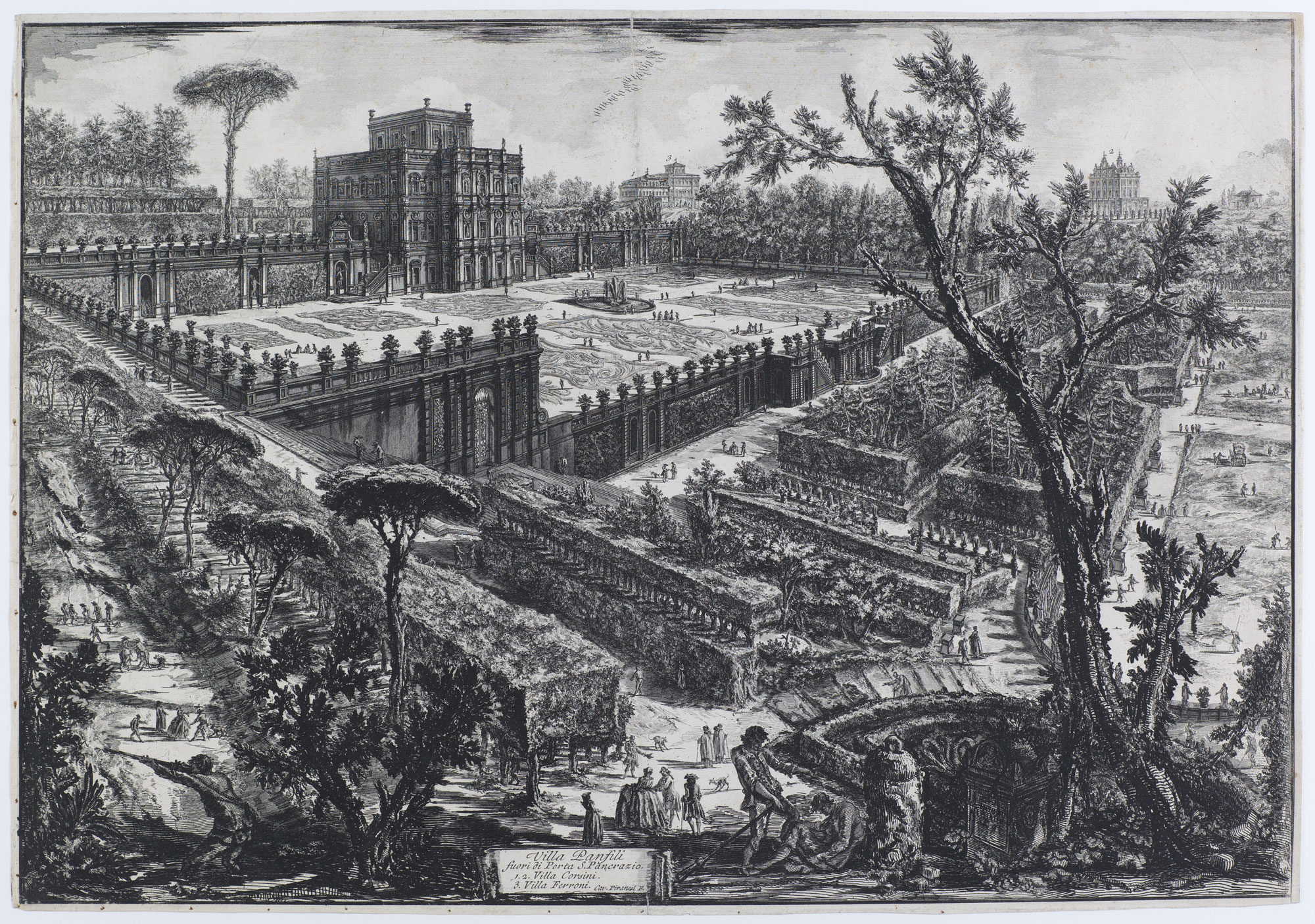
réf. 0727-Bo.J. Radierung 1765, aus Vedute di Roma, auf Bütten. 49,3:70,5 cm.- Unten in der Mitte auf dem Schriftband bezeichnet: "Villa Panfili / fuori di Porta S. Pancrazio. / 1. 2. Villa Corsini. / 3. Villa Ferroni."; unterhalb davon signiert: "Cav. Piranesi F." - Brillanter, tiefschwarzer Abdruck des 1. Zustandes mit schmalem Rändchen um die Plattenkante. Bugfalte geglättet. Literatur: Hind 124, I (von III); Focillon 840; Wilton-Ely 257; Taschen 995.
1776- PRIMO STATO DI TRE -Acquaforte e bulino, 1776, firmata in lastra in basso al centro. Magnifica prova, impressa su carta vergata coeva con filigrana “doppio cerchio e giglio con letter CB”, con pieni margini, in perfetto stato di conservazione. Della serie Vedute di Roma. L’opera consiste in 135 lastre prodotte individualmente dal Piranesi per almeno 30 anni, da circa il 1745, fino alla data della sua morte. All’opera sono aggiunte poi due vedute realizzate dal figlio Francesco. Per la prima volta furono edite dall’editore Giovanni Bouchard nel 1751 (34 lastre), successivamente dallo stesso Piranesi editore a Strada Felice prima e Palazzo Tomati poi (indirizzi che appaiono su molte tavole), fino alla stesura definitiva composta da 137 lastre. Successivamente alla morte dell’autore le matrici furono ereditate dal figlio Francesco, che ne curò la pubblicazione prima nella capitale - le cosiddette tirature “postume romane” - e successivamente a Parigi, dove furono stampate tre edizioni – la cosiddetta “prima di Parigi”, una intermedia (entrambe su carta vergata) e quella curata dall’editore Firmin Didot, la prima su carta senza vergelle, dove le tavole presentano l’aggiunta di un numero arabo ordinale. Tutte le tirature parigine sono piuttosto modeste in qualità, lontane da come il Piranesi le aveva pensate e concepite. Le lastre furono poi acquisite dalla Calcografia Camerale, poi Calcografia Nazionale, oggi Istituto Centrale per la Grafica, dove sono tuttora conservate. - THE FIRST STATE OF THREE -Etching with engraving, 1754, signed on plate at lower right. From the contemporary Roman Edition. A very good impression, printed on contemporary laid paper with watermark "double encircled fleur de lys with letters CB", with margins, very good condition. Taken from Vedute di Roma. The whole work consists of 135 plates which have been individually produced by Piranesi along 30 years, from 1745 circa until his death. Two more works have been subsequently added, two plates by his son Francesco. They have been printed for the first time in 1751 (34 plates) by the editor Giovanni Bouchard, afterwards by Piranesi himself, publisher first in Strada Felice an the in Palazzo Tomati, imprint that can be found in mostly of the plates), until the final edition of 137 plates. After Piranesi's death, his son Francesco inherited the plates, editing them first in Rome and then in Paris, where three editions were printed - the so-called "first Paris edition", an intermediate one (both on laid paper) and the one edited by the publisher Firmin Didot, the first on wowe paper, where the plates have an Arabic ordinal number added. All Parisi issues are rather modest in quality, far from how Piranesi had thought and conceived them. The plates were then acquired by the Calcografia Camerale, then Calcografia Nazionale, today Istituto Centrale per la Grafica, where they are still kept. Hind 124 I/III
1988DESCRIZIONE: Estratto Strenna dei Romanisti Roma 1998, br. ed., pp. da 233 a 247 in 8°. CONDIZIONI: Ottime/Perfette. PESO / WEIGHT: 100 gr. without package
1999catalogo della mostra tenutasi all'Accademia di Francia a Roma 18 novembre 1999-5 marzo 2000. Libro ricco di figure in nero nel testo e di tavole a colori nel testo. Riga da lettura al dorso
2012In-8 (cm. 24), brossura, con alette (macchioline), pp. 118, (2), con illustrazioni in bianco e nero e a colori. Guida a Villa Medici, Roma, sede dell’Académie de France à Rome. Timbro editoriale all’ultima carta. In buono stato di conservazione (good copy).
1998In-4 (cm. 30.80), cartonato editoriale, sovracoperta editoriale illustrata, pp. 105, (3), con illustrazioni a colori soprattutto nel testo. Fotografie di Araldo De Luca. Coordinamento di Michel Hochmann. Testo in italiano e francese. Texte en français. In ottimo stato (nice copy).