713 résultats
1908réf. 6752London: Longmans Green and Company 1908. First Edition First Printing. First Edition First Printing. Squarish quarto. 10.0 x 9 7/8 inches. 68 pp. Original color pictorial glossy paper covered boards with original maroon cloth spine decorated endpapers. With 32 superb full-page color illustrations illustrated color title and line drawings throughout all by Florence K. Upton the illustrator of the Golliwogg Series. This is a wonderful fantasy of an "unsophisticated little boy" who embarks on a journey to rescues a Princess with the help and direction of a fairy. It is one of the scarest of all the books illustrated by Florence Upton and seldom found in presentable condition. This copy with slight rubbing to cover corners rubbed hinges in tact slight toning to title near fine and internally clean and bright. Longmans, Green and Company unknown books
1916réf. 403257Massachusetts 1916. Hardcover. Near Fine. Oblong octavo. Measuring 7" x 5.5". Textured leather over paper boards with "Photographs" stamped in gilt on the front board. Contains a total of 151 images 90 sepia toned or black and white gelatin silver photographs and 61 cyanotype prints measuring between 1" x 1" and 3.5" x 4.5". Rubbing on the boards else very good with near fine photographs. A photo album kept by Florence. M. Osborne from Wellesley Massachusetts between 1907 and 1916. The album documents home life as well as travel throughout the area and including Canada. A sizable number of the early photos are cyanotypes that depict the natural beauties of New England such as ponds beaches and gardens as well as landmarks and town buildings. There are 24 photos from a trip to Quebec showing horse drawn carriages cobblestone roads artistic street views and photos of Montmorency Falls. A trip to Quincy Massachusetts shows photos of the monument to Abigail Adams Cairn as well as Penn's Hill and a water tower. A section of the album entitled "autumn" shows portraits of the family posing around the house in fancy dress including a photo of Osborne dressed in a large fashionable hat. There are also photos of various rooms in the Wellesley Free Library which was of interest to the Osborne family notable Florence's father Weston W. Osborne who was a contributor to the library's acquisition funds. The album switches to sepia tone and black and white photos around 1909 starting with a hike up Point Allerton Hill. The album continues with visits to more New England points of interest including Nahant where they photographed Senator Lodge's house. Two photos of a group of young women are captioned "Junior members of Lynn Public library staff" and are accompanied by two slips of paper listing each woman's name. The album goes on to show the library's reading room and the stairway to the main floor. The final 30 photos are laid in likely to be mounted and captioned at a later time and show women around the house decorated Christmas tables and with family pets. An interesting accumulation of images depicting Wellesley Massachusetts and the surround area with a generous selection of cyanotypes. hardcover books
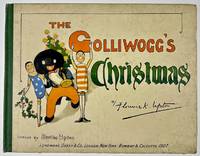
1907réf. 6772London New York Bombay and Calcutta: Longmans Green & Co 1907. First Edition. First Edition. Oblong quarto 11 x 8 1/2 inches. Original cloth-backed color pictorial glossy paper covered boards illustrated endpapers. Illustrated with full color illustrations every other page facing text pages with line drawings. Oblong quarto 11 x 8 1/2 inches. Original cloth-backed color pictorial glossy paper covered boards illustrated endpapers. Illustrated with full color illustrations every other page facing text pages with line drawings. A NEAR FINE COPY of one of the most scarce Golliwogg books rarely seen in this condition with only minor rubbing to corners and edges some faint marking to covers. Both hinges completely in tact. Some light pencil notation giving dates to advertisement of preceding Golliwogg books inaccurately owner's signature Nancy Goulburn on top of title page. The story follows the the adventures of Golliwogg and the Dutch Dolls as they prepare to celebrate Christmas - wondering if Santa Claus and his sleigh are real shopping for trinkets to put in the stockings wrapping presents chopping down a tree making pudding etc and has been one of the most beloved of all the books in the series. Longmans, Green & Co unknown books
1967réf. 12854A COLLECTION OF 21 HOLOGRAPHIC LETTERS DATED BETWEEN 1967 THRU 1981 AND MORE.all from Don Dickerman self proclaimed 20th Century Pirate Restaurateur Artist Explorer Bon Vivante to premier early 20th century magazine illustrator John La Gatta and his wife Florence. Of these 21 letters 18 of the accompanying envelopes are adorned with full hand colored illustrations. Of these 6 are on printed "The Buccaneer Inn" envelopes and 6 written on "The Buccaneer Inn" stationery. Virtually all the other letters are on one of several different artistically printed stationery created by Dickerman and all letters are noted as coming from either Sarasota Florida or Intervale New Hampshire. Along with seven more envelopes void of letters of which 4 are once again adorned with full color hand illustrations; along with 3 postcards 2 from the "The Buccaneer Inn" which are printed in full color depicting cartoon buccaneers and noted as the art of Don Dickerman and the other from an earlier time / restaurant featuring a black & white photo of Black Andy Terrapin Hangman at the helm of a ship; along with 2 large Christmas cards with printed art work by Dickerman once again INSCRIBED to the La Gatta's; along with yet another holograph letter to the La Gatta's written in pencil; along with a 2 page typed letter carbon SIGNED from the La Gatta's to Dickerman with nice content as well. All in all a very nice little archive from this eccentric restaurateur of the 20's & 30's who also served along side naturalist William Beebe as his staff artist on Beebe's West Indies expedition in 1925 and in 1940 had a small part in Errol Flynn's pirate movie The Sea Hawk. Self Published unknown books
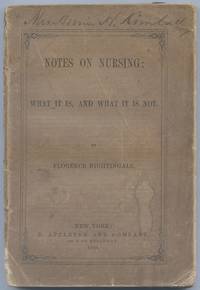
1860réf. 540671New York: D. Appleton and Company 1860. Softcover. Very Good. First American edition wrappered issue. Small octavo. 140 4pp. Owner signature of Mrs. Annie H. Kimball on front wrap some light spotting on the wrappers and first and last leaf lacks about the bottom third of the paper covered spine but a sound and attractive about very good copy in the fragile wrappers. The record of Nightingale's experiences as a manager of nurses in the Crimean War the book was heavily relied upon during the American Civil War. The first American edition is moderately uncommon the wrappered issue is excessively so. D. Appleton and Company unknown books
réf. 346569New York: Doubleday 1983. 227pp. 8vo. Cloth in dj. 227pp. 8vo. With ALS from Jackie Kennedy on Doubleday letterhead to Mrs. Millicent Fenwick laid in thanking her for the marvelous quote on the back of the jacket & wishing her good luck on her Wonderful new job Fenwick was appointed by President Ronald Reagan as United States Ambassador to the Food and Agriculture Organization of the United Nations in Rome Italy. Doubleday unknown books
1950réf. 440987Fenton Michigan 1950. Softcover. Good. Oblong quarto measuring 10.5" x 7.5". Black cloth over stiff paper boards. Contains 374 sepa-toned or black and white silver gelatin photographs measuring between 1" x 1" and 5" x 7" with captions. Album is good only with loose pages and edgewear with very good or better photographs. An extensive collection of family photographs beginning in the 1890s and going through to the 1950s. The album follows the Monnier family originally from Rochester Michigan but they relocated to the Fenton Michigan in the 1890s. One of the youngest siblings Florence seems to be the compiler. She was born at the beginning of the album and as an adult appears to have lovingly collected her family's photography together for a decades long timeline. Of note over one hundred images are circular prints and early Kodaks from the late 1800s. Throughout the album the family is pictured farming hunting and working on carpentry. Leisure time is seen as well with images of the family fishing swimming and traveling including a trip to Palm Beach. Numerous images show them posed with their car one of which shows it with a canoe strapped to the top. The family appears to have kept busy and each member had a variety of hobbies including one who was an amateur scientist with photos of a lab featured throughout. A photo data 1914 features a Monnier brother in a baseball uniform. By World War I Florence's brother Alva was serving with the Navy he's pictured here posing in uniform. Florence ends the album with her married family in the 1950s. The final pages feature group photos of the family from a reunion. An extensive collection of family photographs following a Michigan family over multiple decades with wonderful early photograph. unknown books
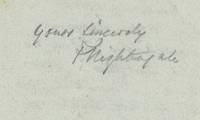
1810réf. 3732018/10/1894. The letter is to Amelia de Laney who had attended the Nightingale Training School in the 1880s Being religious she tells de Laney “God bless you & prosper your work” In the Crimean War Florence Nightingale led a team of nurses to the military hospitals where British soldiers were dying in horrifying conditions - far more from disease and poor sanitation than from battle wounds. She transformed the hospitals dramatically cutting the death rate from around 43% down to just 2%. She became known as ""The Lady with the Lamp"" for walking the wards at night checking on patients. After the war she returned home a national hero but threw herself straight back into work rather than enjoying her fame. She spent the rest of her life campaigning for better sanitation in military and civilian hospitals public health reform and the professionalization of nursing. In 1860 she founded the first professional nursing school at St. Thomas' Hospital in London using money donated by a grateful public. Nurses trained there went on to reform healthcare across the world. Nightingale wrote over 200 works including Notes on Nursing which became a worldwide bestseller and extensive writings on theology public health and hospital reform. By 1894 Florence Nightingale was 74 years old and had been an invalid for decades suffering from what is now believed was chronic brucellosis or ""Crimean fever"" contracted during the Crimean War. This severe bacterial illness caused her debilitating fatigue chronic pain and intermittent fevers severely restricting her mobility. But despite being often confined to her room in South Street London she had by 1894 reached a period where her depression lifted allowing her to occasionally receive visitors. Invitations to visit her at home were however hard to obtain. Even under these trying circumstances she remained an active healthcare pioneer. In 1894 she prepared and submitted a seminal paper titled ""Sick-Nursing and Health-Nursing"" for the International Congress of Charities Correction and Philanthropy in Chicago. Amelia de Laney attended the Nightingale Training School at St. Thomas's Hospital between 1883 and 1886. In 1894 Florence Nightingale gifted a heavily annotated copy of Gray's Anatomy to de Laney who she regarded highly. The inscription dated Easter 1894 contained her ""love & prayers for her highest success.” Though when de Laney moved in 1894 to a position as matron at the newly founded Epileptic Colony in Chalfont St Peter Nightingale privately expressed her concerns to her friend Henry Bonham Carter commenting that the work was ""entirely new. It is not hospital work at all. It seems to me an immense responsibility.” Autograph letter signed 10 South St. Mayfair London October 18 1894 to de Laney whom she addresses as “Dear Miss de Laney” wishing that her work will prosper but declining to see her because of her pressing workload. “I was so glad to hear from you tho’ as you say there is not much settled yet. But if there is patience you may augur good things. I wish I could see you now as you kindly offer. But doctor has strictly forbidden my seeing anyone. And tho’ i cannot adhere to this because there is so much pressing work I dare not however unwillingly stay to add another just now. I am sure you would not wish it. I have not left my room for above a twelvemonth. And my kind doctor comes now every day. I very much hope to see you later on. God bless you & prosper your work. Yours sincerely F. Nightingale.” It is interesting to note that Nightingale who was religious ends the letter to her old student de Laney “God bless you & prosper your work.” It is also fascinating that Nightingale in her 70s continued to have “much pressing work.” An uncommon letter of Nightingale touching on her encouragement to her protege and on her faith and health. <img class=""alignnone wp-image-25018 size-post-window"" src=""https://cdn.raabcollection.com/wp-content/uploads/20231204144051/Folder-site-11-1600x1327.jpg"" alt=""historical memorabilia dealer"" width=""1600"" height=""1327"" /> unknown books
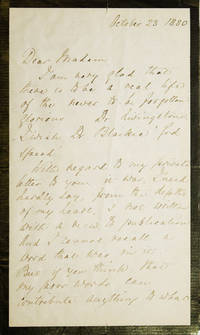
1880réf. 320579Derby 1880. 3pp. folded sheet mourning stationery. With the original mailing envelope. Usual fold. Old tape repair on conjugate leaf with resulting stain affecting a few words of text but not affecting signature. 3pp. folded sheet mourning stationery. With the original mailing envelope. "I am very glad that there is to be a real life of the never to be forgotten glorious Dr. Livingstone. I wish Dr. Blaikie God speed. With regard to my private letter to you it was I need hardly say from the depths of my heart & not written with a view to publication and I cannot recall a word that was in it. But if you think that my poor words can contribute anything to what must be the object of every English speaking nation & not only this but of every man woman & child all over the world viz. to make known one who has opened the way of peace & not terror to those who were 'lying in darkness & the shadow of death' on so large a portion of the globe. I feel that I cannot decline what otherwise is so repugnant to me . And pray believe me ever the faithful servant of yourself & the great memory of as true a hero saint as ever lived ." Written on the occasion of the preparation for imminent publication of William Garden Blaikie's biography of Livingstone published 1880 the letter gives permission for a letter of hers to be published in which she said of Livingstone: "We cannot console ourselves for our loss. He is irreplaceable" p. 458 and called him "the greatest man of his generation unknown books
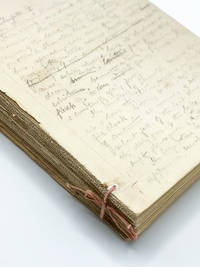
1910réf. 44643n.p.: n.p. 1910. Very good. Original draft entirely written out by hand of the sequel to the international sensation THE ROSARY. While Florence Barclay was working on this manuscript she was in the midst of a life-changing experience: her romance novel THE ROSARY had just become one of the biggest blockbuster novels of the Edwardian era. It was not only a runaway bestseller for years on end but also parodied by PUNCH made into at least five films and described by the Queen of England herself as her favorite book of the year. According to Rachel Anderson it was "said to have been read and wept over by every housemaid in the British Isles." THE MISTRESS OF SHENSTONE was something of its sequel featuring characters first introduced in THE ROSARY. THE MISTRESS OF SHENSTONE is an exquisite romance between a widow and the man who accidentally killed her husband: like THE ROSARY it combines a moving arc of emotional development with an alluring charisma between the main characters. When Barclay arrived in the United States for a book tour of SHENSTONE she was greeted as a celebrity much in the way that Charles Dickens had been on his first trip to the country. In addition to photographers and journalists she was met right off the boat by a crush of fans holding welcome banners. This experience was so unlike what was expected for English authors in the period that her daughter makes special remark upon it in her biography of the author: "To English readers it may seem a surprising outburst and very different to anything that can be imagined as taking place in England by way of reception accorded to a private individual" 220. In 1921 SHENSTONE also became the first of Barclay's books before THE ROSARY to be turned into a film. This manuscript offers a window into the writing process of a famous romance author at the height of her power. In addition to the entire base text in Barclay's hand essentially every page is revised in the same hand in some cases extensively. Common editorial markings include crossed out words and sentences some replaced with new text additions to punctuation and rearranged phrases. It is illuminating to compare the manuscript itself with the details of Barclay's writing as described in her daughter's book LIFE OF FLORENCE L. BARCLAY 1921. In seeking to champion her mother as an author for "ordinary readers" her daughter asserts that Barclay "had no eye to the literary connoisseur the seeker after mere artistic effect" 242. Yet many of the revisions made by Barclay in this draft suggest that she cared much more about the art of her work than the biography claims. Altered words often reflect the author's stylistic refinements seeking a more accurate or elevated word in place of the original e.g. "empty" changed to "desolate". Other changes show a focused eye for paring down. For instance "she poured out the doctor's tea" and "passed it across the folding tea table between them" has been changed simply to "handed it to him." These decisions reflect more than a desire to "supply them her readers with that they wanted" 242: they show an author spending hours refining her craft. A manuscript offering the opportunity to research further into the working process of a major popular romance writer - a topic that has thus far been rarely recorded or studied. 9'' x 6.75''. 386 individual lines sheets thread-bound by hand with pink ribbon filled out in pencil on rectos only. Text begins with Chapter I "On the terrace of Shenstone" and ends with the phrase sentence of the final chapter "Mrs. Jim Airth" in larger script an effect reproduced in the printed final. Editorial markings throughout. Housed in later waxed canvas wrapper with two printed labels "The Mistress of Shenstone" and one handwritten annotation "1st M S of Mistress of Shenstone." Provenance: by descent from author's family. n.p. unknown books
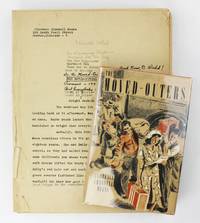
1945réf. 6500Boston: Riverside Press 1945. Overall very good. 233 i.e. 231pp. plus four small sheets. Typescript on letter-sized sheets printed on rectos only. Contemporary manuscript and typed annotations throughout. Tanned somewhat brittle. Some chipping and tape repair. with: 6154pp. plus five plates including frontispiece. Orange publisher's boards in illustrated dust jacket. Minor rubbing and wear to corners and spine ends. Light wear along edges of jacket. Tanned but otherwise clean internally. An original typescript with contemporary manuscript and typed corrections as well as alternative titles for The Moved-Outers the first full-length literary work to address the plight of Japanese Americans sent to internment camps by the U.S. government during World War II. Published by Houghton Mifflin in February 1945 this young adult novel was written by Florence Crannell Means who befriended a Japanese American family that resettled in her hometown Denver. The novel won a Newberry Medal honor award in 1946. The plot of The Moved-Outers centers on Sumiko Sue Ohara a high school senior from Cordova California who has two brothers one who is in the U.S. Army and later dies in combat and an older sister an honor student at a midwestern university. After Pearl Harbor Sue's father a florist is arrested and imprisoned. Sure her second brother Kim and their mother are detained at the Santa Anita holding center and then sent to the Granada War Relocation Center also known as Camp Amache in southeastern Colorado. Sue and her mother try to make the best of things while Kim goes sullen and gets involved with a "zoot-suit gang." The book ends in 1943 with Sue being released to go to college and her brother enlisting in the U.S. Army. The novel was released in early 1945 just as the internment camps were beginning to close and Japanese Americans were returning to the West Coast. The 231-page typescript here is evidently an earlier draft of the novel as there are significant differences between it and the final printed text a copy of which is also present. The typescript includes numerous manuscript and typed corrections to the text and several possible titles added to the first page in manuscript. The typescript and book are accompanied by three printer's proofs of illustrations for the book and an updated but pre-publication typed letter signed by Means to illustrator Helen Blair. In the letter Means mulls her options over a quick publication of The Moved-Outers which is in danger due to a paper shortage across the country because of the war. "Of course I'm thrilled that they want the book for I was always afraid they wouldn't risk that theme" she writes. "In all this I'm trying to think in terms of service to the evacuee and to our own democracy. Means credited the influence of her father a Baptist minister for her ambition to promote interracial understanding or as she often put it to teach that "folks are folks." She often spent months living among the people she wrote about. For this novel she interviewed many Japanese Americans imprisoned in Colorado and her papers at the University of Colorado include a series of questionnaires that Nisei in Denver filled out to give Means details of their removal and their daily life in the camps. Among her other works dealing with issues of race and minority life in America are her first published novel Rainbow Bridge 1934 called one of the first sympathetic portraits of Japanese Americans in mainstream fiction; Tangled Waters 1936 which tells the story of a teenage Navajo girl living with her family on the reservation in Arizona; and Shuttered Windows 1938 which features a Black female teenager as its protagonist. In all a fascinating and unique group of materials relating to this significant novel and its author. Riverside Press unknown books
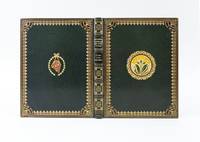
1910réf. ST17129-032London: Published for the Florence Press by Chatto & Windus 1910. ONE OF 250 COPIES ON PAPER 12 additional copies were printed on vellum. 250 x 185 mm. 9 7/8 x 7 1/4". 5 p.l. 120 pp. 1 leaf. ANIIMATED DARK GREEN INLAID CRUSHED MOROCCO ELABORATELY GILT BY SANGORSKI & SUTCLIFFE signed on front turn-in covers with inlaid border of russet ribbon laced at each corner through a blue heart from which is suspended a pair of bells in inlaid brown morocco an inner border of red inlaid hearts alternating with small gilt floral tools front cover with centerpiece medallion of five inlaid flowers in green white and yellow on a densely stippled ground within a red inlaid circle with a gilt collar of oak leaves and acorns rear board with centerpiece inlay in brown and pink of Pan pipes suspended on a ribbon the whole enclosed in a gilt garland; raised bands spine gilt in compartments featuring floral cornerpieces and knotwork centerpiece with red heart and dot inlays very ornate gilt inner dentelles silk pastedowns and endpapers all edges gilt. In a slightly marked quarter morocco fleece-lined clamshell box with gilt titling on spine. 12 fine color plates by Norman Wilkinson. With the binders' typed description of the binding on Sangorski & Sutcliffe letterhead laid in at front. ◆Tips of joints and corners almost imperceptibly rubbed one leaf with small faint stain a few minute marginal adhesions otherwise INTERNALLY AND EXTERNALLY IN VIRTUALLY PERFECT CONDITION. This is a finely bound and finely printed edition of a group of essays short stories and autobiographical and travel sketches originally published in various periodicals and first printed as a collection in 1881. Founded in 1908 by the London publishers Chatto & Windus and operated by Philip Lee Warner the Florence Press had as its expressed intention the production of "beautiful books in the choicest types . . . in larger editions and at lower cost than was usual with such monuments of typography as the issues of the Kelmscott and other presses." Florence books are readily distinguishable by their special type designed by Herbert P. Horne after 15th century Italian faces that are elegant simple and easily readable. Binders Francis Sangorski and George Sutcliffe met as boys attending Douglas Cockerell's bookbinding classes at the L. C. C. Central School. Cockerell was so impressed by their skill that he hired Sutcliffe as a finisher and Sangorski as a forwarder. In 1901 Francis and George went into business for themselves and before long they had become two of the most renowned English binders of the 20th century. We can date the time of our binding to the decade of the 1910s because there is a letter from the binders laid in with an explanation of the decoration on stationery with the printed date "191__." The letter indicates that "250 different pieces of various colored leathers are used as inlays" many to suggest the contents of the essays: "the wedding bells and heart border are suggestive of the first essay 'Virginibus Puerisque.' The front centerpiece composed of spring flowers surrounded by a wreath of oak suggests 'Crabbed Age and Youth' and the back centerpiece suggests 'Pan's Pipes.'" In terms of its design quality of execution and condition the binding is simply beautiful. Published for the Florence Press by Chatto & Windus unknown books
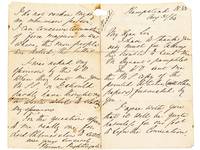
1864réf. 3103Hampstead: np 1864. First edition. nb. Good. FLORENCE NIGHTINGALE REJECTS THE FIRST GENEVA CONVENTION NINE DAYS AFTER ITS SIGNING: "IT IS LIKE AN OPERA CHORUS". A foundation-era manuscript of international humanitarian law: Florence Nightingale's private rejection of the First Geneva Convention written to Britain's Geneva delegate nine days after its signing-the primary source the ICRC's own historians have long identified as the more accurate record of her views and which the Collected Works anticipated without having. -------- This letter sits at the precise intersection of everything Florence Nightingale most fundamentally believed and everything for which she is remembered. Her life's work rested on a single conviction: that the mass death of soldiers from disease neglect and institutional failure was preventable and that the remedy was systemic reform not charitable supplementation.The Geneva Convention of 1864 proposed a different answer to the same problem. She thought it was wrong and this letter says so privately and without diplomatic qualification to Thomas Longmore the man who had just helped negotiate it. On August 22 1864 twelve European states signed the Geneva Convention for the Amelioration of the Condition of the Wounded in Armies in the Field. The Convention established the neutrality and protection of wounded soldiers medical personnel and hospitals and adopted the red cross on a white ground as their identifying emblem. It represented a revolutionary proposition: that even in war international law could impose limits upon belligerent states. Nine days later Nightingale rejected the premise that such an agreement could meaningfully alter the conduct of war. The War Office had sent her the manuscript copy of the Convention's articles - materials furnished to them by the letter's recipient Longmore from the Geneva Conference - and asked for her opinion before Britain's accession was finalized. She was the obvious person to ask: no one alive had more direct experience of the conditions the Convention was designed to address. Her response in this letter is devastating: "It amounts to nothing more than a declaration that humanity to the wounded is a good thing. It is like an Opera chorus. And if the principal European characters sing 'We never will be cruel more' I am sure if England likes to sing too 'We never will be cruel more' I see no objection." For Nightingale the fundamental problem was enforcement. A promise of humane conduct had little value because governments willing to observe it required no treaty while governments unwilling to observe it would simply disregard one: "But it is like vows. People who keep a vow would do the thing without the vow. And if people will not do it without the vow they will not do it with." She applies that reasoning directly to the signatories: "England & France will not be more humane to the enemy wounded for having signed the Convention. And the Convention will not keep semi-barbarous nations like Russia from being inhuman." And Nightingale refuses to disguise the realities of warfare beneath humanitarian rhetoric: "I do not reckon myself an inhuman person I can conceive circumstances of 'force majeure' in war where the more people are killed the better." Her conclusion is political and administrative. The question ultimately belongs not to humanitarian volunteers but to government: "For the question appears to me really one for Lord Palmerston to settle." NIGHTINGALE AGAINST HENRY DUNANT: The letter captures one of the fundamental disagreements at the birth of modern humanitarianism. Nightingale and Henry Dunant Swiss humanitarian co-founder of the Red Cross had confronted essentially the same problem-the catastrophic failure of military systems to care for wounded and sick soldiers-but arrived at profoundly different solutions. Nightingale believed the answer was to reform the state and its military medical administration; Dunant believed the inadequacy of those systems required an independent humanitarian structure capable of supplementing them. Nightingale had already objected to Dunant's proposal for voluntary relief societies arguing that such organizations would assume responsibilities properly belonging to governments. Contemporary accounts record her warning that this would relieve governments of duties "which they alone are in a position to assume." The present letter goes further. Written after the Geneva Convention had actually been signed it addresses not merely Dunant's voluntary relief societies but the international legal mechanism intended to protect the wounded. Her objection was fundamental: no treaty could conjure humane conduct in governments that lacked the will or the administrative capacity to provide it. Critically this was not a position confined to her private correspondence. Lynn McDonald's scholarly edition of the Collected Works records that Nightingale communicated the force majeure argument directly to Dunant himself warning him simultaneously of "the very great danger of taking the responsibility off governments of providing for wounded and sick." The present letter to Longmore is the only known primary document in which she makes this argument in full in her own hand to the man who had negotiated the instrument she was critiquing. It has not previously appeared in the scholarly record. THE SYSTEMS REFORMER BEHIND THE "LADY WITH THE LAMP": The letter also exposes the inadequacy of the sentimental popular image of Nightingale as merely the compassionate "Lady with the Lamp." Nightingale was a formidable researcher statistician administrator and systems reformer. She pioneered the use of statistical information and data visualization to demonstrate preventable military mortality and became the first woman elected a Fellow of the Royal Statistical Society in 1858. Her experience during and after the Crimean War convinced her that preventable military suffering resulted principally from failures of administration sanitation organization and accountability. Her solution was therefore not to create a parallel charitable apparatus but to force governments and military institutions to perform their existing responsibilities. That distinction remains central to scholarship on Nightingale and the Red Cross. The International Committee of the Red Cross ICRC itself acknowledges that although she and Dunant shared the objective of alleviating wartime suffering their "values and approaches differed significantly" and specifically recognizes her skepticism that an international convention protecting the wounded would actually be respected on the battlefield. The ICRC further cautions scholars against confusing "the public declarations of a woman well versed in the art of public relations with her private opinions." The present letter is precisely the private opinion the ICRC's own historians have flagged as the more accurate record of her views. NIGHTINGALE AND THE RED CROSS - PUBLIC MYTH AND PRIVATE OPINION: The historical irony is considerable. In 1872 Henri Dunant publicly credited Nightingale as an inspiration for his humanitarian work declaring that although he was known as founder of the Red Cross and originator of the Geneva Convention "it is to an Englishwoman that all the honour is due." Nightingale consequently became associated in popular memory with the humanitarian movement whose foundational assumptions she had challenged. The International Red Cross Conference of 1907 sent her a formal message saluting her as "the pioneer of the first Red Cross movement." She spent forty years privately maintaining that the movement was built on a false premise. That distinction gives the present manuscript particular force. Written "Private" to Britain's representative at Geneva while the Convention was scarcely a week old it records Nightingale without commemorative hindsight or diplomatic polish. She calls the new international agreement an "Opera chorus" compares its promises to ineffectual vows predicts that civilized powers will behave according to circumstances regardless of their signatures and argues that states inclined toward brutality will simply ignore it. The document thus places one of the nineteenth century's greatest humanitarian reformers at the precise historical moment when two competing models for alleviating suffering in war confronted one another: Dunant's international humanitarian law and voluntary relief movement versus Nightingale's insistence upon state responsibility and systemic military reform. History ultimately incorporated both. Modern military medical systems bear Nightingale's legacy while the Geneva Conventions and the Red Cross embody Dunant's. Their apparently contrary paths ultimately became complementary. This letter captures the disagreement at its source. PROVENANCE: From the personal papers of Sir Thomas Longmore 1816-1895 Professor of Military Surgery at Netley and British delegate to the Geneva Conference of August 1864; thence by family descent. Marked "Private" by Nightingale herself the letter remained among Longmore's papers. Autograph Letter Signed "Florence Nightingale" to Sir Thomas Longmore rejecting the First Geneva Convention nine days after its signing. Hampstead N.W.: August 31 1864. One sheet 7x9 in folded into four pages. Hole at top center. Originally folded to create six panels. Top two panels completely separated at both folds bottom panels separated along vertical fold; other panels just barely attached. There is no loss at the folds and when the panels are placed together everything appears complete and attached. Text throughout legible and unfaded. Signature crisp and fully legible. References: Boissier Pierre. "Florence Nightingale and Henry Dunant: Similarities and Differences." International Review of the Red Cross 1964. McDonald Lynn ed. Florence Nightingale and the European Wars: From the Crimean to the Franco-Prussian War. The Collected Works of Florence Nightingale University of Guelph. Mohr Charlotte. "Florence Nightingale: Portrait of a Pioneer of Modern Nursing in Writings." ICRC Library / Cross-Files August 2018. Angela Countess of Limerick. "Florence Nightingale." International Review of the Red Cross 1964. np unknown books