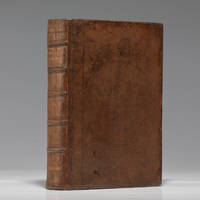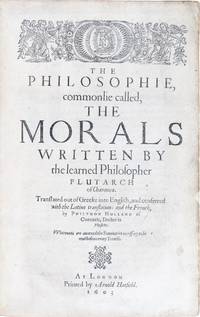
1603ref. 1168London: Printed by Arnold Hatfield 1603. First Edition. Very good. First complete edition in English containing everything you’d ever want to know of what Romans thought about private daily life. An essential balancing compendium for all the Roman history books the historiographer’s question is always what else was going on. It’s a spectacular read but you better wipe off your magnifying glasses because this book is 1400 pages of well-spaced but small type. Full mottled calf by Riviere & Son signed on the verso of the front free endpaper morocco labels marbled endpapers all edges gilt woodcut initials and headpieces rebacked a few faint scratches tiny chip paper flaw from the title page’s edge but fine and complete with the errata. The condition is exceptional for this book. Ugly copies abound but no copy like ours has sold at auction or in the trade since this one sold at Sotheby’s in 1989 for $4675 expensive then and expensive now but the finest of copies usually are. Ex–James Hale Bates 1845–1901 the American travel writer with his armorial bookplate upside down on the rear endpaper. Ex–The Garden Limited see below their bookplate also upside down next to Bates’ the error in placement certainly made by Bates The Garden owners intentionally followed suit. 4 p.l. 1363 1 pp. 32 leaves. Ref: STC 20063. ESTC S115981. Harris p. 116. Lowndes III 1891. The exalted Elizabethan translator Philemon Holland 1552–1637 was a physician and Latinist whose love of the classics prompted his devotion to rendering ancient authors into the language of Shakespeare and his output was prodigious. His first project was a translation of the Roman historian Livy published in 1600. The next year Holland tackled Pliny’s massive Natural History he also translated significant historical works of Suetonius 1606 and Ammianus Marcellinus 1609. The contents of the Morals are amazing. They confront a wild range of topics embracing fortune exile animal intelligence health advice for newlyweds the education of children benefitting from one’s enemies the value of having few or many friends how to recognize a flatterer and 10 times as many more. And though Catullus’ neoteric poems and some documents survive the primary only other source of the private details of Roman daily life beyond this book is just graffiti on the walls of Roman ruins like at Pompeii. Individual Plutarch treatises had been previously translated into English some more liberally than others but this is the first translation of the entire sequence of essays that make up the “Moralia.” Further the value of the collection is enhanced because Plutarch borrows from lost Greek works some of which would otherwise be unknown to us. The modern provenance here is at the zenith. It’s no hyperbole to say that the collection of The Garden Ltd. was the most outstanding American library of notable books put together in the second half of the 20th century. It was comprised of high spots from all periods breathtaking in their impeccable condition. It included the last 1st edition seen of Cervantes’ 1605 Don Quixote and a set of Shakespeare’s 4 folios bought by Dick Manney and then bought by us from Sotheby’s by private treaty in 1991. Does this collection have a backstory It does. Haven O’More was a genial narcissist with an autobiography fattened on bombastic exaggeration. His oft asked question was “Do you know who I am” It should have been “Do you know who I think I am” He found a rich investor Michael Davis and with Davis’ loot he built a staggering library in awe-inspiring condition that he planned to place at the center of his zanily conceived “new sacred city.” But O’More was holding aces and eights and after a public confrontation at Christies over a Gutenberg Bible Davis got bored with O’More’s antics and forced a 1989 sale at Sotheby’s titled The Garden Ltd. Printed by Arnold Hatfield unknown books
1601ref. 3078London: Impensis G. Bishop 1601. FIRST EDITION second issue with cancel title page. Hardcover. Fine. Bound in contemporary English calfskin ruled in blind re-backed and re-cornered in morocco. An excellent copy internally with very minor faults. A few signatures have very marginal damp-stains there are occasional rust spots minor marginal tears and a few natural paper flaws no loss to text. The first title page features an elaborate architectural border with Solomonic columns. "The 'Natural History' of Pliny the Elder is more than a natural history: it is an encyclopaedia of all the knowledge of the ancient world. It comprises 37 books with mathematics and physics geography and astronomy medicine and zoology anthropology and physiology philosophy and history agriculture and mineralogy the arts and letters. The 'Historia' soon became a standard book of reference; abstracts and abridgements appeared by the third century. Bede owned a copy Alcuin sent the early books to Charlemagne and Dicuil the Irish geographer quotes him in the ninth century. It was the basis of Isidore's Etymologiae and such medieval encyclopedias as the Speculum Majus of Vincent of Beauvais and the Catholicon of Balbus. One of the earliest books to be printed at Venice the centre from which so much of classical literature was first dispensed it was later translated into English by Philemon Holland in 1601 and twice reprinted a notable achievement for so vast a text. Over and over again it will be found that the source of some ancient piece of knowledge is Pliny." PMM 5 "Holland's first book the first complete rendering of Livy into English was published in 1600 when he was nearly fifty. It was a work of great importance presented in a grand folio volume of 1458 pages and dedicated to the queen. . "The Livy was followed in the next year by an equally huge translation of the elder Pliny: The Historie of the World Commonly called the Naturall Historie. This encyclopaedia of ancient knowledge about the natural world had already had a great indirect influence in England as elsewhere in Europe but had not been translated into English before and would not be again for 250 years."ODNB. Impensis G. Bishop hardcover books
1779ref. 33200London 1779. Engraved and aquatint map period hand colouring. 14 lettered references large inset with title as above. Rare revolutionary chart of the Hudson River showing the American defenses on the eve of the Battle of Fort Montgomery. On October 6 1777 a British force led by Lieutenant General Sir Henry Clinton attacked Forts Montgomery and Clinton from the landward side where the American defenses were only partially completed. Support from cannon fire from British ships on the Hudson River that had passed through the chevaux de frise on the lower river. By the end of the day both forts had fallen to the British who burned the forts and tore down the stonework buildings. However the battle was a pyrrhic victory for the British. The campaign against the forts caused delays in reinforcing General John Burgoyne at Saratoga where Americans forced the British surrender ten days later at the Battle of Saratoga before Clinton's forces could arrive. The present map which depicts the Forts and the River defenses prior to the battle is from The Atlantic Neptune the finest large scale sea atlas of the United States and Canadian Atlantic coastline ever produced. The maps in the atlas were produced over a seven-year period 1775-82 and are well known for their accurate portrayal of various sounds bays bars harbors as well as navigational hazards. This atlas was used extensively by the Royal Navy during the American Revolution. Des Barres studied under the great mathematician Daniel Bernoulli at the University of Basel before continuing on to the Royal Military College at Woolwich. On the outbreak of the Seven Years war in 1756 he joined the British Royal American Regiment as a military engineer. He came to the attention of General James Wolfe who appointed him to be his aide-de-camp. From 1762 Des Barres was enlisted to survey the coastlines of Nova Scotia Newfoundland and the Gulf of St.Lawrence while his colleague Samuel Holland charted the New England coast and further south. In 1774 Des Barres returned to England where he began work on the Neptune. His dedication to the project was so strong that often at his own expense he continually updated and added new charts and views up until 1784. That year he returned to Canada where he remained for a further forty years becoming a senior political figure and a wealthy land owner and living to the advanced age of 103. The Atlantic Neptune was the first British sea atlas of her North American colonies and one of the most important achievements of eighteenth century cartography. With an official commission from the Royal Navy Des Barres published the first volume in London in 1775 which was soon followed by further volumes. Des Barres' monumental endeavor eventually featured over two-hundred charts and aquatint views many being found in several states. All of the charts were immensely detailed featuring both hydrographical and topographical information. The Neptune met with the highest acclaim from the beginning and is today widely regarded as superior to all other atlases produced during its time. Henry Stevens identified only a single state of this chart issued coloured or uncoloured which appeared in some examples volume four part two of the Atlantic Nepture; the map however is not listed in the engraved list of maps for that section and given the rarity was likely not issued in all copies. National Maritime Museum: Henry Stevens Collection: HNS156; Cf. Phillips Atlases 1198; Hornsby Surveyors of Empire: Samuel Holland J.F.W. Des Barres and the Making of the Atlantic Neptune 2011. unknown books
1606ref. 1305011606. First Edition. SUETONIUS HOLLAND Philemon translator. The Historie of Twelve Caesars Emperors of Rome. WITH: JUSTINUS M. Junianus. The Historie of Justine. London: Matthew Lownes / William Jaggard 1606. Two volumes bound in one. Small folio in sixes 7-1/2 by 11 inches contemporary full brown calf raised bands tan morocco spine label. $24000.First edition in English of SuetoniusÕ dramatic biographies of the Caesars the important Holland translation bound together with a 1606 edition of Justinus' widely read abridgment of Pompeius TrogusÕ Historiae Philippica.""De Vita Caesarum from Julius Caesar to Domitian is largely responsible for that vivid picture of Roman society and its leaders morally and politically decadent that dominated historical thought until modified in modern times by the discovery of nonliterary evidence. The biographies are organized by topics: the emperor's family background career before accession public actions private life appearance personality and deathÉ The earlier lives down to Nero especially those of Julius Caesar and Octavius Caesar are much the fullest perhaps because as an antiquarian Suetonius was drawn to the documentary byways of an earlier ageÉ it is exciting reading"" Britannica. ""Classical 'lives' became prototypes for later writings about individuals. A rival for Plutarch was Suetonius flourished A.D. 112-121 whose Lives of the Caesars overflowed with anecdotes of lust violence and idiosyncrasy"" Boorstin The Creators 586. Holland was considered the ""translator general in his ageÉ while the plague raged at Coventry where Holland lived in 1605-06 Holland translated Suetonius' Historie of Twelve Caesars"" DNB. The work was Robert Graves' primary inspiration for his novel I Claudius 1934. With woodcut initials and elaborate woodcut chapter headpieces incorporating medallion portraits.Justinus' work is an abridgment of the monumental Historiae Philippicae by Roman historian Pompeius Trogus ""a history of the world down to the Roman conquest of the East"" Peck. Justinus' Epitome became a critical source for the history of Macedonia and the Hellenistic kingdoms. First translated into English by Arthur Golding in 1564 it stood as the primary source from which Elizabethans drew their knowledge of classical history. There is little doubt that William Shakespeare was well-acquainted with the book. ""Altogether there are ten or more clear-cut allusions to memorable characterizations and passagesÉ In addition Shakespeare seems to have drawn heavily upon the book in naming many of his dramatic personages"" Charles Barrell. Direct parallels can be found in Henry V Henry VI Titus Andronicus Taming of the Shrew and The Winter's Tale. Golding's much earlier translation is typically cited as Shakespeare's source but it is curious that the translator of this 1606 edition George Wilkins was an associate of Shakespeare a fellow member of the King's Company of Actors and the co-author of Shakespeare's late drama Pericles Prince of Tyre. The unscrupulous Wilkins actually ""extensively plagiarized"" Golding's translation for his own version so the two texts are perforce very similar. With woodcut initials and elaborate woodcut chapter headpieces incorporating medallion portraits. STC 23424. Brueggemann 703. Moss II:636. Harris 145. Palmer 100. STC 24293. Ownership signature dated 1657. Occasional early ink marginal marks.Interior generally crisp and clean; paper flaw to leaf P5 of Suetonius affecting letters but not the sense of the text occasional light dampstaining to top edge of Justinus. Expert restoration to joints which are cracked but holding firm. An exceptional copy. hardcover books
1776ref. 33412London: J. F. W. Des Barres for The Atlantic Neptune 1776. Large engraved chart from Des Barres' Atlantic Neptune on two sheets of laid paper joined each bearing "J Bates" watermark. 43x31 inches sheet size nice margins; contemporary hand-color in outline; slightest offsetting a superior copy. State 4 of 7. Fine chart depicting the waters between New Bedford and Martha's Vineyard. Buzzards Bay and the Vineyard Sound including the Elizabeth Islands and the western half of Martha's Vineyard. Showing much more on-shore information than is typical for a Des Barres chart there are details of property boundaries structures even a road from Menemshaw Pond to Tisbury. Native names throughout remain largely unchanged today. Joseph Des Barres was born in Switzerland in 1721 and educated in Basel before emigrating to England and entering the Royal Military College where he learned engineering and the art of surveying. In 1756 Des Barres was commissioned a Lieutenant in the Royal American Regiment and dispatched to North America. He served in America during the Seven Years War under Colonel Bouquet Lord Howe and General Amherst and participated in the Quebec campaign as General Wolfe's engineer. Though Des Barres was responsible for the surveys done of Nova Scotia and the Isle of Sable the surveying of the coastline of what became the United States was undertaken by Major Samuel Holland a Dutchman who joined the British army during the French and Indian War as an engineer and became ultimately Surveyor General for North America. Holland was in charge of a rather large staff that included Charles Blaskowitz and George Gauld. They ultimately provided greatly improved charts for the entire coastline and the Gulf of Mexico. All this work was done prior to the Revolution which necessarily brought the surveys to an end. The publishing supervised by Des Barres continued throughout the war years. Des Barres compiled and edited the atlas maintaining a high standard throughout. His primary motive seems to have been the navigational usefulness of the charts. He clearly envisioned a navigator's needs in approaching a shoreline. The Atlantic Neptune was the first new survey of American coastlines in a century and the need was very great. The charts were plagiarized for the next thirty or forty years. Des Barres also had a flare for making charts aesthetically appealing so that they are invariably handsome as well as unfailingly interesting. Stevens 88D; John Carter Brown Library Charting the East Coast of North America The Atlantic Neptune Providence: 1972; Robert Lingel 'The Atlantic Neptune' in the Bulletin of the New York Public Library July 1936 pp.571-603; Augustus P. Loring 'The Atlantic Neptune' in American Maritime Prints New Bedford: 1985. J. F. W. Des Barres for The Atlantic Neptune unknown books