1589 risultati
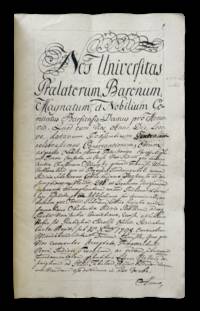
rif. FRE28100 pp. In Latin and Hungarian. In original wrappers with printed ornament on sides stripped with a string. Calligraphic cursive of late 18th century. The document was sealed and signed by a committee of nobles and jurors. A historically interesting juridical manuscript compiled in the town of Aranyosmarót in the Kingdom of Hungary now Zlaté Moravce in southwestern Slovakia. It represents a decision of a trial by the local noble court in a yearslong property dispute between two Hungarian-Slovak noblewomen: Anna Petrikovics and Krisztina Szádeczky. The lawsuit initially arose over the inheritance rights to a house or estate in the Sáros County village of Nagy-Sáró which Anna Petrikovics had taken possession of. In 1788 Krisztina Szadeczky sued her and won: the court ordered Anna to pay her 246 florins in compensation. The retrial was opened at the initiative of Anna Petrikovics due to the emergence of new documents. The manuscript is of interest as an example of an aristocratic dispute arising from complex inheritance and family ties. Representatives of various noble families of the Kingdom of Hungary were involved in the case: the Szádeczky Petrikovics Miticzky Pongracz Ullman Timon and others. Most of them can be identified in genealogical research and tables for example the parents of Anna Petricovics Pal Petrikovics and Klara Miticzky are shown in the genealogical tree Petrikovics család. Nagy Iván: Magyarország családai Reference Library; see more in Nagy Iván’s work Magyarország családai. The manuscript is also interesting as an example of legal proceedings and early modern law citing witness letters contracts parish records and above all genealogical investigations as evidence. Anna Petrikovics lost the case precisely because she was unable to accurately prove her inheritance rights. Overall a rare and historically significant example of an aristocratic lawsuit from the Kingdom of Hungary. unknown
1687In-4°; pp. (8) 472, legatura coeva in piena pergamena con titolo manoscritto al dorso. Storico francese, estensore di cronache e traduttore, Casimir Freschot fu autore prolifico, visse a Roma e a Bologna, scrisse anche opere in italiano. Qui la storia di Ungheria inizia dal 370 e si dipana attraverso i re e le guerre fino alla presa di Buda nel 1686.
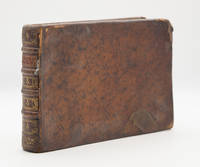
1688rif. 101185Antwerp: Henry van Dunwalt and Gaspar Bouttats 1688. Oblong 12mo. 40 engraved plates portrait of Joseph I and town views by Gaspar Bouttats. 49 1 pp. Bound with: CORONELLI P.M. Courte Description du Royaume de la More'e et des Places Maritimes. Antwerp: Henry van Dunwalt and Gaspar Bouttats nd. 30 engraved plates portrait of Fransisco Morosini town views and plans maps by P.M. Coronelli. 23 1 pp. Contemporary stained calf red morocco spine label spine gilt in compartments with raised bands; areas of loss to leather on covers title-page mounted a few stray purple ink stains plates lightly finger-soiled with occasional small closed to tears and wear a few plates trimmed close. Henry van Dunwalt and Gaspar Bouttats hardcover
1969rif. 59361Budapest Hungary: Ernst Muzeumban. As New. Paperback. FREE UPGRADE to Courier/Priority Shipping Upon Request – – IN STOCK AND IMMEDIATELY AVAILABLE FOR SHIPMENT - AS NEW THE TEXT BLOCK IS PRISTINE CLEAN UNMARKED AND IN EXCELLENT CONDITION - - Text in French and Hungarian. 116 pp. With 43 ills. 20 x 23 cm. -- with a bonus offer-- . 1969. Ernst Muzeumban paperback
1965rif. 58663Budapest Hungary: Galerie Nationale Hongroise. As New. Paperback. FREE UPGRADE to Courier/Priority Shipping Upon Request – – IN STOCK AND IMMEDIATELY AVAILABLE FOR SHIPMENT - AS NEW THE TEXT BLOCK IS PRISTINE CLEAN UNMARKED AND IN EXCELLENT CONDITION - - Text in Hungarian; introduction in Hungarian and French. 60 pp. With 15 ills. 23 x 20 cm. -- with a bonus offer-- . 1965. Galerie Nationale Hongroise paperback
1968rif. 59030Budapest Hungary: Magyar Nemzeti Galeria. As New. Paperback. FREE UPGRADE to Courier/Priority Shipping Upon Request – – IN STOCK AND IMMEDIATELY AVAILABLE FOR SHIPMENT - AS NEW THE TEXT BLOCK IS PRISTINE CLEAN UNMARKED AND IN EXCELLENT CONDITION - - Text in Hungarian. 100 pp. With 369 ills. 23 x 20 cm. -- with a bonus offer-- . 1968. Magyar Nemzeti Galeria paperback
1969rif. 59362Budapest Hungary: Szepmuveszeti Muzeum. As New. Paperback. FREE UPGRADE to Courier/Priority Shipping Upon Request – – IN STOCK AND IMMEDIATELY AVAILABLE FOR SHIPMENT - AS NEW THE TEXT BLOCK IS PRISTINE CLEAN UNMARKED AND IN EXCELLENT CONDITION - - Text in French and Hungarian. 258 pp. With 50 ills. 24 x 20 cm. -- with a bonus offer-- . 1969. Szepmuveszeti Muzeum paperback
1845rif. 25480Paris Au Comptoir des Imprimeurs-Unis 1845 2 vol. in-8 demi-basane bleue, dos ornés en long style rocaille, tranches mouchetées [Rel. de l'époque], rouss
1939rif. 43670Budapest: Pesti Lloyd-nyomada 1939. First edition. Softcover. vg. Folio. 26pp. published unbound. Original cream stapled wraps with title printed in black to back cover protected by modern mylar. To the Honorable Upper and Lower House of the Parliament. Respectful petition of the representatives of the Hungarian Jewish community concerning "Bill No. 72. regarding the restriction of Jews in public and economic life". Official petition of the Hungarian Jews regarding the bill of the Second Anti-Jewish Law No. IV:1939. The Second Anti-Jewish Law was one of a series of anti-Jewish measures passed by the Hungarian Parliament between 1938 and 1941 and the first Hungarian law providing a "racial" definition of the Jewish status according to the Nuremberg Race Law of 1935. Besides of other severe deprivations it sets a ceiling of six percent reduced from twenty of Jews being allowed to work in various financial and commercial professions as well as industrial enterrises employing more than ten persons. It also excluded the Jews from state administrations and jurisdiction prohibited Jews from teaching high school reenacted the Numerus Clausus at universities and partly rescinded their right to vote. Bill No. 702 the Second Anti-Jewish Law was drafted by István Antal state secretary of the Ministry of Justice and Pál Teleki Minister of Religion and Education and was presented for debate before Parliament on December 23 1938. The petition aimed to sway Parliament to disapprove the law claiming it being unconstitutional and delinquent in view of legal equality human rights and the Divine Law and furthermore relinquishing social justice and threatening national unity the emancipation granted by the laws of 1849 and 1867 in short it was deemed to be against the national interest of Hungary. The petition was unsuccessful the bill was approved by Parliament and was signed into law on May 5 1939 effecting the Hungarian Jewry severely with more than 90 thousand Jews losing their jobs and thus lowering the living conditions of approximately 220000 people significantly. Braham R.: The Second Anti-Jewish Law in: The Politics of Genocide: Holocaust in Hungary New York Columbia University Press 1981 pp. 147-156. Scarce important historical document with institutional holdings recorded only in Hungary. Text in Hungarian with slight rubbing to covers. Else in very good condition. Pesti Lloyd-nyomada unknown
1939rif. 43670Budapest: Pesti Lloyd-nyomada 1939. First edition. Softcover. vg. Folio. 26pp. published unbound. Original cream stapled wraps with title printed in black to back cover protected by modern mylar. To the Honorable Upper and Lower House of the Parliament. Respectful petition of the representatives of the Hungarian Jewish community concerning "Bill No. 72. regarding the restriction of Jews in public and economic life". Official petition of the Hungarian Jews regarding the bill of the Second Anti-Jewish Law No. IV:1939. The Second Anti-Jewish Law was one of a series of anti-Jewish measures passed by the Hungarian Parliament between 1938 and 1941 and the first Hungarian law providing a "racial" definition of the Jewish status according to the Nuremberg Race Law of 1935. Besides of other severe deprivations it sets a ceiling of six percent reduced from twenty of Jews being allowed to work in various financial and commercial professions as well as industrial enterrises employing more than ten persons. It also excluded the Jews from state administrations and jurisdiction prohibited Jews from teaching high school reenacted the Numerus Clausus at universities and partly rescinded their right to vote. Bill No. 702 the Second Anti-Jewish Law was drafted by István Antal state secretary of the Ministry of Justice and Pál Teleki Minister of Religion and Education and was presented for debate before Parliament on December 23 1938. The petition aimed to sway Parliament to disapprove the law claiming it being unconstitutional and delinquent in view of legal equality human rights and the Divine Law and furthermore relinquishing social justice and threatening national unity the emancipation granted by the laws of 1849 and 1867 in short it was deemed to be against the national interest of Hungary. The petition was unsuccessful the bill was approved by Parliament and was signed into law on May 5 1939 effecting the Hungarian Jewry severely with more than 90 thousand Jews losing their jobs and thus lowering the living conditions of approximately 220000 people significantly. Braham R.: The Second Anti-Jewish Law in: The Politics of Genocide: Holocaust in Hungary New York Columbia University Press 1981 pp. 147-156. Scarce important historical document with institutional holdings recorded only in Hungary. Text in Hungarian with slight rubbing to covers. Else in very good condition. Pesti Lloyd-nyomada unknown books
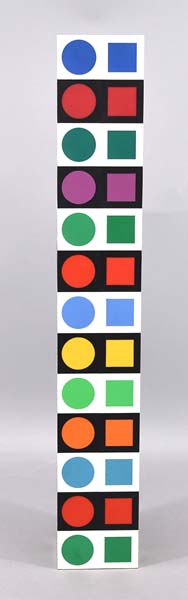
1970rif. 69451ABZumikon (Schweiz)., Editions Pyra AG / Victor Vasarely., o. J. [1970]. 10,2 x 10,2 x 66 cm., 69451A Winzigste Bereibungen und minimalste Klebeschatten auf einer Seite, sonst guter bis sehr guter Zustand.
1653rif. elala1607Saros-Patak Hungary: Typis Illustrissimae Principis Excudebat Georgius Renius 1653. 1653. folio. pp. 1 p.l. 582. old vellum overlapping fore-edges recased vellum soiled ties wanting 3 small library rubberstamps some scattered foxing & browning. In June 1606 Archduke Matthias in the name of the Emperor Rudolph II concluded the Treaty of Vienna with the rebellious Hungarians by granting extensive concessions and in November of the same year he concluded the truce of Zsitvatörök with the Sultan Ahmed I. "By the peace of Vienna Stephen Bocskay obtained religious liberty and political autonomy the restoration of all confiscated estates the repeal of all unrighteous judgments and a complete retrospective amnesty for all the Magyars in royal Hungary besides his own recognition as independent sovereign prince of the enlarged Transylvania. This treaty is remarkable as being the first constitutional compact between the ruling dynasty and the Hungarian nation. Almost equally important was the twenty years truce of Zsitvatörök negotiated by Bocskay between the emperor and the sultan which established for the first time a working equilibrium between the three parts of Hungary with a distinct political preponderance in favour of Transylvania The emperor on the other hand was freed from the humiliating annual tribute to the Porte on payment of a war indemnity of 400000 ". Encyc. Britan. 11th Edn. The text of the two treaties pp. 30 is followed by the articles of various Hungarian statutes and ordinances dating from 1608 to 1649 pp. 31-582. The BM copy contains further articles for 1659 not present here. Saros-Patak [Hungary]: Typis Illustrissimae Principis Excudebat Georgius Renius, 1653. hardcover
1933rif. 20863S.d. (circa 1933-1934); in-folio en feuilles, couverture rempliée gris clair illustrée, chemise demi velin et pièce de titre en cuir, titre doré, papier à la cuve multicolore et doré en forme de feuillage, étui de même ; 86 feuillets non chiffrés, le dernier blanc ; couverture et 50 aquarelles originales de Barta, dont 3 hors-texte.
rif. 20035S.l.n.d. [vers 1850] in-4 oblong (26,5 cm x 37, 5 cm) demi-veau havane à coins, dos lisse orné de filets dorés [Rel. de l'époque], dos et coins refaits