CollectifLivre Rare Book

1 596 résultats
réf. 37180Budapest, 1926. Format 15x23 cm, broche, 279 pages. Avec un portrait de Jozsef Foherceg en frontispice. Ouvrage en langue hongroise. Bon etat.
réf. 26084HUNGARY A GOLDEN AGE. ART AND SOCIETY IN HUNGARY 1896-1914. Miami: Barbican Art Gallery Center 1990. Folio. Pictorial wrappers. 197 pages. First edition. An exhibition catalogue well-illustrated in black and white and color. Fine. unknown books
20018vo. 259 pages. Illustrated with tables. In Hungarian. SUBJECT (S) : Jews Hungary Heves Megye history; Holocaust, Jewish (1939-1945) Hungary Heves Megye; Heves Megye (Hungary) history. OCLC lists 23 copies worldwide. Reviewed below by Randolph L. Braham: "In historical terms, the Jewish communities of Heves County were relatively short-lived. As was the case of their counterparts in virtually all other provinces of Hungary, most of these communities lasted just a little over one hundred years. While some of the settlements were established toward the end of the eighteenth century, most came into being only during the nineteenth century. The Jews were originally encouraged to settle on the estates of the feudal landlords, who were eager to see them engage in trade and commerce - economic pursuits the landed aristocracy found demeaning and the basically illiterate peasantry was not qualified to fill. By 1840, the number of Jews living in the county was 1, 953; it reached a peak of 10, 928 in 1880. During the decades that followed, the size of the county's Jewish population gradually declined, and by the time of the anti-Semitic drive of the 1940s was only a little over 7, 000.The many historical, political, and socioeconomic factors determining the rise and fall of the Jewish communities in the county, including, among others those of Eger, Gyöngyös, Hatvan, Heves, and Tiszafüred, are described and analyzed in this well documented work by Dr. Ágnes Szegö Orbán, head of the public library of Tiszafüred. The author of A tiszafüredi zsidóság törtenete és demográfiája, Orban skillfully exploits the archival resources of the county to document the evolution of the communities, differentiating between the various phases of Hungarys national history. Using the tools of the social sciences, she highlights the social structure and the religious and welfare organizations of the communities, identifies the branches of trade, commerce and industry in which Jews played a pioneering role, and documents the increasingly difficult political climate in which the communities struggled to survive, especially after the end of World War I. As elsewhere in truncated Hungary, the anti-Jewish drive in Heves County intensified in 1938, following the adoption of the First Anti-Jewish Law. This was followed in rapid succession by many increasingly more ominous anti-Semitic acts, culminating in the tragedy that engulfed all of the Jews of Hungary after the German occupation of March 19, 1944. The last section of the book is devoted to the Holocaust era. It succinctly describes the measures that were enacted by the central and local authorities, including the humiliation, isolation, and expropriation of the Jews. It also reveals the horrible conditions that prevailed in the various ghettos, including those of Eger, Gyöngyös, Hatvan, Szúcsi-Bagólyuk, and Tiszafüred, and documents the inhumane conditions under which the Hungarian instruments of state power the civil service, the police and gendarmerie -- carried out the deportations. The attempt to reestablish some of the communities after the war was basically unsuccessful. It was doomed to failure from the beginning. For one thing, only a pitiful number of the relatively few survivors were eager to establish new roots in the towns and villages from which their loved ones had been so brutally deported to Auschwitz. Some of the survivors decided to relocate in the larger cities that for a while at least -- still had viable Jewish communities; others decided to emigrate at the first opportunity. Moreover, the policies of the Soviet-supported Communist regime that came to power shortly after the war discouraged the nurturing of traditional Jewish values or the reinvigoration of religious communities. Fine condition. (Comhist-13-2)
1993A clean, unmarked book with a tight binding. Faded spine. 236 pages.
2002Original Cloth. 8vo. 334 pages. 25 cm. First edition. In Hungarian. The Holocaust: Selected Studies. Collection of articles by Randolph L. Braham. Subjects: Holocaust, Jewish (1939-1945) Holocaust, Jewish (1939-1945) - Historiography. Holocaust, Jewish (1939-1945) - Hungary. Holocaust, Jewish (1939-1945) - Romania. Antisemitism - Europe. Antisemitism. Historiography. Holocaust, Jewish (1939-1945) . OCLC lists 7 copies. Light shelf wear, otherwise fresh and clean. Very good + condition. (BRAHAM-1-48) xx
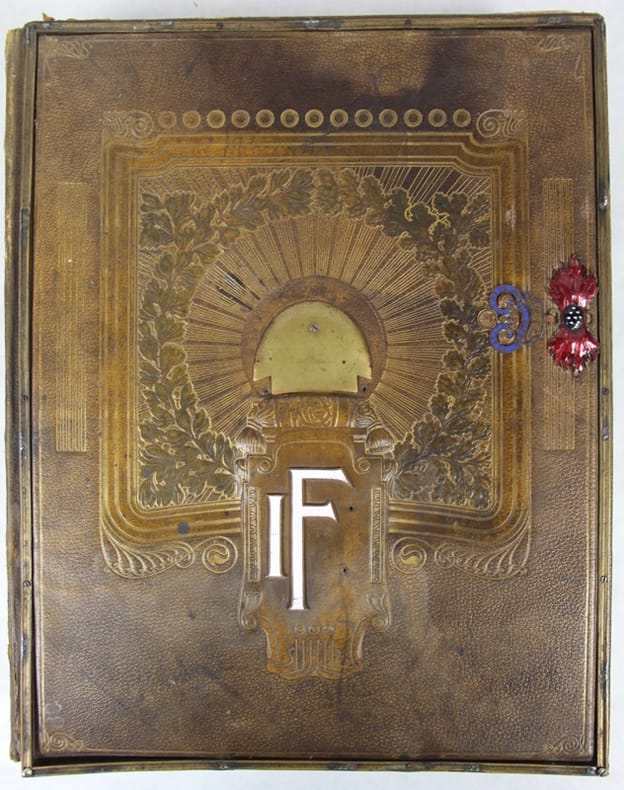
1899réf. 37323Leipzig, Budapest, Vienne, Maximilien Herzig 1899 In-folio, plein chagrin brun, dos à nerfs, premier plat dans un cadre métallique, orné et décoré à froid autour d’une couronne et du monogramme IFJ en métal, le monogramme rehaussé de blanc manque la lettre J, fermoir factice rehaussés rouge, bleu et blanc, rosaces de support en laiton aux coins en second plat une rosaces manque, XXIV- 322 pp. Deux titres frontispice couleurs, ornements décoratifs des table, Illustrations à toutes pages, nombreuses à pleine page, une à double page, certaines sous serpente légendée, en noir ou sépia, 35 lithographies hors-texte sur onglet, certaine sous serpente lég. Large humidité en pied aux hors-texte le frontispice et le titre en couleurs sont préservés, deux ff. et une planche déliés. Brunissures marginales éparses.
1974réf. ZB213989Budapest 1974. Price HAS BEEN REDUCED by 10% until Monday Nov. 2 weekend sale item 6 volumes very large oblong quartos profusely illustrated with maps and charts some external wear particularly to corners but in all near very good. - If you are reading this this item is actually physically in our stock and ready for shipment once ordered. We are not bookjackers. Buyer is responsible for any additional duties taxes or fees required by recipient's country. Budapest unknown
réf. 76600aafBudapest, Société de la Nouvelle Revue de Hongrie, 1943, gr. in-8vo, 48 p., brochure originale.
2019New French Paperback. Roy. 8vo. (24 x 17 cm). In French. 260 p. A l'ere des empires et des nations: La France et les principautes de Moldavie et de Valachie, (1711-1859). Préface Avant-propos I. Cadre conceptuel et état de la recherche I. 1. Empires, nations, corps intermédiaires et zones d'influence I. 2. L'interdépendance entre centre et périphérie dans les relations internationales à l'époque moderne : une spécificité française par rapport à l'Orient I. 3. Un regard sur l'historiographie de la matière et sur les sources disponibles (pour le xviiie siècle, jusqu'à la Révolution française) II. L'expansion russo-autrichienne vers les principautés de Moldavie et de Valachie dans la première moitié du xviiie siècle : l'émergence de la géopolitique de la périphérie danubienne II. 1. La campagne de Pierre le Grand en Moldavie et en Valachie et ses conséquences II. 2. Dans le sillage des Impériaux : la Russie et ses victoires annulées II. 3. Annexion ou organisation des diversions contre les Ottomans : quelle place pour les principautés de Moldavie et de Valachie dans la stratégie des Impériaux ? II. 4. Le Drang nach Südosten et l'occupation de l'Olténie (1718-1739) III. La France et les périphéries orientales du système international dans la première moitié du xviiie siècle III. 1. La tactique de revers et l'accentuation des rivalités impériales sur la ligne du Danube. Le traité de Prut (1711) III. 2. La nouvelle intervention diplomatique française dans la région intermédiaire. La succession de Pologne et le traité de Belgrade (1739) III. 3. Le facteur prussien et les alliances de revers : un test en Europe orientale avant la guerre de Sept Ans IV. Instabilité politique et rivalités impériales : la perception française des principautés de Moldavie et de Valachie dans la première moitié du xviiie siècle IV. 1. Un espace frontière insuffisamment connu, mais non une terra incognita IV. 2. Religion, guerre et diplomatie dans la perception française des principautés IV. 3. Les princes de Moldavie et de Valachie dans la perception française V. La Moldavie et la Valachie dans la politique de la France : renseignements, transmission des dépêches, diplomatie régionale V. 1. La route des principautés pour la transmission de la correspondance diplomatique française V. 2. Intermédiaires français dans la politique régionale de l'Empire ottoman V. 3. Le renversement des alliances et son impact sur le système des engagements de la France en Europe orientale et du sud-estVI. La France et la question polonaise après la guerre de Sept Ans : le dernier recours aux alliances de revers VI. 1. La montée de la rivalité franco-russe après la guerre de Sept Ans VI. 2. La succession de Pologne et le refroidissement des relations diplomatiques franco-russes VI. 3. Les difficultés de l'offensive diplomatique française à Constantinople VI. 4. L'intensification de l'activité des agents français dans l'Empire ottoman VII. Les guerres russo-austro-ottomanes dans la deuxième moitié du xviiie siècle et les principautés de Moldavie et de Valachie VII. 1. La guerre russo-ottomane de 1768-1774 et le premier partage de la Pologne : la transformation politique de l'Europe orientale VII. 2. Le système politique des principautés de Moldavie et de Valachie après le traité de Kutchouk-Kaynardgi (1774) : coimperium, exceptionnalisme et internationalisation VII. 3. Le facteur autrichien et l'annexion de la Bukovine (1775) VII. 4. L'annexion de la Crimée par la Russie (1783) et la dernière coalition russo-autrichienne contre les Ottomans au xviiie siècle VIII. La guerre russo-ottomane de 1768-1774 et le recul de la France en Europe orientale et du sud-est. L'annulation du traité de Prut et l'annexion de la Bukovine par les Habsbourg VIII. 1. La France et le déclenchement de la guerre russo-ottomane VIII. 2. La France face au système d'engagements russo-austro-prussiens en Europe orientale VIII. 3. L'émergence du « système de la Russie en Orient » et l'annexion de la Bukovine par l'Autr
1956Num?ro complet.
réf. 31691Budapest, Stephaneum Nyomda, 1907. In-8, broché, 70 p. (sans couverture).
réf. 43706Budapest, badupest Szekesfovaros Statisztikai Hivatala 1930, 270x190mm, 38 + 1143Seiten, Verlegereinband. Sehr schönes Exemplar.
réf. 116272aafBudapest, Franklin-Tarsulat Kiadasa, s. d., vers 1970, in-4to, env. 500 p. par vols., richement ill., reliure en toile originale.
réf. 116277aafBudapest, A magyar legujabb kor lexikona Kiadasa, 1933, gr. in-8vo, 1112 p., ill. de portraits miniatures en n./b., reliure en demi-cuir.
1977réf. 027426very nice copy; Text in German English Hungarian and French. 789 photos. Booklet with English captions for the photos . Very Good. Hardcover. 1st Edition. 1977. hardcover
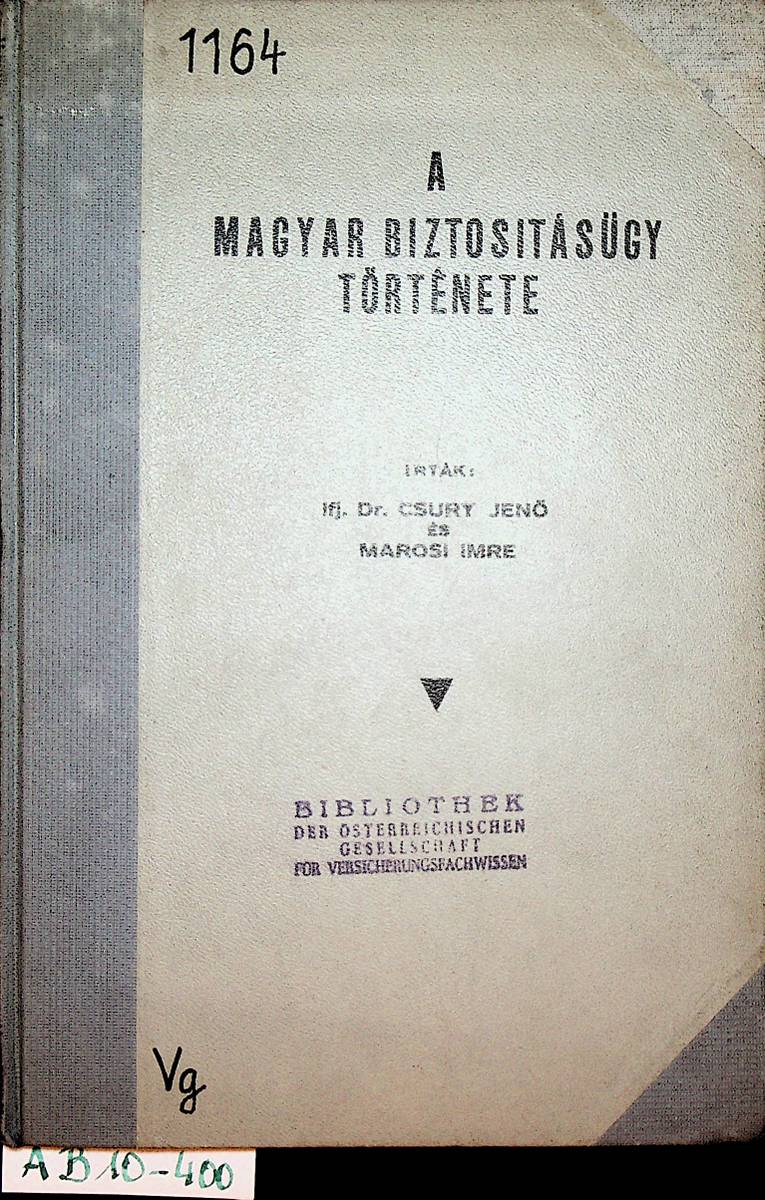
1931réf. AB10-400Budapest, Gyarmati Ferenc, 1931. original half-cloth binding, large 8vo, 226 pp, good copy
1965réf. 58663Budapest Hungary: Galerie Nationale Hongroise. As New. Paperback. FREE UPGRADE to Courier/Priority Shipping Upon Request – – IN STOCK AND IMMEDIATELY AVAILABLE FOR SHIPMENT - AS NEW THE TEXT BLOCK IS PRISTINE CLEAN UNMARKED AND IN EXCELLENT CONDITION - - Text in Hungarian; introduction in Hungarian and French. 60 pp. With 15 ills. 23 x 20 cm. -- with a bonus offer-- . 1965. Galerie Nationale Hongroise paperback
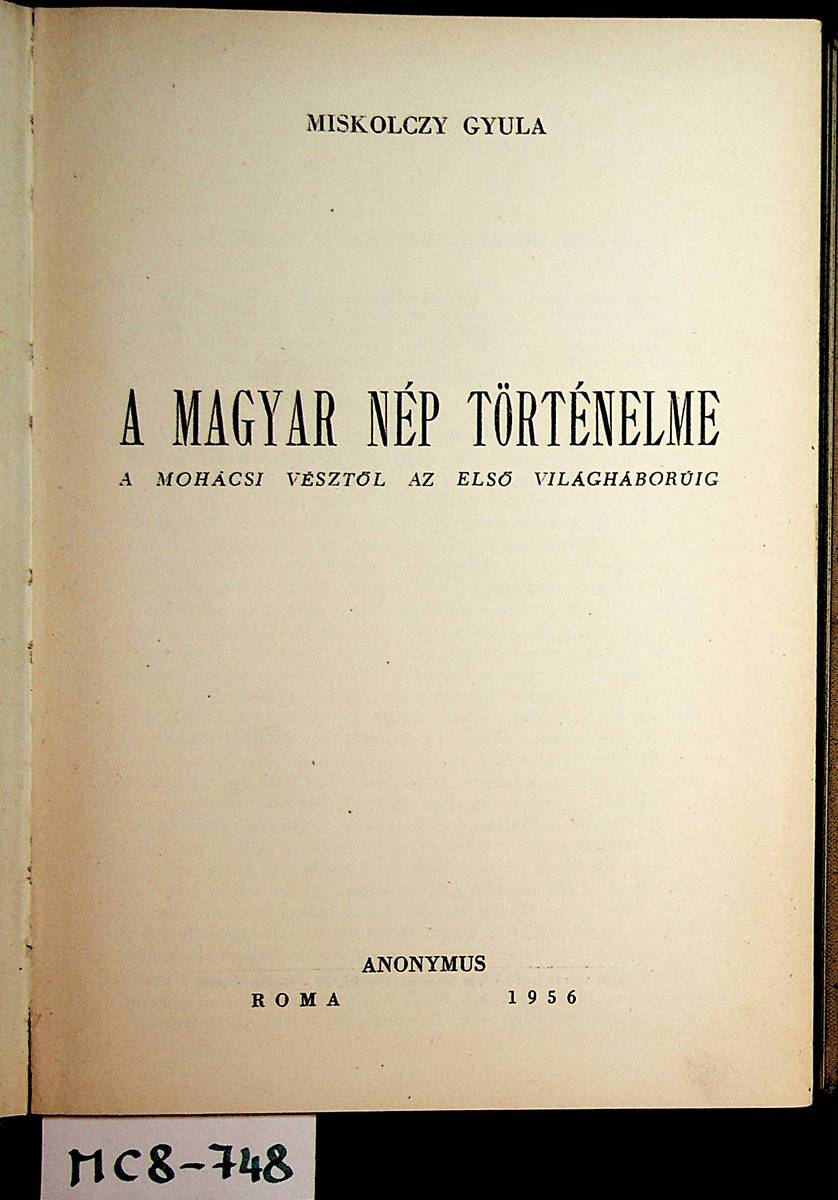
1956réf. MC8-748Roma (Rome, Rom), Anonymus, 1956. original cloth-binding, 8vo, 312 pages, good copy/ original Leinenband, 8?, 312 Seiten; Zustand: gut
In-8, broché, 70 p. (sans couverture). Edition originale. Envoi autographe signé à Alexander Madga. Exemplaire très frais.
1939réf. 43670Budapest: Pesti Lloyd-nyomada 1939. First edition. Softcover. vg. Folio. 26pp. published unbound. Original cream stapled wraps with title printed in black to back cover protected by modern mylar. To the Honorable Upper and Lower House of the Parliament. Respectful petition of the representatives of the Hungarian Jewish community concerning "Bill No. 72. regarding the restriction of Jews in public and economic life". Official petition of the Hungarian Jews regarding the bill of the Second Anti-Jewish Law No. IV:1939. The Second Anti-Jewish Law was one of a series of anti-Jewish measures passed by the Hungarian Parliament between 1938 and 1941 and the first Hungarian law providing a "racial" definition of the Jewish status according to the Nuremberg Race Law of 1935. Besides of other severe deprivations it sets a ceiling of six percent reduced from twenty of Jews being allowed to work in various financial and commercial professions as well as industrial enterrises employing more than ten persons. It also excluded the Jews from state administrations and jurisdiction prohibited Jews from teaching high school reenacted the Numerus Clausus at universities and partly rescinded their right to vote. Bill No. 702 the Second Anti-Jewish Law was drafted by István Antal state secretary of the Ministry of Justice and Pál Teleki Minister of Religion and Education and was presented for debate before Parliament on December 23 1938. The petition aimed to sway Parliament to disapprove the law claiming it being unconstitutional and delinquent in view of legal equality human rights and the Divine Law and furthermore relinquishing social justice and threatening national unity the emancipation granted by the laws of 1849 and 1867 in short it was deemed to be against the national interest of Hungary. The petition was unsuccessful the bill was approved by Parliament and was signed into law on May 5 1939 effecting the Hungarian Jewry severely with more than 90 thousand Jews losing their jobs and thus lowering the living conditions of approximately 220000 people significantly. Braham R.: The Second Anti-Jewish Law in: The Politics of Genocide: Holocaust in Hungary New York Columbia University Press 1981 pp. 147-156. Scarce important historical document with institutional holdings recorded only in Hungary. Text in Hungarian with slight rubbing to covers. Else in very good condition. Pesti Lloyd-nyomada unknown
1939réf. 43670Budapest: Pesti Lloyd-nyomada 1939. First edition. Softcover. vg. Folio. 26pp. published unbound. Original cream stapled wraps with title printed in black to back cover protected by modern mylar. To the Honorable Upper and Lower House of the Parliament. Respectful petition of the representatives of the Hungarian Jewish community concerning "Bill No. 72. regarding the restriction of Jews in public and economic life". Official petition of the Hungarian Jews regarding the bill of the Second Anti-Jewish Law No. IV:1939. The Second Anti-Jewish Law was one of a series of anti-Jewish measures passed by the Hungarian Parliament between 1938 and 1941 and the first Hungarian law providing a "racial" definition of the Jewish status according to the Nuremberg Race Law of 1935. Besides of other severe deprivations it sets a ceiling of six percent reduced from twenty of Jews being allowed to work in various financial and commercial professions as well as industrial enterrises employing more than ten persons. It also excluded the Jews from state administrations and jurisdiction prohibited Jews from teaching high school reenacted the Numerus Clausus at universities and partly rescinded their right to vote. Bill No. 702 the Second Anti-Jewish Law was drafted by István Antal state secretary of the Ministry of Justice and Pál Teleki Minister of Religion and Education and was presented for debate before Parliament on December 23 1938. The petition aimed to sway Parliament to disapprove the law claiming it being unconstitutional and delinquent in view of legal equality human rights and the Divine Law and furthermore relinquishing social justice and threatening national unity the emancipation granted by the laws of 1849 and 1867 in short it was deemed to be against the national interest of Hungary. The petition was unsuccessful the bill was approved by Parliament and was signed into law on May 5 1939 effecting the Hungarian Jewry severely with more than 90 thousand Jews losing their jobs and thus lowering the living conditions of approximately 220000 people significantly. Braham R.: The Second Anti-Jewish Law in: The Politics of Genocide: Holocaust in Hungary New York Columbia University Press 1981 pp. 147-156. Scarce important historical document with institutional holdings recorded only in Hungary. Text in Hungarian with slight rubbing to covers. Else in very good condition. Pesti Lloyd-nyomada unknown books
1933réf. 3413013Budapest, 1933. VII, 813 S. OKart. (angestaubt).
2007Original Cloth. 4to. 1, 590 pages. 28 cm. First Hungarian edition. Edited by Randolph Braham. Housed in illustrated box. Three volume set: 1. Ko¨t. Abau´j-Torna va´rmeyge-Ma´rmaros va´rmegyge - 2. Ko¨t. Maros-Torda va´rmeyge-Zemple´n va´rmegye - 3. Ko¨t. Fu¨ggele´k. The illustrated three-volume Geographical Encyclopedia of the Holocaust in Hungary is a magisterial resource, thorough and exhaustive, chronicling the wartime fate of the Jewish communities in that country where virulent antisemitism is anything but dead, even today. With scores of detailed maps and hundreds of photographs, this reference work is organized alphabetically by county, each prefaced with a map and a contextual history describing its Jewish population up to and into 1944. Entries track the demographic, cultural, and religious changes in even the smallest communities where Jews lived before their marginalization, dispossession, ghettoization, and, finally, deportation to labor and death camps. The encyclope¬dia endows scholars and lay researchers with both panoramic and microscopic views of the virtually last-minute destruction of most of the Jews of Hungary, until then the last sizable surviving Jewish community in occupied Europe. - USHMM. Subjects: Holocaust, Jewish (1939-1945) - Hungary - Encyclopedias. Jews - Persecutions - Hungary - Encyclopedias. Antisemitism - Hungary - Encyclopedias. Judenvernichtung. Antisemitism. Jews - Persecutions. Holocaust, Jewish (1939-1945) . OCLC lists 17 copies. Brand new in publishers plastic. Very good + condition. (BRAHAM-1-45) xx
2010Hardback. 8vo. 1, 480 pages. 25 cm. First edition. In Hungarian. Contains 5, 573 items on the Holocaust in Hungary. Edited by Randolph L. Braham. Subjects: Holocaust, Jewish (1939-1945) - Hungary - Bibliography. Jews - Hungary - History - 20th century - Bibliography. World War, 1939-1945 - Jews - Hungary - Bibliography. Antisemitism - Hungary - History - 20th century - Bibliography. OCLC lists 13 copies. Brand new, wrapped in plastic from publisher. Very good + condition. (BRAHAM-1-26) xx
2026réf. LRB42010611Paris: Editions Recreasoft 2026 Langue : Français. Environ 626 pages. Français : Réimpression à la demande. Édition originale : 1906. Ouvrage en français. Cette reproduction moderne de A muveszetek tortenete: a legregibb idoktol a XIX. szazad vegeíg de Beoty Zsolt 1848-; Hungary. Vallas-es Kozoktatasugyi Ministerium rend accessible un texte ancien ou rare pour la consultation la recherche bibliographique et les collections spécialisées. Images du livre non contractuelles English: Print-on-demand reprint. Original edition : 1906. Text in French. This work provides a comprehensive historical overview of the development of the arts from ancient times to the end of the 19th century. Divided into three volumes Ancient Medieval Modern it examines various artistic styles and movements in detail with particular attention to the Italian Renaissance and its influence in Hungary. A valuable source for art historical research. Book images are non-contractual. Editions Recreasoft. Softcover. New. Editions Recreasoft paperback