New South Wales Pre-settlementBiblio.com
53 résultats
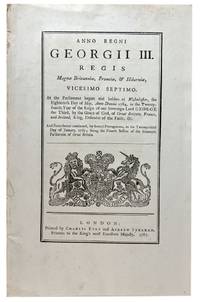
1787réf. 137248London: printed by Charles Eyre and Andrew Strahan 1787. Pp. 6last blank being pages 14-20 with large Royal Coat of Arms woodcut on title page disbound; f'cap. folio; small tear from inner edge into margin of the title page; printed by Charles Eyre and Andrew Strahan Printers to the King London 1787. Ferguson 22. The first Act to set up a judiciary in New South Wales. It provided for the appointment of a Court with power to proceed in a more summary way than usual within the United Kingdom and to sentence offenders to death or corporal punishment and also to assign labour. printed by Charles Eyre and Andrew Strahan unknown
1954réf. 182426Sydney: Oswald L. Ziegler 1954. Edited by Oswald L. Ziegler. Pp. 98last three blank illustrated throughout in colour and black & white with tipped in presentation leaf 'To Her Majesty The Queen from the Government of New South Wales . . .' signed by J. J. Cahill Premier' hinge tender at this point; roy. 4to; full pale blue leather boards decorated in gilt and with a gilt-bronze commemorative medal struck to mark the 1954 Royal Tour laid into upper board at centre gilt dentelles the lower board slightly marked edges a trifle worn; a.e.g.; blue and gold decorative wove paper endpapers; within original Velvel lined box which is worn and split at edges; book label of David Levine Sydney on verso of upper free endpaper and with gift inscription and note that this is a replica of the original book on upper free endpaper; Oswald L. Ziegler Sydney 1954. With some black & white photographs of the original publication. Oswald L. Ziegler unknown
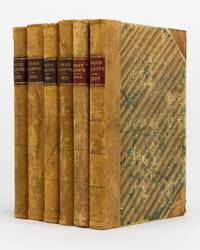
1902réf. 147073Sydney: Printed by William Applegate Gullick Government Printer 1902. First Edition. Hardcover. Very Good. Sydney Printed by William Applegate Gullick Government Printer 1902 to 1907. Folio six volumes 54 index last blank 514; 56 index last blank 498; 56 index 514; 56 index 465; 54 index last blank 442; and 54 index last blank 450 pages with the very occasional illustration of victims or perpetrators of crime reproduced from photographs. Contemporary uniform half calf with contrasting morocco title-labels and marbled papered boards all edges speckled; minor signs of age and handling; in very good condition. Published and distributed weekly to every police station in New South Wales the gazette was produced to alert the constabulary to all manner of criminal activities in great detail warrants arrests and judgements as well as listing missing persons deserting spouses and straying livestock. Rare on the open market; the extensive indexes are an invaluable genealogical resource but the casual browser will not come away disappointed. 6 items. Printed by William Applegate Gullick, Government Printer hardcover
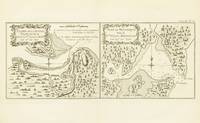
1774réf. 143636Paris: Chez Saillant et Nyon . chez Panckoucke 1774. Very Good. Paris Chez Saillant et Nyon . chez Panckoucke 1774. A two-panel engraved map printed surface 138 × 332 mm sheet size 252 × 363 mm. Vertical centrefold crease as issued; slight indentations to both panels; very slightly tanned and marked at the edges; in excellent condition. The two panels of the map show the Endeavour River where Cook beached the 'Endeavour' for repairs after striking the Great Barrier Reef in 1770 and Botany Bay respectively. It comes from the first French edition of the official account of the voyage 'Relation des voyages entrepris . pour faire des découvertes dans l'hémisphère méridional' 'Tome III. Pl. 17'. Tooley 343; see Beddie 659. Chez Saillant et Nyon ... chez Panckoucke unknown
1807réf. 143631Edinburgh: Thomas Brown 1807. Very Good. Edinburgh Thomas Brown circa 1807/ 1801. An engraved map with original hand colouring printed surface 348 × 298 mm sheet size 394 × 320 mm. Engraved by 'Gavin & Son'. A little tanned and faded; a few faint spots of foxing; a very good copy. A map of the east coast of Australia with inset maps of Port Jackson and Botany Bay Norfolk Island and Lord Howe Island. Tooley 21 suggesting Brown's 'A General Atlas' as the source and the date of 1801. This example is from a later likely separate issue with the paper watermarked 1807. This version is copied from an earlier map published by Robert Wilkinson in 1792 or 1794 see Tooley 14 and 15. Thomas Brown unknown
1802réf. 143671Weimar: im Verlage des Landes Industrie Comptoirs 1802. Very Good. Weimar im Verlage des Landes Industrie Comptoirs 1802 but 1803. An engraved map printed surface 174 × 221 mm sheet size 211 × 260 mm here with ample margins. Two vertical creases; some light tanning with a few tiny spots of foxing; evidence of previous mounting at the edge of the left-hand margin; in excellent condition. A rare German map of the early settlements of New South Wales including Sydney Paramatta sic and Bankstown published in 'Allgemeine Geographische Ephemeriden' Volume 11 in 1803. It is largely copied from a map in David Collins' 'An Account of the English Colony in New South Wales' 1798-1802 itself based on John Hunter's 'Chart of the Coast between Botany Bay and Broken Bay surveyed in 1788 and 89 .' 1793. im Verlage des Landes Industrie Comptoirs unknown
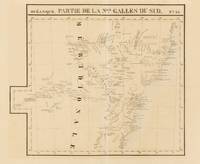
1827réf. 143929Brussells: P.M.G. Vandermaelen 1827. Very Good. Brussells P.M.G. Vandermaelen 1827. A lithographed map printed surface 471 × 547 mm sheet size 533 × 665 mm printed in black and blue. Vertical centrefold crease as issued; remnants of hinge mounts and an old guard on the verso; paper lightly tanned and foxed; in excellent condition. Plate 55 from Vandermaelen's monumental 'Atlas Universel' showing the New South Wales coast from around Batemans Bay to the Solitary Islands. Sydney the Blue Mountains and hinterland are shown including much of the Lachlan River. Vandermaelen's atlas was 'the first world atlas on a uniform scale. The sixth volume covered "Océanique" and it included seventeen maps of Australia. All the sheets were made on the same scale and projection and they were so constructed that they could form a globe of about 1000 gores 7.775 metres in diameter' Clancy: 'The Mapping of Terra Australis' 1995. P.M.G. Vandermaelen unknown
réf. 231567New South Wales Government Railways c. 1930. 16 pp unpaginated only 9 pp are printed/illustrated oblong 45.5 x 19 cm map coloured plates front wrapper has small repaired tears has previously been folded in half else very copy in illustrated wrappers. New South Wales Government Railways, c. 1930 unknown
1929réf. 151810London: Headquarters of the Regiment 1929. Foreword by Colonel Sir Charles Cheers Wakefield. Pp. iixxxiv464 frontispiece and 19 plates 22 folding and 6 text maps decorated endpapers roll of honour summary of decorations awarded index; cr. 4to; qr. red and blue boards lettered decorated and ruled in gilt lightly worn and marked small perforation in upper joint; top edges gilt; edges of leaves a little browned and a trifle soiled free endpapers browned book label of David Levine Sydney on verso upper free endpaper; Headquarters of the Regiment London 1929. First edition. White p. 201. Headquarters of the Regiment unknown
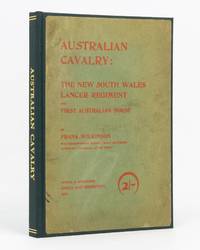
1901réf. 129531Sydney: Angus and Robertson 1901. First Edition. Hardcover. Fair. Sydney Angus and Robertson 1901. Quarto x 64 pages with an illustration plus 8 plates but lacking the colour frontispiece called for by Dornbusch. Modern binder's cloth with the front panel of the original green wrapper printed in red mounted on the front board; text block tide-marked near the head of the spine with the plates a little stained; some discolouration and foxing heavy in places; minor signs of age and use; a decent copy of an absolute rarity. This history of these two cavalry units from their foundation through to the end of the Boer War is 'undoubtedly a regimental record but it is something more - it is an attempt to explain and to some extent combat the unreasoning prejudice which has grown up as a result of the South African campaign against the cavalry arm of the service. On this point Mr. Wilkinson says:- "It is my purpose to show not only that cavalry regiments like the New South Wales Lancers have done equal yeoman service to the Empire in the South African struggle with their comrades in the other branches of the service but that they have done infinitely more as the pioneers of the cavalry movement in Australia to enhance the value of our defence force and to shew the world of what fighting stuff our men are made"' from a review in the 'Daily Telegraph' 12 October 1901. The last 18 pages contain numerous appendices including nominal and casualty rolls. Dornbusch 126; Fielding and O'Neill page 126. Angus and Robertson hardcover
réf. 224039McCarron Stewart & Co. Sydney 1907. 736 pp quarto tinted end-papers b&w photographic plates and illustrations throughout bookplate on front paste-down end-papers foxed boards flecked spine faded top of spine pulled else good copy in purple cloth boards. McCarron, Stewart & Co., Sydney, 1907 hardcover
1908réf. 98743Sydney: W.A. Gullick Government Printer 1908. First Edition. Hardcover. Very Good. Sydney W.A. Gullick Government Printer 1908. Large oblong quarto colour-pictorial title leaf verso blank plus 72 flush-cut full-page gelatin silver photographs each 350 × 275 mm mounted back-to back to form 36 gilt-edged leaves with the images bleeding off all edges. Original full calf gilt later rebacked and recornered in calf a little worn; in very good condition the contents are in excellent order. The broad coverage of the State comprises captioned images of public buildings 12 and street scenes 8 of Sydney; ports and harbours 6 including 3 of Newcastle; north coast farms 8; mines and other industries 10; timber 7; livestock 8; agriculture 6; and leisure 7. Although the album was issued in 1908 it contains a number of images from much earlier negatives. W.A. Gullick, Government Printer hardcover
1807réf. 1711007London: War Office 1807. Thick folio a splendid copy with generous margins on large paper in a fine period binding of crimson straight-grained morocco all edges gilt sides panelled in gilt with greek key borders spine panelled in gilt with green leather label. A magnificent copy of an officer's vade-mecum the who's who of the British army at a moment in time and as the entire list of British Army officers in 1807 the crucial bible for issues of promotion and preferment as well as location and secondment. This issue is of note for including a breakdown of the officers of the New South Wales Corps p. 311 serving under Colonel Francis Grose the roll call of familiar names beginning with Grose Paterson Foveaux and Johnstone spelled thus. Such publications were sometimes bound in magnificent style as here but do not often survive in this sort of perfect condition. . War Office unknown
réf. 55349The signatures are Arthur Morris Captain Alley Donaldson 12th man Fred Johnston Kissell Lindwall Lukeman Miller Moroney Pettiford Saggers and Toshack. The team featured six Test players including five future Invincibles; Alley and Pettiford played for the Services and/or later Commonwealth teams. This was Keith Miller's debut match for NSW after representing Victoria from 1937-38 to 1946-47. On the verso are the pencil signatures for the Victorian team for the match against Queensland in Brisbane 14-18 November 1947 SSM 356. The signatures are Hassett Captain Baker Fitzmaurice Fothergill Freer M.R. Harvey Ray Harvey 12th man Howard Jinks Lambert Meuleman and Ring plus the manager. There are five Test players including two future Invincibles; Howard toured New Zealand in 1949-50 and Fitzmaurice and Lambert toured with the Commonwealth team in India in 1949-50. In excellent condition. unknown
1857réf. 84416Sydney: Government Printer 1857. Near fine. Sydney Government Printer 1857. Foolscap folio 4 pages a bifolium. Drop-title; a near-fine copy uncut and unbound as issued. New South Wales Parliamentary Paper Number 120 of 1857. Seven items of correspondence relating to an alleged incident on the Lower Condamine in 1852 'a collision had taken place between the Police and some petty cattle stealers'. All pretty inconclusive. Government Printer unknown
1863réf. 75777Sydney: Sherriff & Downing 1863. First Edition. Hardcover. Very Good. Sydney Sherriff & Downing 1863. Duodecimo iv 118 10 publisher's advertisements pages plus a folding 'colored sic map of the Colony compiled expressly for the work' 427 × 538 mm and endpaper advertisements. Original flush-cut blind-stamped blue patterned cloth lettered in gilt on the front cover a little rubbed and marked and slightly worn at the extremities; thin strip snipped from the head of the front flyleaf; occasional light foxing; one opening a little discoloured by a newsprint bookmark no longer present; minimal signs of use and age; a very good copy. Provenance: Thomas Thornton Reed 1902-1995 Anglican Archbishop of Adelaide with his signature in pencil at the head of the title page. Ferguson 15645 supplying the date; the advertisement on the rear flyleaf contains testimonials dated January 1863 and suggests those wishing to 'be supplied in May June or July this year are requested to send their orders in without delay'. The map is extensively - and attractively - handcoloured. An augmented edition was published in 1866 see Ferguson 15646. Sherriff & Downing hardcover
réf. 50077Sydney : Government Printer 1885. Invitation card 113 x 115 mm; lithograph printed recto only in black on cream lightweight card stock; O'Connor's name entered in manuscript; toned and lightly marked tiny loss at one corner verso with superficial loss from where the card was once mounted in an album. Provenance: Removed from a dilapidated album of mounted printed ephemera compiled by J. G. O'Connor 1839-1913 Irish-born Sydney journalist printer and politician. From the ADB: 'Joseph Graham O'Connor 1839-1913 journalist and politician was born at Dareen House King's County Ireland son of Stephen O'Connor tanner and currier and his wife Ann née Graham. At 2 he went with his parents to New South Wales. Educated by the Christian Brothers and at the Sydney College he was apprenticed to a wood engraver and printer. In the late 1850s O'Connor began business as an engraver and printer and in 1860 produced the short-lived Sunbeam for the Catholic Young Men's Society. In 1864 he joined W. B. Dalley W. J. Macleay and J. J. Harpur in bringing out the unsuccessful Sydney Times devoted to 'the promotion of Australian literature and the advocacy and encouragement of native industry'. In 1867 he began the Balmain Reporter one of the earliest suburban newspapers. His journalistic pursuits became more exclusively Irish and Catholic. In 1870-71 he edited and printed the Catholic Association Reporter. In 1876 he had debts of over £1400 sold his press and was not discharged from bankruptcy until 1884 after paying 3s. in the £. In 1877 he had begun the Catholic Times in opposition to the Freeman's Journal. In 1880 Archbishop Vaughan was dissatisfied with the Freeman's independent attitude and bought the Catholic Times changing its name to the Express. In 1884 O'Connor took it over again and began the Nation devoted to Irish news; he incorporated it in the Express in 1887. In 1890 debts forced him to close his last newspaper venture and his estate was again sequestered. He had supported his unprofitable newspapers with a mostly successful printing business but in 1892 his friends had him appointed chief clerk on the Water and Sewerage Board at Newcastle from which he retired in 1909. As a youth O'Connor had helped to collect funds to relieve the 1858 Donegal famine victims and next year became an original member of the Celtic Association. In 1869-72 he was lay secretary of the Catholic Association founded by Archbishop Polding in 1867 to support a separate system for Catholic schools. In the 1870s and 1880s he organized several concert tours of country districts to raise funds for the Church. Active in municipal politics with various Irish Catholic factions he was auditor of the Sydney City Council in 1870-74. After several attempts he was elected in 1873 to the Legislative Assembly for Mudgee in the Catholic interest. Defeated in 1875 he lost again in 1880. O'Connor helped to organize the annual St Patrick's Day celebrations and did not eschew more controversial Irish causes: in 1866 he was treasurer of the Irish State Prisoners' Fund organized to assist the dependants of Fenian prisoners in Ireland; in 1871 he helped to welcome Fenian prisoners released from Western Australia and in 1883 he was one of the few prominent Irish Catholics to welcome William and John Redmond. Affectionately known as 'old white hat' from the topper he invariably wore he chaired their first Sydney meeting and was president of the local branch of the Irish National League. He remained close friends with the Redmonds and helped later Irish delegates. At Sydney in 1861 O'Connor had married Mary Earl d.1903. He died of bronchitis at his Mayfield home on 22 July 1913 and was survived by a married daughter. The Irish Parliamentary Party contributed to a monument over his grave in Sandgate cemetery.' unknown
réf. 50370Two large format albumen print photographs each 230 x 280 mm both captioned in the negative at lower right 'Fitzroy Falls Moss Vale'; both in fine condition unmounted. Fitzroy Falls is an 80-metre waterfall located in what is now the Morton National Park in the Southern Highlands region of New South Wales just southeast of Moss Vale and at the head of the Kangaroo Valley. unknown
réf. 50372Three large format albumen print photographs each 230 x 280 mm with captions in the negative; one print with a couple of nicks to top edge otherwise all in fine condition unmounted. unknown
réf. 50402Sydney : S. T. Leigh & Co. 1888. Menu. Folding gilt-edged card 195 x 135 mm chromolithograph illustrated with gold highlights; second and third sides with menu catering was Baumann of Pitt Street under the supervision of W. G. Cassidy toasts and programme of music featuring decorative borders with cartouche illustrations; light foxing overall the rear side which had no printed text with some residual glue and paper adhesions from where the menu was removed from an album mount. A beautifully designed menu for the official banquet to celebrate the centenary of British settlement which was held at the Exhibition Building in Prince Alfred Park near Chalmers Street Sydney. Provenance: Removed from a dilapidated album of mounted printed ephemera compiled by J. G. O'Connor 1839-1913 Irish-born Sydney journalist printer and politician. From the ADB: 'Joseph Graham O'Connor 1839-1913 journalist and politician was born at Dareen House King's County Ireland son of Stephen O'Connor tanner and currier and his wife Ann née Graham. At 2 he went with his parents to New South Wales. Educated by the Christian Brothers and at the Sydney College he was apprenticed to a wood engraver and printer. In the late 1850s O'Connor began business as an engraver and printer and in 1860 produced the short-lived Sunbeam for the Catholic Young Men's Society. In 1864 he joined W. B. Dalley W. J. Macleay and J. J. Harpur in bringing out the unsuccessful Sydney Times devoted to 'the promotion of Australian literature and the advocacy and encouragement of native industry'. In 1867 he began the Balmain Reporter one of the earliest suburban newspapers. His journalistic pursuits became more exclusively Irish and Catholic. In 1870-71 he edited and printed the Catholic Association Reporter. In 1876 he had debts of over £1400 sold his press and was not discharged from bankruptcy until 1884 after paying 3s. in the £. In 1877 he had begun the Catholic Times in opposition to the Freeman's Journal. In 1880 Archbishop Vaughan was dissatisfied with the Freeman's independent attitude and bought the Catholic Times changing its name to the Express. In 1884 O'Connor took it over again and began the Nation devoted to Irish news; he incorporated it in the Express in 1887. In 1890 debts forced him to close his last newspaper venture and his estate was again sequestered. He had supported his unprofitable newspapers with a mostly successful printing business but in 1892 his friends had him appointed chief clerk on the Water and Sewerage Board at Newcastle from which he retired in 1909. As a youth O'Connor had helped to collect funds to relieve the 1858 Donegal famine victims and next year became an original member of the Celtic Association. In 1869-72 he was lay secretary of the Catholic Association founded by Archbishop Polding in 1867 to support a separate system for Catholic schools. In the 1870s and 1880s he organized several concert tours of country districts to raise funds for the Church. Active in municipal politics with various Irish Catholic factions he was auditor of the Sydney City Council in 1870-74. After several attempts he was elected in 1873 to the Legislative Assembly for Mudgee in the Catholic interest. Defeated in 1875 he lost again in 1880. O'Connor helped to organize the annual St Patrick's Day celebrations and did not eschew more controversial Irish causes: in 1866 he was treasurer of the Irish State Prisoners' Fund organized to assist the dependants of Fenian prisoners in Ireland; in 1871 he helped to welcome Fenian prisoners released from Western Australia and in 1883 he was one of the few prominent Irish Catholics to welcome William and John Redmond. Affectionately known as 'old white hat' from the topper he invariably wore he chaired their first Sydney meeting and was president of the local branch of the Irish National League. He remained close friends with the Redmonds and helped later Irish delegates. At Sydney in 1861 O'Connor had married Mary Earl d.1903. He died of bronchitis at his Mayfield home on 22 July 1913 and was survived by a married daughter. The Irish Parliamentary Party contributed to a monument over his grave in Sandgate cemetery.' unknown
réf. 49878Melbourne : printed by Wilson and Mackinnon Collins Street East 1864. Octavo 215 x 140 mm publisher's blind-blocked green pebbled cloth rubbed spine lettered in gilt; original yellow endpapers; title with ownership inscription of John Bowie Wilson New South Wales Government Minister for Lands in the 1860s; pp. vii viii-x 241 3 blank; preliminaries with small toning spot towards fore-edge margin otherwise very clean throughout a near fine copy with a significant political association. In 1863 ""The Riverine Petition"" was sent from the Riverina District of southern New South Wales to Queen Victoria pleading for independence from the colony. Settlers cited geographical isolation neglect of local infrastructure and a desire to align with Melbourne's pastoral interests essentially seeking to separate and form a new colony. This is often referred to as the Riverine District Association movement. Ferguson 14944 Very scarce. hardcover
réf. 49030Cover title. Also titled: Map of City of Sydney New South Wales Australia. Sydney : Govt. Tourist Bureau c.1935. Single sheet 360 x 240 mm folding to 190 x 85 mm colour pictorial front panel with six further panels of text providing information about day tours around Sydney verso with colour map of central Sydney with inset key to places of interest and a wharf directory to lower margin. Fine. unknown
réf. 48410Ordered by the Council to be printed 30 May 1888. Sydney : Charles Potter Government Printer 1888. Foolscap folio disbound from a larger volume pp. 1-6; a good clean copy. New South Wales parliamentary paper that forms part of the ongoing debate about Chinese immigration in the Australian colonies that had raged since the gold rushes - long before the ultimate introduction of the White Australia legislation of 1901-2. The paper tables comments by prominent politicians most notably Henry Parkes regarding a proposed common intercolonial policy that would halt or restrict Chinese immigration. unknown
réf. 76333Macmillan and Co. London. 1886. 1st edition with Preface and Additions by John Neale Dalton. Volume I: XXVIII 676 PP with tables 27 charts and maps and 25 b/w illustrations plus 1 folded chart and 9 b/w plates. Fp in colour: folded map of the Cruise of H.M.S Bacchante 1879-82. Volume II: XII 803 PP with 34 charts maps and plans and 26 b/w illustrations plus 6 b/w plates. Cloth cover gilt device and title on front covers and spine. Top edge gilt. Bookplate of Henry L. White of the "Australian Ornithology Philately and Bibliography". Lower edge of covers rubbed at fore corners and foot of spine. Occasional foxing . Small bump of cover at top corner of Volume I. Gutter of endpapers starting otherwise a very nice set. Scarce. 23 x 16. Macmillan and Co. London. 1886. hardcover
réf. 41125Geelong : Supreme Court of New South Wales for the District of Port Phillip May 1850. Manuscript in ink written on the first two sides of a folio bifolium in the hand of a legal clerk; recording a bond of £160 payable to Deputy Sheriff Alastair Mackenzie. The three liable parties are John Furlong of Barrabool farmer; George Gibbons licensed victualler of South Geelong; and George Elliot general dealer of South Geelong. The condition of the bond is that it will remain in effect from the commencement of Furlong's suit in the Supreme Court at Melbourne or Geelong against Edward Willis and Charles Lambert Swanston joint owners of Native Creek Station a sheep run of 4000 acres for 'taking and unjustly detaining' his property - 'to wit one stack of hay twenty bags of oats and dirty wheat and one horse dray' but that it will be made void if/when the goods are adjudged to have been returned; seals intact on the second side; docketed on the last side: 'Dated day omitted May 1850 / John Furlong and others to A. Mackenzie Esq. Deputy Sheriff / Bond'; original folds; a very well preserved Port Phillip legal document. John Furlong was a pioneer settler in the Geelong district. A farmer with a property called Woodstock in the Barrabool Hills west of Geelong he was a god-fearing man and a member of the Free Church of Scotland. The year 1850 had not begun well for him. In February his wife Margaret had been arrested and briefly detained by the Chief Constable in Geelong on a charge of attempting to take her own life by taking laudanum the authorities also noting that she had recently developed a heavy drinking habit Geelong Advertiser 27 February 1850. Even greater tragedy was to strike the family the following summer: on 10 February 1851 an article on the Barrabool Hills bushfire in The Argus reported that 'Mr Furlong's stacks and fences are burnt ; Mrs Furlong was severely burnt and her injuries may be fatal.' Evidently she survived because in 1853 a Mary Furlong surely in error for Margaret Furlong in company with one Thomas Shaw was charged 20 shillings for being 'drunk in the streets of the town' Geelong Advertiser and Intelligencer 18 October 1853. Following the death of John Furlong two years later the following report appeared The Age 23 August 1855: 'BARRABOOL HILLS. Margaret Furlong an elderly wonun attired in decent widow's weeds appeared to answer the charge of being drunk and raising a crowd in the street. The prisoner stated that she had been celebrating the intelligence of a legacy to a considerable amount and that she was striving to engage a conveyance by the Escort to the Barrabool Hills when the alleged disturbance occurred. In consequence of her promise to leave the town at once she was discharged.' Â unknown